Retrieval Practice vs Rereading: Why One Method Dominates
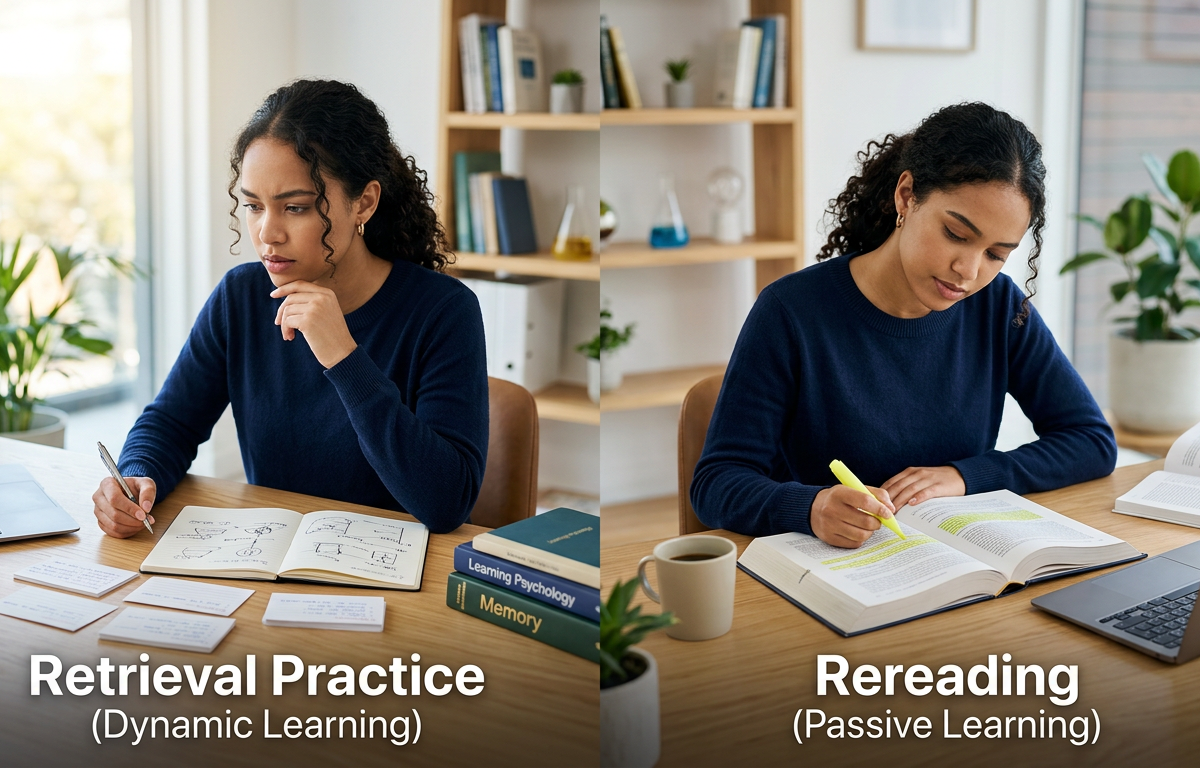
The Science of Study: Retrieval Practice vs. Rereading
Retrieval practice is a learning strategy where you actively pull information out of your brain, whereas rereading is a passive process of looking at material multiple times. This fundamental shift from "input" to "output" defines the debate between Retrieval Practice vs Rereading. While most students spend hours highlighting textbooks, cognitive scientists argue that they are essentially running in place.
Active recall—another name for retrieval—forces the brain to reconstruct a memory. Every time you try to remember a formula or a historical date without looking at your notes, you strengthen the neural path to that information. Conversely, passive review involves scanning words you have already seen. It feels easy because it is easy, but ease is often the enemy of long-term retention. Current academic habits remain stubbornly tethered to the familiar. According to research from the Association for Psychological Science, rereading is one of the most frequently used study techniques among college students. It provides a sense of comfort. However, this comfort is a biological lie. The brain mistakes "recognizing" a sentence for "knowing" the concept behind it.
Why Retrieval Practice Wins: The Cognitive Advantage

Retrieval practice wins because it leverages the "testing effect," a phenomenon where the act of being tested on material significantly improves long-term memory. When you answer a question, you aren't just measuring what you know; you are fundamentally changing how that information is stored. This makes it far superior to passive review for those looking to improve SAT math scores or master complex curricula.
Memory is not a static recording; it is a reconstructive process. Think of your brain like a forest. Rereading is like looking at a map of a trail. Retrieval practice is like actually walking the trail. Each time you walk it, the path becomes clearer and easier to follow next time. Cognitive psychologists call this "effortful retrieval." The more struggle involved in remembering, the deeper the memory is encoded. Robert Bjork, a renowned researcher at UCLA, coined the term "desirable difficulties." Learning should feel hard. If a study session feels effortless, you are likely not learning. Retrieval practice creates this necessary friction. It forces you to combat the forgetting curve—the natural rate at which we lose information—by reinforcing the data at the very moment it begins to slip away.
The Pitfalls of Rereading and the 'Illusion of Competence'
Rereading creates a dangerous "illusion of competence" because it builds fluency rather than mastery. When you read a page for the third time, your brain recognizes the syntax and the layout. You feel like you know the material, but you actually just know the experience of reading it. This is why students often feel confident in their bedrooms but freeze in the exam hall. Highlighting and underlining often exacerbate this problem. These actions are frequently mindless. You might highlight a crucial section of hard geometry practice questions, but if you don't actively try to solve them from scratch, the ink on the page does nothing for the neurons in your head. Highlighting gives the ego a "win" without giving the intellect any muscle. Short-term gains are the siren song of rereading. If you have an exam in two hours, rereading might help you "cram" enough for a passing grade through recognition.
However, that information will vanish within 48 hours. For long-term education, this is a waste of time. True learning requires the transition of data from short-term working memory into the long-term storage of the cerebral cortex, a feat rereading rarely achieves.
Head-to-Head Comparison: Efficiency and Outcomes
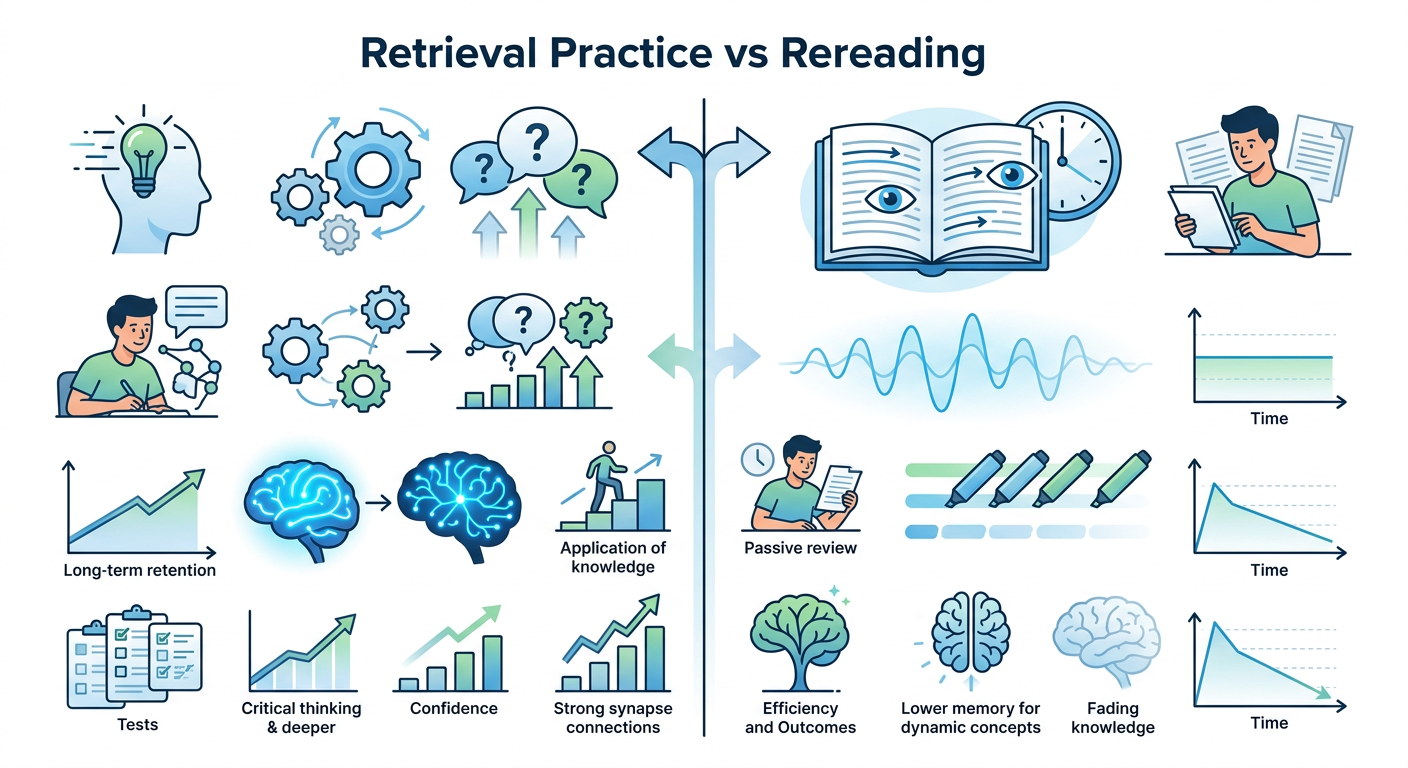
Data consistently shows that students who use active recall vs passive review score higher on delayed tests, even if they spent less time studying. In a landmark study published by Science Magazine, researchers found that students who practiced retrieval remembered 50% more of the material a week later than those who simply reread the text.
In terms of time management, retrieval practice is the clear winner for ROI (Return on Investment). While a retrieval session is more mentally taxing, it is shorter. You can achieve more in 30 minutes of self-testing than in two hours of passive reading. This efficiency is vital when students are trying to balance multiple subjects or avoid common SAT math mistakes under time pressure. Is it versatile? Absolutely. In STEM subjects, retrieval practice looks like solving hard probability practice questions without looking at the solutions. In the humanities, it involves summarizing a chapter from memory or arguing a thesis point without notes. Whether you are learning a language or organic chemistry, the brain's mechanism for storage remains the same: use it or lose it.
Master Your Exams with Active Learning
Stop wasting time on passive rereading. Our platform uses advanced retrieval techniques to help you master SAT concepts and boost your score faster than ever.
Get Started FreeHow to Implement Retrieval Practice in Your Routine
To start, move beyond simple flashcards. While digital decks like Anki or Quizlet are great, they often encourage rote memorization of short facts. For complex topics, use the "Blurting Method." Read a page of your textbook, close it, and write down every single thing you remember on a blank sheet of paper. Then, check your notes to see what you missed. Practice testing is another gold standard. Instead of reviewing your notes on medium statistics practice questions, find fresh problems and attempt them under timed conditions.
This simulates the stress of the actual environment, which helps build "state-dependent" memory. If you can do it in practice, you can do it in the real thing. The Feynman Technique is perhaps the most powerful form of retrieval. Named after physicist Richard Feynman, it involves explaining a concept to a metaphorical five-year-old. When you try to teach someone else, you quickly identify "holes" in your understanding. If you can't explain it simply, you don't understand it well enough. This forces you to retrieve not just facts, but the logical connections between them.
The 'Hybrid' Approach: When Rereading Is Actually Necessary
Rereading isn't entirely useless; it is just often used at the wrong time. You cannot retrieve what you haven't first encoded. Initial encoding requires a careful, focused reading of the material. If you have no mental framework for a topic, trying to "retrieve" it is impossible. Rereading serves as the foundation upon which retrieval is built. The 3R Method (Read-Recite-Review) offers a structured way to combine both. First, you Read a short section. Then, you Recite—close the book and say what you learned out loud.
Finally, you Review the text to verify your accuracy. This method ensures you aren't just scanning words, but actively processing them immediately after intake. Strategic rereading is also helpful for deep contextual understanding. Sometimes, after a session of retrieval, you realize you've missed the "big picture." Going back to the text *after* a failed retrieval attempt is highly effective. The brain is more "primed" to learn the correct answer after it has struggled and failed to find it. This makes the subsequent rereading session much more targeted and intense.
Overcoming the Mental Barrier to Active Learning
The biggest obstacle to Retrieval Practice vs Rereading is the way it feels. Retrieval feels slow, frustrating, and difficult. It exposes your weaknesses. Rereading, on the other hand, feels smooth and successful. You must make a metacognitive shift: realize that the "struggle" is not a sign of failure, but a sign of growth. Reframing mistakes is essential for building a sustainable habit.
When you get a hard coordinate geometry question wrong during self-testing, your brain actually pays more attention to the correct answer when you finally see it. Errors are the "neurological markers" that tell your brain, "This is important, pay attention." Consistency beats intensity. You don't need five-hour retrieval sessions. Start with ten minutes of "closing the book" at the end of every study hour. Ask yourself, "What were the three main points I just read?" By making this a part of your daily rhythm, you train your brain to expect that it will be called upon to perform. That expectation changes how you read in the first place, making you a more active and engaged learner from the very first page.
Ready to Stop Guessing and Start Knowing?
Join thousands of students using evidence-based learning to crush the SAT. Access our bank of practice questions designed to trigger deep retrieval and long-term retention.
Get Started FreeFrequently Asked Questions
Is rereading ever useful in the learning process?
Yes, rereading is necessary for the initial encoding phase. You must read the material to understand the concepts before you can effectively practice retrieval. It is also useful for reviewing specific details you missed during a self-test.
How often should I use retrieval practice?
You should use it in almost every study session. A good rule of thumb is the 80/20 rule: spend 20% of your time reading or watching lectures and 80% of your time trying to retrieve and apply that information through testing or summarizing.
Why does retrieval practice feel harder than rereading?
Retrieval Practice feels harder because it requires "desirable difficulty." Your brain has to exert cognitive energy to find and reconstruct a memory, whereas rereading only requires passive recognition, which uses very little brainpower.
Can I combine retrieval practice with other study methods?
Absolutely. It pairs perfectly with spaced repetition (spacing out your retrieval sessions over days or weeks) and interleaving (mixing different subjects or problem types, like switching between exponents and radicals).
What is the "illusion of competence" in studying?
The illusion of competence is the false belief that you have mastered material because it looks familiar. This usually happens after rereading notes or watching a video, where the ease of following the information is mistaken for the ability to reproduce it independently.
Reviewed by
Michael Danquah, MS, PhD
Dr. Michael Danquah is a professor of pharmaceutical sciences and founder of several educational technology platforms focused on improving student learning and performance.
Enjoyed this article?
Share it with others who might find it helpful.
Related Articles

Active Recall vs Rereading: The Ultimate Science-Backed Winner
Stop wasting time! Compare Active Recall vs Rereading to discover which study method actually improves memory and exam performance. Learn the science now.
Mar 28, 2026

Ace Your Exams: Master Effective Study Without Rereading
Unlock smarter study habits and ace your exams without endless rereading. Discover proven techniques for active recall, spaced repetition, and deeper learning.
Mar 31, 2026

How to Solve Molarity Problems: Step-by-Step Mastery
Learn how to solve molarity problems step-by-step with formulas, unit tips, and worked examples so you can calculate concentration with confidence.
Mar 26, 2026

Avoid These 7 Common Molarity Mistakes in Chemistry
Master chemistry calculations! Avoid common molarity mistakes with our expert guide on unit conversions, dilution errors, and proper lab techniques.
Mar 26, 2026

What Is Molarity? The Complete Guide to Molar Concentration
Master molarity with our complete guide. Learn the formula, step-by-step calculations, and the critical differences between molarity and molality.
Mar 26, 2026