Solving Multistep SAT Geometry: From Circle Equations to Radians
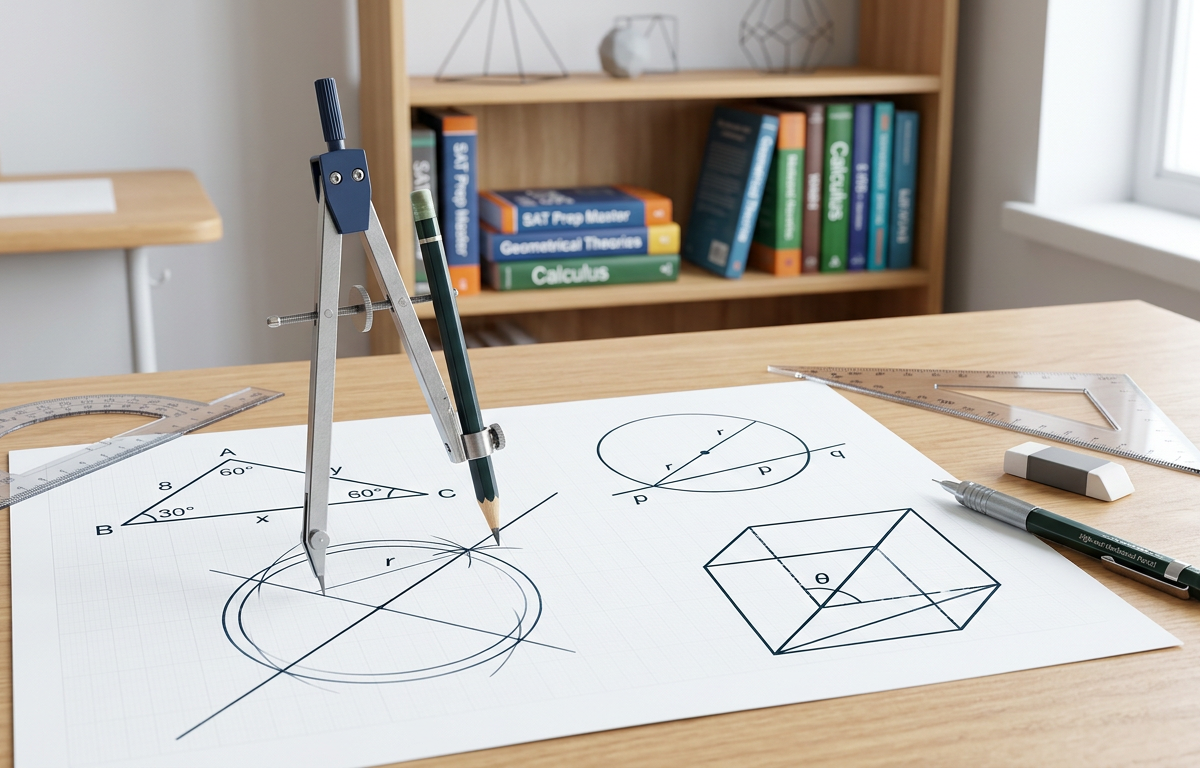
Imagine you are staring at the equation x² + 8x + y² - 10y = 8 on your screen. Most students see a jumble of variables and immediately try to solve for x or y, but the SAT is testing your ability to reorganize this mess into the standard form of a circle. If you cannot instantly recognize that you need to add sixteen and twenty-five to both sides of the equation to complete the square, you will lose two minutes on a problem that should take thirty seconds. Geometry on the digital SAT is rarely about simple shapes; it is about the algebraic manipulation of spatial data.
The real difficulty lies in the transition between different mathematical languages. You might be asked to find the cosine of an angle in one triangle based on the sine of a complementary angle in a similar one, or to convert arc lengths into radian measures without a conversion chart. These questions do not just test if you know the formulas on the reference sheet. They test whether you can identify hidden right triangles inside complex 3D figures or use the relationship between the radius and the circumference to solve for shaded areas. Success here requires moving beyond basic area formulas into the realm of coordinate synthesis and trigonometric identity.
Mastering Hard SAT Geometry Practice Questions
To succeed on the math section of the SAT, students must master complex geometric principles including coordinate geometry, trigonometry, and three-dimensional volume. These Hard SAT Geometry Practice Questions are designed to challenge your spatial reasoning and algebraic application. By practicing these high-level problems, you will develop the precision needed to tackle the most difficult questions the College Board presents on test day.
Synthesizing Algebraic and Geometric Proofs
Hard SAT geometry focuses on the synthesis of multiple geometric properties, such as combining circle theorems with coordinate geometry or using trigonometry to solve for side lengths in non-right triangles. Unlike basic geometry, which might ask for a simple area calculation, advanced questions often require you to find a missing variable using the Pythagorean theorem, properties of similar triangles, or the equation of a circle in the -plane. You must be comfortable with the standard form of a circle equation, , and understanding how radians relate to degrees. Furthermore, many problems integrate concepts from other sections, such as Hard SAT Algebra Word Practice Questions, requiring you to set up equations based on geometric descriptions. Success on these problems relies on your ability to visualize the figure, identify hidden right triangles, and apply the correct formulas for volume and surface area provided in the SAT reference sheet.
Solved Examples
Review these worked examples to understand the logic required for multi-step geometry problems.
- Example 1: Circle Equations
The equation of a circle in the -plane is . What is the area of the circle?
- To find the area, we need the radius . We must complete the square to put the equation in standard form.
- Group terms: .
- Add and to both sides: .
- Simplify: .
- Since , the radius .
- The area .
- Example 2: Arc Length and Radians
A circle has a radius of 6. An arc on the circle has a length of . What is the measure of the central angle of the arc in radians?
- Use the formula for arc length: , where is arc length, is radius, and is the angle in radians.
- Substitute the known values: .
- Solve for : .
- Simplify the fraction: .
- Example 3: Similar Triangles
In triangle , angle is a right angle. Triangle is similar to triangle , where and correspond to and respectively. If , what is the value of ?
- In a right triangle, if , then the side opposite to is 5 and the hypotenuse is 13.
- Since the triangles are similar, the trigonometric ratios remain the same for corresponding angles. Angle corresponds to , and angle corresponds to .
- In triangle , angles and are complementary. Therefore, .
- Since angle corresponds to angle , .
- Thus, .
Practice Questions
Test your skills with these challenging geometry problems. Ensure you have a calculator and scratch paper ready.
1. A cylinder has a volume of and a height of 8. A cone has the same radius as the cylinder but a height of 12. What is the volume of the cone?
2. In the -plane, a circle with center passes through the point . Which of the following is the equation of the circle?
3. A regular hexagon is inscribed in a circle with a radius of 10. What is the perimeter of the hexagon?
4. In triangle , the measure of angle is . If , what is the value of ?
5. A sphere has a surface area of . What is the volume of the sphere in terms of ?
6. Two similar triangles have areas in a ratio of . If the perimeter of the smaller triangle is 20, what is the perimeter of the larger triangle?
7. A circle in the -plane is defined by the equation . What is the circumference of this circle?
8. An arc with a central angle of has a length of . What is the radius of the circle?
9. A right square pyramid has a base edge length of 10 and a slant height of 13. What is the vertical height of the pyramid?
10. In a circle with center , central angle has a measure of radians. What fraction of the circle's area is represented by the sector ?
Answers & Explanations
Carefully review the logic for each solution to identify any gaps in your understanding of SAT Math concepts.
- Answer:
The volume of a cylinder is . Given , we find , so . The volume of a cone is . Substituting the values: . - Answer:
The distance between the center and the point is the radius. Using the distance formula: . The standard equation is , so . - Answer: 60
A regular hexagon is composed of 6 equilateral triangles. If the radius of the circle is 10, the distance from the center to each vertex is 10. Thus, each side of the hexagon is also 10. Perimeter . - Answer:
If , the opposite side is 3 and the adjacent side is 4. In this 3-4-5 right triangle, the hypotenuse is 5. Angle is the other acute angle. . The side opposite to is the side adjacent to , which is 4. So, . - Answer:
The surface area of a sphere is . Dividing by gives , so . The volume is . - Answer: 30
If the ratio of areas is , the ratio of side lengths (and perimeters) is . Here, the ratio of areas is , so the ratio of perimeters is . Set up a proportion: . Solving for , we get , so . - Answer:
Complete the square for . This becomes . The radius . Circumference . - Answer: 6
Convert degrees to radians: radians. Use : . Multiplying both sides by , we find . - Answer: 12
In a square pyramid, the vertical height, half the base length, and the slant height form a right triangle. Half the base length is . Using the Pythagorean theorem: . , so , and . - Answer:
A full circle is radians. The fraction of the circle is .
1. If a circle has the equation \( (x - 5)^2 + (y + 3)^2 = 64 \), what are the coordinates of the center?
Frequently Asked Questions
How is trigonometry used in SAT geometry?
Trigonometry on the SAT primarily involves the ratios sine, cosine, and tangent within right triangles, often requiring students to use the SOH CAH TOA mnemonic. You may also need to know the relationship between complementary angles, such as .
What circle formulas are most common on the SAT?
Students must know the area formula , the circumference formula , and the standard form equation of a circle. Additionally, understanding how to calculate arc length and sector area using proportions of the total circumference or area is vital. For more on algebraic setups, see Hard SAT Systems of Equations Practice Questions.
Do I need to memorize volume formulas for the SAT?
While basic formulas like the area of a rectangle are expected knowledge, the SAT provides a reference sheet at the start of every math section. This sheet includes formulas for the volume of spheres, cones, cylinders, and pyramids, as well as the relationships in special right triangles.
What is the difference between degrees and radians on the test?
The SAT uses both units to measure angles, and you must be able to convert between them using the factor . Many hard geometry questions involve arc length or sector area where the angle is given in radians, simplifying the calculation to or .
How do similar triangles appear in hard questions?
Harder questions often nest one triangle inside another or use parallel lines to create similar triangles that aren't immediately obvious. You must remember that while side lengths are proportional in similar triangles, the interior angles remain congruent. For help with ratios in geometry, visit Hard SAT Ratio and Proportion Practice Questions.
Enjoyed this article?
Share it with others who might find it helpful.
Related Articles
Solving the Hidden Geometry Traps in SAT Triangle Problems
Hard SAT Triangle Practice Questions
Apr 27, 2026
Solving Multistep SAT Geometry: Area and Volume Relationships
Master Medium SAT Area and Volume Practice Questions with our comprehensive guide, featuring solved examples, practice problems, and a quick quiz.
Apr 27, 2026
Easy SAT Circle Practice Questions
Easy SAT Circle Practice Questions
Apr 27, 2026
Solving SAT Geometry Word Problems: Turning Text into Diagrams
SAT Geometry Word Practice Questions with Answers
Apr 27, 2026

Hard SAT Quadratic Equations Practice Questions
Hard SAT Quadratic Equations Practice Questions
Apr 26, 2026
Hard SAT Systems of Equations Practice Questions
Hard SAT Systems of Equations Practice Questions
Apr 26, 2026

Solving High-Stakes Linear Systems and Slope Traps on the SAT
Hard SAT Linear Equations Practice Questions
Apr 26, 2026
Medium SAT Quadratic Equations Practice Questions
Medium SAT Quadratic Equations Practice Questions
Apr 26, 2026