Master Retrieval Practice for Pharmacy Students: The Ultimate Guide

Retrieval practice for pharmacy students is the most effective evidence-based strategy for moving thousands of drug facts from short-term memory into long-term clinical mastery. While typical study habits involve highlighting textbooks or color-coding notes, these passive methods often fail when you're standing in a busy community pharmacy or taking the NAPLEX. True clinical competence requires the ability to pull information out of your brain, not just put it in.
The "fluency illusion" is a dangerous trap in pharmacy education. When you reread a chapter on beta-blockers three times, the text begins to look familiar. Familiarity, however, is not the same as mastery. You might feel like you know the material, but you are actually just recognizing the words on the page. Retrieval practice vs. rereading highlights why this distinction is the difference between an A and a C on your pharmacotherapy exam.
In healthcare education, we are witnessing a massive shift from passive lecture consumption to active cognitive effort. Pharmacy school isn't just about passing tests; it's about patient safety. If you can't recall a drug-drug interaction without checking your phone, you haven't mastered the material. Retrieval practice forces your brain to struggle, and that struggle is exactly where the most durable learning occurs.
The Science of Why Retrieval Works for Long-Term Memory
Retrieval practice works by strengthening the neural pathways associated with specific information, making it easier to access that data in the future. Every time you answer a practice question or explain a mechanism of action (MOA) without looking at your notes, you are physically changing your brain. This process is known as the "Testing Effect," a phenomenon extensively documented by the Association for Psychological Science.
Research in medical education suggests that the act of retrieval is a memory-modifier. It doesn't just measure what you know; it changes what you know. When you retrieve a fact, that fact becomes more "retrievable" later. For a pharmacy student, this means the more times you force yourself to remember that Lisinopril is an ACE inhibitor, the less likely you are to forget it during a high-stakes rotation.
Furthermore, retrieval practice facilitates the "reconsolidation" of data. When you pull a memory to the surface, it becomes briefly unstable before being stored again more securely. This allows you to integrate new clinical data, like a new black box warning, into your existing knowledge of a drug class. By engaging in long-term memory retrieval, you build a "Mental Pharmacy" that remains accessible years after graduation.
Consolidation and the Power of Desirable Difficulties
Robert Bjork, a renowned cognitive psychologist at UCLA, coined the term "desirable difficulties." He argued that learning methods that feel easy are often the least effective. Conversely, methods that feel difficult, like trying to draw a biochemical pathway from memory, lead to better long-term retention. If your brain has to work for the information, it values that information more highly.
Many pharmacy students shy away from active recall because it is mentally taxing. It is much easier to watch a pharmacology video at 1.5x speed than it is to sit with a blank piece of paper and write out everything you know about diuretics. However, the student who writes it out is the one who will remember the nuances of loops versus thiazides during a clinical emergency.
Master Your Pharmacy Exams Faster
Stop wasting time on passive reading and start using the science of active recall to crush your PharmD curriculum and the NAPLEX.
Get Started FreeCore Retrieval Practice Techniques for Pharmacy Students
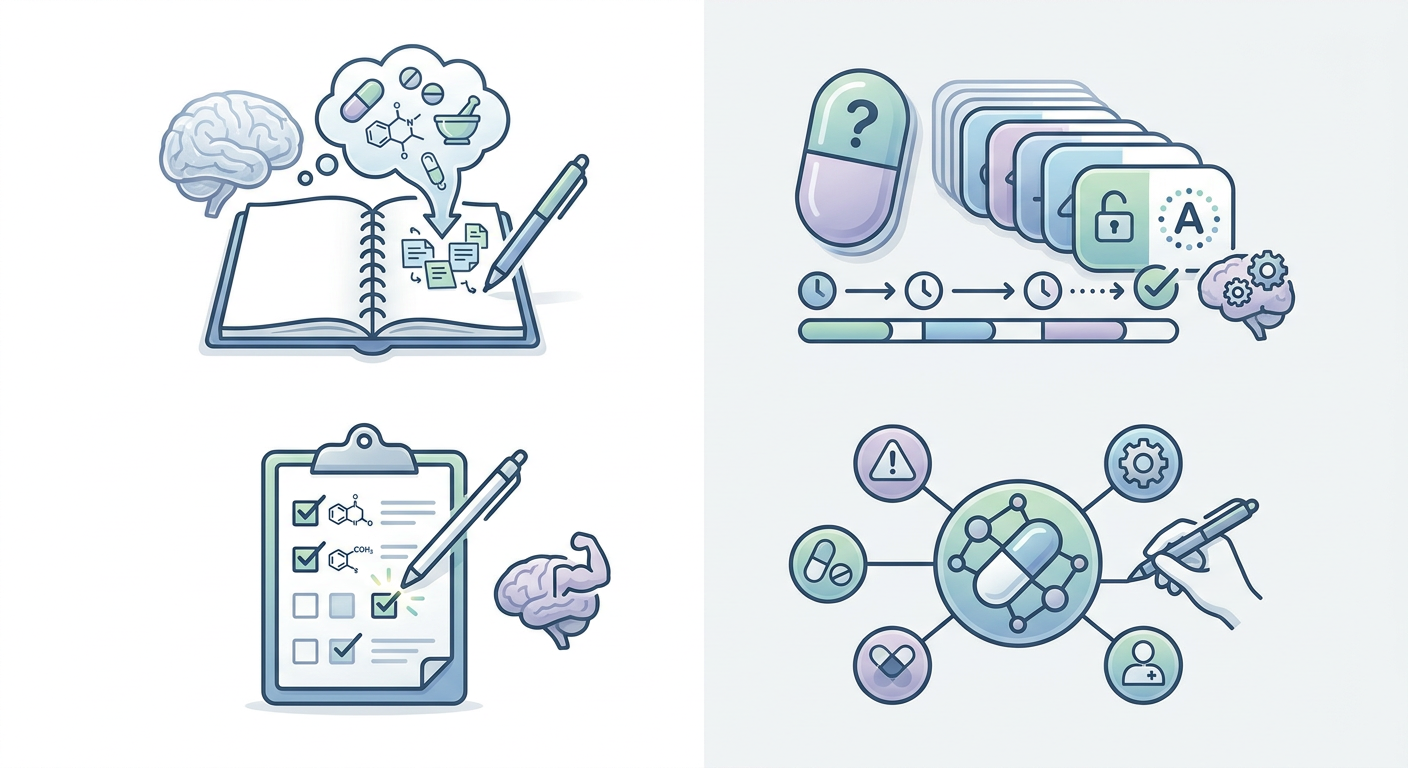
Active recall for pharmacy school isn't just about taking practice tests; it's a philosophy of learning that can be applied to every study session. One of the most effective methods is the "Brain Dump." After a lecture on the autonomic nervous system, shut your laptop and spend 10 minutes writing down every receptor type, neurotransmitter, and physiological effect you can remember. Only after you are completely stuck should you check your notes to see what you missed.
Another powerful tool is "Flashcards 2.0." For a pharmacy student, a basic card might have the drug name on the front and the class on the back. A 2.0 card, however, presents a clinical scenario. Instead of "What is Warfarin?", use "A patient on Warfarin presents with an INR of 5.5 and no bleeding. What is the next step?" This forces you to retrieve not just a name, but a clinical protocol. If you need inspiration, check out these retrieval practice examples for different disciplines.
The Feynman Technique is also invaluable for explaining drug-drug interactions. Named after physicist Richard Feynman, this method involves explaining a complex concept in the simplest terms possible, as if you were talking to a patient. If you can't explain why grapefruit juice interacts with Statins without using jargon, you haven't mastered the retrieval of the underlying CYP3A4 inhibition mechanism.
Designing Your High-Level Flashcards
Keep it Atomic: Each card should cover one specific concept or clinical pearl.
Use Imagery: Include chemical structures or mechanism diagrams to provide visual retrieval cues.
Context is King: Always tie the drug back to its primary indication or a critical side effect.
Integrating Spaced Repetition into the Pharmacy Curriculum
Spaced repetition is the perfect partner for retrieval practice. While retrieval tells you how to study, spacing tells you when. The forgetting curve, first described by Hermann Ebbinghaus, shows that we lose roughly 70% of new information within 24 hours if we don't review it. Using data-driven learning strategies, students can time their reviews to happen just as they are about to forget.
For a 4-year pharmacy program, this means building a schedule where you revisit the "Top 200 Drugs" every few weeks. You cannot afford to learn Cardiovascular meds in P1 year and never look at them again until your NAPLEX review in P4. Tools like Anki or RemNote use algorithms to automate this process, showing you the cards you struggle with more frequently than the ones you know well.
Managing the sheer volume of pharmacotherapy requires a tiered approach. Group your retrieval sessions by drug class or organ system. This builds a hierarchical framework in your mind, making it easier to "hook" new drugs onto existing knowledge. If you're looking for a structured way to handle heavy workloads, the retrieval practice medical guide offers excellent crossover tips for pharmacy students.
Subject-Specific Retrieval Strategies
Pharmacology is the heart of the curriculum, and it requires a specific type of retrieval. Don't just memorize drug lists; retrieve the logic behind the drug. When studying medicinal chemistry, practice drawing the structures from a blank page. Can you identify the sulfonamide moiety in a loop diuretic? If you can retrieve the structure, you can often predict the side effects and cross-sensitivities without separate memorization.
Pharmacy calculations are often the area where students lose points on the NAPLEX. Retrieval practice here means mental retrieval of formulas. Instead of looking up the Cockcroft-Gault equation every time, force yourself to write it out before starting the problem. Consistent problem-solving speed strategies from other standardized tests can actually help pharmacy students improve their calculation efficiency.
During IPPE and APPE rotations, use case-based retrieval. When a preceptor asks you a question about a patient's med list, don't reach for your Lexicomp immediately. Take 30 seconds to try and retrieve the answer. Even if you get it wrong, the act of "failing to retrieve" makes the correct answer stick much better once you eventually look it up. This is evidence-based learning in healthcare education at its most practical level.
Mastering Clinical Scenarios
Review a patient case for 5 minutes.
Close the chart and list all potential drug-related problems (DRPs).
Check your list against the actual clinical findings.
Research the gaps in your knowledge and repeat the process for the next patient.
Overcoming the Challenges of Active Learning
Is retrieval practice slower than re-reading? In the short term, yes. It takes more time to write an essay summary or quiz yourself than it does to scan a page with a highlighter. However, retrieval is much faster in the long run because it eliminates the need for "re-learning" the same material every single semester. You are investing time upfront to save hundreds of hours during board prep.
Mental fatigue is a real hurdle. Retrieval is hard work. To combat this, keep your sessions short and focused. Instead of a 4-hour "highlighting marathon," try four 25-minute "retrieval sprints." This prevents the cognitive overload that often accompanies memorizing complex medications strategies. Remember, the "ego hit" of getting a question wrong is actually a good sign, it highlights exactly where your knowledge gaps are before the actual exam.
It is also vital to balance new material with old. Pharmacy school moves fast, and it’s tempting to only focus on the upcoming exam. However, spending 15% of your time retrieving "old" material from previous modules will significantly reduce your stress during final exams and rotations. Think of it as maintenance for your mental database.
The Role of Faculty and Peer Groups
Collaborative retrieval is one of the most underutilized tools in pharmacy school. Peer quizzing forces you to articulate your knowledge out loud, which is a different cognitive pathway than writing. When you explain the mechanism of a monoclonal antibody to a classmate, you are identifying your own lack of clarity in real-time. This is why Harvard’s education research often emphasizes peer-to-peer instruction.
Don't be afraid to use faculty office hours for active retrieval checks. Instead of asking "Can you explain this again?", try saying "I think the mechanism of this drug is X, Y, and Z—am I missing any nuances?" This shifts the interaction from one of passive listening to one of active verification. Advocacy for low-stakes testing in the classroom is also gaining ground; small, weekly quizzes are much better for long-term learning than two massive midterms.
Effective study groups should avoid "group read-alouds." Instead, assign each member a topic and have them create 5 "hard" practice questions for the rest of the group. This ensures everyone is engaging in high-level retrieval and provides a variety of clinical perspectives on the same material.
Preparing for the NAPLEX and MPJE using Retrieval Practice
The NAPLEX is a marathon of retrieval. With over 200 questions covering a vast array of clinical topics, you cannot rely on short-term memory. Long-range planning is essential. Start using practice exams six months out, not as a way to "see what you know," but as a way to learn. Each question you answer—right or wrong—is a retrieval event that strengthens your memory for the big day.
Simulating exam conditions is another way to enhance retrieval strength. If you study in a loud coffee shop but the exam is in a silent cubicle, your "state-dependent" memory might fail you. Practice retrieving information in a quiet, timed environment. This builds the mental stamina required to maintain focus over several hours. For those struggling with the law portion (MPJE), building a "Mental Pharmacy" of laws through flashcards and verbal recall is the only way to keep the varying state and federal regulations straight.
Finally, treat every day on rotations as a mini-NAPLEX. Every time a nurse asks you a question or a doctor asks for a dose adjustment, you are performing a retrieval event. If you approach these interactions with the intention of retrieving the answer first, you will be more than prepared when you finally sit for your boards.
Unlock Your Full Potential with Bevinzey
Use our advanced tools to create personalized retrieval practice sessions and master pharmacological concepts in half the time.
Get Started FreeFrequently Asked Questions
What is the difference between active recall and retrieval practice?
In the context of pharmacy school, these terms are often used interchangeably. Active recall is the specific act of pulling information from your memory, while retrieval practice is the broader study strategy of using active recall repeatedly over time to build long-term retention.
How often should pharmacy students use retrieval practice?
Daily is ideal. Because of the volume of information in pharmacy school, engaging in at least 30 minutes of retrieval practice every day—even for "old" material—is the best way to prevent the forgetting curve from taking hold.
Are flashcards the only way to do retrieval practice in pharmacy school?
Not at all. While flashcards are popular, you can also use "brain dumps," practice questions, drawing chemical structures from memory, or teaching a concept to a peer. The key is simply that you are producing the information from your mind without looking at a source.
Can retrieval practice help with NAPLEX preparation?
Yes, it is the most effective way to prepare. The NAPLEX requires you to retrieve information across diverse clinical areas quickly. By using retrieval practice throughout your P1-P4 years, you ensure that the foundations of pharmacy practice are deeply encoded in your long-term memory.
Why does retrieval practice feel harder than re-reading notes?
Retrieval feels harder because it requires more cognitive effort. This is known as a "desirable difficulty." The effort you put into remembering actually creates stronger, more durable neural connections, whereas re-reading feels "easy" but doesn't actually store information effectively.
Reviewed by
Michael Danquah, MS, PhD
Dr. Michael Danquah is a professor of pharmaceutical sciences and founder of several educational technology platforms focused on improving student learning and performance.
Enjoyed this article?
Share it with others who might find it helpful.
Related Articles

How to Study for Exams in Pharmacy School
Master pharmacy school exams with science-backed strategies. Learn how to use active recall, manage clinical cases, and memorize the Top 200 drugs efficiently.
Apr 2, 2026

How to Solve Molarity Problems: Step-by-Step Mastery
Learn how to solve molarity problems step-by-step with formulas, unit tips, and worked examples so you can calculate concentration with confidence.
Mar 26, 2026

Avoid These 7 Common Molarity Mistakes in Chemistry
Master chemistry calculations! Avoid common molarity mistakes with our expert guide on unit conversions, dilution errors, and proper lab techniques.
Mar 26, 2026

What Is Molarity? The Complete Guide to Molar Concentration
Master molarity with our complete guide. Learn the formula, step-by-step calculations, and the critical differences between molarity and molality.
Mar 26, 2026
Why Molarity Matters: Converting Mass to Moles for Lab Solutions
Master chemistry with our guide to the molarity formula. Learn how to calculate concentration with step-by-step examples, units, and practical lab tips.
Mar 26, 2026