Medium SAT Geometry Practice Questions
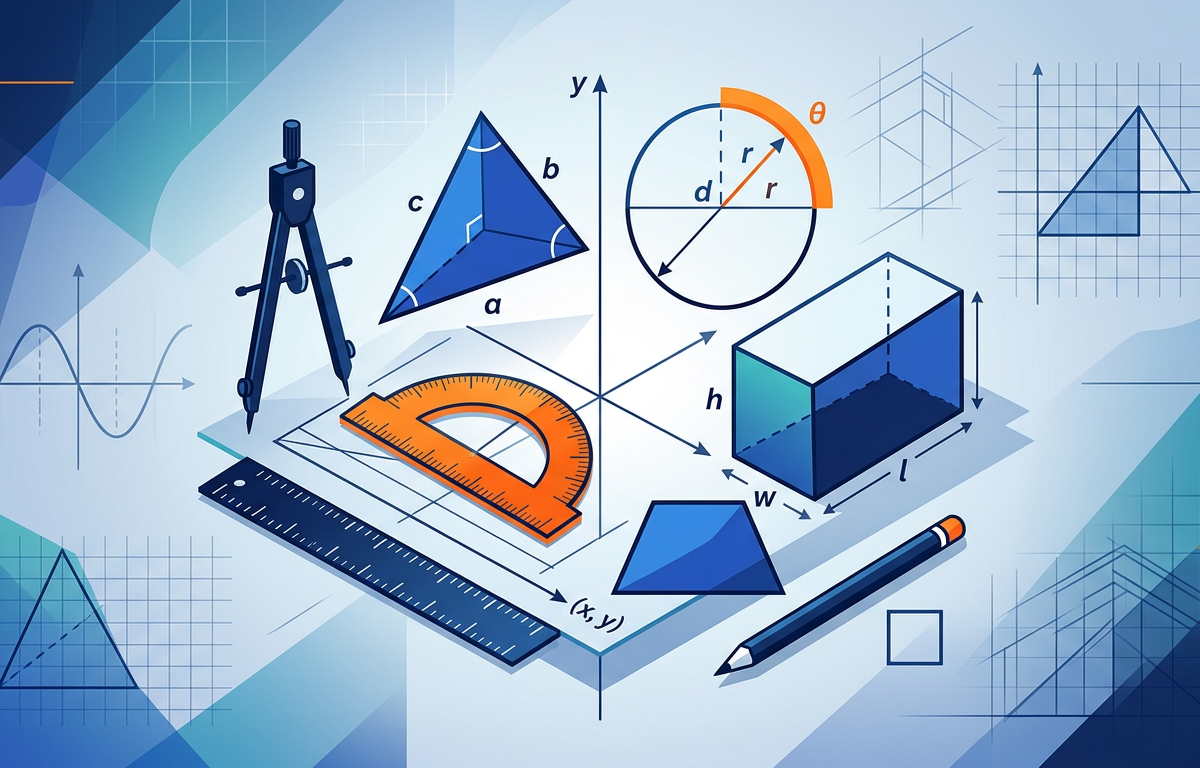
Mastering geometry is essential for achieving a high score on the Digital SAT, as geometric principles account for approximately 15% of the Math section. These Medium SAT Geometry Practice Questions focus on the core areas tested: lines and angles, triangles, circles, and area/volume calculations. By practicing these intermediate-level problems, you will sharpen your ability to apply theorems and formulas to more complex, multi-step scenarios.
Concept Explanation
SAT Geometry involves the study of shapes, sizes, relative positions of figures, and the properties of space, primarily focusing on 2D plane geometry and 3D solids. To succeed on medium-difficulty questions, you must be comfortable with the Pythagorean theorem, properties of special right triangles (30-60-90 and 45-45-90), and circle theorems. Unlike easy questions that might ask for a simple area, medium questions often require you to find a missing dimension first or combine multiple concepts, such as finding the arc length of a circle using its radius and central angle. Understanding the relationship between similar triangles and the properties of parallel lines intersected by a transversal is also vital. For more foundational practice, you might find Easy SAT Word Problems Practice Questions helpful before tackling these geometric challenges.
Solved Examples
Review these step-by-step solutions to understand the logic required for medium-level geometry problems.
- Example 1: In the -plane, a circle has center and a radius of 5. What is the equation of the circle?
- Recall the standard form of a circle equation:
- Identify the center and the radius .
- Substitute the values:
- Simplify the signs and the square:
- Example 2: A right triangle has a hypotenuse of length 10 and one leg of length 6. What is the area of the triangle?
- Use the Pythagorean theorem to find the missing leg :
- Calculate the squares:
- Subtract 36 from both sides: , so .
- Use the area formula :
- Example 3: In a circle with center , the measure of central angle is . If the radius of the circle is 10, what is the length of arc ?
- Recall the arc length formula:
- Substitute the given values: and .
- Calculate:
- Simplify the fraction: .
- Final result:
Practice Questions
- A rectangular prism has a volume of 120 cubic centimeters. If the length is 5 cm and the width is 4 cm, what is the height of the prism in centimeters?
- In triangle , angle measures and angle measures . If the hypotenuse has a length of , what is the length of side ?
- Two parallel lines are intersected by a transversal. If one of the alternate interior angles is represented by and the other is , what is the value of ?
- A cylinder has a radius of 3 and a height of 10. What is the total surface area of the cylinder in terms of ?
- The area of a circle is . What is the circumference of the circle?
- Triangle is similar to triangle . If the ratio of the side lengths of to is and the area of is 20, what is the area of triangle ?
- A square is inscribed in a circle with a radius of . What is the area of the square?
- In the -plane, a line passes through the origin and the point . What is the measure of the angle this line makes with the positive -axis?
- A regular hexagon is divided into six equilateral triangles. If the side length of the hexagon is 6, what is the total area of the hexagon?
- The volume of a sphere is given by the formula . If the radius is doubled, by what factor does the volume increase?
Answers & Explanations
- Answer: 6. The volume of a prism is . Substituting the values: . Dividing by 20 gives .
- Answer: 8. This is a 45-45-90 special right triangle. The ratio of sides is . Since the hypotenuse is , we set , which means . Sides and are both 8.
- Answer: 15. Alternate interior angles are equal when lines are parallel. Set the expressions equal: . Subtracting gives . Adding 20 gives , so .
- Answer: . The surface area formula is . Substituting and : .
- Answer: . Area , so and . Circumference .
- Answer: 45. The ratio of areas of similar triangles is the square of the ratio of their sides. Side ratio is , so area ratio is . Set up the proportion: . For more on ratios, check Medium SAT Ratio and Proportion Practice Questions.
- Answer: 100. The diagonal of the square is the diameter of the circle. Diameter . In a square, the diagonal . Thus, , so side . Area .
- Answer: . A line through and has a slope of . The angle satisfies . In the first quadrant, .
- Answer: . The area of one equilateral triangle is . With , area is . Since there are 6 triangles, total area is .
- Answer: 8. Volume is proportional to the cube of the radius (). If the radius becomes , the new volume is proportional to . Thus, the volume increases by a factor of 8.
1. If a circle has a radius of 5, what is the length of an arc intercepted by a central angle of 60 degrees?
Frequently Asked Questions
How is geometry tested on the Digital SAT?
Geometry on the Digital SAT focuses on properties of lines, angles, triangles, circles, and 3D shapes. You are expected to use the provided reference sheet while solving problems involving area, volume, and trigonometry.
Do I need to memorize all geometry formulas for the SAT?
While many formulas for area and volume are provided in the reference sheet, you should memorize the Pythagorean theorem, circle equations, and special right triangle ratios. Knowing these by heart saves time during the test.
What are special right triangles?
Special right triangles are triangles with specific angle measures, namely 45-45-90 and 30-60-90. Their side lengths follow consistent ratios that allow you to find missing sides without complex calculations. You can explore more algebraic relationships in Medium SAT Algebra Word Practice Questions.
What is the difference between a central angle and an inscribed angle?
A central angle has its vertex at the center of the circle, while an inscribed angle has its vertex on the circle's circumference. For the same arc, the central angle is always twice the measure of the inscribed angle.
How do I handle geometry problems in the xy-plane?
Coordinate geometry problems require combining geometric properties with algebraic formulas like the distance formula or slope. Visualizing the shape or sketching it on scratch paper is highly recommended for accuracy.
What is the most common geometry mistake on the SAT?
The most common mistake is forgetting to check if the question asks for the radius or the diameter. Many students solve for the radius and select that answer choice even when the question asks for the diameter or circumference.
Enjoyed this article?
Share it with others who might find it helpful.
Related Articles
Easy SAT Geometry Practice Questions
Easy SAT Geometry Practice Questions
Apr 27, 2026
SAT Geometry Practice Questions with Answers
SAT Geometry Practice Questions with Answers
Apr 27, 2026

Hard SAT Geometry Word Practice Questions
Hard SAT Geometry Word Practice Questions
Apr 27, 2026
Hard SAT Coordinate Geometry Practice Questions
Hard SAT Coordinate Geometry Practice Questions
Apr 27, 2026
Solving the Hidden Geometry Traps in SAT Triangle Problems
Hard SAT Triangle Practice Questions
Apr 27, 2026
Medium SAT Geometry Word Practice Questions
Medium SAT Geometry Word Practice Questions
Apr 27, 2026
Medium SAT Coordinate Geometry Practice Questions
Medium SAT Coordinate Geometry Practice Questions
Apr 27, 2026
Easy SAT Geometry Word Practice Questions
Easy SAT Geometry Word Practice Questions
Apr 27, 2026