How Retrieval Practice Boosts Long-Term Memory: Scientist's Guide

Understanding the Science of Retrieval Practice
Retrieval practice is a learning strategy where you deliberately bring information to mind from memory, forcing your brain to "output" knowledge rather than just "input" it. Most students believe that learning happens when you put information into your head by reading a textbook or watching a lecture. However, cognitive scientists discovered that the real magic happens when you try to get that information out of your head.
The "Testing Effect" represents one of the most robust findings in educational psychology, proving that the act of taking a test, even a practice one, improves long-term retention. How Retrieval Practice Improves Long-Term Memory is through a process called consolidation, where the brain stabilizes a memory trace after initial acquisition. Research published by the American Psychological Association demonstrates that students who use active recall retain up to 50% more information a week later compared to those who simply re-read their notes.
Input-only learning fails because it creates a "storage" without an "access" route. Think of your brain like a massive warehouse; if you keep tossing boxes (facts) through the door but never practice finding them, you will never locate them during the high pressure of an exam. To move information from fragile short-term storage to durable long-term storage, you must practice the retrieval path. This is why comparing Retrieval Practice vs Rereading reveals such a massive gap in actual mastery.
The Biological Impact: How the Brain Changes During Retrieval
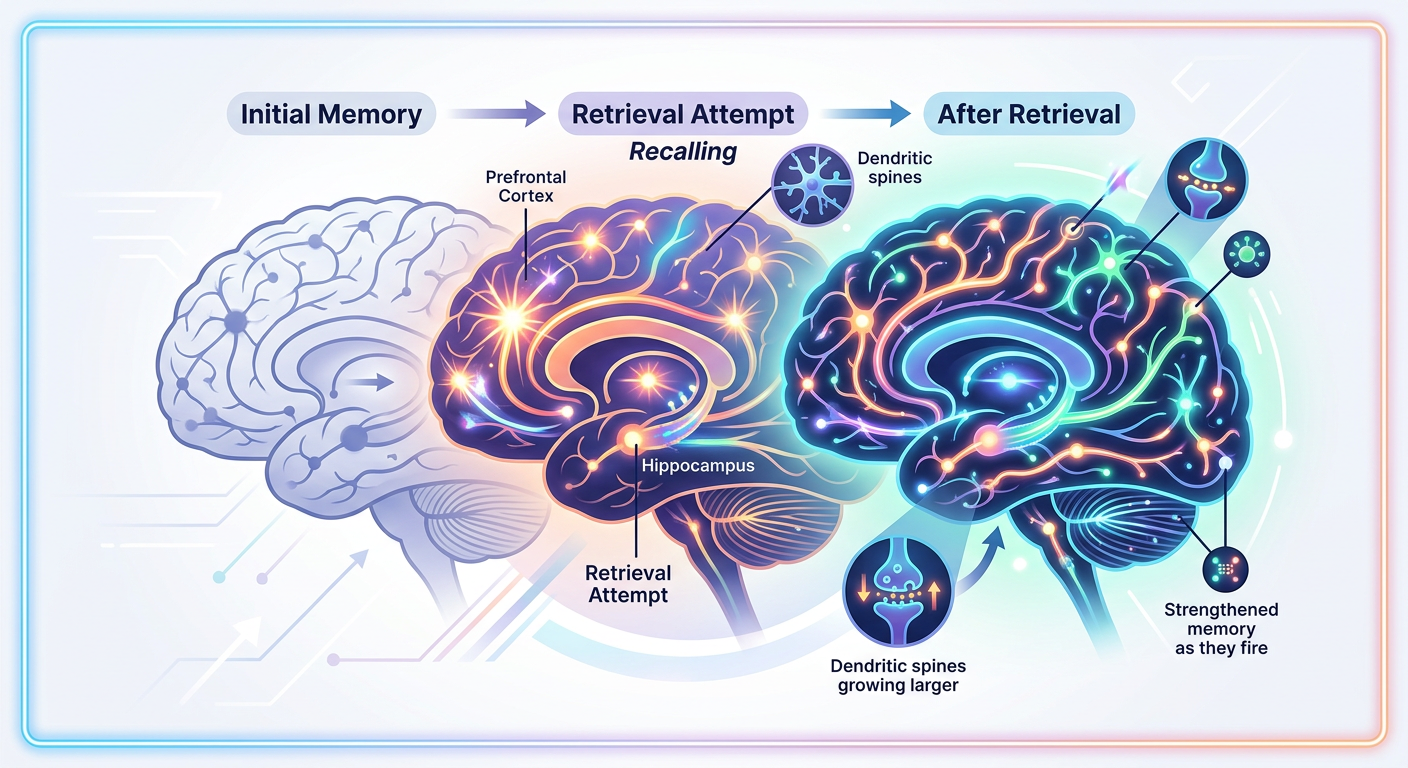
Retrieval practice physically reconfigures your brain by strengthening synaptic connections and building "neural scaffolding." Every time you struggle to remember a fact, your hippocampus and prefrontal cortex engage in a high-intensity dialogue to locate that specific data point. This effort signals to the brain that the information is vital for survival, triggering the release of neurotransmitters that thicken the myelin sheath around those specific neural pathways.
Memory is not a static video recording but a living process of reconsolidation. When you retrieve a memory, it enters a "labile" or flexible state where it can be updated with new context or connected to more recent information before being stored again. How Retrieval Practice Improves Long-Term Memory is by making these traces "sturdier" each time they are accessed, effectively "saving" the file in a more permanent format. This is the biological reason why improving your SAT score requires more than just looking at solutions; it requires the physical effort of solving the problem yourself.
Elizabeth Ljung Bjork and Robert Bjork coined the term "desirable difficulty" to describe this phenomenon. Mental effort is not a sign that you are failing to learn; rather, it is the fuel for neural growth. If a study session feels easy and "smooth," you are likely experiencing the illusion of fluency, whereas a session that feels like a mental workout is actually producing the deepest long-term gains.
Retrieval Practice vs. Passive Review: The Evidence
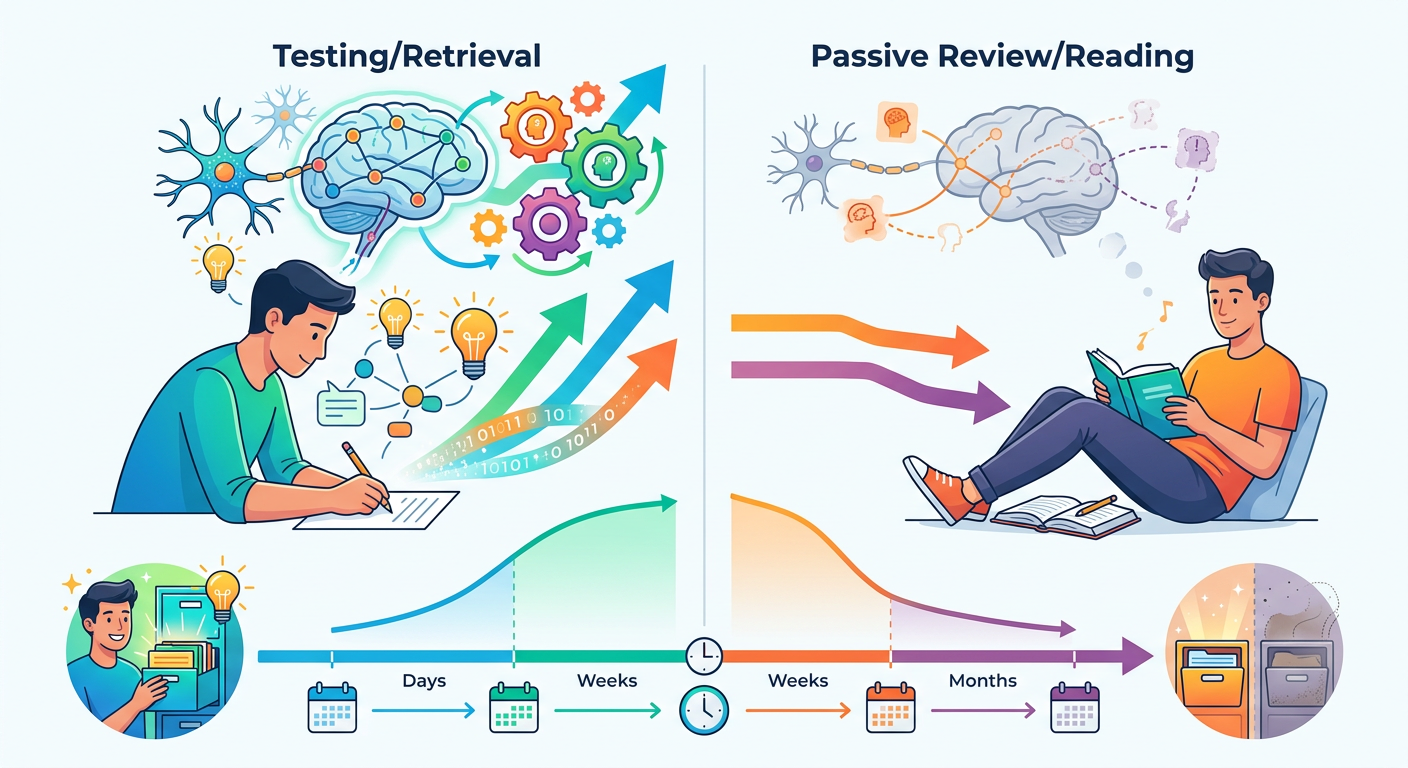
Passive review, which includes highlighting, underlining, and re-reading, creates a dangerous "illusion of knowing." Because the text looks familiar as your eyes glide across the page, your brain tricks you into thinking you have mastered the material. This fluency is a mask for "recognition memory," which is vastly different from "recall memory." In a high-stakes environment, you won't have the book in front of you to trigger that recognition.
A landmark study by Roediger and Karpicke (2006) showcased this divide perfectly. They compared students who studied the same material repeatedly with students who studied once and then took three practice tests. While the "repeated study" group felt more confident and performed better on a test given immediately, the "testing" group outperformed them by a staggering margin on a test given one week later. Passive review leads to rapid forgetting because it never forces the brain to build its own retrieval cues.
Many students fall into the trap of doing "Easy SAT" work because it feels productive, but without moving into challenging territory, they never see growth. For example, practicing Easy SAT Decimals Practice Questions is a great starting point, but you must eventually force your brain to retrieve these rules in a mixed-format environment to truly secure them in your long-term memory.
Core Mechanisms: Why Retrieval Works So Well

Retrieval improves memory because it encourages "elaborative retrieval." When you search your mind for an answer, you don't just find an isolated fact; you activate a web of related concepts. This process connects new knowledge to old schemas, creating multiple "mental hooks" that make the information easier to find later. It is essentially an organizational tool for the subconscious mind.
Secondly, retrieval provides an immediate feedback loop. It is the only way to accurately identify your "known unknowns." Many students fail exams because they didn't realize they didn't know the material until it was too late. For instance, a student might think they understand geometry until they sit down and fail Hard SAT Geometry Practice Questions. That failure is actually a win because it highlights exactly what needs to be fixed before the real test.
Finally, regular retrieval practice drastically reduces test anxiety. Anxiety often stems from the fear of the unknown and the "brain freeze" of the testing environment. By making "testing" a daily, low-stakes habit, you desensitize yourself to the pressure. The familiar act of recalling information becomes a "muscle memory" response rather than a stressful event. You gain metacognitive awareness, knowing exactly what you know and how long it takes you to find it.
Master Your Exams with Active Recall
Stop wasting hours on passive reading. Use the Bevinzey platform to leverage the power of retrieval practice and spaced repetition to lock in your knowledge forever.
Get Started FreePowerful Retrieval Strategies for Every Learner
One of the most effective ways to implement this is through the "Brain Dump" or free recall. Put away your notes, take a blank sheet of paper, and write down everything you can remember about a topic for 10 minutes. This disorganized, effortful search for information forces your brain to build its own structure. Once finished, check your notes to see what you missed—those gaps are your new study priorities.
The Feynman Technique is another gold-standard retrieval strategy. Act as if you are teaching a complex concept to a sixth-grader. If you hit a point where you cannot explain a step simply, you have identified a hole in your retrieval path. This method is exceptionally useful for quantitative subjects, such as explaining the logic behind Hard SAT Standard Deviation Practice Questions.
Digital Flashcards: Use tools like Anki or Quizlet that utilize active recall benefits and the spaced repetition system.
Concept Mapping: Draw a map of how ideas relate, but do it entirely from memory before checking the source.
Low-Stakes Quizzing: Take a quiz daily. It doesn't matter if you get 10% right; the struggle to find the answer is what builds the memory.
Integrating Retrieval with Spaced Repetition (The Winning Combo)
Retrieval practice is most effective when it is spread out over time. Hermann Ebbinghaus, a pioneer in memory research, discovered the "Forgetting Curve," which shows that we lose nearly 70% of new information within 24 hours if we don't attempt to retrieve it. To combat this, you must interrupt the curve just as you are about to forget. This is the neuroscience of memory retrieval in action: "re-learning" is faster and deeper than "initial learning."
How Retrieval Practice Improves Long-Term Memory is amplified when you use "interleaving." Instead of studying only one topic for three hours (blocked practice), mix 3–4 different topics in a single session. If you are preparing for a math exam, swap between Hard SAT Exponents and Hard SAT Probability Questions. This forces your brain to not only retrieve the "how" but also the "which" (which formula do I need for this specific problem?).
A sample schedule might involve reviewing a new concept 24 hours after learning, then 3 days later, then 1 week later, and finally 1 month later. Each time you retrieve the information, the interval before you need to retrieve it again expands. This is the cornerstone of efficient, high-performance learning used by medical students and top-tier test-takers.
Overcoming the Implementation Gap: Practical Challenges
The biggest hurdle to using retrieval practice is that it feels frustrating. We are conditioned to associate "ease" with "learning," but in cognitive science, the opposite is true. When you can't remember an answer, your brain's "error correction" mechanism actually primes you to store the correct answer more deeply once you see it. You must adopt a growth mindset that views a forgotten answer as a valuable data point rather than a failure.
Managing cognitive load is also vital. Do not try to use active recall for 5 hours straight; the mental exhaustion will lead to diminishing returns. Instead, dedicate 20% of your time to "encoding" (reading/watching) and 80% to "retrieving" (quizzing/summarizing). This 80/20 split ensures you are spending the most energy on the activities that satisfy the forgetting curve psychology requirements.
If you find yourself making Common SAT Math Mistakes, don't just read the correct answer. Cover the solution, wait ten minutes, and try to solve the problem again from scratch. This small delay forces a fresh retrieval, ensuring the correction actually sticks in your long-term memory. According to National Center for Education Statistics data, evidence-based study habits like these significantly bridge the gap between low and high-performing students.
Turning Retrieval into a Lifelong Habit
Learning is not a spectator sport. To truly master any subject—whether it's advanced calculus or a new language—you must move away from the comfort of your highlighter and toward the challenge of an empty page. How Retrieval Practice Improves Long-Term Memory is not just a theory; it is a biological reality of how our neurons communicate and consolidate information.
By shifting your focus from "how much can I read?" to "how much can I retrieve?", you take control of your cognitive development. This shift requires discipline and the willingness to be wrong, but the reward is a mind that retains knowledge for years, not just until the next Tuesday. Start today by closing this article and listing three main points you remembered without looking back at the headers—congratulations, you just started your first retrieval session.
Ready for a Smarter Way to Study?
Join thousands of students who have transformed their grades using our evidence-based retrieval tools. Build long-term memory that lasts far beyond exam day.
Get Started FreeFrequently Asked Questions
What is the difference between retrieval practice and active recall?
These terms are often used interchangeably. Retrieval practice is the broader educational strategy of bringing information to mind, while active recall is the specific cognitive process of retrieving information without the help of external cues.
How often should I use retrieval practice to see results?
Consistency matters more than duration. Even 5–10 minutes of daily low-stakes testing or "brain dumping" can show significant improvements in retention within just two weeks.
Does retrieval practice work for all types of subjects or just facts?
It works for both. While easy for facts (dates, vocabulary), you can apply it to complex subjects by explaining concepts from memory, solving problems without notes, or drawing systems diagrams from scratch.
Why does retrieval practice feel harder than re-reading?
It feels harder because it requires "desirable difficulty." Your brain is physically building and strengthening neural pathways, which consumes more glucose and mental energy than passive observation.
What are some simple retrieval practice activities for students?
Try the "Cover, Recite, Check" method, write your own practice questions while reading, or use flashcards. Another great method is to end every study session with 5 minutes of writing down everything you just learned.
Can retrieval practice prevent 'exam brain freeze' or anxiety?
Yes. By practicing retrieval in a low-stakes environment, you build "recall fluency." This makes the process automatic, reducing the cognitive load and panic that typically cause brain freeze during high-stakes exams.
Reviewed by
Michael Danquah, MS, PhD
Dr. Michael Danquah is a professor of pharmaceutical sciences and founder of several educational technology platforms focused on improving student learning and performance.
Enjoyed this article?
Share it with others who might find it helpful.
Related Articles

How to Solve Molarity Problems: Step-by-Step Mastery
Learn how to solve molarity problems step-by-step with formulas, unit tips, and worked examples so you can calculate concentration with confidence.
Mar 26, 2026

Avoid These 7 Common Molarity Mistakes in Chemistry
Master chemistry calculations! Avoid common molarity mistakes with our expert guide on unit conversions, dilution errors, and proper lab techniques.
Mar 26, 2026

What Is Molarity? The Complete Guide to Molar Concentration
Master molarity with our complete guide. Learn the formula, step-by-step calculations, and the critical differences between molarity and molality.
Mar 26, 2026

Why Molarity Matters: Converting Mass to Moles for Lab Solutions
Master chemistry with our guide to the molarity formula. Learn how to calculate concentration with step-by-step examples, units, and practical lab tips.
Mar 26, 2026

Molarity vs Molality: The Essential Difference Explained
Master the difference between molarity vs molality. Learn the formulas, key differences, and when to use each in this comprehensive chemistry guide.
Mar 26, 2026