Hard SAT Exponents Practice Questions

Hard SAT Exponents Practice Questions
Mastering Hard SAT Exponents Practice Questions requires a deep understanding of algebraic manipulation, radical properties, and the ability to solve complex equations under time pressure. The SAT math section frequently tests your ability to rewrite expressions with different bases and handle fractional exponents. By practicing these advanced problems, you can ensure you are prepared for the most challenging questions the College Board might throw your way.
Concept Explanation
SAT exponent rules are a set of algebraic laws that govern how to simplify and solve expressions where a base is raised to a power. At the heart of these rules are the product, quotient, and power laws, which allow for the condensation of complex terms. For advanced SAT problems, you must also be proficient with negative exponents, which represent reciprocals, and rational (fractional) exponents, which represent roots. For instance, the expression is equivalent to . Understanding how to change bases—such as recognizing that can be rewritten as —is often the key to solving higher-level equations. These concepts are frequently integrated with other topics, such as quadratic equations and functions.
| Rule Name | Formula | Example |
|---|---|---|
| Product Rule | ||
| Power of a Power | ||
| Rational Exponents |
Solved Examples
Review these step-by-step solutions to understand the logic required for Hard SAT Exponents Practice Questions.
- Example 1: Base Manipulation
If and , what is the value of ?- Rewrite both equations with common bases: and .
- Set the exponents equal to each other: and .
- Recognize that is a difference of squares: .
- Substitute the values: .
- The final answer is 15.
- Example 2: Rational Exponents
Given that , simplify the expression .- Convert the radicals to fractional exponents: .
- Apply the quotient rule by subtracting the exponents: .
- Find a common denominator for the fractions: .
- The simplified expression is or .
- Example 3: Complex Substitution
If and , express in terms of and .- Use the power rule to rewrite as .
- Substitute for , so .
- Use the quotient rule for the subtraction in the exponent: .
- Substitute for to get .
Practice Questions
Test your skills with these Hard SAT Exponents Practice Questions. These problems mirror the difficulty level of the "No Calculator" and "Calculator" sections of the SAT, specifically targeting the Heart of Algebra and Passport to Advanced Math domains.
1. If , , and , what is the value of ?
2. If , what is the value of ?
3. Given that , express in terms of .
4. If for all , what is the value of ?
5. If , what is the value of ?
6. For , which of the following is equivalent to ?
7. If , what is the value of ?
8. If is a positive integer and , then in terms of is:
9. Solve for if .
10. If , what is the value of ?
Answers & Explanations
- Answer: 16. Using the quotient rule, . We are given . Adding the two equations: , so .
- Answer: -1. Rewrite 16 as . The equation becomes , so . Subtracting from both sides gives .
- Answer: . Using exponent rules, . Since , and , the expression is .
- Answer: 1. Convert to fractional exponents: . Since the bases are the same, . Simplify to . Thus, , so .
- Answer: 6. Rewrite 8 as and 64 as . The equation becomes , which simplifies to . Therefore, .
- Answer: . Rewrite the expression: .
- Answer: 124. Factor out from the left side: . Since , then .
- Answer: . Factor out : . This simplifies to . Solving for , we get .
- Answer: 7. Rewrite bases as powers of 3: . This gives . Solving for gives .
- Answer: 1,000,000. Raise both sides of the original equation to the 6th power to clear the denominators in the exponents: . This simplifies to .
1. Which of the following is equivalent to \( 4^{x+1} \)?
Frequently Asked Questions
How do I handle negative exponents on the SAT?
A negative exponent indicates that the base should be moved to the opposite part of a fraction (from numerator to denominator or vice versa) and the exponent made positive. For example, .
What is the most common mistake with exponent rules?
The most common error is adding exponents when bases are being added instead of multiplied. Exponent laws like only apply to multiplication and division, not addition or subtraction.
How do I solve equations with different bases?
You should attempt to rewrite all terms using the same prime base. For example, if an equation contains 4, 8, and 16, rewrite them all as powers of 2 to allow the exponents to be set equal to one another.
What are rational exponents?
Rational exponents are exponents written as fractions, where the numerator represents the power and the denominator represents the root. This is a fundamental concept often paired with algebra word problems on the SAT.
Can I use a calculator for exponent questions?
While some exponent questions appear in the calculator section, many are in the no-calculator section to test your knowledge of properties. Even when a calculator is allowed, knowing the rules is often faster than numerical estimation. You can find more practice in our SAT Math Practice Set.
Enjoyed this article?
Share it with others who might find it helpful.
Related Articles

Medium SAT Exponents Practice Questions
Medium SAT Exponents Practice Questions
Apr 27, 2026
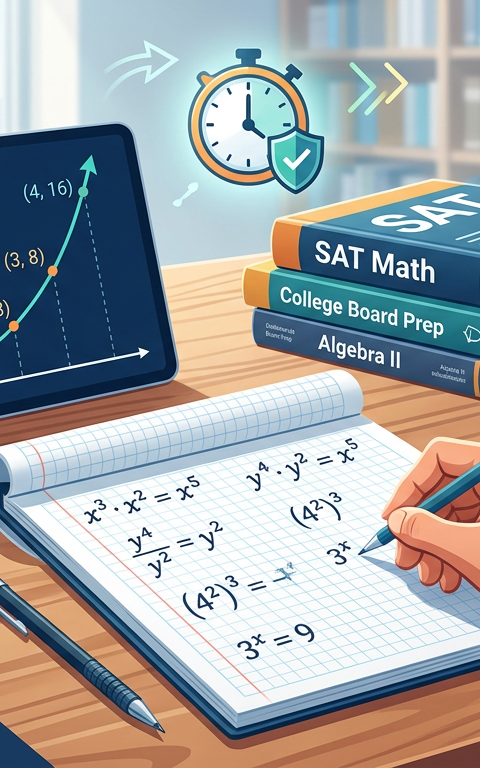
Easy SAT Exponents Practice Questions
Easy SAT Exponents Practice Questions
Apr 27, 2026

Defeating Extraneous Solutions and Rational Exponents on the SAT
Hard SAT Radicals Practice Questions
Apr 27, 2026
Solving High-Level SAT Integer Logic and Number Theory Problems
Hard SAT Integers Practice Questions
Apr 27, 2026

Hard SAT Number Properties Practice Questions
Hard SAT Number Properties Practice Questions
Apr 27, 2026

Hard SAT Percent Practice Questions
Hard SAT Percent Practice Questions
Apr 27, 2026

Hard SAT Decimals Practice Questions
Hard SAT Decimals Practice Questions
Apr 27, 2026

Hard SAT Fractions Practice Questions
Hard SAT Fractions Practice Questions
Apr 27, 2026