Medium MCAT Genetics Practice Questions

Concept Explanation
Medium MCAT genetics practice questions focus on the application of Mendelian principles, non-Mendelian inheritance patterns, and the molecular mechanisms of DNA replication and repair. Genetics on the MCAT requires a deep understanding of how information flows from DNA to proteins and how that information is partitioned during meiosis. Mastery of this subject involves calculating allele frequencies through Hardy-Weinberg equilibrium, interpreting pedigree charts, and predicting the phenotypic ratios of dihybrid crosses. Understanding the nuances of genetics practice questions is essential for the Biological and Biochemical Foundations of Living Systems section. Key topics include linkage, recombination frequency, and the effects of various mutations on protein function.
Solved Examples
- Hardy-Weinberg Frequency: In a population in Hardy-Weinberg equilibrium, the frequency of a recessive autosomal allele for a particular trait is 0.4. What is the frequency of the heterozygous genotype?
- Identify the given value: .
- Calculate the frequency of the dominant allele using the equation . Thus, .
- Use the Hardy-Weinberg formula for heterozygotes: .
- Substitute the values: . The frequency of the heterozygous genotype is 48%.
- Recombination Mapping: Three genes (A, B, and C) are located on the same chromosome. The recombination frequency between A and B is 12%, between B and C is 7%, and between A and C is 5%. Determine the order of the genes.
- Identify the largest distance: A and B are 12 units apart.
- Check the intermediate distances: A to C is 5 units and C to B is 7 units.
- Since , gene C must sit between A and B.
- The gene order is A-C-B (or B-C-A).
- Mendelian Probability: What is the probability of producing an offspring with the genotype from a cross between parents with genotypes and ?
- Break the cross into individual Punnett squares for each gene.
- For gene A: probability of is .
- For gene B: probability of is .
- For gene C: probability of is .
- Multiply the individual probabilities: .
Practice Questions
1. A researcher identifies a mutation in a yeast strain that prevents the separation of sister chromatids during anaphase II of meiosis. If the original diploid cell had , how many chromosomes will be present in a gamete that results from this error?
2. In fruit flies, the allele for long wings (L) is dominant over short wings (l), and the allele for red eyes (R) is dominant over white eyes (r). A dihybrid cross is performed (). What fraction of the offspring is expected to have long wings and white eyes?
3. A specific form of color blindness is an X-linked recessive trait. If a carrier female has children with a normal-vision male, what is the probability that their first son will be colorblind?
Need more MCAT practice questions?
Generate unlimited MCAT-style questions with instant explanations and adaptive practice powered by Bevinzey AI.
Generate Questions Free4. Which of the following mutations is most likely to result in a truncated protein product?
5. In a population of 1000 individuals, 90 exhibit a recessive phenotype. Assuming the population is in Hardy-Weinberg equilibrium, how many individuals are expected to be homozygous dominant?
6. A DNA sample contains 22% Adenine. According to Chargaff’s rules, what is the expected percentage of Guanine in this sample?
7. A test cross is used to determine the genotype of an individual displaying a dominant phenotype. This individual is crossed with another individual of what genotype?
8. During which phase of meiosis does crossing over (genetic recombination) occur, increasing genetic diversity?
9. If two genes have a recombination frequency of 50%, what does this suggest about their physical location on the chromosomes?
10. An individual with blood type AB marries an individual with blood type O. What are the possible blood types of their children?
Answers & Explanations
1. 7 or 9: Normal meiosis results in haploid gametes (). If nondisjunction occurs in anaphase II, one daughter cell receives both sister chromatids () and the other receives none ().
2. 3/16: In a standard dihybrid cross ( ratio), the frequency of dominant for the first trait and recessive for the second is .
3. 50%: The mother is and the father is . Sons receive the Y from the father and either or from the mother. There is a 50% chance the son receives the allele.
4. Nonsense mutation: A nonsense mutation changes a codon for an amino acid into a premature stop codon, leading to early termination of translation.
5. 490: , so . Since , . Homozygous dominant frequency is . Total individuals: .
6. 28%: If , then . . The remaining must be . Since , .
7. Homozygous recessive: A test cross always involves crossing the unknown dominant phenotype ( or ) with a known homozygous recessive () to observe the offspring phenotypes.
8. Prophase I: Synapsis and the formation of chiasmata occur during Prophase I, allowing for the exchange of genetic material between homologous chromosomes. For more on cellular division, see our cell biology practice questions.
9. They are unlinked: A recombination frequency of 50% is the maximum possible and indicates that genes are either on different chromosomes or very far apart on the same chromosome, behaving as if they assort independently.
10. Type A and Type B: The AB parent provides either the or allele. The O parent provides only the allele. Possible genotypes are (Type A) and (Type B).
1. Which technique is most commonly used to amplify a specific sequence of DNA for genetic analysis?
Frequently Asked Questions
What is the difference between penetrance and expressivity?
Penetrance refers to the proportion of individuals with a specific genotype who actually express the associated phenotype. Expressivity describes the degree or intensity to which a particular genotype is expressed phenotypically in an individual.
How does the law of independent assortment apply to linked genes?
Linked genes are located close together on the same chromosome and do not follow the law of independent assortment because they tend to be inherited together. They only assort independently if a crossover event occurs between them, which is less likely the closer they are.
What are the requirements for a population to be in Hardy-Weinberg equilibrium?
A population must have no mutations, no natural selection, no gene flow (migration), a very large population size, and random mating. These conditions ensure that allele frequencies remain constant over generations.
What is the functional difference between DNA Polymerase I and III in prokaryotes?
DNA Polymerase III is the primary enzyme for elongating the leading and lagging strands during replication. DNA Polymerase I removes RNA primers via its 5' to 3' exonuclease activity and replaces them with DNA nucleotides.
How do retroviruses violate the central dogma of molecular biology?
Retroviruses use the enzyme reverse transcriptase to synthesize DNA from an RNA template. This reverses the standard flow of genetic information, which typically moves from DNA to RNA to protein. For more on viral genetics, check our MCAT biology practice questions.
Need more MCAT practice questions?
Generate unlimited MCAT-style questions with instant explanations and adaptive practice powered by Bevinzey AI.
Generate Questions FreeReviewed by
Michael Danquah, MS, PhD
Dr. Michael Danquah is a professor of pharmaceutical sciences and founder of several educational technology platforms focused on improving student learning and performance.
Enjoyed this article?
Share it with others who might find it helpful.
Related Articles

Applying Coulomb’s Law and Potential to MCAT Biological Systems
MCAT Electrostatics Practice Questions with Answers
May 14, 2026
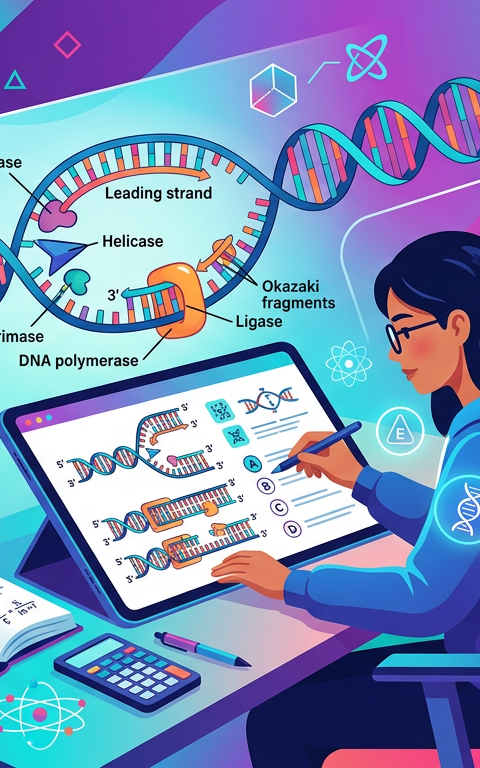
Hard MCAT DNA Replication Practice Questions
Master high-level DNA replication concepts with these hard MCAT practice questions covering enzymes, directionality, and telomeres.
May 14, 2026
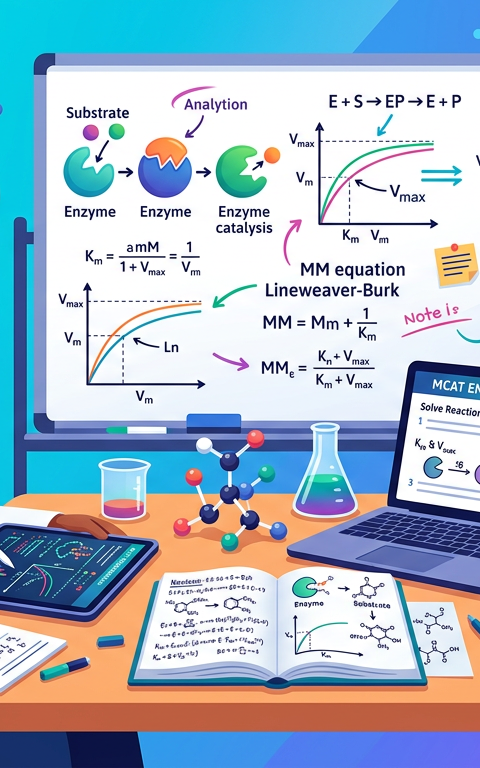
Hard MCAT Enzyme Practice Questions
Hard MCAT Enzyme Practice Questions
May 14, 2026

Medium MCAT DNA Replication Practice Questions
Medium MCAT DNA Replication Practice Questions
May 14, 2026

Medium MCAT Enzyme Practice Questions
Medium MCAT Enzyme Practice Questions
May 14, 2026

Easy MCAT DNA Replication Practice Questions
Master DNA replication with these easy MCAT practice questions. Learn about helicase, polymerase, and semi-conservative replication with detailed explanations.
May 14, 2026

MCAT Enzyme Kinetics: Solving KM and Vmax Without a Calculator
Easy MCAT Enzyme Practice Questions
May 14, 2026
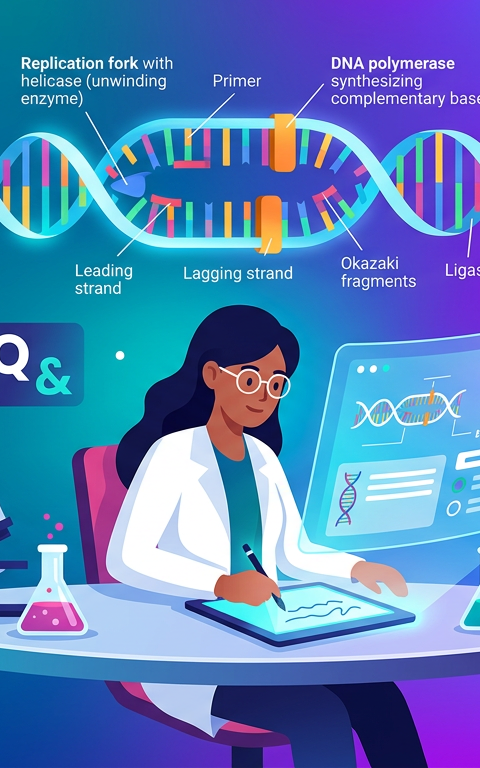
MCAT DNA Replication Practice Questions with Answers
MCAT DNA Replication Practice Questions with Answers
May 14, 2026