MCAT Enzyme Kinetics: Solving KM and Vmax Without a Calculator

When you encounter a Michaelis-Menten problem on the MCAT, the trap isn't usually the math itself, but the relationship between substrate concentration and the Km. Many students freeze when they see a question asking for the reaction velocity at 15 mM substrate with a Km of 5 mM, trying to perform complex division under time pressure. The key is recognizing that you are simply finding a ratio: if [S] is three times the Km, the denominator becomes four times the Km, leading to a predictable 75% of the maximum velocity.
Understanding enzymes goes beyond memorizing that they lower activation energy. You must be able to visualize how an inhibitor physically interacts with the enzyme-substrate complex versus the free enzyme. If an inhibitor binds exclusively to the complex, it locks the substrate in place, paradoxically appearing to increase affinity while simultaneously dropping the turnover rate. Distinguishing these shifts in Vmax and Km on a Lineweaver-Burk plot is the difference between guessing and knowing the correct inhibition type within seconds.
Mastering Catalytic Rates and Inhibition Mechanics
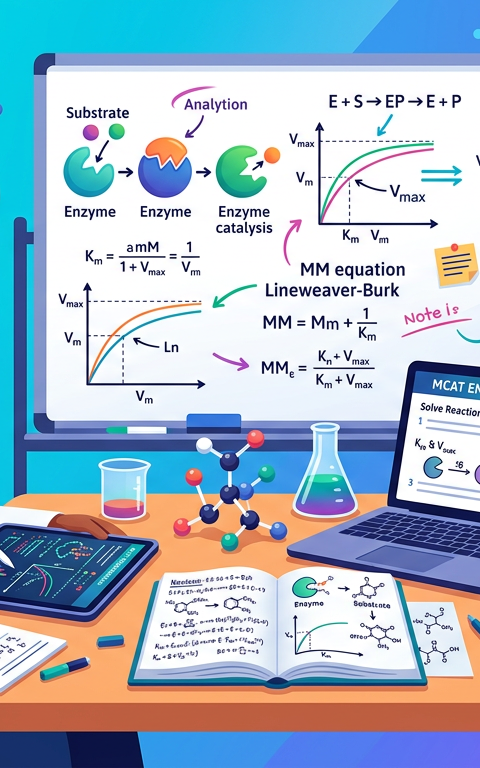
Enzymes are biological catalysts, typically proteins, that increase the rate of chemical reactions by lowering the activation energy required for the reaction to proceed. These molecules are essential for metabolism and are characterized by their specificity, meaning each enzyme generally acts on a specific substrate to catalyze a specific reaction. According to Nature, enzymes do not alter the equilibrium constant of a reaction; instead, they allow the system to reach equilibrium much faster. This is achieved through the formation of an enzyme-substrate complex at a specific region of the enzyme known as the active site. Understanding enzyme kinetics, particularly the Michaelis-Menten model, is a cornerstone of Easy MCAT Organic Chemistry Practice Questions and biochemistry preparation. Key terms to master include , the maximum velocity of the reaction, and , the substrate concentration at which the reaction velocity is half of its maximum value. Enzymes can also be regulated by inhibitors, which are categorized as competitive, noncompetitive, uncompetitive, or mixed based on how they interact with the enzyme and substrate.
Solved Examples
- Calculating Fractional Saturation: An enzyme has a of . If the substrate concentration is , what fraction of the maximum velocity is the reaction operating at?
- Identify the Michaelis-Menten equation:
- Substitute the given values into the equation:
- Simplify the denominator:
- Calculate the final fraction:
- The enzyme is operating at 75% of its maximum velocity.
- Identifying Inhibition Type: A researcher observes that adding an inhibitor increases the of an enzyme but does not change the . What type of inhibition is occurring?
- Recall the definitions of inhibition. Competitive inhibitors bind to the active site, competing with the substrate.
- Since they can be outcompeted by adding more substrate, the remains reachable (unchanged).
- However, more substrate is needed to reach half-saturation, which increases the apparent .
- Conclusion: This is competitive inhibition.
- Determining Catalytic Efficiency: Enzyme A has a of and a of . Enzyme B has a of and a of . Which enzyme is more efficient?
- The formula for catalytic efficiency is
- Calculate for Enzyme A:
- Calculate for Enzyme B:
- Compare the results: 50 is greater than 20.
- Conclusion: Enzyme A is more efficient.
Practice Questions
1. Which of the following best describes the effect of an enzyme on the Gibbs free energy () of a reaction?
2. A Lineweaver-Burk plot shows two lines intersecting on the y-axis but having different x-intercepts. What type of inhibition does this represent?
3. If an enzyme follows Michaelis-Menten kinetics, what happens to the reaction rate when is much smaller than ?
Feel more confident on exam day.
Practice with realistic MCAT-style questions and strengthen your understanding before test day arrives.
Practice Free Now4. Which class of enzymes catalyzes the movement of a functional group from one molecule to another?
5. An uncompetitive inhibitor binds to which of the following?
6. How does an increase in temperature typically affect the rate of an enzyme-catalyzed reaction before reaching the denaturation point?
7. In the context of Easy MCAT Kinetics Practice Questions, what does a low value indicate about an enzyme's affinity for its substrate?
8. Which of the following is true regarding a zymogen?
9. The "induced fit" model of enzyme-substrate binding suggests that:
10. What is the effect of a noncompetitive inhibitor on and ?
Answers & Explanations
- Answer: Enzymes do not change . Enzymes only affect the kinetics (speed) of the reaction by lowering the activation energy (). They do not alter the thermodynamics, meaning the initial and final energy states of reactants and products remain the same.
- Answer: Competitive inhibition. On a Lineweaver-Burk plot, the y-intercept represents . If the lines intersect at the y-axis, the is identical for both inhibited and uninhibited reactions, which is a hallmark of competitive inhibition.
- Answer: The rate is proportional to the substrate concentration. When , the denominator in the Michaelis-Menten equation simplifies to roughly . The equation becomes , showing a first-order dependence on .
- Answer: Transferases. Transferases catalyze the transfer of groups such as methyl, phosphate, or acetyl groups. For more on organic mechanisms, see our Easy MCAT Organic Reactions Practice Questions.
- Answer: The enzyme-substrate (ES) complex only. Uncompetitive inhibitors do not bind to the free enzyme; they only bind once the substrate has already entered the active site, locking it in.
- Answer: The reaction rate increases. According to the Arrhenius equation, increasing temperature increases the kinetic energy of molecules, leading to more frequent and energetic collisions, thus increasing the rate until the protein structure begins to unfold (denature).
- Answer: High affinity. A low means that only a small amount of substrate is required to saturate half of the enzyme's active sites, indicating that the enzyme binds the substrate very tightly.
- Answer: It is an inactive precursor that requires cleavage to become active. Zymogens (like pepsinogen) are a form of regulation that prevents enzymes from acting in the wrong place or at the wrong time.
- Answer: The enzyme undergoes a conformational change upon substrate binding. Unlike the older "lock and key" model, induced fit posits that the active site is flexible and molds itself around the substrate to achieve the transition state.
- Answer: decreases, remains unchanged. Noncompetitive inhibitors bind to an allosteric site regardless of whether the substrate is present. This reduces the number of functional enzymes (lowering ) but does not interfere with the binding affinity of the remaining active enzymes (leaving unchanged).
1. Which enzyme class catalyzes the joining of two large molecules, usually coupled with ATP hydrolysis?
Frequently Asked Questions
What is the difference between a coenzyme and a cofactor?
Cofactors are non-protein molecules that assist enzymes, and they can be inorganic (like metal ions) or organic. Coenzymes are a specific subset of organic cofactors, such as vitamins or NADH, that often carry chemical groups between reactions.
How does pH affect enzyme activity?
Enzymes have an optimal pH at which their catalytic activity is highest because the ionization state of amino acids in the active site is critical for binding and catalysis. Deviations from this pH can lead to denaturation or loss of function, as noted by Khan Academy.
What is the significance of the kcat/Km ratio?
The ratio represents the catalytic efficiency of an enzyme, accounting for both how fast the enzyme works once bound and how well it binds the substrate. It is the best measure to compare an enzyme's preference for different substrates.
What is an allosteric site?
An allosteric site is a location on an enzyme separate from the active site where effector molecules can bind. This binding induces a conformational change that either increases (activation) or decreases (inhibition) the enzyme's activity.
Why does Vmax stay the same in competitive inhibition?
In competitive inhibition, the inhibitor and substrate compete for the same active site. By significantly increasing the substrate concentration, the substrate will eventually outcompete the inhibitor for every active site, allowing the reaction to reach its original maximum velocity.
Feel more confident on exam day.
Practice with realistic MCAT-style questions and strengthen your understanding before test day arrives.
Practice Free NowReviewed by
Michael Danquah, MS, PhD
Dr. Michael Danquah is a professor of pharmaceutical sciences and founder of several educational technology platforms focused on improving student learning and performance.
Enjoyed this article?
Share it with others who might find it helpful.
Related Articles
Hard MCAT Enzyme Practice Questions
Hard MCAT Enzyme Practice Questions
May 14, 2026

Medium MCAT Enzyme Practice Questions
Medium MCAT Enzyme Practice Questions
May 14, 2026

MCAT Enzyme Practice Questions with Answers
MCAT Enzyme Practice Questions with Answers
May 14, 2026

Applying Coulomb’s Law and Potential to MCAT Biological Systems
MCAT Electrostatics Practice Questions with Answers
May 14, 2026

Hard MCAT DNA Replication Practice Questions
Master high-level DNA replication concepts with these hard MCAT practice questions covering enzymes, directionality, and telomeres.
May 14, 2026

Medium MCAT DNA Replication Practice Questions
Medium MCAT DNA Replication Practice Questions
May 14, 2026

Easy MCAT DNA Replication Practice Questions
Master DNA replication with these easy MCAT practice questions. Learn about helicase, polymerase, and semi-conservative replication with detailed explanations.
May 14, 2026

MCAT DNA Replication Practice Questions with Answers
MCAT DNA Replication Practice Questions with Answers
May 14, 2026