MCAT DNA Replication Practice Questions with Answers
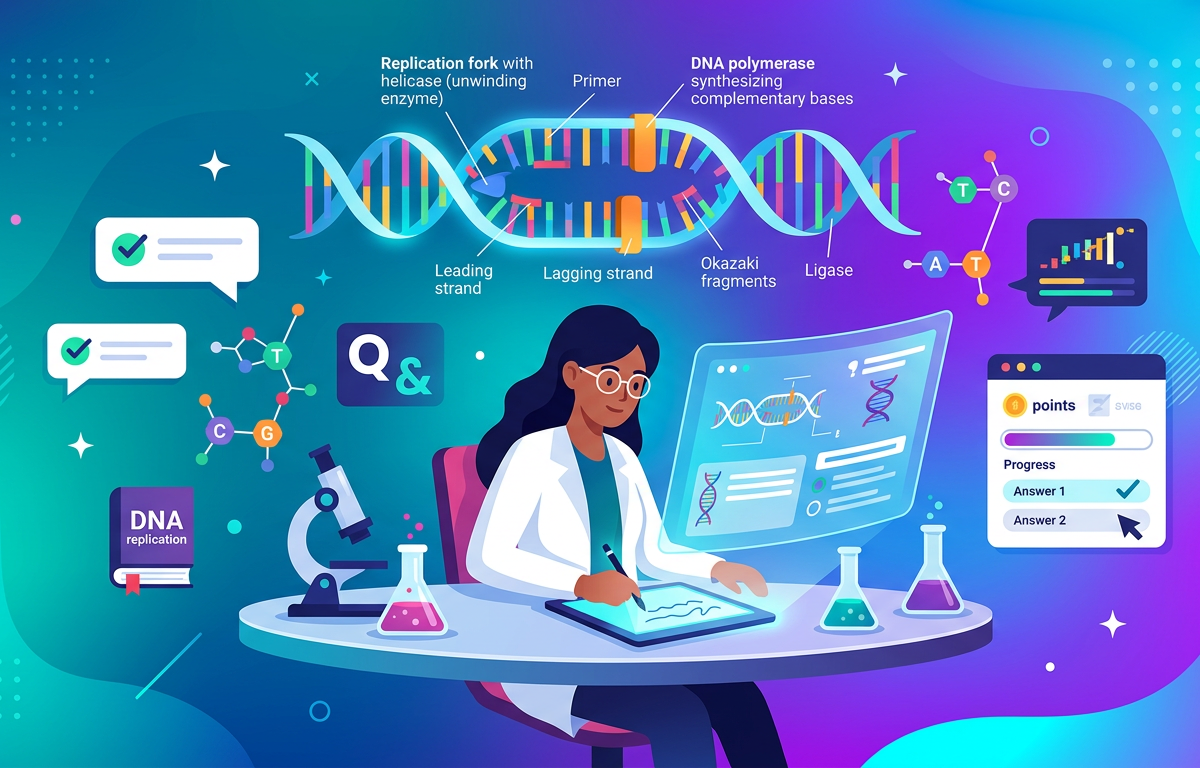
MCAT DNA Replication Practice Questions with Answers
Mastering DNA replication is essential for success on the Biological and Biochemical Foundations of Living Systems section of the MCAT. This process ensures that every cell in an organism contains the same genetic information. By understanding the enzymes, directions, and mechanisms involved, you can tackle complex questions regarding genetics and molecular biology. This guide provides a comprehensive overview and MCAT DNA Replication practice questions to help you refine your knowledge.
Concept Explanation
DNA replication is the biological process of producing two identical replicas of DNA from one original DNA molecule, occurring during the S phase of the cell cycle. This process is semiconservative, meaning each new DNA molecule consists of one original (parental) strand and one newly synthesized (daughter) strand. According to Nature Education, the high fidelity of this process is maintained by specific polymerases and repair mechanisms.
The process begins at the origin of replication, where helicase unwinds the double helix, creating a replication fork. Single-stranded binding proteins (SSBs) prevent the strands from re-annealing, while topoisomerase (DNA gyrase in prokaryotes) relieves torsional strain ahead of the fork. Primase synthesizes a short RNA primer, providing a free 3'-OH group for DNA polymerase to begin adding deoxyribonucleotides. Synthesis always occurs in the direction. This creates a leading strand, synthesized continuously toward the fork, and a lagging strand, synthesized discontinuously in Okazaki fragments away from the fork. Finally, DNA ligase seals the nicks between fragments.
Key differences exist between prokaryotic and eukaryotic replication. Prokaryotes typically have a single circular chromosome with one origin, whereas eukaryotes have multiple linear chromosomes with thousands of origins. Eukaryotes also utilize telomerase to maintain the ends of linear chromosomes, a concept often tested alongside general chemistry principles involving molecular stability.
Solved Examples
- Problem: If a DNA strand has the sequence , what is the sequence of the complementary strand synthesized during replication?
Solution:- Identify the base pairing rules: A pairs with T, and G pairs with C.
- Determine the antiparallel orientation: The new strand must run relative to the template.
- Match the bases: A-T, T-A, G-C, C-G, C-G, T-A.
- The complementary sequence is , which is written as .
- Problem: A researcher inhibits the enzyme Topoisomerase. What is the most likely immediate effect on the replication fork?
Solution:- Recall the function of Topoisomerase: It removes supercoils and relieves torsional strain.
- As helicase unwinds DNA, the DNA ahead of the fork becomes overwound.
- Without Topoisomerase, the tension would become so great that the DNA would break or the fork would stall.
- Conclusion: DNA replication stops because the double helix cannot be further unwound.
- Problem: Explain why the lagging strand requires more Primase activity than the leading strand.
Solution:- The leading strand is synthesized continuously in the direction toward the fork, requiring only one primer.
- The lagging strand is synthesized in the direction opposite to fork movement.
- As the fork opens, new segments of the template are exposed, requiring a new RNA primer for each Okazaki fragment.
- Therefore, Primase must act repeatedly on the lagging strand.
Practice Questions
1. Which of the following enzymes is responsible for replacing RNA primers with DNA nucleotides in prokaryotes?
2. During DNA replication, the sliding clamp (PCNA in eukaryotes) serves what primary function?
3. If a mutation inactivates the exonuclease activity of DNA polymerase, what is the most likely consequence?
Your MCAT prep should adapt to you.
Bevinzey analyzes your performance and helps you focus on the concepts you need most.
Try Adaptive Practice4. In eukaryotes, which DNA polymerase is primarily responsible for the synthesis of the leading strand?
5. Telomerase carries its own template in the form of what molecule?
6. Contrast the number of origins of replication in E. coli versus a human somatic cell.
7. A scientist observes that Okazaki fragments are being synthesized but not joined together. Which enzyme is most likely defective?
8. Why is DNA replication considered "semidiscontinuous"?
9. What is the role of Single-Stranded Binding Proteins (SSBs) at the replication fork?
10. How does the structure of a dideoxynucleotide (ddNTP) differ from a deoxynucleotide (dNTP), and how does this affect replication?
Answers & Explanations
- DNA Polymerase I: In prokaryotes, DNA Pol I has exonuclease activity, allowing it to remove the RNA primer and replace it with DNA.
- Processivity: The sliding clamp helps hold the DNA polymerase onto the template strand, significantly increasing the enzyme's processivity (the number of nucleotides added per binding event).
- Increased Mutation Rate: The exonuclease activity is the "proofreading" function. Without it, mispaired bases cannot be removed during synthesis, leading to a higher frequency of permanent mutations. Similar logic applies to reaction mechanisms where intermediate stability dictates the final product.
- DNA Polymerase ε (epsilon): While multiple polymerases are involved, ε is generally associated with leading strand synthesis, while δ (delta) handles the lagging strand.
- RNA: Telomerase is a ribonucleoprotein that contains an RNA sequence used as a template to extend the end of linear chromosomes. This is a form of reverse transcription.
- One vs. Thousands: E. coli (prokaryote) has a single origin of replication (oriC). Human cells (eukaryotes) have thousands of origins to ensure the large genome is replicated within the S phase.
- DNA Ligase: Ligase is responsible for catalyzing the formation of the phosphodiester bond that "glues" the sugar-phosphate backbones of Okazaki fragments together.
- Leading vs. Lagging: It is called semidiscontinuous because one strand (leading) is synthesized continuously, while the other (lagging) is synthesized in short, discontinuous bursts.
- Stabilization: SSBs bind to the newly separated individual DNA strands to prevent them from re-annealing into a double helix or forming hairpin loops that would stall the polymerase.
- Lack of 3'-OH: ddNTPs lack the group found in dNTPs. Since DNA polymerase requires a to attach the next nucleotide, incorporation of a ddNTP results in chain termination. This is the basis of Sanger sequencing.
1. Which enzyme is responsible for relieving the torsional strain (supercoiling) ahead of the replication fork?
Frequently Asked Questions
What is the difference between helicase and topoisomerase?
Helicase actively breaks the hydrogen bonds between nitrogenous bases to "unzip" the DNA double helix. Topoisomerase works ahead of the replication fork to cut and rejoin the DNA backbone, relieving the physical tension caused by unwinding.
Why does DNA replication only occur in the 5' to 3' direction?
DNA polymerase can only add new nucleotides to a free group. The chemical energy for the phosphodiester bond comes from the hydrolysis of the high-energy phosphate bonds on the incoming triphosphate nucleotide, which occurs at the end.
What are Okazaki fragments?
Okazaki fragments are short sequences of DNA nucleotides synthesized discontinuously on the lagging strand. They are eventually joined together by DNA ligase to create a continuous strand.
How is eukaryotic DNA replication different from prokaryotic?
Eukaryotic replication involves multiple origins of replication, linear chromosomes, and specialized enzymes like telomerase. Prokaryotic replication typically occurs from a single origin on a circular chromosome and utilizes different polymerase isoforms like Pol III and Pol I.
What happens if DNA polymerase makes a mistake?
DNA polymerase has an intrinsic proofreading mechanism via its exonuclease activity that removes incorrect bases. If a mistake escapes this phase, other repair pathways like mismatch repair (MMR) identify and correct the error after replication is complete.
Your MCAT prep should adapt to you.
Bevinzey analyzes your performance and helps you focus on the concepts you need most.
Try Adaptive PracticeReviewed by
Michael Danquah, MS, PhD
Dr. Michael Danquah is a professor of pharmaceutical sciences and founder of several educational technology platforms focused on improving student learning and performance.
Enjoyed this article?
Share it with others who might find it helpful.
Related Articles
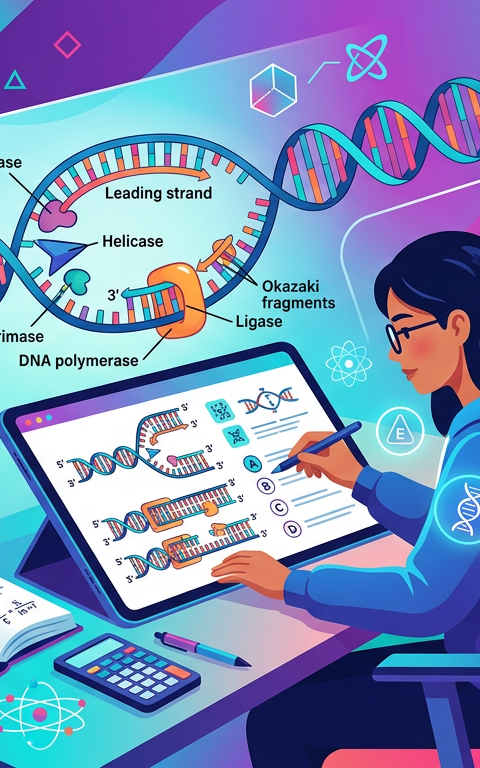
Hard MCAT DNA Replication Practice Questions
Master high-level DNA replication concepts with these hard MCAT practice questions covering enzymes, directionality, and telomeres.
May 14, 2026
Medium MCAT DNA Replication Practice Questions
Medium MCAT DNA Replication Practice Questions
May 14, 2026

Easy MCAT DNA Replication Practice Questions
Master DNA replication with these easy MCAT practice questions. Learn about helicase, polymerase, and semi-conservative replication with detailed explanations.
May 14, 2026

Applying Coulomb’s Law and Potential to MCAT Biological Systems
MCAT Electrostatics Practice Questions with Answers
May 14, 2026
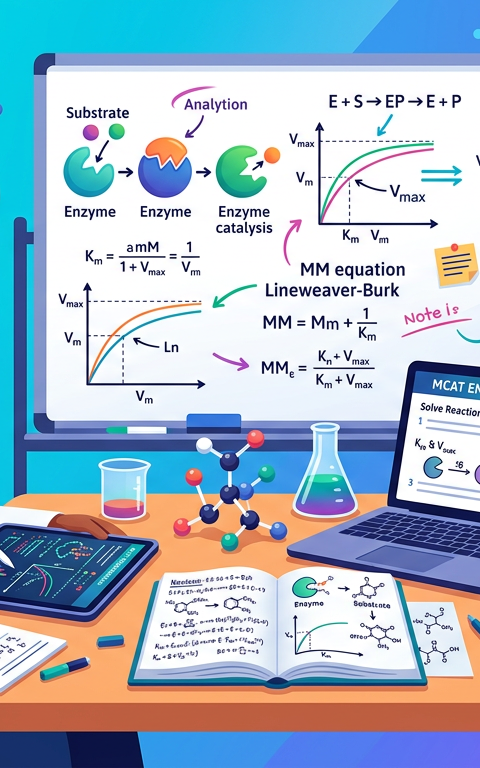
Hard MCAT Enzyme Practice Questions
Hard MCAT Enzyme Practice Questions
May 14, 2026

Medium MCAT Enzyme Practice Questions
Medium MCAT Enzyme Practice Questions
May 14, 2026

MCAT Enzyme Kinetics: Solving KM and Vmax Without a Calculator
Easy MCAT Enzyme Practice Questions
May 14, 2026

MCAT Enzyme Practice Questions with Answers
MCAT Enzyme Practice Questions with Answers
May 14, 2026