MCAT Cell Biology Practice Questions with Answers
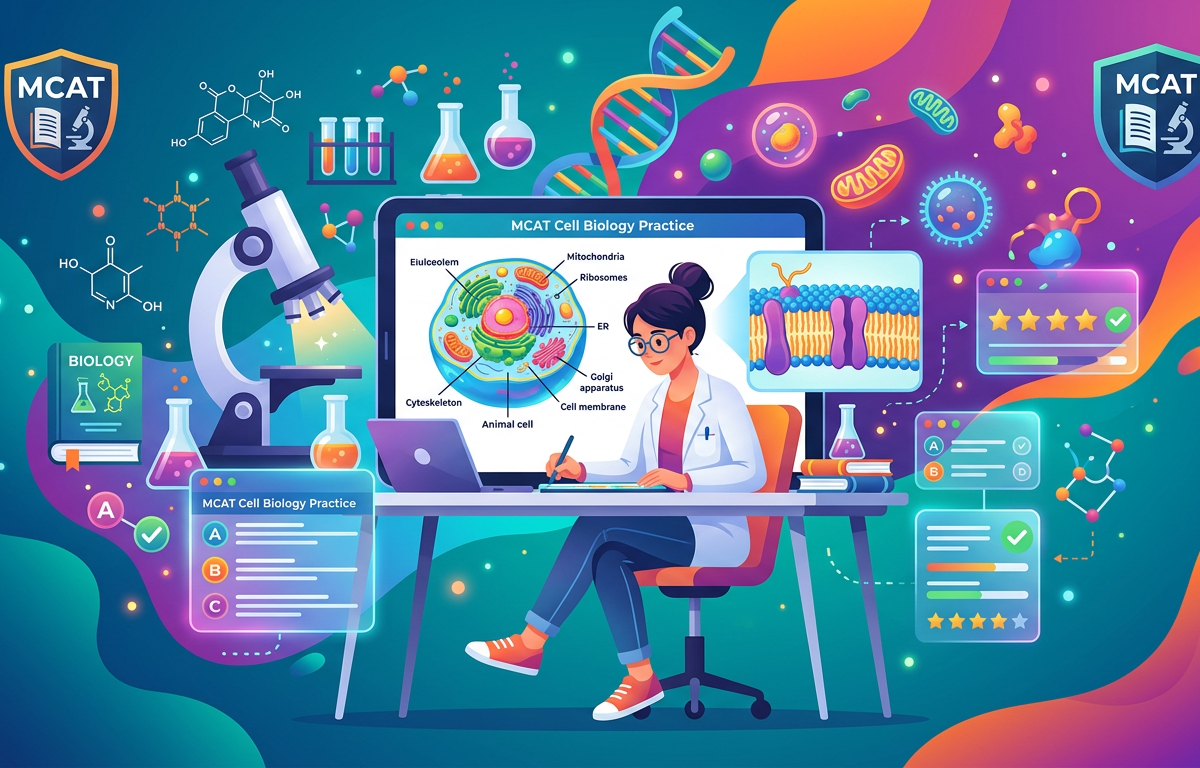
MCAT Cell Biology Practice Questions with Answers
Mastering cell biology is a fundamental requirement for success on the Biological and Biochemical Foundations of Living Systems section of the MCAT. This guide provides comprehensive MCAT Cell Biology Practice Questions with Answers, detailed explanations, and a deep dive into the core cellular mechanisms you must understand to excel.
Concept Explanation
MCAT Cell Biology encompasses the study of cellular structure, function, and reproduction in both prokaryotic and eukaryotic organisms. At its core, this subject focuses on how cells maintain homeostasis, generate energy, and communicate through complex biochemical signaling pathways. According to the AAMC, cell biology tests your ability to relate molecular processes to physiological outcomes. Key topics include the endomembrane system, mitochondrial bioenergetics, the cell cycle, and the fluid mosaic model of the plasma membrane. Understanding the distinction between eukaryotic organelles and prokaryotic structures is vital, as is mastering the mechanics of mitosis and meiosis. To truly excel, students often find that mastering medicine through retrieval practice helps solidify these complex microscopic concepts into long-term memory.
The Plasma Membrane and Transport
The plasma membrane is a semi-permeable phospholipid bilayer that regulates the entry and exit of molecules. Transport mechanisms are categorized by their energy requirements: passive transport (simple diffusion, facilitated diffusion, and osmosis) occurs along a concentration gradient, while active transport (primary and secondary) requires energy, typically in the form of ATP, to move solutes against their gradient. The sodium-potassium pump (-ATPase) is a classic example of primary active transport, moving 3 out and 2 in to maintain the resting membrane potential.
Organelle Function and Protein Trafficking
Eukaryotic cells utilize membrane-bound organelles to compartmentalize biochemical reactions. The nucleus stores genetic material, while the Rough Endoplasmic Reticulum (RER) is the site of synthesis for proteins destined for secretion or membrane insertion. The Golgi apparatus modifies and sorts these proteins. Lysosomes contain hydrolytic enzymes for degradation, and mitochondria are the "powerhouses" where the citric acid cycle and oxidative phosphorylation occur. For students preparing for high-stakes exams, using retrieval practice for STEM subjects can significantly improve the ability to recall these specific organelle functions under pressure.
Solved Examples
Example 1: Calculating Osmotic Pressure
A cell is placed in a solution of 0.3 M glucose at 310 K. What is the osmotic pressure () of the solution? (Use )
- Identify the formula for osmotic pressure: .
- Determine the van't Hoff factor () for glucose. Since glucose does not dissociate in water, .
- Substitute the values: .
- Calculate the result: .
Example 2: Genetics of the Cell Cycle
If a cell has 24 chromosomes during the G1 phase, how many chromatids are present during the G2 phase?
- In G1, chromosomes are single-stranded. There are 24 chromosomes and 24 chromatids.
- During the S phase (Synthesis), DNA replication occurs. Each chromosome is duplicated to form two sister chromatids.
- In G2, the cell has finished replication but has not yet divided. The number of chromosomes remains 24, but each consists of two chromatids.
- Total chromatids = .
Example 3: Mitochondrial Inheritance
A female with a mitochondrial disease marries a healthy male. What is the probability that their offspring will inherit the disease?
- Mitochondria are inherited maternally because the ovum provides almost all the cytoplasm and organelles to the zygote, while the sperm contributes only nuclear DNA.
- Since the mother is affected, she will pass her mitochondrial DNA to all her children.
- The probability of inheritance is 100% for both sons and daughters.
Practice Questions
- A researcher treats a population of cells with a drug that inhibits the function of the nucleolus. Which cellular process will be most directly impaired?
- Which of the following molecules would most easily cross the plasma membrane via simple diffusion: Glucose, Sodium ions, Estrogen, or Insulin?
- A mutation in the gene encoding the protein tubulin would most likely affect which of the following cellular structures: Microfilaments, Intermediate filaments, Centrioles, or Desmosomes?
Ready to boost your MCAT score?
Practice smarter with Bevinzey’s AI-powered MCAT quizzes, explanations, and personalized study tools.
Start MCAT Prep Free- During which phase of the cell cycle does the nuclear envelope break down and chromatin condense into chromosomes?
- If the concentration of is 145 mM extracellularly and 12 mM intracellularly, in which direction will move if a non-selective cation channel opens?
- Which organelle is responsible for the detoxification of drugs and the synthesis of lipids such as steroids?
- Explain why a defect in the dynein motor protein would lead to male infertility and chronic respiratory infections.
- A cell is treated with a chemical that prevents the formation of the cleavage furrow. Which stage of the cell cycle is being targeted?
- What is the primary difference between the ribosomes found in the cytosol of a human cell and those found in an E. coli cell?
- Compare the roles of the lysosome and the proteasome in cellular degradation.
Answers & Explanations
- Ribosome synthesis. The nucleolus is the site of ribosomal RNA (rRNA) transcription and the assembly of ribosomal subunits. Inhibiting it stops the production of ribosomes, eventually halting protein synthesis.
- Estrogen. As a steroid hormone, estrogen is small and nonpolar (lipophilic), allowing it to pass directly through the hydrophobic core of the lipid bilayer without the need for a transporter.
- Centrioles. Centrioles are composed of microtubules, which are made of tubulin dimers. Microfilaments are made of actin, and intermediate filaments are made of various proteins like keratin.
- Prophase. This is the first stage of mitosis where the genetic material condenses and the machinery for division (spindle apparatus) begins to form as the nuclear membrane disappears.
- Into the cell. Ions move down their electrochemical gradient. Since the extracellular concentration () is much higher than the intracellular concentration (), will flow inward.
- Smooth Endoplasmic Reticulum (SER). Unlike the RER, the SER lacks ribosomes and specializes in lipid metabolism, steroid hormone production, and detoxification in the liver.
- Cilia and Flagella dysfunction. Dynein is the motor protein responsible for the sliding of microtubules in cilia (found in the respiratory tract) and flagella (the tail of the sperm). A defect leads to immotile sperm and the inability to clear mucus from the lungs.
- Cytokinesis. The cleavage furrow is formed by an actin-myosin contractile ring during cytokinesis, which physically divides the cytoplasm into two daughter cells following mitosis.
- Sedimentation coefficient (Size). Eukaryotic cytosolic ribosomes are 80S (composed of 60S and 40S subunits), whereas prokaryotic ribosomes are 70S (composed of 50S and 30S subunits).
- Lysosomes use acid hydrolases to digest bulk materials (autophagy or endocytosis) within a membrane-bound vesicle. Proteasomes are protein complexes that specifically degrade individual proteins tagged with ubiquitin in the cytosol.
1. Which organelle contains its own DNA and replicates independently of the nucleus?
Frequently Asked Questions
What is the difference between primary and secondary active transport?
Primary active transport uses energy directly from ATP hydrolysis to move molecules against a gradient, while secondary active transport uses the electrochemical gradient established by primary transport to power the movement of another substance.
How do eukaryotic and prokaryotic flagella differ?
Eukaryotic flagella are composed of microtubules in a 9+2 arrangement and move in a whip-like fashion using dynein, whereas prokaryotic flagella are made of flagellin and rotate like a propeller using a proton motive force.
What is the role of cholesterol in the plasma membrane?
Cholesterol acts as a fluidity buffer, increasing membrane fluidity at low temperatures by preventing tight packing of phospholipids and decreasing fluidity at high temperatures by restricting molecular movement.
Why is the rough ER called "rough"?
The rough ER is studded with ribosomes on its cytoplasmic surface, which gives it a granular appearance under an electron microscope and indicates its role in synthesizing secretory proteins.
What occurs during the S phase of the cell cycle?
The S phase, or synthesis phase, is the period during which the cell replicates its entire genome, ensuring that each daughter cell receives a complete set of genetic information after division. Integrating active retrieval practice into your study routine can help you better visualize these temporal stages of the cell cycle.
Ready to boost your MCAT score?
Practice smarter with Bevinzey’s AI-powered MCAT quizzes, explanations, and personalized study tools.
Start MCAT Prep FreeReviewed by
Michael Danquah, MS, PhD
Dr. Michael Danquah is a professor of pharmaceutical sciences and founder of several educational technology platforms focused on improving student learning and performance.
Enjoyed this article?
Share it with others who might find it helpful.
Related Articles
Hard MCAT Biology Exam Practice Questions
Hard MCAT Biology Exam Practice Questions
May 9, 2026

Applying Coulomb’s Law and Potential to MCAT Biological Systems
MCAT Electrostatics Practice Questions with Answers
May 14, 2026
Hard MCAT DNA Replication Practice Questions
Master high-level DNA replication concepts with these hard MCAT practice questions covering enzymes, directionality, and telomeres.
May 14, 2026
Hard MCAT Enzyme Practice Questions
Hard MCAT Enzyme Practice Questions
May 14, 2026
Medium MCAT DNA Replication Practice Questions
Medium MCAT DNA Replication Practice Questions
May 14, 2026

Medium MCAT Enzyme Practice Questions
Medium MCAT Enzyme Practice Questions
May 14, 2026

Easy MCAT DNA Replication Practice Questions
Master DNA replication with these easy MCAT practice questions. Learn about helicase, polymerase, and semi-conservative replication with detailed explanations.
May 14, 2026

MCAT Enzyme Kinetics: Solving KM and Vmax Without a Calculator
Easy MCAT Enzyme Practice Questions
May 14, 2026