MCAT Biology Practice Questions with Answers

MCAT Biology Practice Questions with Answers
Mastering the biological sciences is a cornerstone of a competitive medical school application, and utilizing high-quality MCAT Biology practice questions with answers is the most effective way to identify knowledge gaps and refine critical thinking skills. The MCAT Biology section tests your understanding of complex physiological systems, molecular genetics, and cellular processes through a combination of discrete questions and passage-based analysis. By engaging in active retrieval practice, you can move beyond rote memorization to achieve the deep conceptual mastery required for the 132-score threshold.
Concept Explanation
MCAT Biology encompasses the study of living systems from the molecular level to the complex interactions of organ systems, focusing on how organisms maintain homeostasis and pass on genetic information. To succeed, students must understand the central dogma of molecular biology—how DNA is transcribed into RNA and translated into proteins—as well as the metabolic pathways like glycolysis and the Krebs cycle that power cellular life. Furthermore, the exam emphasizes human anatomy and physiology, requiring a detailed grasp of the nervous, endocrine, circulatory, and reproductive systems. According to the Association of American Medical Colleges (AAMC), the biology section focuses on "Biological and Biochemical Foundations of Living Systems," which integrates biology with organic and general chemistry. Effective preparation involves applying these concepts to experimental data, a skill best honed through targeted practice testing and thorough review of explanations.
Solved Examples
Reviewing these worked examples will help you understand the logic required to navigate complex MCAT biology problems.
- Genetics and Probability: A man with an X-linked recessive disorder marries a woman who is a carrier for the same disorder. What is the probability that their first daughter will be affected by the disorder?
- Identify the genotypes: The father is and the mother is .
- Set up the Punnett square for the offspring.
- The possible female genotypes are (carrier) and (affected).
- Since the question asks for the probability that their daughter is affected, we only look at the female offspring. There is a 50% chance (1 out of 2) that a daughter will be affected.
- Enzyme Kinetics: An enzyme follows Michaelis-Menten kinetics. If the substrate concentration is equal to the Michaelis constant , what is the initial reaction velocity in terms of ?
- Recall the Michaelis-Menten equation:
- Substitute into the equation:
- Simplify the denominator:
- The terms cancel out, leaving:
- Cellular Respiration: How many molecules of ATP are produced from the complete oxidation of one molecule of glucose in a eukaryotic cell, assuming the malate-aspartate shuttle is used?
- Glycolysis produces 2 ATP and 2 NADH.
- Pyruvate dehydrogenase complex produces 2 NADH (1 per pyruvate).
- The Krebs cycle produces 2 GTP (equivalent to ATP), 6 NADH, and 2 .
- Total tallies: 4 ATP/GTP, 10 NADH, and 2 .
- Using the malate-aspartate shuttle, each NADH yields approximately 2.5 ATP, and each yields 1.5 ATP.
- Calculation: ATP.
Practice Questions
- Which of the following hormones is a peptide hormone that acts via a second messenger system?
- A) Testosterone
- B) Cortisol
- C) Insulin
- D) Aldosterone
- During the action potential of a neuron, which event is primarily responsible for repolarization?
- A) Opening of voltage-gated sodium channels
- B) Closing of voltage-gated potassium channels
- C) Opening of voltage-gated potassium channels
- D) Sudden influx of chloride ions
- In a population in Hardy-Weinberg equilibrium, the frequency of a recessive allele (q) is 0.3. What is the frequency of the heterozygous genotype?
- A) 0.09
- B) 0.42
- C) 0.49
- D) 0.21
Ready to boost your MCAT score?
Practice smarter with Bevinzey’s AI-powered MCAT quizzes, explanations, and personalized study tools.
Start MCAT Prep Free- Which organelle is responsible for the post-translational modification and packaging of proteins destined for secretion?
- A) Smooth Endoplasmic Reticulum
- B) Lysosome
- C) Golgi Apparatus
- D) Nucleolus
- A researcher discovers a mutation in a tRNA molecule that changes the anticodon from 5'-UAC-3' to 5'-UAA-3'. Which mRNA codon will this mutated tRNA now recognize?
- A) 5'-AUU-3'
- B) 5'-UUA-3'
- C) 5'-AUG-3'
- D) 5'-AAU-3'
- Which of the following best describes the function of the loop of Henle in the nephron?
- A) Filtration of blood into the Bowman's capsule
- B) Secretion of hydrogen ions into the distal tubule
- C) Creation of an osmotic gradient in the renal medulla
- D) Reabsorption of glucose and amino acids
- During muscle contraction, which of the following happens to the A-band of the sarcomere?
- A) It shortens
- B) It lengthens
- C) It remains constant in length
- D) It disappears entirely
- Which type of inhibitor binds only to the enzyme-substrate complex, effectively decreasing both and ?
- A) Competitive inhibitor
- B) Noncompetitive inhibitor
- C) Mixed inhibitor
- D) Uncompetitive inhibitor
Answers & Explanations
- Answer: C. Insulin is a peptide hormone. Unlike steroid hormones (testosterone, cortisol, aldosterone), which are lipophilic and can cross the cell membrane to bind intracellular receptors, peptide hormones are hydrophilic and must bind to extracellular receptors, triggering a second messenger cascade (like cAMP or IP3).
- Answer: C. Repolarization occurs when voltage-gated potassium channels open, allowing to flow out of the cell down its electrochemical gradient, making the inside of the cell more negative again. This process is detailed in neurobiology resources like Khan Academy's MCAT course.
- Answer: B. In Hardy-Weinberg equilibrium, the frequency of genotypes is given by . If , then . The frequency of the heterozygote is , which is .
- Answer: C. The Golgi apparatus is the "post office" of the cell. It receives proteins from the Rough ER, modifies them (e.g., glycosylation), and sorts them into vesicles for transport to the cell membrane or other organelles.
- Answer: B. tRNA anticodons bind to mRNA codons in an antiparallel fashion. If the anticodon is 5'-UAA-3', the complementary mRNA codon must be 3'-AUU-5'. Reading from 5' to 3', this is 5'-UUA-3'.
- Answer: C. The loop of Henle uses a countercurrent multiplier system to pump salts into the medulla, creating a high osmotic pressure that allows the collecting duct to reabsorb water later. For more on renal physiology, see Nature Scitable.
- Answer: C. The A-band represents the entire length of the thick (myosin) filaments. During contraction, the actin filaments slide over the myosin, but the myosin filaments themselves do not change length; therefore, the A-band remains constant.
- Answer: D. Uncompetitive inhibitors bind only to the enzyme-substrate (ES) complex. This effectively "locks" the substrate in the enzyme, decreasing (increasing apparent affinity) and decreasing because the complex cannot proceed to product as quickly.
1. Which of the following is the primary site of gas exchange in the human lungs?
Frequently Asked Questions
What is the best way to study for MCAT Biology?
The most effective strategy is to combine content review with active retrieval practice, focusing on understanding the "why" behind biological processes rather than just memorizing facts. Regularly taking practice tests and analyzing every wrong answer helps build the stamina and critical thinking required for the actual exam.
How much of the MCAT is biology?
Biology is a major component of the MCAT, appearing primarily in the "Biological and Biochemical Foundations of Living Systems" section, which consists of 59 questions. Additionally, biological concepts often overlap with the Psychology and Sociology section, making up roughly 25-30% of the total exam content.
Do I need to memorize all the amino acids for the MCAT?
Yes, you must memorize the names, three-letter codes, one-letter codes, and chemical properties (polarity, charge, hydrophobicity) of all 20 standard amino acids. Amino acid chemistry is one of the most frequently tested topics in the biology and biochemistry sections.
What are the high-yield topics in MCAT Biology?
High-yield topics include amino acids and proteins, enzyme kinetics, molecular genetics (DNA replication and transcription), metabolic pathways, and the endocrine and nervous systems. Mastery of these areas provides a strong foundation for scoring well on both discrete and passage-based questions.
Is MCAT Biology harder than introductory college biology?
While the core concepts are similar, the MCAT is significantly more challenging because it requires you to apply knowledge to unfamiliar experimental contexts and data. Success depends less on recall and more on your ability to synthesize information across different biological disciplines.
Ready to boost your MCAT score?
Practice smarter with Bevinzey’s AI-powered MCAT quizzes, explanations, and personalized study tools.
Start MCAT Prep FreeReviewed by
Michael Danquah, MS, PhD
Dr. Michael Danquah is a professor of pharmaceutical sciences and founder of several educational technology platforms focused on improving student learning and performance.
Enjoyed this article?
Share it with others who might find it helpful.
Related Articles

Hard MCAT Biology Exam Practice Questions
Hard MCAT Biology Exam Practice Questions
May 9, 2026

Applying Coulomb’s Law and Potential to MCAT Biological Systems
MCAT Electrostatics Practice Questions with Answers
May 14, 2026
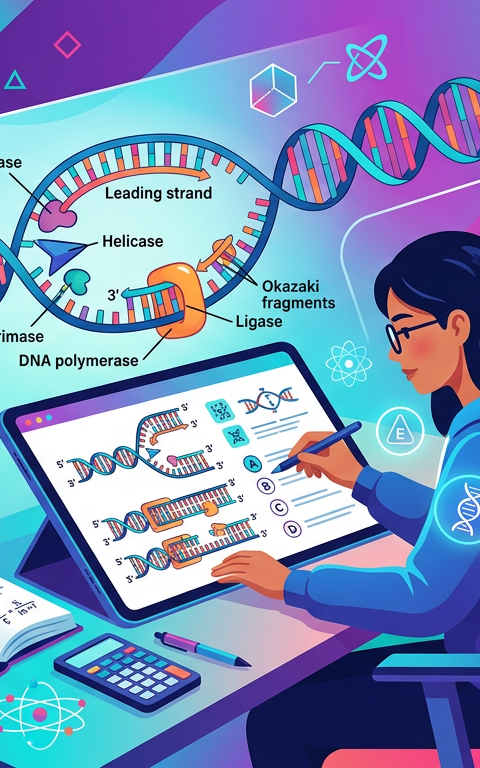
Hard MCAT DNA Replication Practice Questions
Master high-level DNA replication concepts with these hard MCAT practice questions covering enzymes, directionality, and telomeres.
May 14, 2026
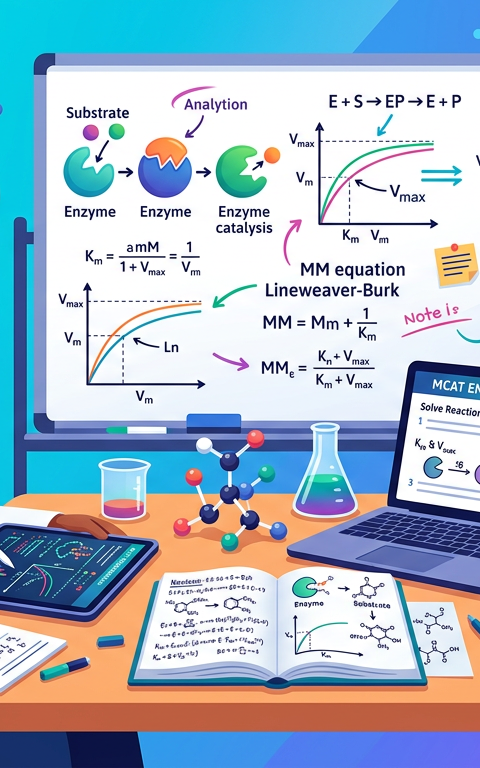
Hard MCAT Enzyme Practice Questions
Hard MCAT Enzyme Practice Questions
May 14, 2026
Medium MCAT DNA Replication Practice Questions
Medium MCAT DNA Replication Practice Questions
May 14, 2026

Medium MCAT Enzyme Practice Questions
Medium MCAT Enzyme Practice Questions
May 14, 2026

Easy MCAT DNA Replication Practice Questions
Master DNA replication with these easy MCAT practice questions. Learn about helicase, polymerase, and semi-conservative replication with detailed explanations.
May 14, 2026

MCAT Enzyme Kinetics: Solving KM and Vmax Without a Calculator
Easy MCAT Enzyme Practice Questions
May 14, 2026