Medium MCAT Enzyme Practice Questions

Concept Explanation
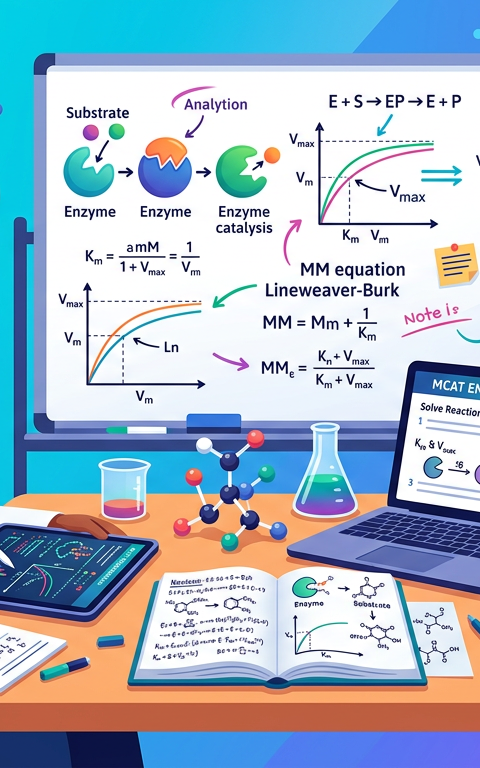
Enzymes are biological catalysts, typically proteins, that increase the rate of chemical reactions by lowering the activation energy without being consumed in the process. They function by stabilizing the transition state of a reaction within a specialized pocket known as the active site. The study of enzymes is fundamental for the MCAT because it bridges the gap between biological systems and chemical kinetics. Key concepts include the Michaelis-Menten model, which describes the relationship between reaction velocity and substrate concentration, and the various types of inhibition (competitive, non-competitive, uncompetitive, and mixed). Understanding these interactions is as crucial as mastering Medium MCAT Kinetics Practice Questions. Enzymes exhibit specificity, meaning they only catalyze particular reactions, a property often explained by the induced fit model where the enzyme undergoes a conformational change upon substrate binding to ensure a tight fit.
To quantify enzyme efficiency, we use the Michaelis-Menten equation:
In this equation, represents the maximum reaction velocity at saturating substrate concentrations, and (the Michaelis constant) represents the substrate concentration at which the reaction velocity is half of . A low indicates high affinity for the substrate. Additionally, the catalytic efficiency of an enzyme is defined by the ratio . For a more in-depth look at how these molecules interact with other organic species, you might also find Medium MCAT Organic Chemistry Practice Questions helpful in your preparation.
Solved Examples
- Calculating Vmax and Km from a Data Set: An enzyme-catalyzed reaction shows a velocity of 25 μmol/min at a substrate concentration of 5 mM. If the is known to be 50 μmol/min, what is the ?
- Start with the Michaelis-Menten equation: .
- Substitute the known values: .
- Simplify the numerator: .
- Multiply both sides by : .
- Divide by 25: .
- Solve for : .
- Determining Inhibition Type: In a Lineweaver-Burk plot, the control line and the inhibited line intersect on the y-axis but have different slopes. What type of inhibition is occurring?
- Identify what the y-intercept represents: The y-intercept is .
- Since they intersect on the y-axis, the remains unchanged.
- Identify what the x-intercept represents: The x-intercept is . Different slopes with the same y-intercept mean the x-intercepts must be different.
- Conclusion: Competitive inhibitors increase but do not change . Therefore, this is competitive inhibition.
- Calculating Catalytic Efficiency: An enzyme has a of and a of . Calculate the catalytic efficiency.
- Use the formula: .
- Plug in the values: .
- Perform the division: or .
Practice Questions
1. An enzyme follows Michaelis-Menten kinetics. If the substrate concentration is equal to 3 times the , what is the reaction velocity expressed as a fraction of ?
2. A researcher introduces a molecule that binds only to the enzyme-substrate (ES) complex. How will this affect the observed and on a Lineweaver-Burk plot?
3. Which of the following amino acids is most likely to be found in the active site of an enzyme that uses acid-base catalysis at physiological pH (7.4)?
- Aspartate
- Histidine
- Valine
- Leucine
Feel more confident on exam day.
Practice with realistic MCAT-style questions and strengthen your understanding before test day arrives.
Practice Free Now4. In a reaction where is 10 μM and the initial velocity is 40% of , what is the substrate concentration?
5. An uncompetitive inhibitor is added to an enzymatic reaction. What is the effect on the slope of the Lineweaver-Burk plot ()?
6. An enzyme catalyzes the conversion of substrate A to product B. If the Gibbs free energy () of the reaction is -15 kJ/mol, what is the effect of the enzyme on the equilibrium constant ()?
7. A sigmoidal curve on a plot of reaction velocity vs. substrate concentration is indicative of what enzyme property?
8. How does an increase in temperature typically affect the rate of an enzyme-catalyzed reaction before the point of denaturation?
9. A non-competitive inhibitor binds to an enzyme with the same affinity as it binds to the enzyme-substrate complex. How does this inhibitor affect the x-intercept of a Lineweaver-Burk plot?
10. Which class of enzymes is responsible for the movement of a functional group from one molecule to another, such as in the reaction catalyzed by hexokinase?
Answers & Explanations
- Answer: 0.75 Vmax. Using the Michaelis-Menten equation: .
- Answer: Both Vmax and Km decrease. Molecules that bind only to the ES complex are uncompetitive inhibitors. By removing ES, they shift the equilibrium (Le Chatelier's principle), appearing to increase affinity (lower ) and reducing the amount of functional enzyme available to reach .
- Answer: Histidine. Histidine has a pKa of approximately 6.0, which is close to physiological pH. This allows it to act as both a proton donor and acceptor, making it a common participant in acid-base catalysis. For more on functional group properties, check out Medium MCAT Functional Group Practice Questions.
- Answer: 6.67 μM. Set up the equation: . Divide by : . Then leads to , so , which gives .
- Answer: The slope remains unchanged. In uncompetitive inhibition, both and decrease by the same factor (). Since the slope of a Lineweaver-Burk plot is , the factors cancel out, resulting in a line parallel to the original.
- Answer: No effect. Enzymes lower the activation energy to speed up the rate of reaction but do not change the thermodynamics of the reaction. Therefore, , , and remain unchanged. This concept is explored in detail on Wikipedia's Enzyme Kinetics page.
- Answer: Cooperativity. Sigmoidal (S-shaped) kinetics indicate that the binding of a substrate to one active site affects the affinity of other active sites, a hallmark of allosteric enzymes.
- Answer: The rate increases. According to the Arrhenius Law, increasing temperature increases the kinetic energy of molecules, leading to more frequent and energetic collisions, thus increasing the reaction rate until the protein begins to denature.
- Answer: The x-intercept remains unchanged. In pure non-competitive inhibition, the inhibitor binds to E and ES with equal affinity. This reduces but leaves unchanged. Since the x-intercept is , it does not move.
- Answer: Transferases. Transferases catalyze the transfer of functional groups (like a phosphate group from ATP to glucose in the case of hexokinase) from one molecule to another.
1. Which of the following best describes the effect of a competitive inhibitor?
Frequently Asked Questions
What is the difference between a cofactor and a coenzyme?
Cofactors are non-protein molecules that assist enzymes, often categorized as inorganic ions like Mg2+. Coenzymes are a specific subset of cofactors that are organic molecules, such as NADH or vitamins.
How do enzymes affect the activation energy of a reaction?
Enzymes lower the activation energy by stabilizing the transition state. This reduces the energy barrier that reactants must overcome to become products, thereby increasing the reaction rate.
What does a low Km value indicate about an enzyme?
A low Km value indicates that the enzyme reaches half of its maximum velocity at a low substrate concentration. This signifies a high affinity between the enzyme and its substrate.
What is the main characteristic of a feedback inhibition loop?
Feedback inhibition occurs when the final product of a metabolic pathway acts as an inhibitor for an enzyme earlier in the pathway. This mechanism helps the cell maintain homeostasis by preventing the over-accumulation of products.
Why does pH affect enzyme activity?
Changes in pH can alter the ionization state of amino acid R-groups within the active site or the substrate itself. Extreme pH levels can disrupt ionic bonds and lead to the denaturation of the enzyme's tertiary structure.
Feel more confident on exam day.
Practice with realistic MCAT-style questions and strengthen your understanding before test day arrives.
Practice Free NowReviewed by
Michael Danquah, MS, PhD
Dr. Michael Danquah is a professor of pharmaceutical sciences and founder of several educational technology platforms focused on improving student learning and performance.
Enjoyed this article?
Share it with others who might find it helpful.
Related Articles
Hard MCAT Enzyme Practice Questions
Hard MCAT Enzyme Practice Questions
May 14, 2026

MCAT Enzyme Practice Questions with Answers
MCAT Enzyme Practice Questions with Answers
May 14, 2026

MCAT Enzyme Kinetics: Solving KM and Vmax Without a Calculator
Easy MCAT Enzyme Practice Questions
May 14, 2026

Applying Coulomb’s Law and Potential to MCAT Biological Systems
MCAT Electrostatics Practice Questions with Answers
May 14, 2026

Hard MCAT DNA Replication Practice Questions
Master high-level DNA replication concepts with these hard MCAT practice questions covering enzymes, directionality, and telomeres.
May 14, 2026

Medium MCAT DNA Replication Practice Questions
Medium MCAT DNA Replication Practice Questions
May 14, 2026

Easy MCAT DNA Replication Practice Questions
Master DNA replication with these easy MCAT practice questions. Learn about helicase, polymerase, and semi-conservative replication with detailed explanations.
May 14, 2026

MCAT DNA Replication Practice Questions with Answers
MCAT DNA Replication Practice Questions with Answers
May 14, 2026