Easy MCAT Physiology Practice Questions

Mastering Easy MCAT Physiology Practice Questions
Preparing for the Medical College Admission Test (MCAT) requires a deep understanding of how the human body maintains homeostasis through complex organ systems. Utilizing easy MCAT physiology practice questions is an essential first step in building the foundational knowledge needed to tackle the more complex passages found on the actual exam. By focusing on the core mechanics of the cardiovascular, respiratory, and renal systems, you can ensure that your basic science background is rock-solid before moving on to advanced clinical application scenarios.
Concept Explanation
Physiology is the branch of biology that deals with the normal functions of living organisms and their parts. In the context of the MCAT, physiology focuses on how organ systems integrate to maintain a stable internal environment, known as homeostasis. For example, the cardiovascular system works in tandem with the respiratory system to deliver oxygen to tissues while removing carbon dioxide. Key concepts include the mechanical action of the heart, the gas exchange occurring at the alveolar-capillary interface, and the filtration processes of the nephron. Mastering these basics is a prerequisite for understanding more specialized topics, such as those covered in MCAT endocrine system practice questions.
Solved Examples
Reviewing solved problems helps clarify the logic required to answer physiology questions correctly. Here are three examples demonstrating fundamental physiological principles.
- Example 1: Blood Flow Resistance
If the radius of an arteriole is reduced by half due to vasoconstriction, what happens to the resistance to blood flow, assuming all other factors remain constant?
- Identify the relevant formula: Poiseuille’s Law states that resistance is proportional to .
- Substitute the change: If the new radius .
- Calculate the factor: .
- Conclusion: The resistance increases by a factor of 16.
- Example 2: Oxygen Dissociation Curve
How does an increase in blood levels (hypercapnia) affect the hemoglobin-oxygen dissociation curve?
- Recall the Bohr Effect: Increased leads to increased concentration (lower pH).
- Determine the shift: High acidity and high decrease hemoglobin's affinity for oxygen.
- Analyze the graph: A decrease in affinity is represented by a rightward shift of the curve.
- Conclusion: The curve shifts to the right, facilitating oxygen unloading at the tissues.
- Example 3: Renal Filtration
Which pressure gradient is the primary driver of glomerular filtration in the kidney?
- Identify the forces: Glomerular capillary hydrostatic pressure, Bowman's space hydrostatic pressure, and oncotic pressures.
- Determine the dominant force: The blood pressure in the glomerular capillaries is significantly higher than the opposing pressures.
- Conclusion: Glomerular capillary hydrostatic pressure is the primary force pushing fluid into the nephron.
Practice Questions
Test your knowledge with these easy MCAT physiology practice questions covering various organ systems. For more comprehensive biology review, check out our MCAT biology practice questions.
- Which of the following valves prevents the backflow of blood from the aorta into the left ventricle?
- During inhalation, the diaphragm contracts and moves in which direction?
- In the nephron, where does the majority of nutrient reabsorption (such as glucose and amino acids) occur?
Need more MCAT practice questions?
Generate unlimited MCAT-style questions with instant explanations and adaptive practice powered by Bevinzey AI.
Generate Questions Free- Which type of muscle tissue is characterized by being multinucleated and under voluntary control?
- What is the primary function of bile salts in the digestive system?
- Which hormone, secreted by the posterior pituitary, increases water reabsorption in the collecting ducts?
- The "pacemaker" of the heart, which initiates the electrical impulse for contraction, is known as the:
- Which cell type in the stomach is responsible for secreting hydrochloric acid (HCl)?
- What is the primary site of gas exchange in the human lungs?
- Which of the following describes the state of the ventricles during diastole?
Answers & Explanations
- Aortic Semilunar Valve: This valve sits between the left ventricle and the aorta. It opens during systole to allow blood to exit and closes during diastole to prevent blood from flowing back into the heart.
- Downward: When the diaphragm contracts, it flattens and moves inferiorly (downward). This increases the volume of the thoracic cavity, decreasing pressure and allowing air to flow in.
- Proximal Convoluted Tubule (PCT): Nearly 100% of glucose and amino acids are reabsorbed in the PCT via secondary active transport.
- Skeletal Muscle: Unlike smooth or cardiac muscle, skeletal muscle is striated, multinucleated, and controlled by the somatic nervous system. Learn more about control systems in our MCAT nervous system practice questions.
- Emulsification of Fats: Bile salts are amphipathic molecules that break down large fat droplets into smaller micelles, increasing the surface area for lipase enzymes to work.
- Antidiuretic Hormone (ADH/Vasopressin): ADH increases the number of aquaporins in the collecting duct, allowing more water to be reabsorbed into the blood.
- Sinoatrial (SA) Node: Located in the right atrium, the SA node spontaneously depolarizes to set the heart rate.
- Parietal Cells: These cells use a proton pump ( ATPase) to secrete hydrogen ions into the stomach lumen.
- Alveoli: These tiny air sacs provide a massive surface area and a very thin membrane for the diffusion of and . For more on cellular structures, see MCAT cell biology practice questions.
- Relaxation and Filling: Diastole refers to the period when the heart muscle relaxes, allowing the chambers to fill with blood.
1. Which of the following is the correct path of electrical conduction in the heart?
Frequently Asked Questions
What is the difference between systole and diastole?
Systole is the phase of the cardiac cycle where the heart muscle contracts and pumps blood into the arteries. Diastole is the phase where the heart muscle relaxes and the chambers fill with blood.
How does the kidney regulate blood pressure?
The kidney regulates blood pressure through the Renin-Angiotensin-Aldosterone System (RAAS), which increases sodium and water retention. It also adjusts blood volume directly by altering the rate of water excretion in the urine.
What is the role of surfactant in the lungs?
Surfactant reduces the surface tension of the fluid lining the alveoli, preventing them from collapsing during exhalation. This significantly decreases the work required to breathe and keeps the small airways open.
How does the body transport carbon dioxide in the blood?
Most carbon dioxide is transported as bicarbonate ions () in the plasma, while smaller amounts are dissolved directly in the plasma or bound to hemoglobin as carbaminohemoglobin.
What is the function of the myelin sheath in the nervous system?
The myelin sheath acts as an electrical insulator that speeds up the conduction of nerve impulses through a process called saltatory conduction. It allows the action potential to "jump" between gaps known as Nodes of Ranvier.
Need more MCAT practice questions?
Generate unlimited MCAT-style questions with instant explanations and adaptive practice powered by Bevinzey AI.
Generate Questions FreeReviewed by
Michael Danquah, MS, PhD
Dr. Michael Danquah is a professor of pharmaceutical sciences and founder of several educational technology platforms focused on improving student learning and performance.
Enjoyed this article?
Share it with others who might find it helpful.
Related Articles

Applying Coulomb’s Law and Potential to MCAT Biological Systems
MCAT Electrostatics Practice Questions with Answers
May 14, 2026
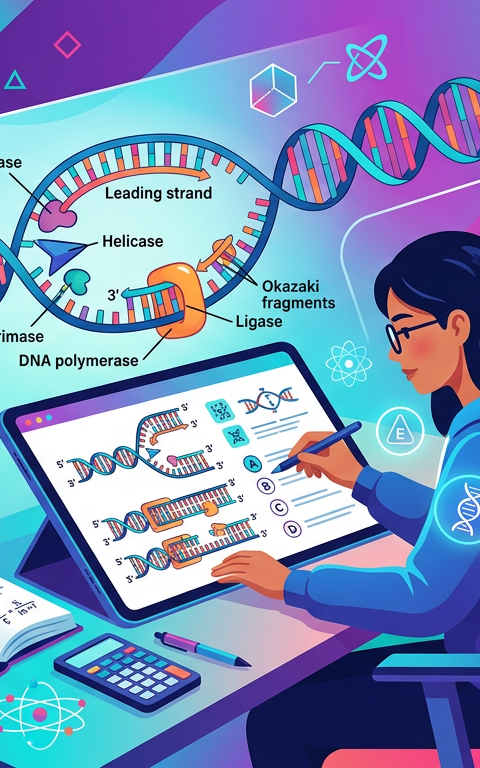
Hard MCAT DNA Replication Practice Questions
Master high-level DNA replication concepts with these hard MCAT practice questions covering enzymes, directionality, and telomeres.
May 14, 2026
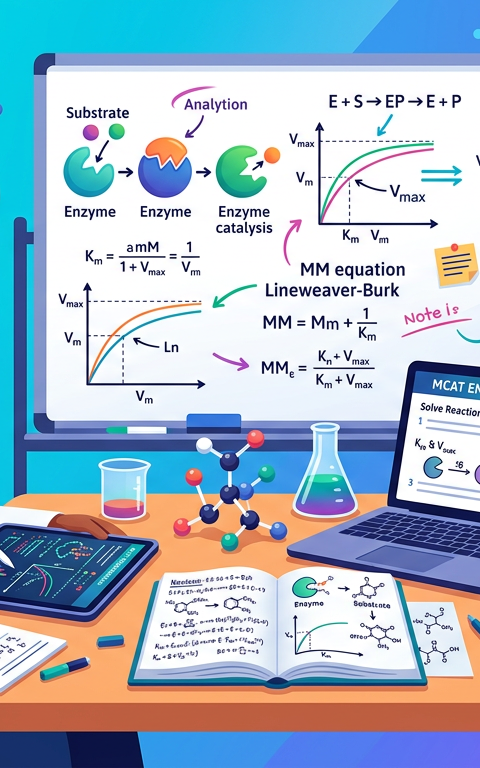
Hard MCAT Enzyme Practice Questions
Hard MCAT Enzyme Practice Questions
May 14, 2026

Medium MCAT DNA Replication Practice Questions
Medium MCAT DNA Replication Practice Questions
May 14, 2026

Medium MCAT Enzyme Practice Questions
Medium MCAT Enzyme Practice Questions
May 14, 2026

Easy MCAT DNA Replication Practice Questions
Master DNA replication with these easy MCAT practice questions. Learn about helicase, polymerase, and semi-conservative replication with detailed explanations.
May 14, 2026

MCAT Enzyme Kinetics: Solving KM and Vmax Without a Calculator
Easy MCAT Enzyme Practice Questions
May 14, 2026

MCAT DNA Replication Practice Questions with Answers
MCAT DNA Replication Practice Questions with Answers
May 14, 2026