MCAT Endocrine System Practice Questions with Answers
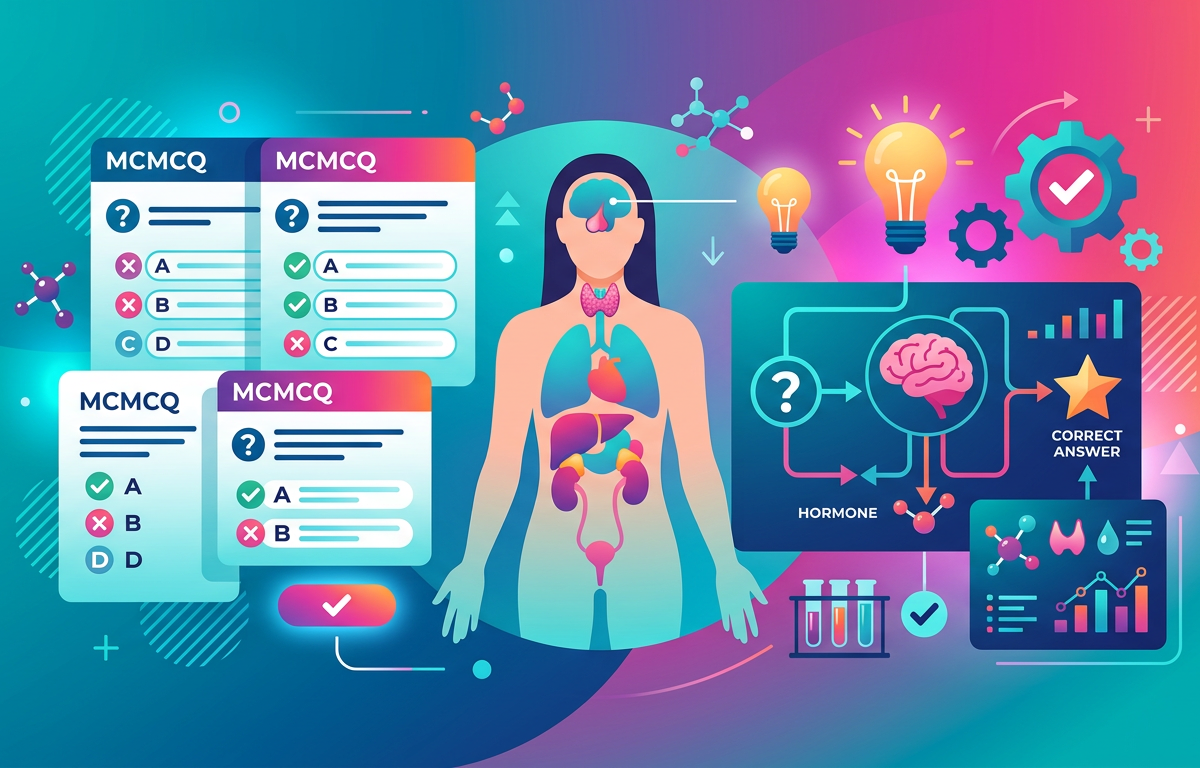
MCAT Endocrine System Practice Questions with Answers
Mastering the endocrine system is a vital step for any pre-medical student, as it serves as a central pillar for the Biology and Biochemistry section of the exam. The MCAT Endocrine System Practice Questions with Answers provided here will help you navigate the complex web of hormones, glands, and feedback loops that regulate human physiology. This guide combines conceptual clarity with rigorous practice to ensure you are prepared for the high-yield topics frequently tested by the AAMC.
Concept Explanation
The endocrine system is a network of glands that produce and secrete hormones, which act as chemical messengers to regulate diverse bodily functions such as metabolism, growth, and reproduction. Unlike the nervous system, which uses electrical impulses for rapid communication, the endocrine system releases hormones directly into the circulatory system to reach distant target organs. Hormones are generally classified into three chemical categories: peptides, steroids, and amino acid derivatives.
Peptide hormones, such as insulin and ADH, are water-soluble and bind to extracellular receptors, triggering a second messenger cascade (e.g., cAMP or ). Steroid hormones, like cortisol and testosterone, are lipid-derived from cholesterol. These are nonpolar, allowing them to cross the cell membrane and bind to intracellular or nuclear receptors, where they directly influence gene transcription. Amino acid-derived hormones, such as epinephrine and thyroxine, vary in their solubility and mechanism of action depending on their specific structure.
The system is primarily governed by the hypothalamus-pituitary axis. The hypothalamus acts as the bridge between the nervous and endocrine systems, controlling the anterior pituitary via releasing hormones (hypophyseal portal system) and the posterior pituitary via direct axonal projections. Negative feedback loops are the hallmark of endocrine regulation, where the final product of a pathway inhibits the release of hormones earlier in the sequence to maintain homeostasis. For students looking to optimize their learning, using retrieval practice for medical education can significantly enhance the retention of these complex hormonal pathways.
Solved Examples
To help you apply these concepts, here are three fully worked examples demonstrating the logic required for MCAT-style questions.
- Example 1: Hormone Mechanism
A researcher identifies a new hormone that is lipid-soluble and requires a carrier protein for transport in the blood. Is this hormone more likely to bind to a membrane-bound receptor or a nuclear receptor?
- Identify the solubility: The hormone is lipid-soluble (lipophilic).
- Recall hormone types: Steroid hormones are lipophilic and typically require carrier proteins in the aqueous environment of the blood.
- Determine the mechanism: Because it is lipophilic, it can diffuse through the phospholipid bilayer of the target cell.
- Conclusion: It will bind to an intracellular or nuclear receptor to modulate gene expression.
- Example 2: Calcium Regulation
If a patient presents with chronically low blood calcium levels (hypocalcemia), which hormone would you expect to be elevated in their blood work?
- Identify the physiological trigger: Low blood calcium.
- Recall the relevant glands: The parathyroid glands and the thyroid gland (C-cells) regulate calcium.
- Analyze hormone functions: Parathyroid hormone (PTH) increases blood calcium by stimulating osteoclasts and renal reabsorption. Calcitonin decreases blood calcium.
- Conclusion: PTH will be elevated as a compensatory mechanism to restore calcium levels.
- Example 3: Feedback Loops
A patient has a tumor in the anterior pituitary that hypersecretes Thyroid Stimulating Hormone (TSH). What would be the expected levels of TRH and Thyroid Hormone (T3/T4)?
- Identify the primary defect: High TSH from the pituitary.
- Determine downstream effects: High TSH stimulates the thyroid gland to produce high levels of T3 and T4.
- Analyze feedback: High T3 and T4 will travel to the hypothalamus and inhibit the release of Thyrotropin-releasing hormone (TRH).
- Conclusion: TRH will be low, and T3/T4 will be high.
Practice Questions
- Which of the following hormones is secreted by the posterior pituitary?
- A patient has extremely high levels of serum cortisol but low levels of ACTH. Which of the following is the most likely cause?
- Which hormone acts to increase blood glucose levels by stimulating glycogenolysis and gluconeogenesis in the liver?
Ready to boost your MCAT score?
Practice smarter with Bevinzey’s AI-powered MCAT quizzes, explanations, and personalized study tools.
Start MCAT Prep Free- Describe the solubility and mechanism of action for the hormone Aldosterone.
- During a period of prolonged fasting, which hormone is primarily responsible for maintaining blood glucose levels?
- Compare the effects of ADH (Vasopressin) and Aldosterone on blood osmolarity.
- A deficiency in dietary iodine would most likely lead to an increase in the secretion of which hormone?
- Which gland is responsible for the "fight or flight" response, and which hormones does it release for this purpose?
- Somatostatin is known to inhibit the secretion of which two pancreatic hormones?
- How does the mechanism of action of Epinephrine differ from that of Thyroxine (), despite both being amino acid derivatives?
Answers & Explanations
- Oxytocin and ADH: The posterior pituitary does not synthesize hormones; it stores and releases Oxytocin and Antidiuretic Hormone (ADH) produced in the hypothalamus.
- Adrenal Cortex Tumor: High cortisol levels normally inhibit ACTH via negative feedback. Since ACTH is low, the cortisol production is likely independent of the pituitary, pointing to a primary adrenal issue like a tumor.
- Glucagon: Produced by alpha cells of the pancreas, glucagon raises blood sugar levels during the post-absorptive state.
- Aldosterone: This is a steroid hormone (lipid-soluble). It diffuses into cells of the distal convoluted tubule and collecting duct to increase the expression of pumps, leading to sodium reabsorption and water following osmotically.
- Glucagon and Cortisol: While glucagon acts quickly, cortisol provides a sustained response to stress and fasting by promoting gluconeogenesis and lipid mobilization.
- Osmolarity Difference: ADH increases water reabsorption only, which decreases blood osmolarity. Aldosterone increases both sodium and water reabsorption, keeping blood osmolarity relatively unchanged.
- TSH (Thyroid Stimulating Hormone): Iodine is required to synthesize T3 and T4. Low iodine leads to low T3/T4, which removes the negative feedback on the pituitary, causing a massive increase in TSH (often resulting in a goiter).
- Adrenal Medulla: This gland releases the catecholamines Epinephrine and Norepinephrine directly into the bloodstream to trigger rapid physiological changes.
- Insulin and Glucagon: Somatostatin acts as a general inhibitory hormone in the pancreas, suppressing both alpha and beta cell activity.
- Receptor Location: Epinephrine is a catecholamine and acts like a peptide hormone (extracellular receptor, second messengers). Thyroxine acts like a steroid hormone (intracellular receptor, gene transcription).
To master these distinctions, many students find that retrieval practice for STEM subjects is more effective than passive reading. By forcing your brain to recall the differences between peptide and steroid mechanisms, you build stronger neural pathways for exam day.
1. Which of the following is a characteristic of steroid hormones?
Frequently Asked Questions
What is the difference between direct and tropic hormones?
Direct hormones act immediately on target tissues to cause a physiological change, whereas tropic hormones act on other endocrine glands to stimulate the release of further hormones. For example, GH is a direct hormone, while TSH is a tropic hormone because it targets the thyroid gland.
How do peptide hormones initiate a cellular response?
Peptide hormones are polar and cannot cross the plasma membrane, so they bind to extracellular receptors to activate a signaling cascade. This typically involves a G-protein coupled receptor and a second messenger like cyclic AMP (cAMP) that amplifies the signal within the cell.
Why does the MCAT focus so much on the hypothalamus?
The hypothalamus is the master regulator of the endocrine system, coordinating signals from the brain to control most other glands. Understanding its role is essential for grasping how the body maintains balance in response to external and internal environmental changes.
What are the three classes of hormones based on chemical structure?
The three classes are peptides (chains of amino acids), steroids (derived from cholesterol), and amino acid derivatives (modified single amino acids). Each class has distinct properties regarding solubility, transport, and receptor binding that are frequently tested on the MCAT.
How can I best study the endocrine system for the MCAT?
The most effective way to study is through active recall and retrieval practice vs practice tests. Instead of just reading a list of hormones, draw out the feedback loops and try to predict the physiological outcome of a hormone deficiency or excess.
For more in-depth reviews of biological systems, you can visit resources like Khan Academy's MCAT Organ Systems or refer to the AAMC official content guidelines.
Ready to boost your MCAT score?
Practice smarter with Bevinzey’s AI-powered MCAT quizzes, explanations, and personalized study tools.
Start MCAT Prep FreeReviewed by
Michael Danquah, MS, PhD
Dr. Michael Danquah is a professor of pharmaceutical sciences and founder of several educational technology platforms focused on improving student learning and performance.
Enjoyed this article?
Share it with others who might find it helpful.
Related Articles
Hard MCAT Endocrine System Practice Questions
Hard MCAT Endocrine System Practice Questions
May 9, 2026

Hard MCAT Immune System Practice Questions
Master the complexities of the immune system with these hard MCAT practice questions covering MHC restriction, clonal selection, and the complement system.
May 9, 2026

Hard MCAT Philosophy Passage Practice Questions
Master Hard MCAT Philosophy Passage Practice Questions with our comprehensive guide featuring solved examples, practice questions, and expert explanations.
May 17, 2026

Hard MCAT Humanities Passage Practice Questions
Master Hard MCAT Humanities Passage Practice Questions with our comprehensive guide featuring solved examples, practice questions, and expert strategies.
May 17, 2026

Hard MCAT Critical Analysis Practice Questions
Hard MCAT Critical Analysis Practice Questions
May 17, 2026

Hard MCAT Reading Comprehension Practice Questions
Hard MCAT Reading Comprehension Practice Questions
May 17, 2026

Hard MCAT CARS Passage Practice Questions
Master high-difficulty MCAT CARS passages with our expert guide featuring solved examples, practice questions, and detailed logical analysis.
May 17, 2026

Hard MCAT CARS Practice Questions
Master Hard MCAT CARS Practice Questions with our comprehensive guide featuring solved examples, practice passages, and expert reasoning strategies.
May 17, 2026