Easy Heat of Reaction Practice Questions
Concept Explanation
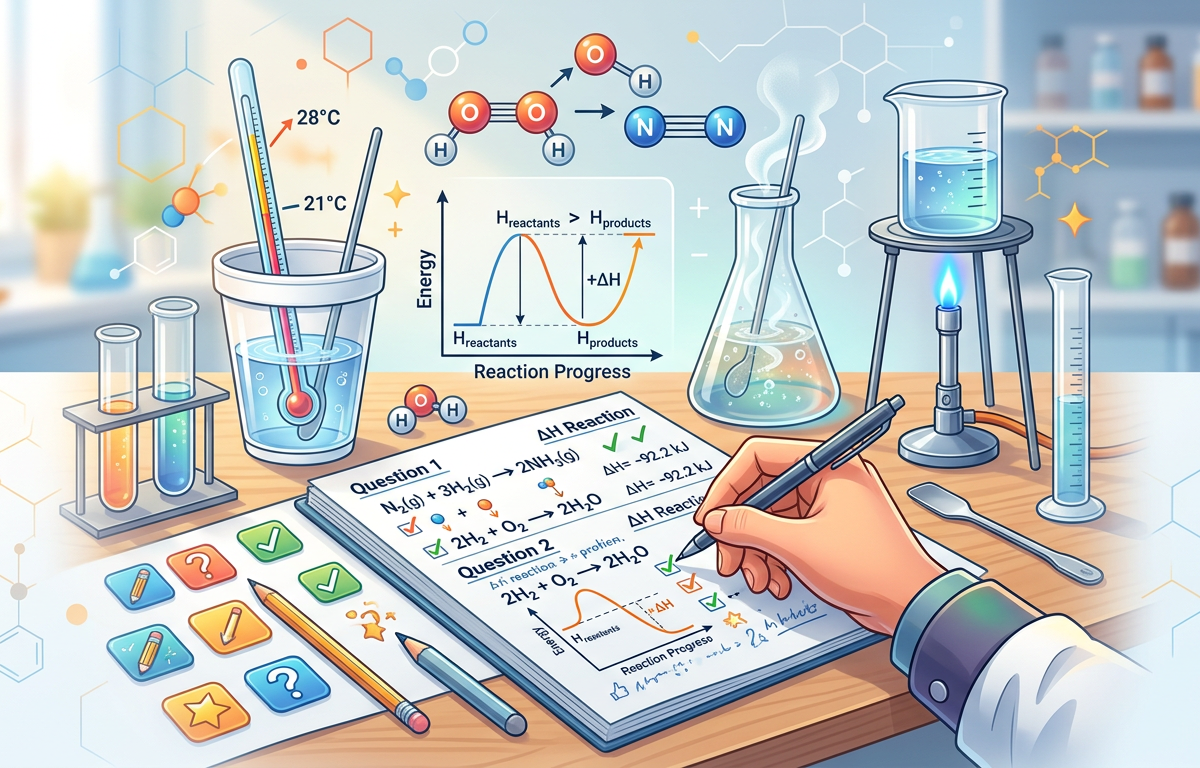
The heat of reaction, also known as enthalpy of reaction (ΔH), is the amount of energy released or absorbed during a chemical process at constant pressure. This fundamental concept in thermodynamics tells us whether a reaction is exothermic (releasing heat to the surroundings) or endothermic (absorbing heat from the surroundings). When a reaction releases energy, the enthalpy change is negative (ΔH < 0), and the temperature of the environment typically rises. Conversely, endothermic reactions have a positive enthalpy change (ΔH > 0), drawing energy inward and cooling the surroundings. Understanding heat of reaction is essential for predicting how much fuel is needed for industrial processes or how much energy is stored in chemical bonds. You can explore more about energy storage in our guide on Bond Energy Practice Questions with Answers. According to the Laws of Thermodynamics, energy cannot be created or destroyed, only transformed, which is why we track these heat transfers so precisely in chemistry.
Solved Examples
Review these step-by-step solutions to understand how to calculate and interpret the heat of reaction in basic scenarios.
Example 1: Identifying Exothermic vs. Endothermic
A reaction has a ΔH value of -484 kJ/mol. Is this reaction exothermic or endothermic, and is heat being released or absorbed?Observe the sign of the enthalpy change (ΔH).
Since ΔH is negative (-484 kJ/mol), the reaction is exothermic.
In an exothermic reaction, heat is released into the surroundings.
Example 2: Calculating Heat from Moles
The combustion of methane is represented by: CH₄ + 2O₂ → CO₂ + 2H₂O (ΔH = -890 kJ/mol). How much heat is released when 2 moles of methane are burned?Identify the molar ratio from the equation (1 mole of CH₄ releases 890 kJ).
Multiply the given amount (2 moles) by the heat of reaction per mole.
Calculation: 2 mol × (-890 kJ/mol) = -1780 kJ.
The reaction releases 1780 kJ of heat.
Example 3: Reversing a Thermochemical Equation
If the formation of water from its elements (H₂ + ½O₂ → H₂O) has a ΔH of -286 kJ/mol, what is the ΔH for the decomposition of water (H₂O → H₂ + ½O₂)?Recognize that the decomposition is the exact reverse of the formation reaction.
Apply the rule that reversing a reaction changes the sign of ΔH.
Result: ΔH = +286 kJ/mol (Endothermic).
Practice Questions
Test your knowledge with these easy heat of reaction practice questions. Use the concepts of enthalpy and stoichiometry to find the answers.
A chemical reaction absorbs 150 kJ of energy from its surroundings. What is the ΔH for this reaction?
Classify the following process as exothermic or endothermic: C(s) + O₂(g) → CO₂(g) + 393.5 kJ.
In a laboratory experiment, a student notices that the beaker becomes very cold to the touch during a reaction. Is the ΔH of this reaction positive or negative?
Want unlimited practice questions like these?
Generate AI-powered questions with step-by-step solutions on any topic.
Try Question Generator Free →The thermochemical equation for the production of ammonia is: N₂(g) + 3H₂(g) → 2NH₃(g) ΔH = -92.2 kJ. How much heat is released when only 1 mole of NH₃ is produced?
If a reaction has a ΔH of +50 kJ, is the energy of the products higher or lower than the energy of the reactants?
Consider the reaction: 2H₂(g) + O₂(g) → 2H₂O(l) ΔH = -572 kJ. Calculate the heat released when 4 moles of H₂ react completely with oxygen.
True or False: In an endothermic reaction, the enthalpy of the system increases.
A reaction releases 250 J of heat. Convert this value to kJ and state the ΔH.
If 0.5 moles of a substance react and release 100 kJ of heat, what is the molar heat of reaction (ΔH per mole)?
Which state of matter change is always exothermic: Melting or Freezing?
Answers & Explanations
Answer: +150 kJ. Because the reaction absorbs energy, it is endothermic, and the sign for ΔH must be positive.
Answer: Exothermic. In this notation, the energy (393.5 kJ) is written on the product side, meaning it is released during the reaction.
Answer: Positive. A cold beaker indicates an endothermic reaction where the system takes heat from the surroundings (including your hand), leading to a positive ΔH. For more on how temperature changes relate to heat, see our Calorimetry Practice Questions with Answers.
Answer: 46.1 kJ. The equation shows -92.2 kJ for every 2 moles of NH₃ produced. To find the heat for 1 mole, divide by 2: 92.2 / 2 = 46.1 kJ.
Answer: Higher. In an endothermic reaction (positive ΔH), the system absorbs energy, meaning the products have more stored chemical energy than the reactants.
Answer: 1144 kJ. The balanced equation shows that 2 moles of H₂ release 572 kJ. Therefore, 4 moles (which is double the amount) will release 572 × 2 = 1144 kJ.
Answer: True. Endothermic reactions absorb heat, which increases the total enthalpy (H) of the system.
Answer: -0.25 kJ. First, convert Joules to kilojoules (250 / 1000 = 0.25). Since heat is released, the ΔH is negative.
Answer: -200 kJ/mol. If 0.5 moles release 100 kJ, then 1 mole would release 200 kJ (100 / 0.5 = 200). Since it is released, ΔH = -200 kJ/mol.
Answer: Freezing. Freezing involves a substance losing kinetic energy to transition from liquid to solid, making it an exothermic process. Melting is endothermic. You can find more complex multi-step calculations in our Hess’s Law Practice Questions.
1. Which of the following describes an exothermic reaction?
Frequently Asked Questions
What is the difference between ΔH and q?
While both represent heat, q is the heat transferred under any conditions, whereas ΔH (enthalpy change) specifically refers to the heat exchanged at constant pressure. In most introductory chemistry lab settings, these values are treated as equivalent.
Why is the heat of reaction important in real life?
Engineers use these values to design safe chemical reactors and determine the efficiency of fuels like gasoline or hydrogen. According to NASA, calculating the heat of reaction for rocket propellants is critical for determining how much thrust a vehicle can generate.
Can the heat of reaction be measured directly?
Yes, it is typically measured using a device called a calorimeter, which captures the temperature change of a surrounding medium (like water) to calculate energy transfer. For more details on this technique, check out resources from the American Chemical Society.
Does the physical state of reactants matter for ΔH?
The state of matter (solid, liquid, or gas) significantly affects the heat of reaction because energy is required or released during phase changes. For example, burning liquid ethanol releases a different amount of heat than burning gaseous ethanol.
What is a standard heat of reaction?
A standard heat of reaction is the enthalpy change measured when all reactants and products are in their standard states at 1 bar of pressure and a specified temperature, usually 25°C. This allows scientists to compare different reactions under a consistent set of rules.
Want unlimited practice questions like these?
Generate AI-powered questions with step-by-step solutions on any topic.
Try Question Generator Free →
Want unlimited practice questions like these?
Generate AI-powered questions with step-by-step solutions on any topic.
Try Question Generator Free →Enjoyed this article?
Share it with others who might find it helpful.
Related Articles
Hard Le Chatelier’s Principle Practice Questions
Master Hard Le Chatelier’s Principle Practice Questions with our comprehensive guide featuring solved examples, practice problems, and detailed explanations.
Mar 30, 2026

Hard Reaction Quotient (Q) Practice Questions
Hard Reaction Quotient (Q) Practice Questions
Mar 30, 2026
Grams to Moles Practice Questions with Answers
Master grams to moles conversions with our comprehensive guide. Includes step-by-step examples, practice questions, and detailed answers for chemistry students.
Mar 26, 2026
Avogadro’s Number Practice Questions with Answers
Master the mole concept with our Avogadro’s Number practice questions. Includes step-by-step solved examples, a quick quiz, and detailed explanations.
Mar 26, 2026

Empirical Formulas: Solving Ratios from Mass and Percent Data
Master empirical formula calculations with 10 practice questions, worked answers, and a free step-by-step calculator for mass, percentage, and combustion problems.
Mar 26, 2026