Calculating Enthalpy Changes Using Bond Enthalpy Data
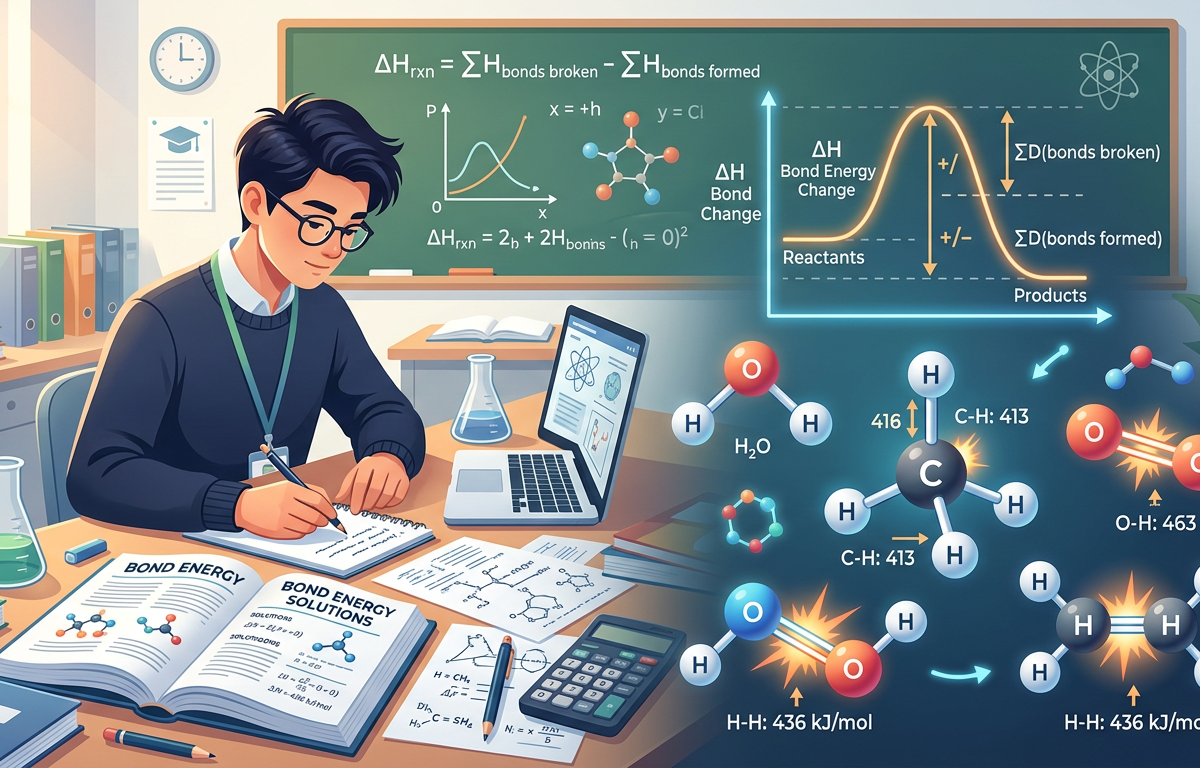
When you calculate the enthalpy of a reaction using heats of formation, you subtract the energy of the reactants from the products. However, when switching to bond energies, students often trip up because the logic flips entirely. Because breaking bonds requires an input of energy while forming them releases it, you must subtract the energy of the products from the reactants. Forgetting this reversal is the most common reason for getting the right numerical value with the wrong mathematical sign.
Think of it as a chemical bank account. You spend energy to snap the H-H and O=O bonds in hydrogen and oxygen gas. You then get a payout when the new O-H bonds in water vapor form. If the energy payout from forming bonds is greater than the cost of breaking them, the reaction is exothermic and your ΔH will be negative. This article provides targeted practice for these gaseous phase calculations, focusing on identifying every individual bond within a molecule so no energy value is left out of your final summation.
The Mechanics of Bond Enthalpy
Bond energy, also known as bond enthalpy, is the amount of energy required to break one mole of a specific chemical bond in the gas phase. It is a direct measure of the strength of a chemical bond; higher bond energy values indicate stronger, more stable bonds. In chemical reactions, energy is absorbed to break existing bonds (an endothermic process) and released when new bonds form (an exothermic process). Scientists utilize average bond energies, typically measured in kilojoules per mole (kJ/mol), to estimate the overall enthalpy change (ΔH) of a reaction. According to Wikipedia's entry on bond-dissociation energy, these values are specific to the gaseous state to avoid interference from intermolecular forces found in liquids or solids.
To calculate the enthalpy of a reaction using bond energies, you use the following formula:
ΔHrxn = Σ(Bond Energies of Reactants) - Σ(Bond Energies of Products)
This "reactants minus products" approach is unique to bond energy calculations and differs from the "products minus reactants" approach used with heats of formation. Understanding this concept is as fundamental to chemistry as mastering pH calculation practice questions is to acid-base theory. Key factors influencing bond energy include bond order (triple bonds are stronger than double or single bonds) and atomic radius (smaller atoms generally form stronger bonds due to better orbital overlap).
Solved Examples
These examples demonstrate how to apply bond energy values to determine if a reaction is exothermic or endothermic.
Example 1: Combustion of Hydrogen
Calculate the enthalpy change for the reaction: 2H₂(g) + O₂(g) → 2H₂O(g).
Bond energies: H-H = 436 kJ/mol; O=O = 495 kJ/mol; O-H = 463 kJ/mol.
Identify bonds broken (reactants): 2 moles of H-H and 1 mole of O=O.
Calculate energy absorbed: (2 × 436) + (1 × 495) = 872 + 495 = 1367 kJ.
Identify bonds formed (products): 2 moles of H₂O contains 4 moles of O-H bonds.
Calculate energy released: 4 × 463 = 1852 kJ.
Apply formula: ΔH = 1367 - 1852 = -485 kJ. The reaction is exothermic.
Example 2: Formation of Hydrogen Chloride
Determine ΔH for: H₂(g) + Cl₂(g) → 2HCl(g).
Bond energies: H-H = 436 kJ/mol; Cl-Cl = 242 kJ/mol; H-Cl = 431 kJ/mol.
Bonds broken: 1 H-H (436 kJ) and 1 Cl-Cl (242 kJ). Total = 678 kJ.
Bonds formed: 2 H-Cl (2 × 431 kJ) = 862 kJ.
ΔH = 678 - 862 = -184 kJ.
Example 3: Decomposition of Ammonia
Calculate ΔH for the reaction: 2NH₃(g) → N₂(g) + 3H₂(g).
Bond energies: N-H = 391 kJ/mol; N≡N = 941 kJ/mol; H-H = 436 kJ/mol.
Bonds broken: 2 moles of NH₃ have 6 N-H bonds. 6 × 391 = 2346 kJ.
Bonds formed: 1 N≡N (941 kJ) and 3 H-H (3 × 436 = 1308 kJ). Total = 2249 kJ.
ΔH = 2346 - 2249 = +97 kJ. This is an endothermic reaction.
Practice Questions
Use the following average bond energies (kJ/mol) for these questions: C-H: 413, C-C: 348, C=C: 614, O=O: 495, C=O: 799, O-H: 463, H-H: 436, Cl-Cl: 242, C-Cl: 328.
Calculate the enthalpy change for the chlorination of methane: CH₄(g) + Cl₂(g) → CH₃Cl(g) + HCl(g). (Bond energy H-Cl = 431 kJ/mol).
Estimate the energy released during the combustion of 1 mole of methane (CH₄ + 2O₂ → CO₂ + 2H₂O).
Determine ΔH for the hydrogenation of ethene: C₂H₄(g) + H₂(g) → C₂H₆(g).
Want unlimited practice questions like these?
Generate AI-powered questions with step-by-step solutions on any topic.
Try Question Generator Free →Compare the energy required to break the bonds in 1 mole of CO₂ versus 1 mole of O₂. Which is more stable?
Calculate ΔH for the reaction: 2C₂H₆(g) + 7O₂(g) → 4CO₂(g) + 6H₂O(g).
A reaction has a ΔH of -150 kJ. If the bonds broken require 500 kJ, how much energy is released when the new bonds form?
Why is the combustion of hydrocarbons consistently exothermic in terms of bond energies?
Calculate the enthalpy change for the formation of hydrazine: N₂(g) + 2H₂(g) → N₂H₄(g). (N-N = 163 kJ/mol, N-H = 391 kJ/mol, N≡N = 941 kJ/mol).
Determine the C=O bond energy if the combustion of formaldehyde (CH₂O + O₂ → CO₂ + H₂O) has a ΔH of -520 kJ/mol. (Use standard values for others).
Explain how active recall can help you remember the difference between bond dissociation energy and lattice energy.
Answers & Explanations
Answer: -104 kJ. Bonds broken: 1 C-H (413) + 1 Cl-Cl (242) = 655 kJ. Bonds formed: 1 C-Cl (328) + 1 H-Cl (431) = 759 kJ. ΔH = 655 - 759 = -104 kJ.
Answer: -808 kJ. Broken: 4 C-H (1652) + 2 O=O (990) = 2642 kJ. Formed: 2 C=O (1598) + 4 O-H (1852) = 3450 kJ. ΔH = 2642 - 3450 = -808 kJ.
Answer: -124 kJ. Broken: 1 C=C (614) + 1 H-H (436) = 1050 kJ. Formed: 1 C-C (348) + 2 C-H (826) = 1174 kJ. ΔH = 1050 - 1174 = -124 kJ.
Answer: CO₂ is more stable. Breaking CO₂ requires 2 × 799 = 1598 kJ. Breaking O₂ requires 495 kJ. Higher energy requirement indicates higher stability.
Answer: -2830 kJ. Reactants: [2 × (1 C-C + 6 C-H)] + [7 × O=O] = [2 × (348 + 2478)] + 3465 = 5652 + 3465 = 9117 kJ. Products: [4 × 2 C=O] + [6 × 2 O-H] = [8 × 799] + [12 × 463] = 6392 + 5556 = 11948 kJ. ΔH = 9117 - 11948 = -2831 kJ.
Answer: 650 kJ. ΔH = Bonds Broken - Bonds Formed. -150 = 500 - X; X = 650 kJ.
Answer: The energy released by forming strong C=O and O-H bonds in the products is significantly greater than the energy required to break C-H, C-C, and O=O bonds.
Answer: +95 kJ. Broken: 1 N≡N (941) + 2 H-H (872) = 1813 kJ. Formed: 1 N-N (163) + 4 N-H (1564) = 1727 kJ. ΔH = 1813 - 1727 = 86 kJ (Note: small variations exist based on source tables).
Answer: ~700-800 kJ/mol. This requires algebraic rearrangement of the ΔH formula to solve for the unknown C=O bond in the reactant.
Answer: Active recall forces the brain to retrieve the specific definition that bond energy applies to covalent gaseous molecules, whereas lattice energy applies to ionic solids, as noted in resources like LibreTexts Chemistry.
1. Which process is always endothermic?
Frequently Asked Questions
What is the difference between bond energy and bond enthalpy?
While often used interchangeably, bond energy usually refers to the average energy of a bond across various molecules, whereas bond enthalpy specifically refers to the enthalpy change at constant pressure. Both quantify the strength of chemical bonds in the gas phase.
Why are average bond energies sometimes inaccurate?
Average bond energies are calculated by taking the mean of a specific bond type across many different molecules. Because the actual strength of a bond is influenced by neighboring atoms in a specific molecule, the average value is only an estimate for any single reaction.
How does bond length relate to bond energy?
There is an inverse relationship between bond length and bond energy. Shorter bonds, such as triple bonds, generally have higher bond energies because the nuclei are closer to the shared electrons, creating a stronger electrostatic pull.
Can bond energy be used for ionic compounds?
No, bond energy is a concept specifically designed for covalent bonds in discrete molecules. For ionic compounds, scientists use lattice energy to describe the strength of the electrostatic forces holding the crystal lattice together.
Is breaking bonds always endothermic?
Yes, breaking a chemical bond always requires an input of energy to overcome the attractive forces between the atoms. This is why the "bonds broken" part of the enthalpy equation is always a positive value in terms of energy consumption.
Does temperature affect bond energy values?
Standard bond energies are typically reported at 298 K. While bond strengths can vary slightly with significant temperature changes, they are generally treated as constants for most introductory and intermediate thermochemistry calculations.
Want unlimited practice questions like these?
Generate AI-powered questions with step-by-step solutions on any topic.
Try Question Generator Free →
Want unlimited practice questions like these?
Generate AI-powered questions with step-by-step solutions on any topic.
Try Question Generator Free →Enjoyed this article?
Share it with others who might find it helpful.
Related Articles

Calculating High-Stakes Meds: BSA Mosteller Formula Practice
Master hard body surface area-based dosage calculations with our comprehensive guide, solved examples, and practice questions for healthcare students.
May 17, 2026
Calculating Kc: Mastering the Ratio of Equilibrium Concentrations
Master the Equilibrium Constant (Kc) with our comprehensive guide featuring solved examples, practice questions, and detailed explanations for chemistry students.
Mar 30, 2026
Calculating Enthalpy Changes: Hess’s Law Puzzle Solving Guide
Master Hess’s Law with our comprehensive guide featuring solved examples, step-by-step practice questions, and detailed answers for chemistry students.
Mar 29, 2026

Stoichiometry of the Flask: Calculating Solute Mass and Dilutions
Master solution preparation with these easy practice questions. Learn to calculate molarity, mass, and dilutions with step-by-step examples and a quick quiz.
Mar 27, 2026

Calculating Mass Ratios: Percent Composition Mastery and Problems
Master percentage composition with our comprehensive guide featuring step-by-step solved examples, practice questions, and a quick quiz to test your knowledge.
Mar 26, 2026

Empirical Formulas: Solving Ratios from Mass and Percent Data
Master empirical formula calculations with 10 practice questions, worked answers, and a free step-by-step calculator for mass, percentage, and combustion problems.
Mar 26, 2026
Scaling Up: Using Molar Mass to Predict Lab Quantities
Learn how to convert moles to grams with our comprehensive guide, featuring step-by-step solved examples and 10 practice questions with detailed answers.
Mar 26, 2026
Closing the Efficiency Gap: Calculating Percent Yield in Chemistry
Learn the difference between theoretical and actual yield with our comprehensive guide. Includes formulas, solved examples, and 10 practice questions with answers.
Mar 21, 2026