Calorimetry Practice Questions with Answers
Concept Explanation
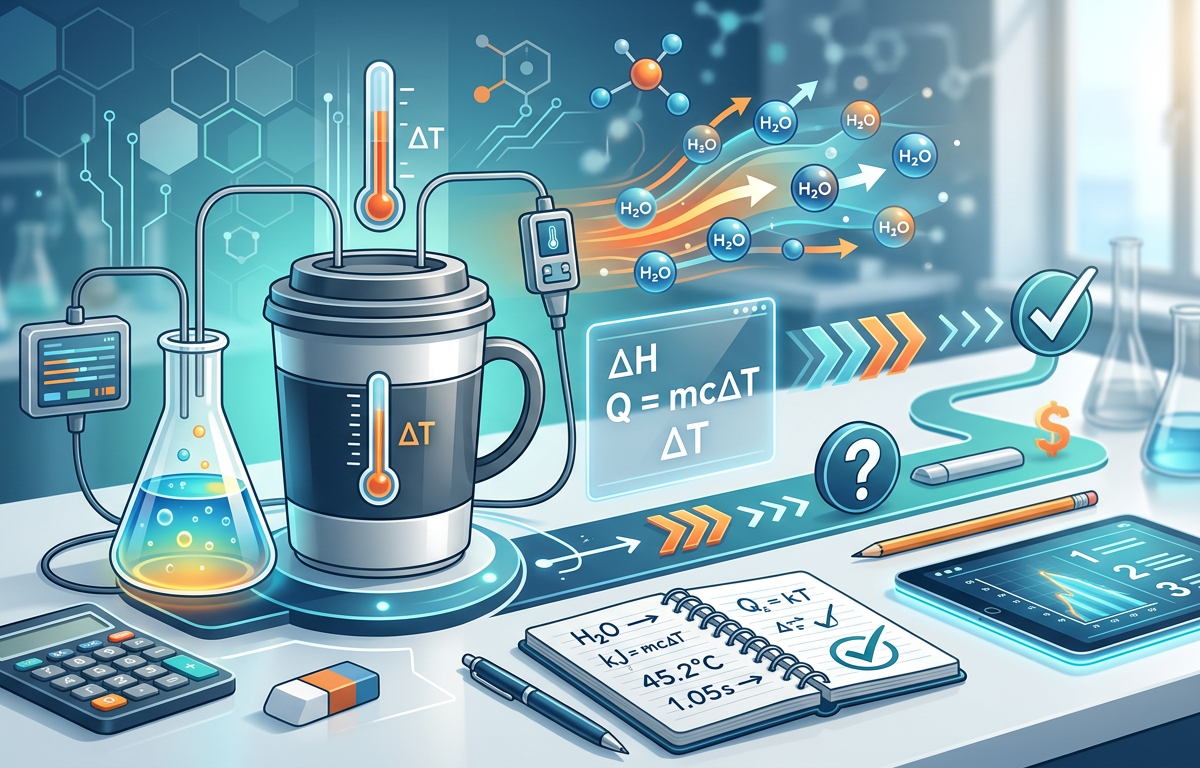
Calorimetry is the experimental measurement of heat exchange during chemical reactions or physical changes, governed by the principle of conservation of energy. In an isolated system, the heat lost by a substance is equal to the heat gained by another substance until thermal equilibrium is reached. This process relies on specific heat capacity ($c$), which is the amount of energy required to raise the temperature of one gram of a substance by one degree Celsius.
The fundamental equation used in calorimetry calculations is:
Where:
$q$ is the heat energy transferred (in Joules, J).
$m$ is the mass of the substance (in grams, g).
$c$ is the specific heat capacity ().
$ΔT$ is the change in temperature ().
When performing these calculations, it is vital to distinguish between constant-pressure calorimetry (often performed in a coffee-cup calorimeter) and constant-volume calorimetry (using a bomb calorimeter). In aqueous solutions, we often assume the density and specific heat are identical to those of pure water ($1.00 g/mL$ and $4.184 J/g°C$). Understanding these concepts is as fundamental to chemistry as mastering pH calculations or solution preparation.
Solved Examples
Follow these step-by-step solutions to understand how to apply calorimetry formulas to real-world problems.
Example 1: Calculating Heat Absorbed
How much heat is required to raise the temperature of 250.0 g of water from 20.0°C to 80.0°C? (Specific heat of water = $4.184 J/g°C$)
Identify the known values: , , , .
Calculate $ΔT$: $80.0 - 20.0 = 60.0°C$.
Apply the formula: .
Solve: or $62.76 kJ$.
Example 2: Finding Specific Heat Capacity
A 50.0 g piece of an unknown metal at 100.0°C is placed in 100.0 g of water at 22.0°C. The final temperature of the system is 28.5°C. What is the specific heat of the metal?
Calculate heat gained by water: .
Use the principle : The metal lost 2,719.6 J, so .
Calculate $ΔT$ for the metal: $28.5 - 100.0 = -71.5°C$.
Rearrange the formula for $c$: .
Solve: .
Example 3: Enthalpy of Reaction
When 50.0 mL of 1.0 M HCl is mixed with 50.0 mL of 1.0 M NaOH in a calorimeter, the temperature rises from 21.0°C to 27.5°C. Calculate the enthalpy change ($ΔH$) in kJ/mol. (Assume density = 1.0 g/mL and )
Find total mass of solution: $50.0 mL + 50.0 mL = 100.0 g$.
Calculate heat produced: .
Find moles of reactant: .
Calculate $ΔH$: .
Practice Questions
Test your knowledge with these calorimetry practice questions. These range from basic heat calculations to complex thermal equilibrium problems.
1. A 15.75 g piece of iron absorbs 1086.75 J of heat, and its temperature changes from 25°C to 175°C. Calculate the specific heat capacity of iron.
2. How much energy is needed to heat 45.0 g of copper () from 25.0°C to 75.0°C?
3. If 200.0 g of water at 20.0°C is mixed with 150.0 g of water at 80.0°C, what is the final temperature of the mixture?
Want unlimited practice questions like these?
Generate AI-powered questions with step-by-step solutions on any topic.
Try Question Generator Free →4. A 0.500 g sample of naphthalene () is burned in a bomb calorimeter. The temperature of the 1.50 kg of water in the calorimeter rises from 24.2°C to 27.3°C. If the heat capacity of the calorimeter is $850 J/°C$, calculate the heat of combustion of naphthalene in kJ/mol.
5. A 30.0 g sample of a metal at 95.0°C is dropped into 50.0 g of water at 22.0°C. The final temperature is 27.2°C. Identify the metal by calculating its specific heat. (Refer to Wikipedia's table of specific heat capacities for reference).
6. How much heat is released when 10.0 g of steam at 100.0°C condenses to liquid water at 100.0°C? (Heat of vaporization )
7. A student mixes 100.0 mL of 0.50 M HCl with 100.0 mL of 0.50 M KOH. Both solutions are initially at 22.5°C. After mixing, the temperature rises to 25.9°C. Calculate the molar enthalpy of neutralization.
8. A 25.0 g bolt made of an alloy is heated to 90.0°C and placed in a calorimeter containing 100.0 g of water at 20.0°C. The final temperature is 21.8°C. What is the specific heat of the alloy?
9. What is the final temperature when 10.0 g of ice at 0°C is added to 50.0 g of water at 40.0°C? (Heat of fusion )
10. An experimenter uses a bomb calorimeter with a heat capacity of $10.5 kJ/°C$. The combustion of a 1.20 g sample of sugar causes a temperature rise of 1.85°C. Calculate the energy value of the sugar in kJ/g.
Answers & Explanations
$0.46 J/g°C$. Use . . .
$866.25 J$. Use .
$45.7°C$. . Solve for : $150T_f - 12000 = -200T_f + 4000 → 350T_f = 16000 → T_f = 45.7°C$.
. . . Total . Moles of naphthalene ($128.17 g/mol$) = $0.500 / 128.17 = 0.0039 mol$. (adjusted for sig figs).
$0.53 J/g°C$. . .
$-22.6 kJ$. Moles of water = $10.0 g / 18.02 g/mol = 0.555 mol$. . Since it is condensation, heat is released (negative).
. Total mass = 200 g. . Moles = $0.1 L · 0.5 M = 0.05 mol$. .
$0.44 J/g°C$. . .
$19.7°C$. Heat to melt ice: $10.0 · 334 = 3340 J$. Remaining heat in water: . Heat left for warming: $8368 - 3340 = 5028 J$. Total mass = 60 g. . Final .
$16.2 kJ/g$. . Energy per gram = $19.425 / 1.20 = 16.19 kJ/g$.
1. Which variable in the equation $q = mcΔT$ represents the specific heat capacity?
Frequently Asked Questions
What is the difference between heat capacity and specific heat capacity?
Heat capacity is the amount of heat required to raise the temperature of an entire object by 1°C, while specific heat capacity is the heat required per unit mass (usually 1 gram). Specific heat is an intensive property of the material, whereas heat capacity depends on the size of the sample.
Why is water commonly used in calorimetry?
Water is used because it has a very high specific heat capacity, meaning it can absorb or release large amounts of heat with relatively small changes in temperature. Additionally, it is inexpensive, non-toxic, and its properties are well-documented in scientific literature like NIST databases.
Does calorimetry measure temperature or heat?
Calorimetry measures the change in temperature to calculate the transfer of heat energy. While the thermometer reads temperature, the calorimetry formulas convert those degrees into Joules or Calories of energy transfer.
What is the sign convention for q in calorimetry?
By convention, $q$ is positive when heat is absorbed by the system (endothermic) and negative when heat is released by the system (exothermic). In a calorimeter, the heat lost by the reaction is gained by the surroundings (water), so .
How do you handle phase changes in calorimetry problems?
During a phase change, the temperature remains constant, so you must use the heat of fusion or vaporization () instead of the $mcΔT$ formula. If a substance is heated and then melts, you must calculate the heat for each step separately and sum them up.
Want unlimited practice questions like these?
Generate AI-powered questions with step-by-step solutions on any topic.
Try Question Generator Free →
Want unlimited practice questions like these?
Generate AI-powered questions with step-by-step solutions on any topic.
Try Question Generator Free →Enjoyed this article?
Share it with others who might find it helpful.
Related Articles
Hard Le Chatelier’s Principle Practice Questions
Master Hard Le Chatelier’s Principle Practice Questions with our comprehensive guide featuring solved examples, practice problems, and detailed explanations.
Mar 30, 2026

Hard Reaction Quotient (Q) Practice Questions
Hard Reaction Quotient (Q) Practice Questions
Mar 30, 2026
Grams to Moles Practice Questions with Answers
Master grams to moles conversions with our comprehensive guide. Includes step-by-step examples, practice questions, and detailed answers for chemistry students.
Mar 26, 2026
Avogadro’s Number Practice Questions with Answers
Master the mole concept with our Avogadro’s Number practice questions. Includes step-by-step solved examples, a quick quiz, and detailed explanations.
Mar 26, 2026
Empirical Formulas: Solving Ratios from Mass and Percent Data
Master empirical formula calculations with 10 practice questions, worked answers, and a free step-by-step calculator for mass, percentage, and combustion problems.
Mar 26, 2026