Empirical Formulas: Solving Ratios from Mass and Percent Data
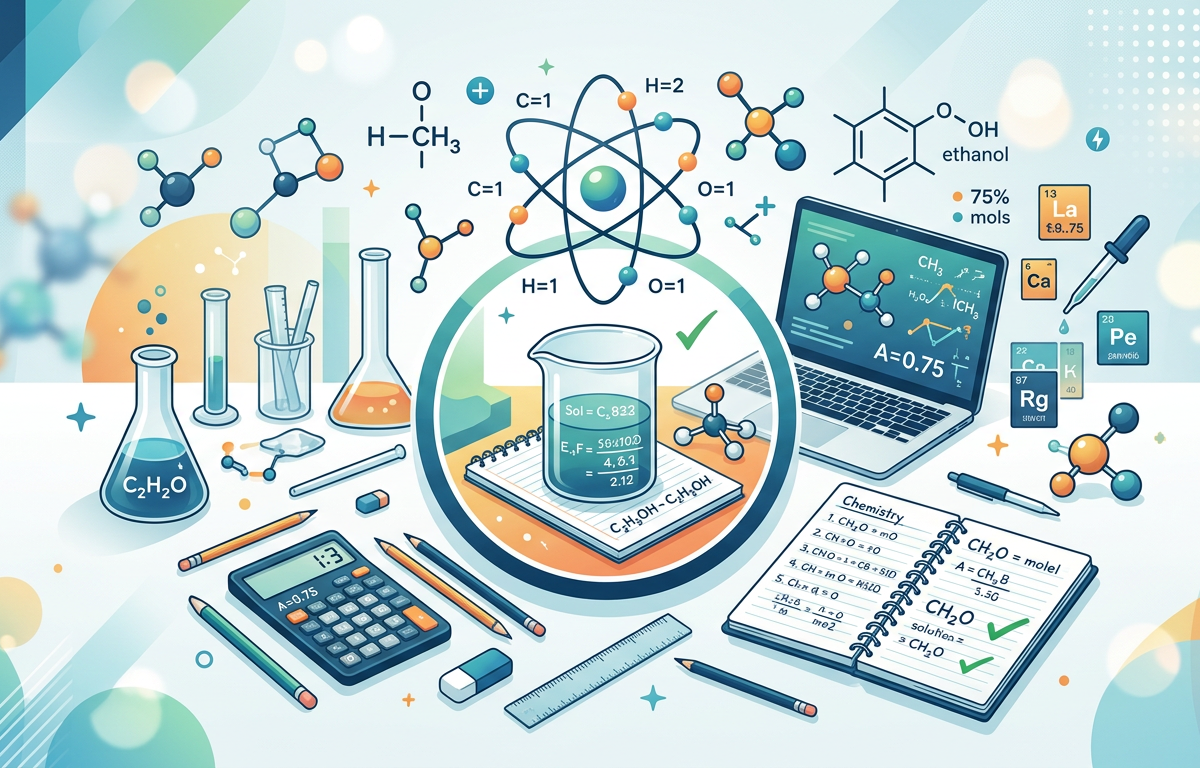
Free Empirical Formula Calculator
Enter at least two elements with their percentages to see the empirical formula and full worked solution.
Like this free empirical formula calculator?
Bevinzey offers AI-powered study tools that go way beyond — flashcards, quizzes, smart notes, and more.
Try Bevinzey FreeImagine you have a sample containing 69.9% iron and 30.1% oxygen. If you simply round the molar ratio of 1 to 1.5 down to the nearest whole number, you end up with an impossible chemical identity. The jump from 1.5 to a final formula of Fe2O3 is where most students stumble, forgetting that empirical formulas represent the absolute simplest whole-number ratio of atoms, not just the first set of integers you encounter after dividing by the smallest mole value.
This process requires a strict sequence: converting grams or percentages into moles, finding the relative ratio, and applying a multiplier to resolve decimals like 0.33, 0.5, or 0.66 into clean integers. Whether you are dealing with a simple binary salt like magnesium chloride or complex hydrocarbons identified through combustion analysis, the goal is to bridge the gap between measurable laboratory mass and the microscopic reality of atomic counts. By working through these specific cases, you will identify exactly when to round and when to multiply to ensure your stoichiometry remains accurate.
Converting Elemental Ratios to Formulas
An empirical formula is the simplest whole-number ratio of atoms of each element present in a compound. Unlike a molecular formula, which shows the actual number of atoms in a molecule, the empirical formula provides the most reduced form of the chemical identity. For example, while the molecular formula of glucose is C6H12O6, its empirical formula is CH2O. This concept is fundamental in analytical chemistry, particularly when identifying unknown substances through combustion analysis or elemental percentage data. To determine an empirical formula, you must convert the mass or percentage of each element into moles, find the molar ratio by dividing by the smallest number of moles, and then ensure all ratios are whole numbers. This process is closely linked to the mole concept, which serves as the bridge between macroscopic mass and microscopic atomic counts. Understanding these ratios is essential for more complex calculations, such as stoichiometry practice questions that require balanced chemical equations based on correct formulas.
Before diving into the examples, try the free empirical formula calculator at the top of this page. Enter the mass or percentage of each element and it instantly shows the moles, the ratio division, and the final formula, so you can check every practice question below step by step.
Solved Examples
Following these steps will help you master the calculation of empirical formulas from experimental data.
Example 1: Finding the formula from mass. A sample contains 13.5 g of calcium and 5.4 g of oxygen. What is the empirical formula?
Convert mass to moles: Ca = 13.5 g / 40.08 g/mol = 0.337 mol; O = 5.4 g / 16.00 g/mol = 0.338 mol.
Divide by the smallest value (0.337): Ca = 0.337 / 0.337 = 1; O = 0.338 / 0.337 ≈ 1.
The empirical formula is CaO, calcium oxide.
Example 2: Using percentage composition. A compound is 40.0% carbon, 6.7% hydrogen, and 53.3% oxygen by mass. Find the empirical formula.
Assume a 100 g sample: C = 40.0 g, H = 6.7 g, O = 53.3 g.
Convert to moles: C = 40.0 / 12.01 = 3.33 mol; H = 6.7 / 1.01 = 6.63 mol; O = 53.3 / 16.00 = 3.33 mol.
Divide by 3.33: C = 1, H = 1.99 (round to 2), O = 1.
The empirical formula is CH2O.
Example 3: Handling non-integer ratios. A compound consists of 69.9% iron and 30.1% oxygen.
Moles Fe: 69.9 / 55.85 = 1.25 mol. Moles O: 30.1 / 16.00 = 1.88 mol.
Divide by 1.25: Fe = 1; O = 1.88 / 1.25 = 1.5.
Multiply by 2 to get whole numbers: Fe = 2, O = 3.
The empirical formula is Fe2O3.
More Worked Examples
These two examples cover the question types that appear most often on exams: combustion analysis and converting an empirical formula into a molecular formula.
Example 4: Empirical formula from combustion analysis
Complete combustion of 0.255 g of a hydrocarbon produces 0.802 g of carbon dioxide and 0.329 g of water. What is the empirical formula of the hydrocarbon?
All of the carbon ends up in the CO2: moles C = 0.802 g / 44.01 g/mol = 0.0182 mol.
All of the hydrogen ends up in the H2O: moles H2O = 0.329 g / 18.02 g/mol = 0.0183 mol, so moles H = 2 × 0.0183 = 0.0365 mol.
Divide by the smallest value (0.0182): C = 1; H = 0.0365 / 0.0182 ≈ 2.
The empirical formula is CH2.
Example 5: From empirical formula to molecular formula
A compound has the empirical formula CH2 and a molar mass of 56.1 g/mol. What is its molecular formula?
Calculate the mass of one empirical unit: 12.01 + 2(1.01) = 14.03 g/mol.
Divide the molar mass by the empirical unit mass: 56.1 / 14.03 ≈ 4.
Multiply every subscript by 4. The molecular formula is C4H8.
Practice Questions
1. A compound is found to contain 2.4 g of magnesium and 7.1 g of chlorine. Calculate its empirical formula.
2. Determine the empirical formula of a substance that is 25.9% nitrogen and 74.1% oxygen by mass.
3. A hydrocarbon is 85.7% carbon and 14.3% hydrogen. What is its empirical formula?
Want unlimited practice questions like these?
Generate AI-powered questions with step-by-step solutions on any topic.
Try Question Generator Free →4. Analysis of a salt shows it contains 56.5% potassium, 8.7% carbon, and 34.8% oxygen. What is the empirical formula?
5. A 10.00 g sample of a compound contains 4.00 g of carbon, 0.67 g of hydrogen, and 5.33 g of oxygen. Calculate the empirical formula.
6. Find the empirical formula for a compound containing 32.4% sodium, 22.5% sulfur, and 45.1% oxygen.
7. A compound contains 18.8% lithium, 16.3% carbon, and 64.9% oxygen. Determine the empirical formula.
8. A 15.0 g sample of a lead oxide contains 13.0 g of lead and the rest is oxygen. What is the empirical formula?
9. A compound is 26.6% potassium, 35.4% chromium, and 38.0% oxygen. Find the empirical formula.
10. Determine the empirical formula of a compound with 43.7% phosphorus and 56.3% oxygen.
Answers & Explanations
MgCl2: Moles Mg = 2.4/24.3 = 0.0988; Moles Cl = 7.1/35.45 = 0.200. Ratio Cl/Mg = 0.200/0.0988 ≈ 2.
N2O5: Moles N = 25.9/14.01 = 1.849; Moles O = 74.1/16.00 = 4.631. Ratio O/N = 4.631/1.849 = 2.5. Multiply by 2 to get 5:2.
CH2: Moles C = 85.7/12.01 = 7.13; Moles H = 14.3/1.01 = 14.16. Ratio H/C = 14.16/7.13 ≈ 2.
K2CO3: Moles K = 1.445, C = 0.724, O = 2.175. Dividing by 0.724 gives K=2, C=1, O=3.
CH2O: Moles C = 0.333, H = 0.663, O = 0.333. Ratio is 1:2:1.
Na2SO4: Moles Na = 1.409, S = 0.702, O = 2.819. Dividing by 0.702 gives Na=2, S=1, O=4.
Li2CO3: Moles Li = 2.709, C = 1.357, O = 4.056. Ratio is 2:1:3.
PbO2: Mass of oxygen = 15.0 − 13.0 = 2.0 g. Moles Pb = 13.0/207.2 = 0.0627; Moles O = 2.0/16.00 = 0.125. Ratio O/Pb = 0.125/0.0627 ≈ 2.
K2Cr2O7: Moles K = 0.68, Cr = 0.68, O = 2.375. Ratio K:Cr:O = 1:1:3.5. Multiply by 2 to get 2:2:7.
P2O5: Moles P = 1.41, Moles O = 3.52. Ratio O/P = 2.5. Multiply by 2 to get 5:2.
1. Which of the following is an empirical formula?
Common Mistakes to Avoid
Rounding ratios too early. A ratio of 1.5 is not 1 or 2; multiply all ratios by 2 instead. Only round when a value is within about 0.05 of a whole number, such as 1.99 or 2.98.
Using atomic numbers instead of atomic masses. Moles come from dividing mass by molar mass (g/mol), not by the atomic number from the periodic table.
Forgetting to convert percentages to grams. With percentage data, always assume a 100 g sample first so each percentage becomes a mass in grams.
Skipping the divide-by-the-smallest step. Raw mole values are not the formula. You must divide every mole value by the smallest one to get the ratio.
Confusing empirical and molecular formulas. The empirical formula is only the simplest ratio. You need the molar mass of the compound to scale it up to the true molecular formula, as shown in Example 5.
Frequently Asked Questions
What is the difference between an empirical and molecular formula?
The empirical formula represents the simplest whole-number ratio of elements in a compound, whereas the molecular formula shows the actual number of atoms of each element in a single molecule. For instance, ethyne (C2H2) and benzene (C6H6) share the same empirical formula, CH, but have different molecular structures and properties. You can learn more about these distinctions in our guide on moles to grams practice questions.
How do you handle decimal ratios like 1.5 or 1.33?
When the mole ratio results in a decimal, you must multiply all ratios by the smallest integer that converts the decimal into a whole number. For example, multiply by 2 if you have a .5 decimal, or multiply by 3 if you have a .33 or .66 decimal. This ensures the chemical formula reflects discrete atomic units as defined by Dalton's Atomic Theory.
Can two different compounds have the same empirical formula?
Yes, many different compounds can share the same empirical formula because it only describes the ratio of atoms, not the total count or arrangement. Formaldehyde (CH2O), acetic acid (C2H4O2), and glucose (C6H12O6) all have the same empirical formula but vastly different chemical identities. This is a common point of confusion for students, similar to the differences explored in molarity vs molality guides.
Why is the empirical formula used in chemistry?
The empirical formula is used primarily to identify unknown substances through experimental techniques like elemental analysis. It provides the basic building blocks of a substance's composition, which can then be combined with molar mass data to determine the exact molecular formula. Reference materials from Khan Academy provide excellent visual aids for this experimental process.
Do ionic compounds have molecular formulas?
Ionic compounds do not have molecular formulas because they exist as giant crystal lattices rather than individual molecules. Therefore, the empirical formula (also called a formula unit) is the standard way to represent ionic substances like NaCl or MgCl2. For more on how these ratios affect solution concentration, see our molarity formula explained article.
Want unlimited practice questions like these?
Generate AI-powered questions with step-by-step solutions on any topic.
Try Question Generator Free →Enjoyed this article?
Share it with others who might find it helpful.
Related Articles

Solving High-Stakes IV Titrations and Weight-Based Infusions
Master advanced IV flow rate calculations with these hard practice questions. Covers weight-based dosing, titrations, and dimensional analysis for nurses.
May 17, 2026

Solving Weight-Based Dosing: The 2.2 Conversion and Rounding Logic
Weight-Based Dosage Calculations Practice Questions with Answers
May 17, 2026
Solving Combined Gas Law Problems: Managing Three Changing Variables
Master the Combined Gas Law with this comprehensive guide featuring clear explanations, step-by-step solved examples, and 10 practice questions with answers.
Apr 2, 2026
Solving Charles’s Law: Avoiding the Celsius Temperature Trap
Master Charles’s Law with our comprehensive guide featuring solved examples, practice questions, and step-by-step explanations for chemistry students.
Apr 2, 2026
Solving PV=nRT: Why Units and Constants Trip Up Every Student
Master the Ideal Gas Law with these easy practice questions. Includes step-by-step solved examples, unit conversion tips, and a quick quiz to test your skills.
Apr 2, 2026
Predicting Radioactive Decay: Solving for Mass and Time Intervals
Master half-life calculations with our comprehensive guide featuring step-by-step solved examples, practice questions, and detailed answers for students.
Apr 2, 2026
Solving Equilibrium Problems Without Losing Your Stoichiometry
Master chemical equilibrium with these easy ICE table practice questions. Learn to calculate concentrations and K values with step-by-step solved examples.
Mar 30, 2026

Solving Kp with Dalton’s Law and Partial Pressure Gradients
Master Hard Kp Calculations with our comprehensive guide. Includes solved examples, practice questions on partial pressure, and Kp to Kc conversions.
Mar 30, 2026