Avogadro’s Number Practice Questions with Answers
Concept Explanation
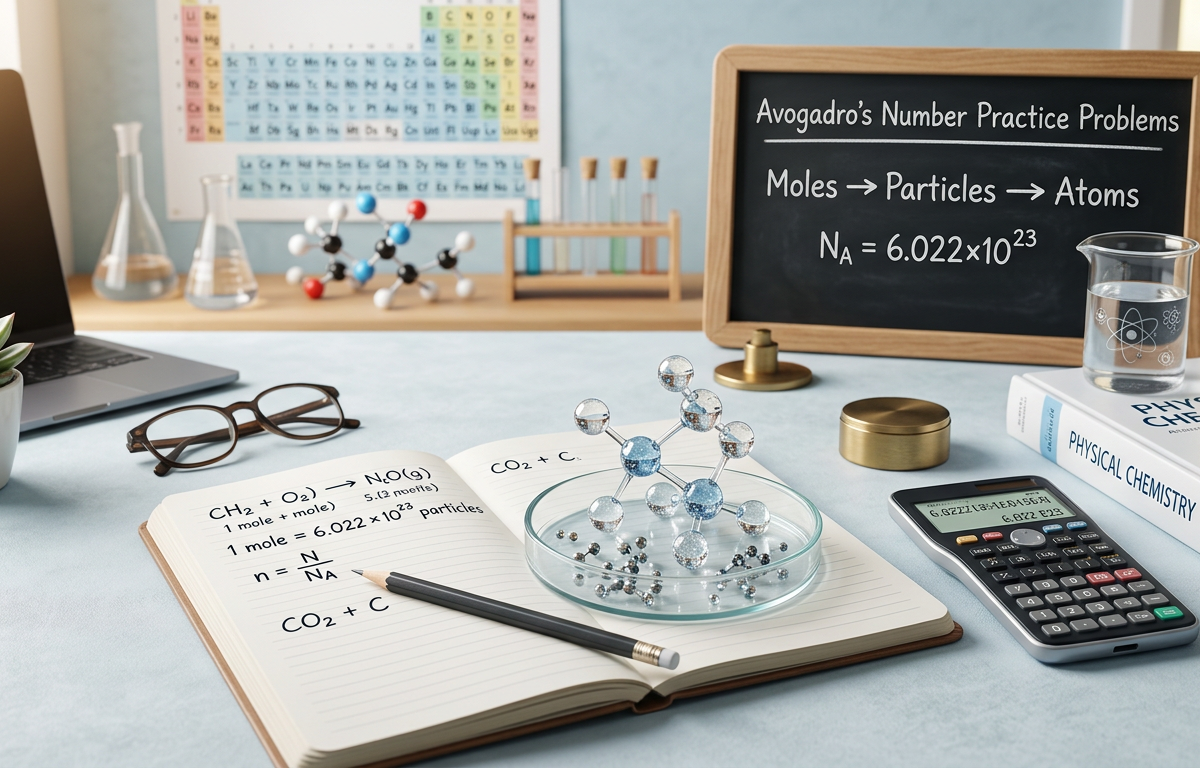
Avogadro’s number, approximately 6.022 × 10²³, represents the exact number of constituent particles (usually atoms or molecules) contained in one mole of a substance. This fundamental constant provides the bridge between the microscopic world of atoms and the macroscopic world of grams and liters that we measure in the laboratory. Named after the Italian scientist Amedeo Avogadro, this value is officially defined by the International System of Units (SI) as the number of atoms in exactly 12 grams of carbon-12.
Understanding Avogadro's number is essential for mastering the mole concept. It allows chemists to count atoms by weighing them. For example, if you have one mole of water (H₂O), you have 6.022 × 10²³ molecules of water. Because each water molecule contains two hydrogen atoms and one oxygen atom, that same mole would contain 2 × (6.022 × 10²³) hydrogen atoms and 1 × (6.022 × 10²³) oxygen atoms.
To use Avogadro's number in calculations, we typically use the following conversion factors:
To find particles: Number of moles × (6.022 × 10²³ particles / 1 mole)
To find moles: Number of particles / (6.022 × 10²³ particles / 1 mole)
This constant is a cornerstone of stoichiometry, enabling us to predict the outcomes of chemical reactions with mathematical precision.
Solved Examples
Review these step-by-step solutions to understand how to apply Avogadro's number in common chemistry problems.
Example 1: Calculating Atoms from Moles
How many atoms are in 2.5 moles of pure gold (Au)?
Identify the given value: 2.5 moles of Au.
Set up the conversion using Avogadro's number: Atoms = moles × (6.022 × 10²³ atoms/mol).
Perform the calculation: 2.5 × 6.022 × 10²³ = 1.5055 × 10²⁴.
Final Answer: 1.5 × 10²⁴ atoms (rounded to significant figures).
Example 2: Calculating Moles from Molecules
A sample contains 1.204 × 10²⁴ molecules of Carbon Dioxide (CO₂). How many moles is this?
Identify the given value: 1.204 × 10²⁴ molecules.
Set up the conversion: Moles = molecules / (6.022 × 10²³ molecules/mol).
Perform the calculation: (1.204 × 10²⁴) / (6.022 × 10²³) = 2.0.
Final Answer: 2.0 moles of CO₂.
Example 3: Atoms in a Compound
How many total atoms are in 0.5 moles of Glucose (C₆H₁₂O₆)?
Determine molecules first: 0.5 moles × 6.022 × 10²³ = 3.011 × 10²³ molecules.
Count atoms per molecule: 6 (C) + 12 (H) + 6 (O) = 24 atoms per molecule.
Multiply molecules by atoms per molecule: (3.011 × 10²³) × 24 = 7.2264 × 10²⁴.
Final Answer: 7.23 × 10²⁴ total atoms.
Practice Questions
Test your knowledge with these Avogadro’s number practice questions. They range from basic conversions to more complex multi-step problems.
How many atoms are in 4.0 moles of Silver (Ag)?
Calculate the number of moles in a sample containing 3.011 × 10²³ atoms of Iron (Fe).
How many molecules of Oxygen (O₂) are present in 0.75 moles?
Want unlimited practice questions like these?
Generate AI-powered questions with step-by-step solutions on any topic.
Try Question Generator Free →A balloon contains 9.033 × 10²³ atoms of Helium (He). How many moles of Helium are in the balloon?
How many individual hydrogen atoms are in 2.0 moles of Methane (CH₄)?
Calculate the number of formula units in 5.2 moles of Sodium Chloride (NaCl).
A sample of water contains 1.806 × 10²⁴ molecules. How many moles of water does this represent?
How many total atoms are in 1.5 moles of Sulfur Dioxide (SO₂)?
Convert 0.25 moles of Calcium (Ca) into the number of atoms.
If you have 4.516 × 10²³ molecules of Nitrogen gas (N₂), how many moles do you have?
Answers & Explanations
2.41 × 10²⁴ atoms. (4.0 mol × 6.022 × 10²³ atoms/mol = 2.4088 × 10²⁴).
0.5 moles. (3.011 × 10²³ atoms / 6.022 × 10²³ atoms/mol = 0.5).
4.52 × 10²³ molecules. (0.75 mol × 6.022 × 10²³ molecules/mol = 4.5165 × 10²³).
1.5 moles. (9.033 × 10²³ / 6.022 × 10²³ = 1.5).
4.82 × 10²⁴ atoms. (2.0 moles × 6.022 × 10²³ molecules/mol = 1.2044 × 10²⁴ molecules. Since there are 4 H atoms per molecule: 1.2044 × 10²⁴ × 4 = 4.8176 × 10²⁴).
3.13 × 10²⁴ units. (5.2 mol × 6.022 × 10²³ = 3.131 × 10²⁴).
3.0 moles. (1.806 × 10²⁴ / 6.022 × 10²³ = 3).
2.71 × 10²⁴ atoms. (1.5 mol × 6.022 × 10²³ molecules/mol = 9.033 × 10²³ molecules. SO₂ has 3 atoms per molecule: 9.033 × 10²³ × 3 = 2.7099 × 10²⁴).
1.51 × 10²³ atoms. (0.25 mol × 6.022 × 10²³ = 1.5055 × 10²³).
0.75 moles. (4.516 × 10²³ / 6.022 × 10²³ = 0.75).
1. What is the numerical value of Avogadro’s number?
Frequently Asked Questions
What is the purpose of Avogadro's number in chemistry?
Avogadro's number serves as a conversion factor that allows chemists to switch between the number of microscopic particles and the macroscopic amount of substance measured in moles. It is essential for relating atomic-level properties to measurable laboratory quantities like mass.
Does Avogadro's number change for different substances?
No, Avogadro's number is a universal constant that remains the same regardless of the substance being measured. One mole of any substance, whether it is lead, water, or air, always contains exactly 6.022 × 10²³ representative particles.
How do I convert grams to particles using Avogadro's number?
To convert grams to particles, you must first convert grams to moles by dividing by the molar mass of the substance. Once you have the number of moles, multiply that value by Avogadro's number (6.022 × 10²³) to find the total number of particles.
Why is Avogadro's number such a large value?
Avogadro's number is incredibly large because atoms and molecules are extremely small. To have a quantity of matter large enough to see and weigh in a laboratory, such as a few grams, an astronomical number of individual atoms must be present.
Is Avogadro's number an exact integer?
Historically, it was an experimentally determined value with uncertainty, but as of the 2019 redefinition of SI units, it is now an exact defined constant. The official value is exactly 6.02214076 × 10²³ mol⁻¹.
Want unlimited practice questions like these?
Generate AI-powered questions with step-by-step solutions on any topic.
Try Question Generator Free →
Want unlimited practice questions like these?
Generate AI-powered questions with step-by-step solutions on any topic.
Try Question Generator Free →Enjoyed this article?
Share it with others who might find it helpful.
Related Articles

Calculating High-Stakes Meds: BSA Mosteller Formula Practice
Master hard body surface area-based dosage calculations with our comprehensive guide, solved examples, and practice questions for healthcare students.
May 17, 2026

Solving High-Stakes IV Titrations and Weight-Based Infusions
Master advanced IV flow rate calculations with these hard practice questions. Covers weight-based dosing, titrations, and dimensional analysis for nurses.
May 17, 2026

Solving Weight-Based Dosing: The 2.2 Conversion and Rounding Logic
Weight-Based Dosage Calculations Practice Questions with Answers
May 17, 2026
Predicting Periodic Anomalies: Beyond Basic Trend Rules
Hard Periodic Trends Practice Questions
Apr 4, 2026
Hard Electron Configuration Practice Questions
Hard Electron Configuration Practice Questions
Apr 4, 2026
Medium Electron Configuration Practice Questions
Master medium-level electron configuration with our comprehensive guide, including solved examples, stability exceptions, and practice questions with answers.
Apr 4, 2026
Easy Electron Configuration Practice Questions
Master the basics of atomic structure with our Easy Electron Configuration Practice Questions. Learn the Aufbau principle and how to write configurations.
Apr 4, 2026
Electron Configuration Practice Questions with Answers
Master electron configuration with our comprehensive guide featuring solved examples, practice questions, and detailed explanations for chemistry students.
Apr 4, 2026