Active Recall vs Rereading: The Ultimate Science-Backed Winner

Most students spend hours highlighting textbooks and scanning their notes, yet they struggle to remember the material when the exam timer starts. The showdown between Active Recall vs Rereading isn't just a matter of preference; it is a battle between what feels good and what actually works. Research consistently shows that while rereading provides a false sense of security, active recall builds the neural architecture required for true mastery.
The Great Study Debate: Active Recall vs Rereading Explained
Active recall is a study method that requires you to retrieve information from your memory without looking at your notes, whereas rereading is the passive act of consuming the same text multiple times. When you use active recall, you are forcing your brain to work, which signals that the information is important enough to store long-term. In contrast, rereading relies on recognition, which is a much weaker cognitive process than retrieval.
The "Illusion of Competence" is the primary reason students fail to fix their study habits. When you reread a page for the third time, the text looks familiar. Your brain confuses this familiarity with actual knowledge. You think, "I know this," but what you really mean is, "I recognize this." Recognition only works if the information is right in front of you; recall works when you are staring at a blank exam paper.
Cognitive scientists have long regarded retrieval practice as the gold standard of learning. Instead of pouring information into your brain (input), you are practicing the act of pulling it out (output). This shift from consumer to creator is what separates top-tier students from those who simply stay busy.
Ready to Stop Guessing?
Transform your study sessions with AI-powered tools designed for active recall.
Get Started FreeThe Science of Memory: Why Our Brains Prefer Retrieval over Input
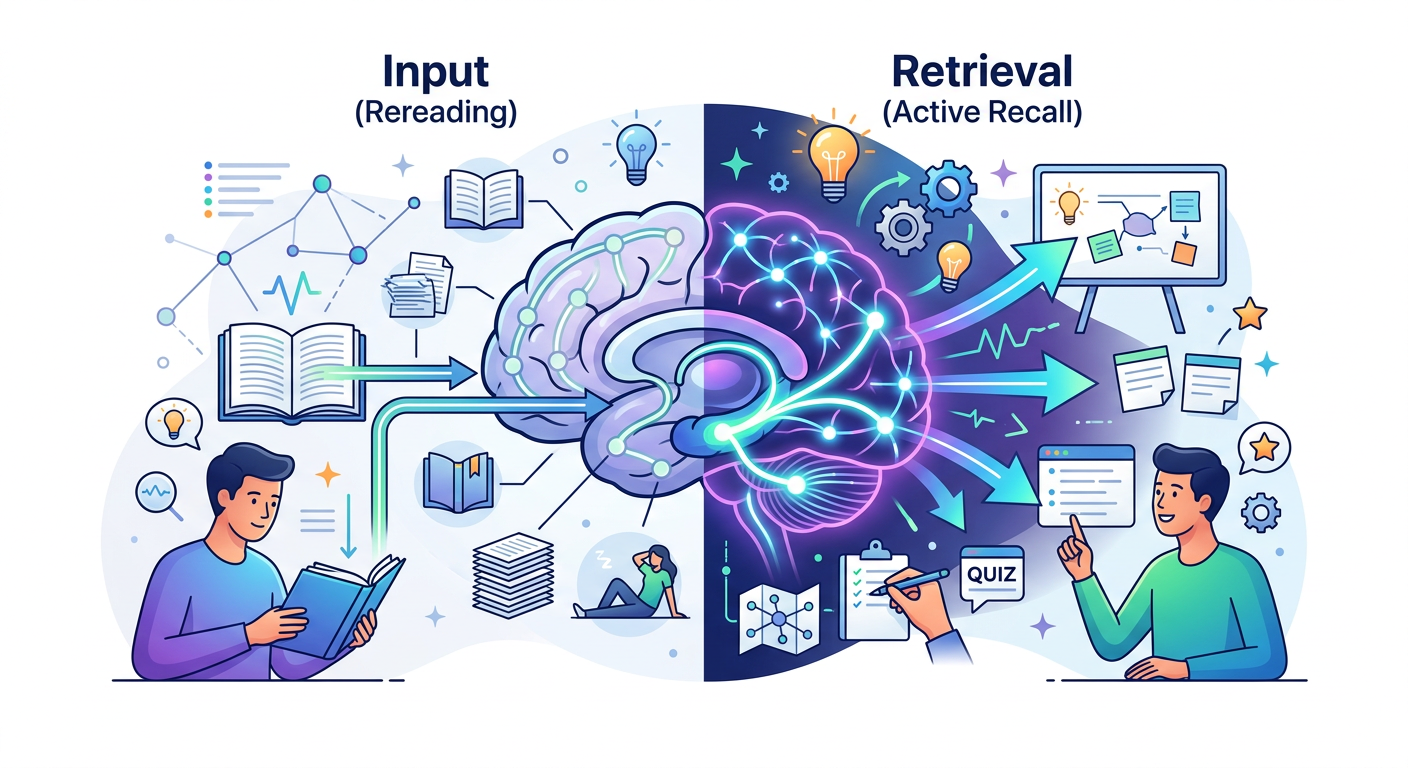
The brain prioritizes information that it has to work to retrieve because the effort of "searching" for an answer strengthens the neural pathways associated with that data. This phenomenon is known as the Testing Effect. Essentially, the act of taking a test, even a self-administered one, is a more potent learning event than an additional hour of study time.
When you learn something new, your brain undergoes "encoding," where it creates a preliminary memory trace. However, these traces are fragile. Through retrieval, you initiate a process called consolidation. Every time you successfully recall a fact, you make that memory more resistant to forgetting. It is the difference between drawing a line in the sand and carving it into stone.
How does "desirable difficulty" factor in? Coined by Robert Bjork, this concept suggests that learning is most effective when it feels somewhat challenging. If studying feels easy, you probably aren't learning much. Active recall is inherently difficult, which is exactly why it produces superior long-term retention compared to the low-effort path of rereading.
The Problem with Rereading: Why It’s a Passive Trap
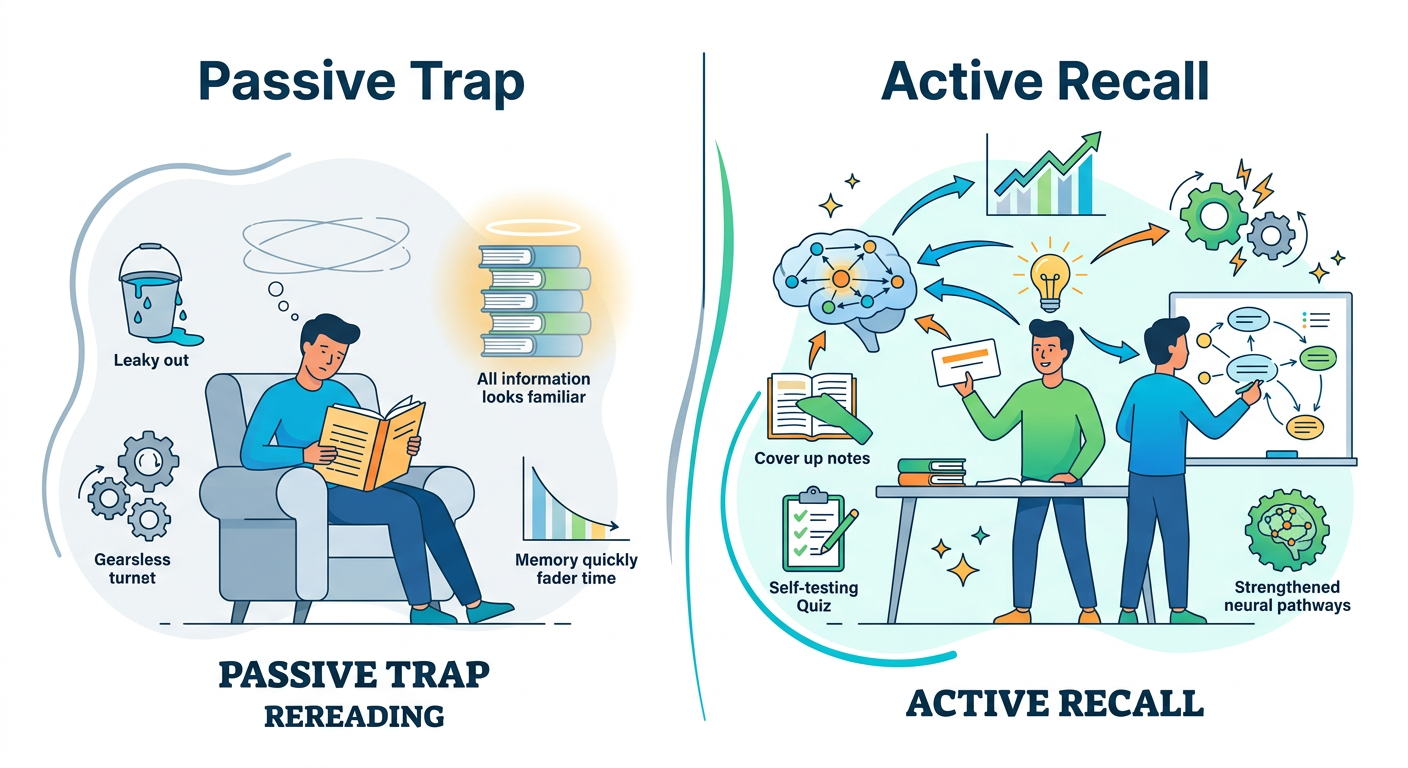
Rereading is the most popular study technique because it is psychologically comfortable and requires very little mental energy. It allows you to feel productive without the pain of cognitive strain. This creates a "passive trap" where you spend hours "studying" but perform poorly because you never actually practiced the skill of retrieval.
Low cognitive engagement leads to rapid memory decay. If you are not interacting with the material, questioning it, applying it, or retrieving it, your brain assumes the information is "trash" data and discards it within 24 hours. Highlighting and underlining often exacerbate this issue, as they give students the feeling of "doing something" while they are actually just coloring.
Is rereading ever useful? Yes, but only during the "priming phase." If you are seeing a topic for the very first time, you must read the text to build a mental framework. However, once you understand the basic gist, you should immediately transition to active learning strategies. Rereading should consume no more than 20% of your total study time.
How to Master Active Recall: 5 Proven Techniques
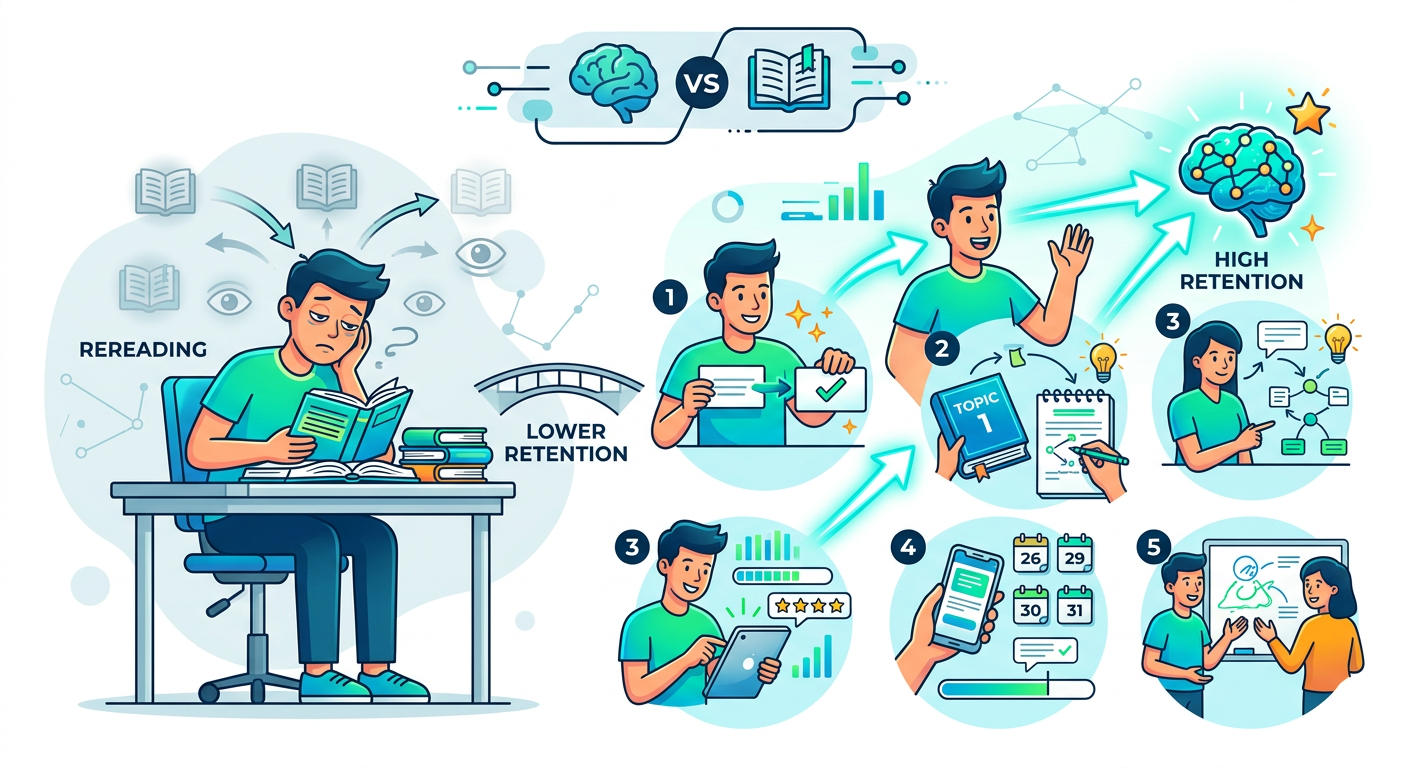
The "Blurting" method is one of the most effective ways to start. After reading a chapter, close the book and write down everything you can remember on a blank piece of paper. Once you've exhausted your memory, go back to the book with a red pen and fill in what you missed. This highlights your "knowledge gaps" instantly.
You can also redefine the Cornell Note-Taking System for retrieval. Instead of just taking notes, focus heavily on the "cue" column. Write questions in that column that correspond to the notes on the right. When it's time to review, cover the notes and try to answer your own questions. This turns your notebook into a self-testing tool.
The Feynman Technique: Explain a concept to a "five-year-old" (or an imaginary audience) without looking at your notes. If you stumble, you’ve found a gap in your understanding.
Flashcards (AIflashcard.net/Anki/Quizlet): Use digital cards to automate your testing process. This is particularly effective for subjects like chemistry where you might need to solve molarity practice questions repeatedly.
Past Papers: Doing actual exam questions is the ultimate form of active recall because it mimics the "retrieval environment" you will face on test day.
To truly excel, you must integrate these strategies into a structured study schedule. Consistency is more important than intensity. Doing 30 minutes of active recall daily is significantly more effective than a 10-hour rereading marathon the night before an exam.
The Power Couple: Combining Active Recall with Spaced Repetition
Active recall works best when paired with spaced repetition, a technique that involves reviewing information at increasing intervals to combat the "Forgetting Curve." This curve, discovered by Hermann Ebbinghaus, shows that we lose roughly 50% of new information within an hour if we don't actively retrieve it.
The optimal review schedule follows a pattern: review after 1 day, then 3 days, then 7 days, and then 30 days. By timing your active recall sessions just as you are about to forget the material, you force your brain to work harder to "find" the memory. This effort maximizes the strength of the neural connection.
Modern tools like Anki or RemNote use algorithms to handle this scheduling for you. They show you the hardest cards more frequently and push the easy cards further into the future. This ensures you are always operating in the "zone of desirable difficulty" and not wasting time on things you already know.
Active Recall vs Rereading: A Side-by-Side Comparison
In terms of efficiency, active recall is the clear winner despite taking more energy per minute. While rereading a chapter might take 30 minutes and yield 10% retention, 15 minutes of "blurting" or self-testing can yield up to 80% retention. It is "high-intensity interval training" for your brain.
Students who rely on active recall often report lower stress levels during exams. Because they have spent weeks practicing the act of retrieval, the exam feels like "just another practice session." They have already encountered and fixed their mistakes in a low-stakes environment, whereas the "rereader" is testing their retrieval skills for the first time during the actual final.
"The more effortful the retrieval, the more the memory is strengthened. Learning that's easy is like writing in sand, here today and gone tomorrow." — Make It Stick: The Science of Successful Learning
Active recall also fosters deeper critical thinking. When you have to explain "why" a concept works, such as distinguishing between molarity vs molality, you build a web of interconnected knowledge. Rereaders often possess "siloed" facts that they cannot connect or apply to complex problems.
Practical Implementation: A Step-by-Step Guide for Students
Transitioning from passive to active learning requires a mindset shift. You must accept that "feeling confused" is a sign that learning is happening. Start by looking at your current study notes and turning every heading into a question. If the heading is "The Krebs Cycle," your question is "What are the 8 steps of the Krebs Cycle and where do they occur?"
Manage brain fatigue by using the Pomodoro technique: 25 minutes of intense retrieval followed by a 5-minute break. Active recall is mentally taxing, and you cannot do it for four hours straight like you can with rereading. Quality over quantity is the rule here. For more structure, you might use a study plan template to track which topics you have "actively" recalled each week.
A sample 7-day plan might look like this: 1. Monday: Read chapter 1 (Priming) and create 10 flashcards. 2. Tuesday: Active recall on those 10 cards. 3. Thursday: Redo the same 10 cards + 10 new cards from chapter 2. 4. Sunday: Practice test on chapters 1 and 2 without notes.
Common Mistakes to Avoid in Active Recall
The most fatal mistake is failing to close the feedback loop. If you try to recall an answer and get it wrong, or only partially right, you must check the correct answer immediately. Retrieval without feedback can actually reinforce incorrect information in your memory. Always verify your "blurts" against the source material.
Another pitfall is rote memorization without comprehension. You can memorize the definition of a "mole" using active recall, but if you don't understand the underlying chemistry, you will struggle with grams to moles practice questions. Use the Feynman technique to ensure your foundation is solid before you start drilling facts.
Finally, don't over-complicate the process. You don't need fancy apps or expensive software. A pen, a piece of paper, and the willingness to struggle are the only tools required to start using science-backed study techniques. The goal is to spend less time looking at the book and more time looking at the ceiling while you think.
Master Your Exams with Active Recall
Stop wasting hours on passive rereading. Join Bevinzey today and use our AI-powered retrieval practice tools to lock in knowledge and boost your grades.
Get Started FreeFrequently Asked Questions
Is rereading ever useful for studying?
Rereading is useful for the initial "priming" stage when you encounter a topic for the first time. It helps you understand the context and vocabulary, but it should be followed immediately by active recall to ensure the information is actually stored.
How do I start using active recall if I'm used to highlighting?
Stop highlighting and start writing questions in the margins of your book. Every time you feel the urge to highlight a "key fact," turn it into a question instead. Later, look only at the questions and try to answer them aloud.
Can active recall prevent exam anxiety?
Yes. Anxiety often stems from a lack of confidence in your ability to retrieve information under pressure. Since active recall is essentially "simulating the exam," it builds the confidence and neural strength needed to stay calm on test day.
What are the best apps for active recall?
Anki is the gold standard for spaced repetition and flashcards. AIflashcard.net, Quizlet and RemNote are also excellent alternatives. However, even a simple Word document with hidden answers or a physical notebook can be highly effective.
Is active recall harder than rereading?
Yes, significantly. It requires much more mental effort because you are actively searching your memory. This "desirable difficulty" is exactly what makes it so much more effective for long-term retention.
How often should I use active recall for long-term memory?
Use it in conjunction with spaced repetition. Review the material 24 hours after learning, then 3 days later, then 1 week later, and then once a month. This schedule maximizes the chance of the information reaching your long-term memory.
Enjoyed this article?
Share it with others who might find it helpful.
Related Articles

Retrieval Practice vs Rereading: Why One Method Dominates
Discover why retrieval practice is more effective than rereading for long-term memory. Comparison of active recall vs. passive study methods for learners.
Apr 27, 2026

Ace Your Exams: Master Effective Study Without Rereading
Unlock smarter study habits and ace your exams without endless rereading. Discover proven techniques for active recall, spaced repetition, and deeper learning.
Mar 31, 2026

How to Solve Molarity Problems: Step-by-Step Mastery
Learn how to solve molarity problems step-by-step with formulas, unit tips, and worked examples so you can calculate concentration with confidence.
Mar 26, 2026

Avoid These 7 Common Molarity Mistakes in Chemistry
Master chemistry calculations! Avoid common molarity mistakes with our expert guide on unit conversions, dilution errors, and proper lab techniques.
Mar 26, 2026
What Is Molarity? The Complete Guide to Molar Concentration
Master molarity with our complete guide. Learn the formula, step-by-step calculations, and the critical differences between molarity and molality.
Mar 26, 2026