Unlock Your Potential: Why Most Students Study Wrong & How to Fix It

Many students spend hours poring over textbooks and notes, only to find themselves struggling to recall information come exam time. They often wonder, "Why do I study so hard but still perform poorly?" The answer often lies not in a lack of effort, but in approach. This article explores common pitfalls in learning and fundamentally explains why students study wrong, offering science-backed strategies to transform your study habits and truly unlock your potential.
The Illusion of Productive Studying: Common Misconceptions
Many students confuse familiarity with genuine understanding, falling victim to study methods that feel productive but yield minimal results.
They might spend hours with their books open, feeling like they've absorbed a lot, when in reality, their brain hasn't adequately processed the information for long-term retention. This often stems from relying on passive techniques rather than engaging with the material actively.
Passive Reading vs. Active Recall: A Critical Distinction
Simply reading a chapter, even multiple times, rarely translates into deep understanding or lasting memory. Passive reading allows your brain to coast, recognizing words without actively retrieving or processing their meaning.
Active recall, on the other hand, involves deliberately pulling information from your memory. It's like exercising a muscle – the more you try to retrieve a piece of information, the stronger the neural pathway becomes. This crucial difference explains why many feel they know the material, only to draw a blank on a test.
Highlighting & Underlining: A False Sense of Security
Highlighting passages gives students a false sense of security, often making them believe they're actively learning. While it might draw attention to key phrases, it's largely a mechanical exercise.
Research consistently shows that highlighting alone does not significantly improve comprehension or retention. It becomes truly effective only when paired with more active strategies, like summarizing highlighted sections in your own words or using them as cues for active recall practice.
Rereading Notes: The Comfort Zone Trap
Rereading notes is a common study method, but it's largely an inefficient one. It feels comfortable, even productive, because the material becomes familiar. This familiarity, however, often masks a lack of true comprehension.
Your brain recognizes the words and sentences, but it isn't forced to reconstruct the knowledge or make meaningful connections. It's akin to repeatedly looking at the answers to a puzzle without ever trying to solve it yourself.
The Myth of Multitasking: Divided Attention, Diminished Returns
Despite popular belief, multitasking actually reduces learning efficiency and retention, not improves it. When you juggle multiple tasks, like watching a lecture while texting friends, your brain constantly switches between stimuli.
This "context switching" prevents deep engagement with any single task, leading to shallower processing and poorer memory encoding. Focus is a finite resource, and dividing it inevitably diminishes overall performance. Harvard Business Review has explored the detrimental effects of multitasking on productivity and learning.
Understanding How Our Brains Learn (and Forget)
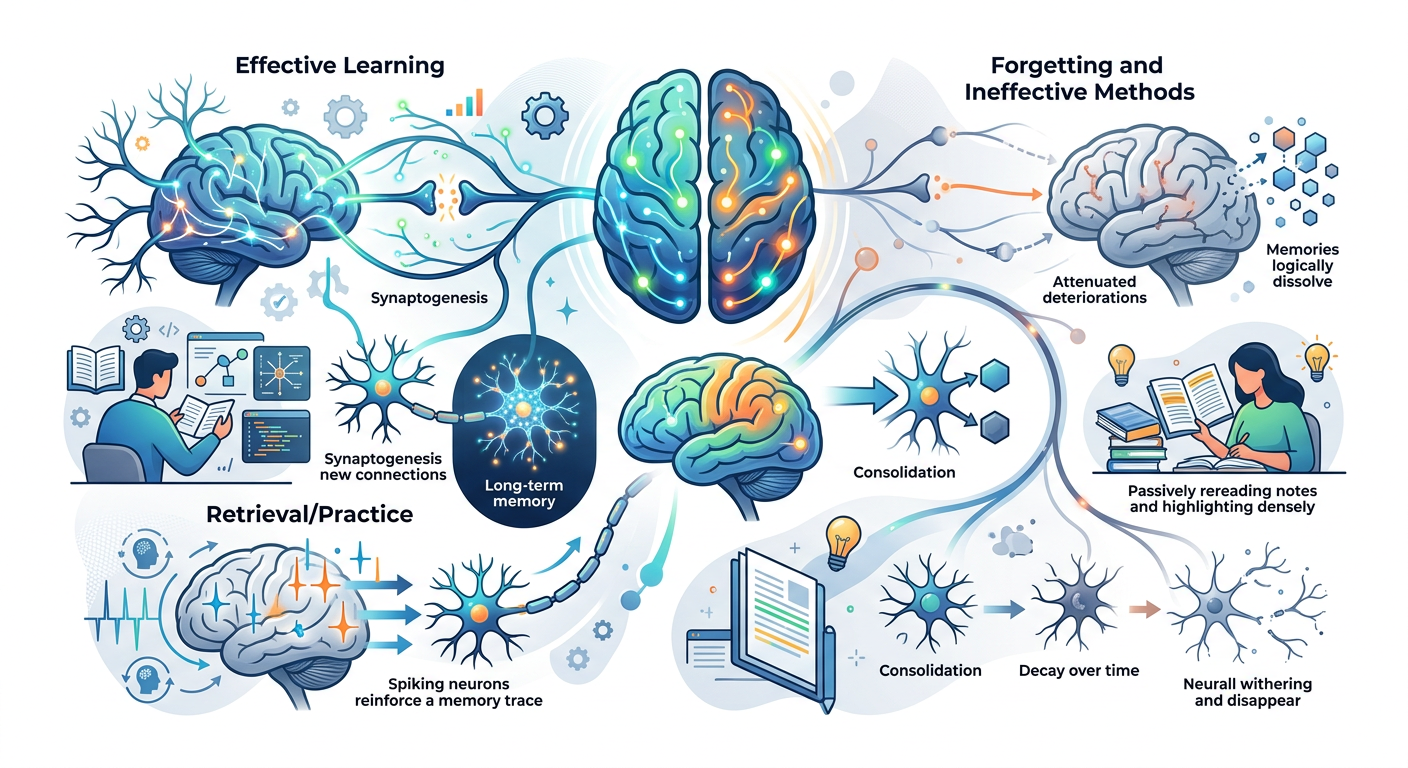
Effective study strategies are rooted in how our brains process, store, and retrieve information. Understanding these mechanisms helps us work with our cognition, not against it.
Cognitive science provides valuable insights into optimizing learning, revealing that certain activities naturally align with our brain's architecture for memory and understanding.
The Forgetting Curve: Why Spaced Repetition is Your Ally
Hermann Ebbinghaus, a pioneering psychologist, first described the "forgetting curve" in 1885. This principle illustrates that we rapidly forget newly learned information unless we actively try to retain it.
Crucially, the rate of forgetting isn't linear; we forget most rapidly after initial learning, but subsequent reviews slow this decay. Spaced repetition, strategically reviewing material at increasing intervals, directly combats this natural tendency to forget, solidifying memories over time. This approach underpins many study techniques that actually work.
Cognitive Load Theory: Don't Overload the System
Our working memory, the mental workbench where we process information, has a limited capacity. Cognitive Load Theory explains that too much information presented at once can overwhelm this capacity, hindering learning.
When working memory gets overwhelmed, it struggles to transfer information to long-term memory. Breaking down complex topics into smaller, manageable chunks and focusing on one concept at a time reduces cognitive load, allowing for more effective processing and retention.
Memory Consolidation: The Role of Sleep and Breaks
Memory consolidation primarily happens during sleep. As we sleep, our brains actively transfer information from temporary storage in the hippocampus to more permanent storage in the neocortex.
This process transforms fragile new memories into more stable, long-lasting ones. Skipping sleep or prolonged, uninterrupted study sessions are counterproductive because they deprive the brain of this essential consolidation phase. Short breaks during study sessions also give your brain a chance to process and reset, improving overall focus and retention.
Neural Pathways: How Practice Strengthens Learning
Learning physically changes your brain by creating and strengthening neural pathways. Each time you engage with a concept, especially through active recall or problem-solving, you reinforce these connections.
Consistent, deliberate practice makes these pathways more efficient, allowing for quicker and more accurate retrieval of information. It's why practicing easy molarity practice questions repeatedly eventually makes them second nature.
Active Learning Strategies That Actually Work

Transforming your study habits means embracing active learning, strategies that demand your brain to engage deeply with material. These methods are proven to build stronger memory traces and deeper understanding.
They move beyond passive reception and push you towards meaningful interaction with the content, making your study time significantly more effective.
Active Recall: Testing Yourself is Learning
Active recall is one of the most powerful effective study strategies. Instead of passively rereading, you actively retrieve information from memory.
This could involve using flashcards, doing practice questions, or simply closing your book and trying to explain a concept in your own words. Every time you retrieve a memory, you strengthen its neural pathway, making it easier to recall in the future. For example, practicing hard molality practice questions without looking at solutions actively trains your recall.
Spaced Repetition: Defeating the Forgetting Curve
Spaced repetition involves reviewing material at progressively longer intervals. Think of reviewing a concept after one day, then three days, then a week, then a month.
This strategic timing ensures you confront the material just as you're about to forget it, forcing your brain to work harder for retrieval, which in turn solidifies the memory. Digital flashcard apps like Anki often incorporate spaced repetition algorithms, making it easy to implement.
Elaboration: Connecting New Information to Existing Knowledge
Elaboration is the process of attaching new information to what you already know. When you learn something new, ask "how does this relate to X?" or "why is this true?"
Creating analogies, drawing concept maps, or thinking about real-world examples helps integrate new knowledge into your existing mental frameworks, making it more meaningful and easier to remember. Rather than just memorizing a definition, try to explain its function or history, like understanding what molarity is in the broader context of solution chemistry.
Interleaving: Mixing Up Your Subjects for Deeper Understanding
Interleaving means mixing different types of problems or different subjects during a single study session. Instead of dedicating an entire evening to only one subject, you might alternate between chemistry, history, and math.
This technique, contrary to typical "block practice," helps your brain differentiate between concepts and forces you to select the correct strategy for each problem, leading to deeper understanding and better transfer of knowledge. It's a key component of how to study effectively.
Self-Explanation: The Power of Teaching It to Yourself (or Others)
When you try to explain a concept aloud in your own words, you quickly discover gaps in your understanding. This "explaining it to an imaginary friend" method forces you to organize your thoughts, identify logical connections, and clarify confused points.
Teaching others is an even more powerful form of self-explanation, as it requires you to anticipate questions and structure your explanation for clarity. This process deepens your own comprehension and retention considerably.
Optimize Your Study Environment and Habits
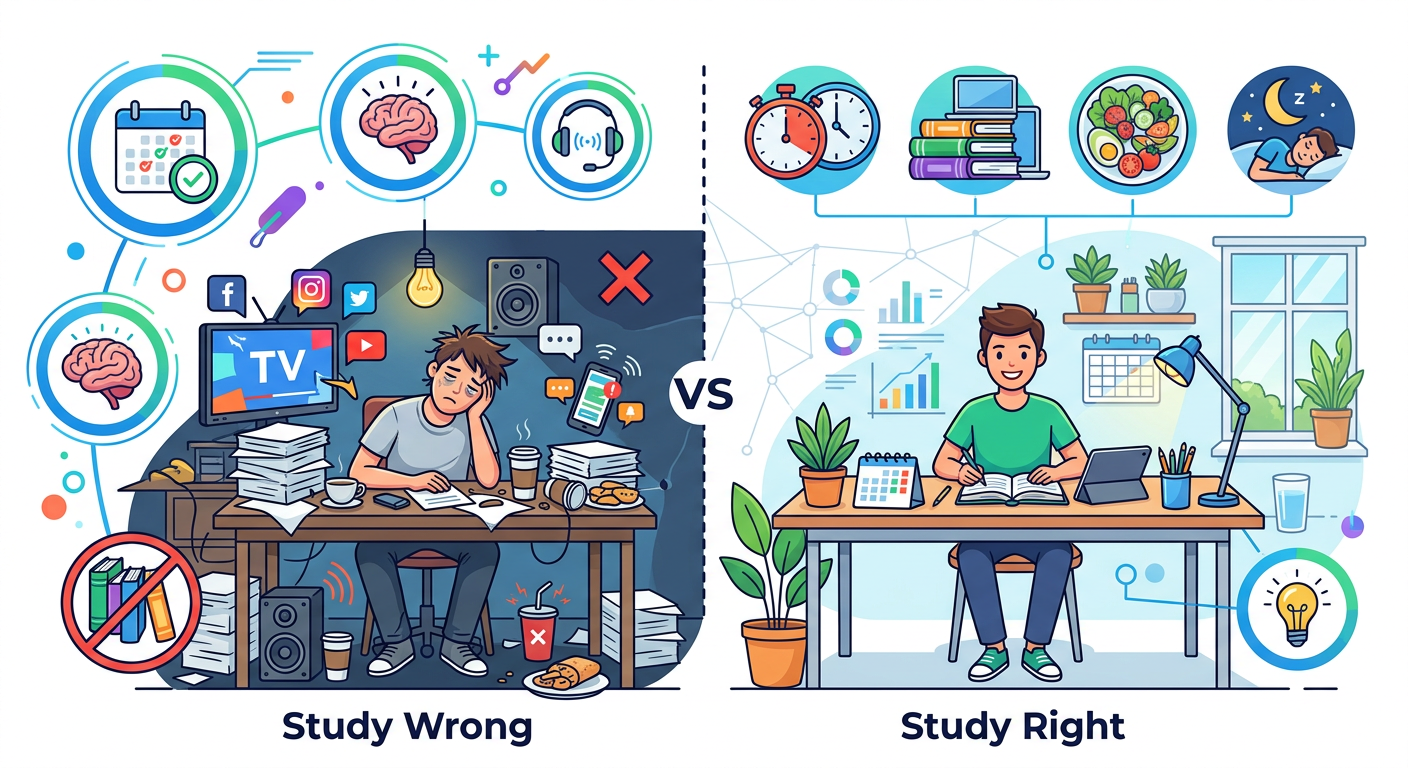
Your physical and mental state significantly influence your ability to learn and retain information. Developing smart study habits and creating an optimal environment are as crucial as the study methods themselves.
Even the most effective study strategies can falter if your surroundings are distracting or your body isn't adequately fueled and rested.
Creating a Distraction-Free Zone: Taming the Digital Beast
A cluttered, noisy, or digitally overloaded environment can drastically impair focus. Identify and eliminate common study mistakes in your setting.
Turn off social media notifications, put your phone in another room, and consider using website blockers during dedicated study time. A quiet, organized space signals to your brain that it's time to focus, improving the quality of your deep work.
The Pomodoro Technique and Time Management
The Pomodoro Technique is a simple yet powerful time management method. You break your study time into 25-minute focused bursts, called "Pomodoros," separated by short 5-minute breaks.
After four Pomodoros, you take a longer break (15-30 minutes). This structured approach helps maintain focus, prevents burnout, and ensures regular mental resets, leading to more productive study sessions.
Goal Setting: Strategic Planning for Study Sessions
Before you even open a book, set clear, specific goals for your study session. Instead of "study chemistry," aim for "master the molarity formula and solve 10 practice problems."
Specific goals provide direction, increase motivation, and allow you to measure progress, which reinforces positive study habits for success. Break down larger goals into smaller, achievable steps to avoid feeling overwhelmed.
The Importance of Regular Breaks and Exercise
Contrary to the belief that more hours equal more learning, regular breaks are vital for sustained focus and cognitive performance. Short breaks prevent mental fatigue and allow your brain to consolidate information passively.
Furthermore, physical exercise significantly boosts brain health. Even a 20-minute walk can improve memory, attention, and problem-solving abilities by increasing blood flow to the brain and releasing helpful neurotransmitters. Psychology Today offers further insights into the cognitive benefits of exercise.
Nutrition and Hydration: Fueling Your Brain for Optimal Performance
Your brain is an energy-intensive organ, consuming about 20% of your body's daily calorie intake. Proper nutrition and hydration directly impact its functioning.
A diet rich in whole foods, healthy fats, and antioxidants supports cognitive clarity and memory. Dehydration, even mild, can impair concentration, memory, and mood. Ensure you're drinking enough water throughout the day and fueling your body with nutrient-dense foods, avoiding sugary snacks that lead to energy crashes.
Beyond Rote Memorization: Developing Deeper Understanding
True learning extends far beyond simply recalling facts; it involves building robust conceptual frameworks and the ability to apply knowledge flexibly. Students often study wrong by overemphasizing rote methods.
This deeper understanding equips you not just for exams, but for real-world problem-solving and lifelong learning. It shifts the focus from "what" to "how" and "why."
Critical Thinking and Problem-Solving Skills
Critical thinking moves you from passive information absorption to active engagement. It involves analyzing information, evaluating arguments, and formulating reasoned judgments.
Developing these skills means asking probing questions, considering alternative perspectives, and identifying underlying assumptions. When you approach a topic with a critical lens, you're not just learning facts; you're developing the intellectual tools to solve complex problems, such as those found in stoichiometry word problems.
Metacognition: Learning How to Learn
Metacognition is "thinking about thinking." It's your ability to monitor and control your own learning processes. This includes assessing your understanding, identifying your learning strengths and weaknesses, and adapting your strategies accordingly.
For example, if you find yourself consistently making common molarity mistakes, metacognition prompts you to reflect on *why* and adjust your study method. Students with strong metacognitive skills are more effective learners because they can self-regulate and optimize their study efforts.
Embracing Failure: Learning from Mistakes
Many students view mistakes as evidence of failure, leading to frustration and discouragement. However, a growth mindset recognizes mistakes as invaluable learning opportunities.
Each error provides feedback, highlighting areas where understanding is weak or strategies are ineffective. Analyzing why a mistake occurred and consciously correcting it strengthens neural connections and prevents repetition. View incorrect answers on practice tests not as failures, but as signposts for what to revisit.
Seeking Feedback and Collaboration
Feedback offers an external, objective perspective on your understanding and performance. It helps you pinpoint blind spots and refine your approach. Don't shy away from asking instructors, TAs, or peers for constructive criticism.
Collaborative learning, where you discuss and explain concepts with others, also deepens understanding. It forces you to articulate your thoughts, consider different viewpoints, and collectively solve problems—a skill highly valued in academic and professional settings. The National Center for Education Statistics frequently highlights the positive impacts of collaborative learning.
Common Obstacles to Effective Studying and How to Overcome Them
Even with the best intentions, students face significant psychological and practical hurdles that derail their study efforts. Understanding these obstacles is the first step towards overcoming them.
Addressing these challenges effectively can bridge the gap between knowing how to study and genuinely implementing those strategies, ensuring you don't study wrong due to common pitfalls.
Procrastination: Understanding the Roots and Breaking the Cycle
Procrastination isn't merely laziness; it's often an emotional regulation problem. Students procrastinate to avoid negative emotions associated with a task: anxiety, boredom, or the fear of failure.
Breaking the cycle involves starting small, setting concrete deadlines, and using strategies like the Pomodoro Technique to initiate work. Focusing on the "just start" mentality, rather than the daunting entirety of a task, significantly helps overcome this pervasive obstacle.
Test Anxiety: Managing Stress and Performing Under Pressure
Test anxiety can severely impair performance, even for well-prepared students. It’s a physiological and psychological response to perceived threats.
Managing anxiety involves a combination of thorough preparation (to build confidence), mindfulness techniques (like deep breathing), visualization (imagining success), and reframing negative thoughts into more positive, empowering ones. Adequate sleep and nutrition before an exam also play a crucial role in maintaining calm and focus.
Lack of Motivation: Finding Your 'Why'
Motivation often wanes when the connection between daily study tasks and long-term goals becomes hazy. Reconnecting with your "why", your ultimate aspirations, passions, or the impact you want to make, can reignite intrinsic motivation.
Setting smaller, achievable milestones and celebrating progress also provides crucial extrinsic motivation boosts. Sometimes, just a simple change in study environment or routine can spark renewed interest. This is key to building how to study effectively.
Information Overload: Prioritizing What Matters
Modern curricula often present a vast amount of information, leading to feelings of overwhelm. This information overload can make it difficult to prioritize or distinguish essential concepts from minor details.
Effective note-taking, summarizing key ideas, and creating concept maps help filter and organize information. Learning to identify the main themes, core principles, and learning objectives for each topic allows you to focus your energy on what truly matters, preventing you from getting lost in a sea of details.
Stop Studying Wrong, Start Learning Right!
Ready to transform your academic performance with proven, science-backed study strategies? Bevinzey offers the tools and guidance you need to make every study session count. Don't just learn; master the material.
Get Started FreeFrequently Asked Questions
Why is rereading notes not an effective study method?
Rereading notes creates an illusion of familiarity, making you feel like you know the material without actually engaging in the active retrieval necessary for true learning and long-term memory. Your brain doesn't have to work hard to recognize information, so it doesn't effectively encode it.
What is active recall and how can I incorporate it into my study routine?
Active recall involves retrieving information from your memory without looking at your notes. You can incorporate it by using flashcards, teaching concepts aloud to yourself or others, doing practice questions from scratch, or simply closing your textbook and writing down everything you remember about a topic.
How does sleep impact my ability to learn and remember information?
Sleep is crucial for memory consolidation, the process where newly learned information is transferred from short-term to long-term storage in the brain. Without adequate sleep, your brain cannot effectively process and "cement" new memories, leading to poorer retention and reduced learning capacity.
Can multitasking help me study more efficiently?
No, multitasking actually reduces learning efficiency and retention. Your brain constantly switches between tasks, preventing deep focus and hindering the proper encoding of information. This "context switching" diminishes the quality of your learning and often leads to more mistakes.
What are some practical strategies to overcome procrastination?
To overcome procrastination, break tasks into smaller, manageable steps, use the Pomodoro Technique (25 minutes of focused work, 5-minute break), start with the easiest part of a task, set clear deadlines, and identify the underlying emotional reasons for delaying. Focusing on "just starting" often breaks the inertia.
How often should I take breaks while studying for optimal performance?
Short, regular breaks are essential for optimal performance. Techniques like the Pomodoro Technique suggest 5-minute breaks after every 25 minutes of focused study, and a longer break (15-30 minutes) after about 2 hours. These breaks help prevent mental fatigue, improve focus, and allow your brain to process information.
Enjoyed this article?
Share it with others who might find it helpful.
Related Articles

How to Solve Molarity Problems: Step-by-Step Mastery
Learn how to solve molarity problems step-by-step with formulas, unit tips, and worked examples so you can calculate concentration with confidence.
Mar 26, 2026

Avoid These 7 Common Molarity Mistakes in Chemistry
Master chemistry calculations! Avoid common molarity mistakes with our expert guide on unit conversions, dilution errors, and proper lab techniques.
Mar 26, 2026

What Is Molarity? The Complete Guide to Molar Concentration
Master molarity with our complete guide. Learn the formula, step-by-step calculations, and the critical differences between molarity and molality.
Mar 26, 2026

Why Molarity Matters: Converting Mass to Moles for Lab Solutions
Master chemistry with our guide to the molarity formula. Learn how to calculate concentration with step-by-step examples, units, and practical lab tips.
Mar 26, 2026

Molarity vs Molality: The Essential Difference Explained
Master the difference between molarity vs molality. Learn the formulas, key differences, and when to use each in this comprehensive chemistry guide.
Mar 26, 2026