10 Study Techniques That Actually Work (Science-Backed)

Beyond the Highlighter: Why Most Students Study Wrong
Most students spend hours rereading textbooks and color-coding notes, yet they struggle to recall that same information during an exam. This happens because these traditional methods lean on "passive review," which creates a false sense of security. When you read a chapter for the fourth time, the text feels familiar, leading your brain to mistake recognition for actual mastery.
Psychologists call this the "illusion of competence." You aren't actually learning; you are simply becoming better at recognizing the words on the page. To find study techniques that actually work, we must embrace "desirable difficulties." This concept suggests that learning should feel somewhat taxing to be effective. If your brain isn't working hard to retrieve information, it isn't building the neural pathways necessary for long-term retention.
Active learning triggers distinct neural patterns compared to passive reading. When you actively engage with material, your prefrontal cortex and hippocampus work in tandem to encode data more deeply. Highlighting is a low-utility strategy because it requires almost no cognitive effort. If you find yourself mindlessly dragging a neon marker across a page, you've essentially switched your brain to "autopilot" mode.
To truly master complex subjects, you need a proven step-by-step guide that prioritizes mental strain over comfort. Transitioning from passive to active methods is painful at first. However, that mental friction is the literal sound of your brain getting smarter.
The Gold Standard: Evidence-Based Cognitive Strategies
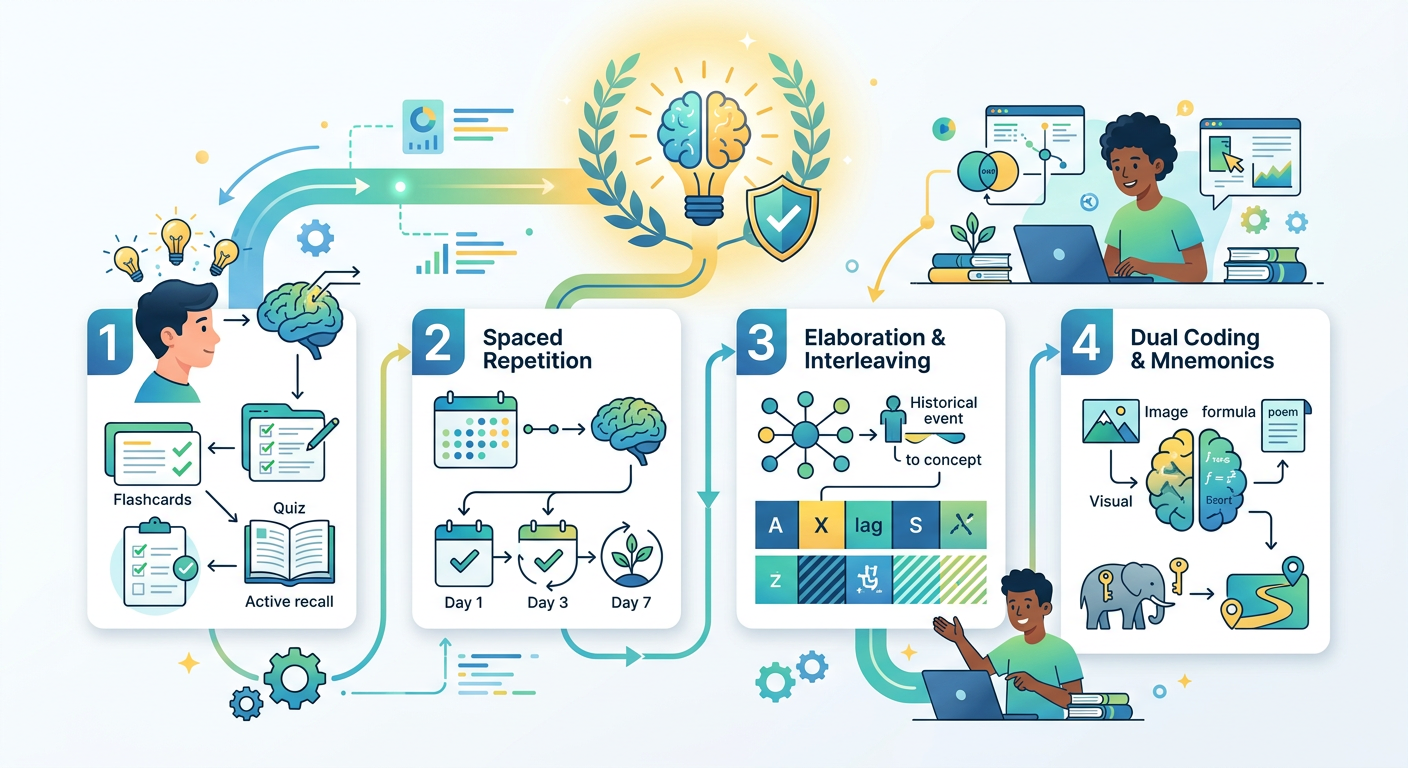
Active recall and spaced repetition are the most effective study techniques that actually work because they align with how the human brain naturally processes information. Active recall is the practice of forcing your brain to retrieve a piece of information without looking at your notes. Every time you successfully recall a fact, you strengthen the neural "bridge" to that memory, making it easier to find later.
Instead of rereading a chapter on chemistry, try closing the book and writing down everything you remember about molarity. You can then check your knowledge using molarity practice questions with answers to see where your gaps lie. This feedback loop is essential for genuine understanding.
Spaced repetition systems (SRS) solve the problem of the "Forgetting Curve." First identified by Hermann Ebbinghaus, this curve shows that we forget about 70% of new information within 24 hours if we don't review it. By spacing out your reviews—day one, day three, day seven, and so on—you "reset" the curve and move the information from short-term to long-term memory.
Interleaving vs. Blocking: Why Variety Wins
Block practice is the common habit of studying one specific topic for hours before moving to the next. Interleaving, however, involves mixing different topics or problem types in a single session. This forces your brain to constantly differentiate between concepts. According to a study published by the American Psychological Association, students who used interleaving performed significantly better on final tests than those who used blocked practice.
Deep Mastery: The Feynman Technique and Elaborative Interrogation
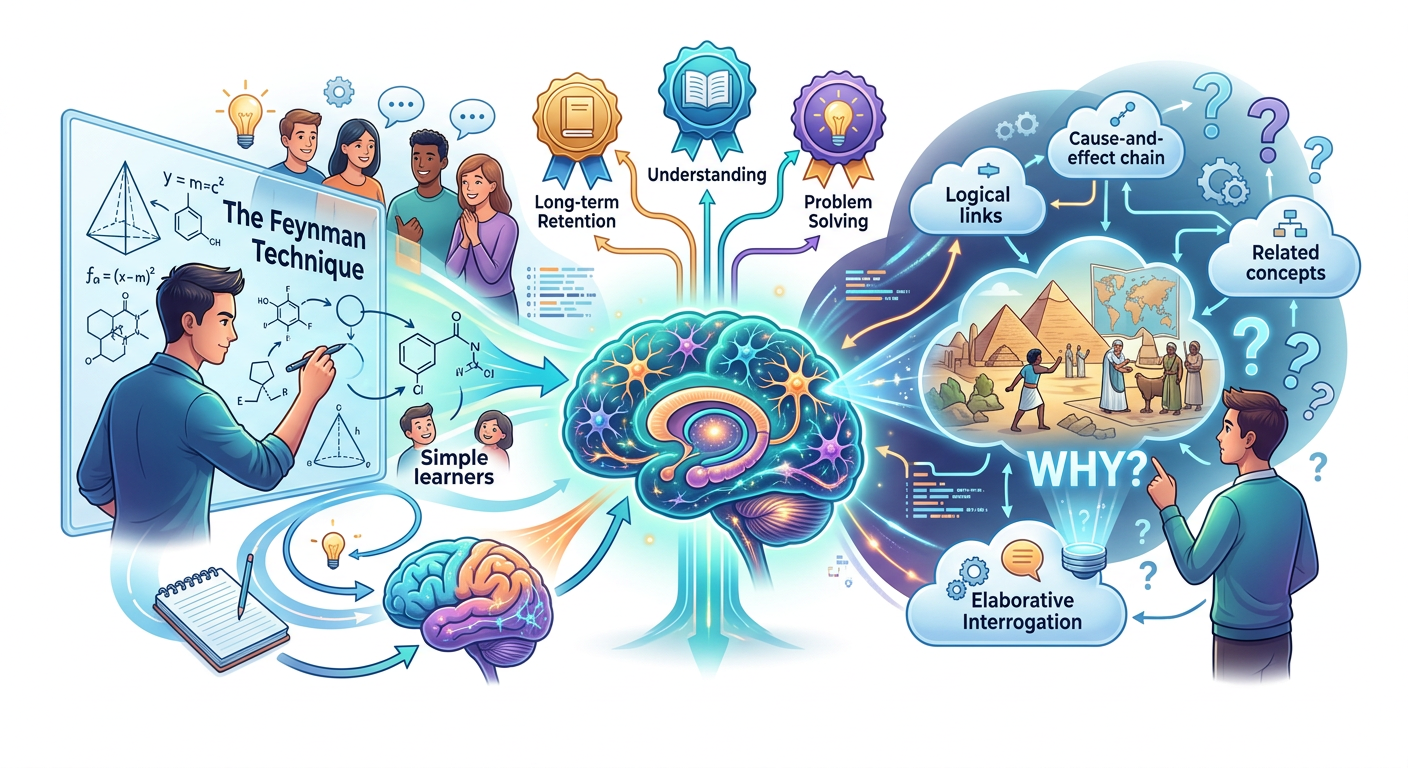
The Feynman Technique is a mental model named after the Nobel Prize-winning physicist Richard Feynman, designed to ensure you understand a concept rather than just memorizing its name. It involves four simple steps: choose a concept, teach it to a toddler (or use very simple language), identify your gaps, and review. If you cannot explain why a process occurs without using jargon, you don't truly understand it yet.
Elaborative interrogation takes this further by constantly asking "why" and "how" questions. When learning about concentration in chemistry, don't just memorize the formula; ask yourself why molality is used instead of molarity in certain temperature-dependent scenarios. Exploring the essential difference between molarity and molality helps build a mental web of connected ideas rather than isolated facts.
Dual coding is another heavy hitter in the world of study techniques that actually work. It suggests that our brains process visual and verbal information through separate channels. By combining a diagram with a written explanation, you provide your brain with two distinct pathways to retrieve the same information. This creates a "double-coding" effect that makes the memory much more resilient.
Optimizing Your Brain for Peak Performance

The human brain is not wired for multitasking; it is wired for sequential processing. When you switch from your textbook to a text message, you pay a "switching cost." Research from researchers at Stanford University shows that heavy multitaskers, those who multitask a lot and feel they are good at it, were actually worse at filtering out irrelevant information.
The Pomodoro Technique is a classic for a reason. By working in 25-minute bursts followed by a 5-minute break, you maintain a high level of focus while preventing the "cognitive load" from overwhelming your working memory. Working memory has a limited capacity, typically about four to seven chunks of information. If you try to cram too much at once, your brain effectively "overflows," and learning stops.
For more intense subjects, many students find success with the 50/10 variation. This allows for deeper "flow states" while still ensuring you don't burn out by the third hour. If you are practicing difficult calculations, such as hard molarity practice questions, the longer 50-minute blocks provide the necessary time to tackle complex, multi-step problems without interruption.
Environmental and Biological Factors in Learning
Sleep is not a luxury; it is a biological necessity for physical memory consolidation. While you sleep, your hippocampus replays the day’s learning, systematically moving it to the neocortex for long-term storage. Pulling an all-night study session is counterproductive because it prevents this crucial transfer. In fact, sleep deprivation can impair your cognitive function as much as being legally intoxicated.
Your environment also plays a role through context-dependent memory. Studies suggest that we recall information better when we are in the same environment where we learned it. However, because you likely won't take your exam in your bedroom, the better strategy is to vary your study locations. This "decontextualizes" the information, making it more accessible regardless of where you are.
Digital minimalism is the practice of removing distractions before they occur. If your phone is in the same room, your brain is actively working to ignore it. That effort uses up valuable cognitive resources that should be going toward your studies. Put your phone in another room entirely and watch your retention rates soar.
Note-Taking Systems for Better Retention
The Cornell Note-Taking System is a structured format that forces you to engage with your notes as you write them. By dividing your page into three sections—cues, notes, and a summary—you create a built-in active recall tool. The "cues" column acts as a self-test section you can use later to quiz yourself without needing to buy extra flashcards.
Visual thinkers often prefer mind mapping for complex subjects. This technique allows you to see the hierarchy and relationships between different concepts. For instance, if you are studying solution chemistry, a mind map could link molarity to molality practice questions and dilution formulas, showing how they all stem from the mole concept.
The "Pen vs. Keyboard" debate is largely settled by research. While typing is faster and allows you to record more information word-for-word, handwriting forces you to summarize and synthesize information in real-time. This extra processing step means those who take notes by hand typically have a deeper conceptual understanding of the lecture than those who type verbatim transcripts. For more on this, check out these 8 science-backed secrets to mastery.
Overcoming Procrastination and Building a Study Habit
Procrastination is rarely a time-management issue; it is usually an emotion-management issue. We avoid studying because the task feels overwhelming or boring. The "5-Minute Rule" is a powerful way to bypass this resistance. Commit to studying for just five minutes. Normally, the hardest part is starting; once the friction of beginning is gone, continuing is much easier.
Building a sustainable schedule requires metacognition—the act of thinking about your thinking. At the end of each week, review which study techniques that actually work for you and which don't. Perhaps you found that your exam strategies are strong, but your daily habits are weak. Adjusting your approach based on results is the mark of an elite student.
Identity-based habits, a concept popularized by authors like James Clear, suggest that you should focus on becoming a "studious person" rather than just "getting an A." When you view studying as part of who you are, you no longer rely on fleeting motivation. You study because that is what a dedicated student does, making the habit much harder to break over the long term.
Frequently Asked Questions
What is the most effective study technique according to science?
Active recall and spaced repetition are widely considered the most effective techniques. These methods involve testing yourself and spacing out your review sessions to ensure long-term retention and combat the forgetting curve.
How can I stay focused while studying for long periods?
Use the Pomodoro Technique (25 minutes of work followed by a 5-minute break) to prevent cognitive fatigue. Additionally, removing your smartphone from your study area significantly increases your sustained attention span.
Are the 7-3-2 and 1-3-5 study methods effective?
Yes, these are variations of spaced repetition and task prioritizing. They work well for managing workload and ensuring consistent reviews, though their effectiveness depends on whether you are using active retrieval during those sessions.
How do I stop procrastinating and start studying?
Apply the "5-Minute Rule" by committing to work for just five minutes. Most of the resistance to studying is in the transition from rest to work; once you begin, the momentum usually carries you forward.
Does listening to music help or hurt study performance?
It depends on the task. Music with lyrics can interfere with language-based tasks (reading/writing) due to the "irrelevant sound effect." Instrumental or ambient music is generally preferred for concentration.
How many hours a day should a student study?
Quality often beats quantity. For most students, 3-5 hours of intense, high-focus study is more effective than 8-10 hours of distracted, passive review. Always prioritize sleep over extra study hours.
Start Learning Smarter Today
Join thousands of students using AI-powered study tools to achieve better results.
Get Started FreeEnjoyed this article?
Share it with others who might find it helpful.
Related Articles

How to Solve Molarity Problems: Step-by-Step Mastery
Learn how to solve molarity problems step-by-step with formulas, unit tips, and worked examples so you can calculate concentration with confidence.
Mar 26, 2026

Avoid These 7 Common Molarity Mistakes in Chemistry
Master chemistry calculations! Avoid common molarity mistakes with our expert guide on unit conversions, dilution errors, and proper lab techniques.
Mar 26, 2026

What Is Molarity? The Complete Guide to Molar Concentration
Master molarity with our complete guide. Learn the formula, step-by-step calculations, and the critical differences between molarity and molality.
Mar 26, 2026

Why Molarity Matters: Converting Mass to Moles for Lab Solutions
Master chemistry with our guide to the molarity formula. Learn how to calculate concentration with step-by-step examples, units, and practical lab tips.
Mar 26, 2026

Molarity vs Molality: The Essential Difference Explained
Master the difference between molarity vs molality. Learn the formulas, key differences, and when to use each in this comprehensive chemistry guide.
Mar 26, 2026