Master Your Exams: The Ultimate Guide to Efficient Study Techniques

Many students spend countless hours with their textbooks, yet often feel their efforts don't translate into desired results. The truth is, simply putting in time doesn't guarantee mastery. Learning how to study efficiently means maximizing your output for every hour you invest, transforming your study sessions from a grind into a productive journey towards understanding and retention. This guide breaks down the science and strategies behind effective learning, helping you reclaim your time and boost your academic performance.
We'll move beyond passive techniques like endless rereading and highlighting, which often feel productive but yield little long-term gain. Instead, we'll explore methods rooted in cognitive psychology, designed to truly embed information into your memory and enhance your comprehension. Get ready to revolutionize your approach to studying.
Understanding Efficient Study: Beyond Just Rereading
Efficient studying truly means you're getting the best possible learning outcome for the time and energy you expend. It's about working smarter, not just harder. Think of it like this: if you spend two hours learning a concept and deeply understand it, retaining it for weeks, that's far more efficient than spending four hours on the same concept only to forget it by the next day.
The Pitfalls of Traditional Studying (Rereading and Highlighting)
Many students gravitate towards rereading notes or highlighting textbooks, mistakenly believing these actions equate to learning. Unfortunately, these passive methods often create an illusion of competence. When you reread, the material feels familiar, leading your brain to falsely conclude you've mastered it. Highlighting, a common practice, typically involves marking too much text without active engagement, turning a textbook into a colorful, but not necessarily understood, document. Research, including studies published in Psychological Science in the Public Interest, consistently shows that these techniques are among the least effective study strategies.
To truly learn, your brain needs to actively process, retrieve, and manipulate information. Passive activities like listening to a lecture without taking notes, or flipping through flashcards without attempting to recall the answer, often fall short of this active engagement. This is why many find themselves struggling despite significant time investment.
The Science Behind Effective Learning: Cognitive Psychology Basics
Effective learning is deeply rooted in how our brains process and store information. Key concepts from cognitive psychology, like memory formation, attention, and cognitive load, provide a framework for understanding why some study methods work better than others. Our brains don't just record information; they actively construct meaning.
Memory, especially long-term memory, strengthens through retrieval practice and spaced repetition. Attention is a finite resource; sustained focus helps encode information more effectively. Cognitive load refers to the amount of mental effort used in the working memory; effective strategies manage this load to prevent overwhelm. Understanding these basics is fundamental to adopting study techniques that actually work.
Setting the Stage for Success: Pre-Study Preparation
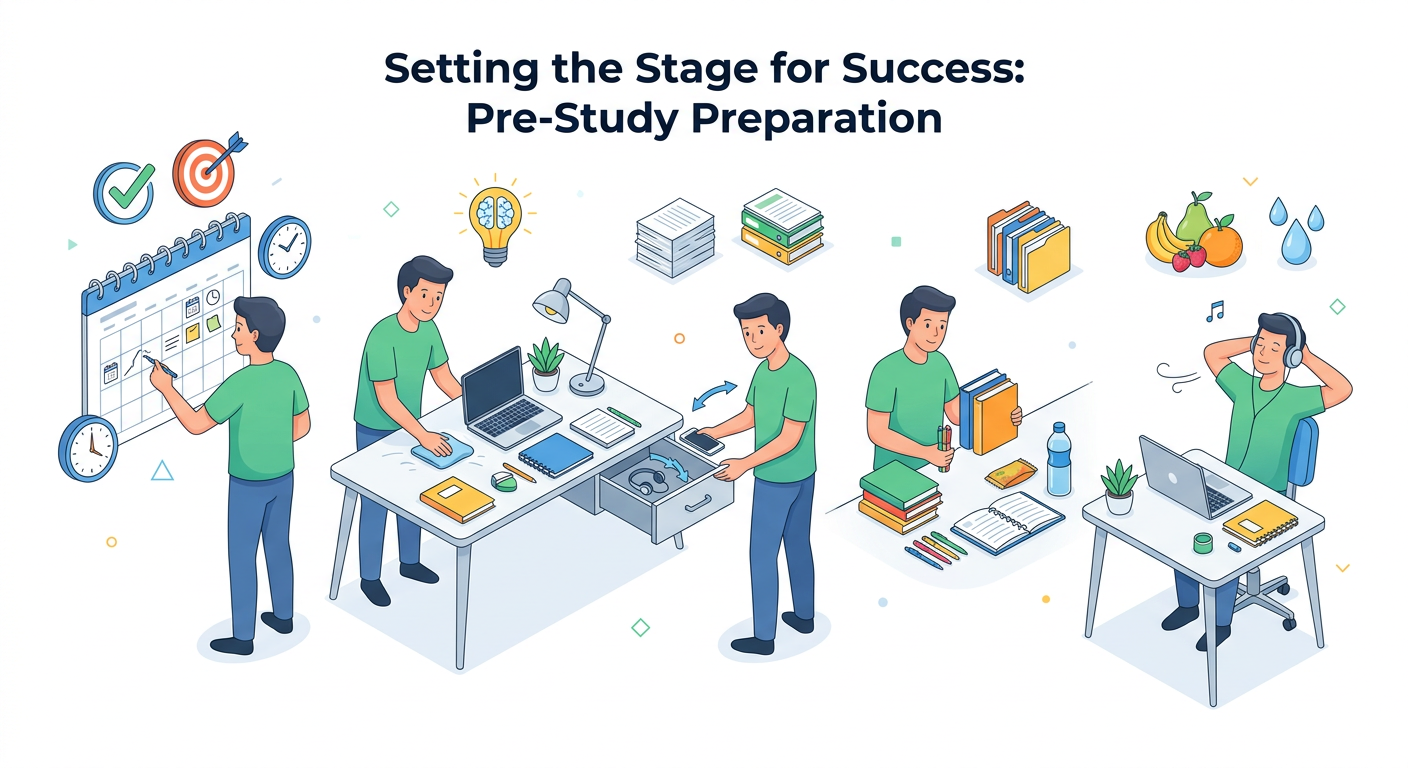
Before you even open a book, intelligent preparation can significantly boost your study efficiency. Good preparation sets clear goals and creates an environment conducive to learning, saving you precious time and effort later on.
Defining Your Learning Objectives: What Do You Need to Know?
Before any study session, you must clearly define what you intend to achieve. Rather than saying, "I'll study chemistry," ask, "What specific concepts in chemistry do I need to understand today?" Pinpointing learning objectives like "I need to understand Hess's Law and solve three related problems" provides a tangible target. This clarity allows you to focus your efforts and measure your progress meaningfully.
Optimizing Your Study Environment: Declutter and Focus
Your physical environment profoundly impacts your ability to concentrate. A tidy, well-organized study space minimizes distractions and signals to your brain that it's time to focus. Ensure good lighting, a comfortable chair, and silence (or instrumental background noise if that helps you). Turning off phone notifications and closing unnecessary tabs on your computer are crucial steps in creating a distraction-free zone. Consider trying out different locations, a library, a quiet cafe, or a dedicated desk at home, to find what works best for you, as discussed in why students study wrong.
Gathering Your Resources: Textbooks, Notes, and Digital Tools
Having all your necessary materials readily available before you start prevents interruptions and maintains flow. This includes textbooks, lecture notes, highlighters, pens, and any digital tools or websites you might need. Organize these resources logically; for instance, keep all materials for a specific chapter together. Pre-sorting resources means you spend more time learning and less time searching, making your study hours far more productive.
Strategic Planning: Your Roadmap to Mastery

Effective time management forms the backbone of efficient studying. A well-constructed study plan doesn't just dictate what you study, but also when and for how long, ensuring balanced coverage and preventing burnout.
Time Management Techniques: The Pomodoro Technique and Time Blocking
Two powerful techniques for managing study time are the Pomodoro Technique and time blocking. The Pomodoro Technique involves working for 25 minutes, then taking a 5-minute break, repeating this cycle four times before taking a longer break (20-30 minutes). This method enhances focus and prevents mental fatigue. Time blocking, on the other hand, dedicates specific blocks of time in your schedule to particular tasks or subjects. For example, you might block off 2-4 PM on Tuesdays for "Biology Chapter 5 Review." Both techniques help you maintain discipline and ensure all topics receive adequate attention, as detailed in our guide on creating an effective study schedule.
Creating a Realistic Study Schedule That Sticks
Building a study schedule requires honesty about your available time and energy levels. Don't overschedule; cramming too much into one day leads to exhaustion and reduced retention. Allocate specific times for each subject, factoring in breaks, meals, and even leisure activities. Review and adjust your schedule weekly based on your progress and any unexpected commitments. A realistic schedule is a sustainable one, preventing the common pitfalls identified in common study mistakes.
Prioritization Skills: Identifying High-Impact Topics
Not all topics are created equal in terms of importance. Learn to identify high-impact topics by reviewing syllabi, past exams, and instructor cues. Focus more time and energy on complex concepts, areas you struggle with, and topics frequently tested. This doesn't mean ignoring smaller details, but rather allocating your mental resources strategically. For instance, if you're preparing for a chemistry exam, dedicate more time to understanding stoichiometry rather than just memorizing elemental symbols. Our ultimate study plan template for students offers a structured approach to this.
Engage Your Brain: Active Learning Strategies That Work
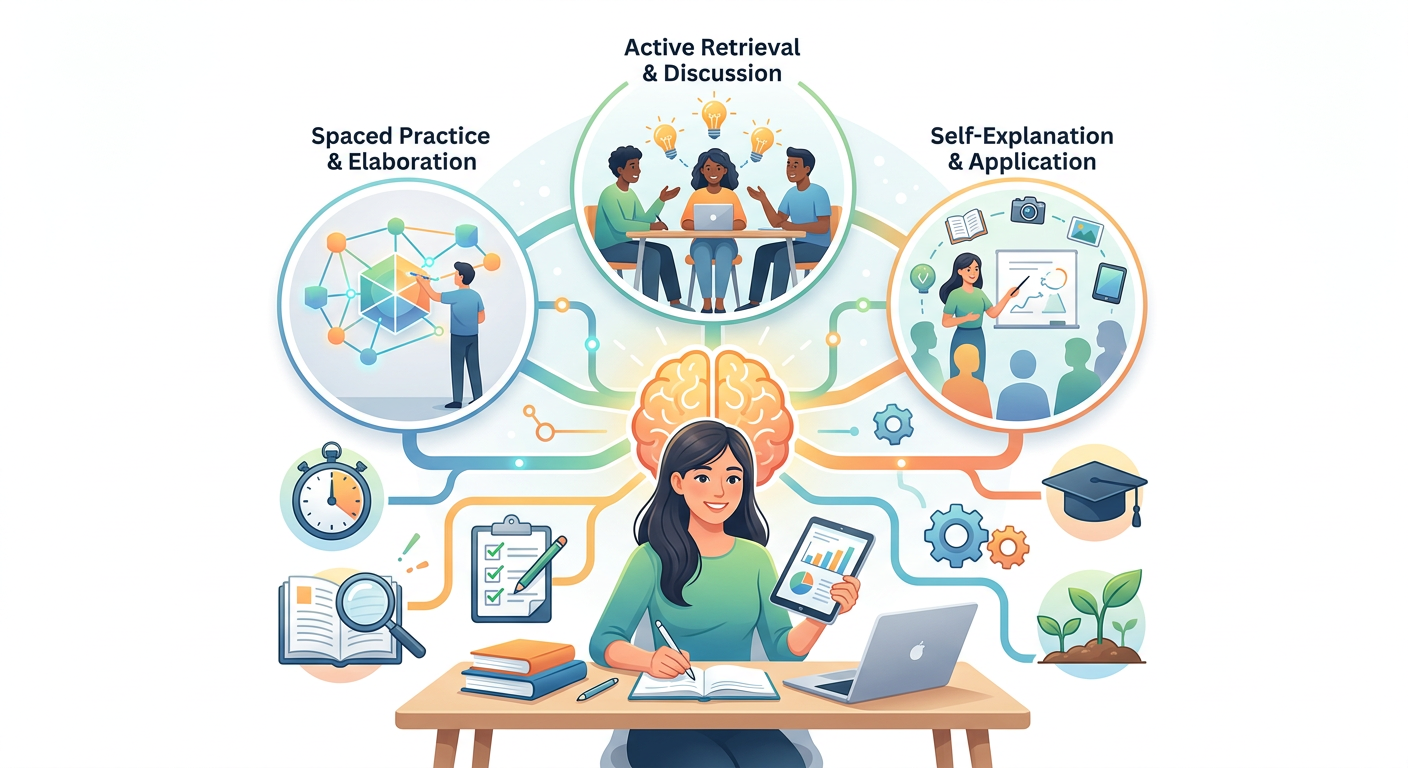
Passive consumption of information rarely leads to deep understanding or long-term retention. Active learning strategies, conversely, force your brain to engage with the material, strengthening neural pathways and improving recall.
Active Recall: Testing Yourself to Strengthen Memory
Active recall is one of the most potent learning strategies, compelling you to retrieve information directly from memory rather than just passively re-reading it. Instead of merely reviewing notes, quiz yourself on concepts, define terms without looking them up, or try to explain a topic aloud. Flashcards, practice questions, and self-made quizzes are excellent tools for active recall. This process, often uncomfortable initially, dramatically boosts retention because the act of retrieval itself strengthens the memory trace. For a deeper dive, explore mastering active recall for effective study.
Spaced Repetition: The Power of Timed Review
Spaced repetition involves reviewing material at increasing intervals over time, precisely when you're about to forget it. This method leverages the "spacing effect," where learning is more effective when study sessions are spread out. Digital flashcard apps like AIflashcard.net, Anki are built on this principle, presenting cards you're struggling with more frequently and those you know well less often. Incorporating spaced repetition into your study routine, perhaps by scheduling reviews of previous topics weekly, ensures long-term retention. The National Institutes of Health provides further insights into the cognitive science behind this.
Elaboration and Interleaving: Making Connections and Mixing It Up
Elaboration involves connecting new information to existing knowledge, asking "why" and "how" questions, and finding examples. For instance, when learning about Newton's Laws, try to explain them using real-world scenarios you encounter daily. Interleaving means mixing different subjects or topics during a single study session rather than massing practice on one topic. Instead of studying only math for three hours, switch between math, history, and chemistry every 30-60 minutes. This method helps discriminate between concepts and improves problem-solving skills across different problem types. Interleaving strengthens your overall understanding for exams and prevents rote memorization.
The Feynman Technique: Explaining to Understand
The Feynman Technique is a powerful mental model for learning complex concepts by simplifying and explaining them. First, choose a topic you want to understand. Second, try to explain it in simple terms as if teaching it to someone completely unfamiliar with the subject (even a child). Third, identify gaps in your knowledge where you struggle to explain clearly. Fourth, go back to your resources to fill those gaps. Finally, refine your explanation, using simple analogies to clarify. This iterative process forces deep understanding and exposes any superficial learning. It’s an exceptional method for students looking to study effectively step by step.
Transform Your Study Habits with Bevinzey
Ready to stop struggling and start mastering your subjects? Bevinzey provides the tools and structured approach you need to apply these efficient study techniques effectively. Organize your notes, create powerful flashcards, and track your progress to achieve academic excellence.
Get Started FreeOptimizing Your Learning Style and Resources
While often debated, understanding how you best absorb information can refine your approach. Crucially, don't limit yourself to one style; diversify your resources for comprehensive understanding.
Understanding Your Learning Preferences (and Moving Beyond Them)
You might identify as a "visual learner" or an "auditory learner," but research suggests that strictly adhering to a single learning style can be limiting. While you might have preferences, engaging multiple senses and learning modalities generally leads to better retention. For example, even if you prefer visual learning, try explaining a concept aloud (auditory/verbal) or creating a physical model (kinesthetic). This multi-modal approach creates stronger memory traces. Recognize your preferences, but embrace variety for deeper learning, as emphasized in guidance from the U.S. Department of Education.
Leveraging Diverse Resources: Videos, Podcasts, and Interactive Tools
Don't confine your learning to textbooks alone. The digital age offers an abundance of supplementary resources that can clarify complex topics and make learning more engaging. Watch educational videos on YouTube or Khan Academy, listen to podcasts while commuting, or use interactive simulations and quizzes. These diverse formats can present information in new ways, catering to different thinking styles and reinforcing understanding from multiple angles. For instance, if you're struggling with what molarity is, watching a detailed video explanation might be more helpful than just reading the textbook.
The Role of Note-Taking: Beyond Transcription to Comprehension
Effective note-taking is not about copying verbatim what's on a slide or in a book; it's about active processing. Methods like the Cornell Notes system, which divides your page into sections for main notes, cues, and a summary, encourage active summarization and retrieval practice. Mind mapping visually connects ideas, making complex relationships clearer. Instead of writing everything down, focus on key concepts, draw diagrams, and use abbreviations. The act of summarizing and synthesizing information in your own words during note-taking significantly enhances comprehension and retention. This is an essential skill, often neglected, that dramatically boosts how to study efficiently.
Overcoming Obstacles: Common Challenges and Solutions
Every student faces hurdles, from the magnetic pull of procrastination to the overwhelming tide of information. Recognizing these challenges and having strategies to tackle them head-on is crucial for sustained academic success.
Battling Procrastination: Strategies to Get Started
Procrastination can cripple even the most well-intentioned study plans. To combat it, try the 'five-minute rule': commit to working on a task for just five minutes. Often, once you start, the momentum builds, and you continue for much longer. Break large tasks into smaller, more manageable chunks. If a chapter feels overwhelming, focus on reading just one subheading. Reward yourself for starting and for completing tasks, reinforcing positive habits. Acknowledging that procrastination often stems from fear of failure or perfectionism can also help address its root causes, as explored in why students study wrong.
Managing Distractions in a Digital Age
Smartphones and the internet are constant sources of distraction. To manage them, try using website blockers or productivity apps during study sessions. Turn off non-essential notifications, or put your phone in another room entirely. Create a "digital detox" period specifically for studying. If you need your computer for study, close all irrelevant tabs and apps. Even putting a "Do Not Disturb" sign on your door can signal to others (and yourself) that you need uninterrupted focus. This disciplined approach is essential for anyone trying to figure out how to study efficiently.
Dealing with Information Overload: Focus on What Matters
In an era of information abundance, it's easy to feel swamped. Prioritize. Refer back to your learning objectives and focus on the core concepts and skills required. Don't feel compelled to absorb every single detail if it's not central to your understanding or assessment. Skim academic papers for key arguments, and don't get lost in tangential research. Use concept maps or outlines to visually organize complex information, helping you see the forest not just the trees. Being selective is not about being lazy; it's about being strategic.
Combating Burnout: The Importance of Breaks and Self-Care
Sustained, intense studying without breaks leads to burnout, diminishing both learning and well-being. Regular breaks are non-negotiable. Step away from your study materials every 25-50 minutes (as with the Pomodoro Technique) to move around, stretch, or do something enjoyable. Ensure you're getting adequate sleep – 7-9 hours for most adults – as sleep is crucial for memory consolidation. Eat nutritious meals, stay hydrated, and incorporate physical activity into your routine. These self-care practices aren't luxuries; they are fundamental components of maintaining the mental stamina required for effective and efficient study. For additional reading on student wellbeing, Psychological Science often publishes relevant studies.
Measuring Progress and Adapting Your Approach
Effective studying isn't a static process; it's dynamic. Regularly assessing your progress and being willing to adjust your methods ensures you remain on the most efficient path to mastery.
Self-Assessment and Practice Tests: Identifying Knowledge Gaps
The most reliable way to know what you truly understand (and what you don't) is through self-assessment. Don't wait for graded exams. Regularly take practice tests, work through end-of-chapter questions, or use online quizzes. Pay close attention to the questions you answer incorrectly; these are your knowledge gaps. Instead of just noting the wrong answer, spend time understanding why it was wrong and review the associated material. This targeted approach saves immense study time, focusing your efforts where they're most needed and embodying the principles of how to study efficiently. Practice questions, such as our molarity practice questions, are excellent for this.
Analyzing Your Study Performance: What's Working and What Isn't?
After a study session or a quiz, take a few minutes to reflect. Ask yourself: Was this method effective for this topic? Did I maintain focus? Did I retain the information I set out to learn? If you consistently struggle with certain types of problems or retain little from specific study methods, it's a clear signal to change your approach. Keep a brief study journal to track what strategies you used and their perceived effectiveness. This meta-cognition, thinking about your thinking, is a hallmark of successful learners.
Flexibility is Key: Adjusting Your Strategy as Needed
No single study method works for every subject or every individual all the time. Be flexible and adapt your strategies based on the material, your current energy levels, and your performance feedback. If active recall isn't working for a highly conceptual subject, try teaching it to someone else (Feynman Technique). If you're feeling overwhelmed, pare down your goals for a session. The ability to pivot and adjust your study plan based on real-time feedback is perhaps the most efficient study skill of all. It ensures your efforts are always channeled into the most productive avenues.
Frequently Asked Questions
What is the most effective study technique for exams?
The most effective study technique for exams is active recall combined with spaced repetition. Actively testing yourself (active recall) significantly strengthens memory, and reviewing material at increasing intervals (spaced repetition) ensures long-term retention. These two methods, often used together with tools like flashcards, consistently outperform passive techniques like rereading.
How can I stay motivated to study for long periods?
To stay motivated, set clear, achievable goals for each study session, use the Pomodoro Technique to incorporate regular breaks, and reward yourself for completing tasks. Breaking large tasks into smaller ones reduces overwhelm. Also, remind yourself of your long-term academic goals and the benefits of mastering the material.
Is it better to study alone or in a group?
Both solo and group study have benefits. Solo study is excellent for deep focus and initial learning, allowing you to develop independent understanding. Group study can be beneficial for discussing complex concepts, clarifying doubts, and teaching each other (which is a powerful learning tool), but it requires disciplined participants to remain productive.
How do I balance studying with other commitments?
Balancing commitments requires careful time management. Create a realistic weekly schedule that blocks out dedicated time for studying, classes, work, sleep, and personal activities. Prioritize tasks, learn to say no to non-essential activities, and remember that consistent, shorter study sessions are often more effective than infrequent, long cramming sessions.
What are some common mistakes to avoid when studying?
Avoid passive studying (like just rereading and highlighting), multitasking, cramming everything last minute, neglecting sleep, and studying in a distracting environment. Also, don't shy away from challenging material; confronting your weaknesses leads to greater understanding.
How much sleep do I need to optimize my learning?
Most adults require 7-9 hours of quality sleep per night to optimize learning and memory consolidation. During sleep, your brain processes and stores information learned throughout the day. Chronic sleep deprivation impairs concentration, problem-solving skills, and the ability to form new memories, making study efforts far less productive.
Enjoyed this article?
Share it with others who might find it helpful.
Related Articles

How to Solve Molarity Problems: Step-by-Step Mastery
Learn how to solve molarity problems step-by-step with formulas, unit tips, and worked examples so you can calculate concentration with confidence.
Mar 26, 2026

Avoid These 7 Common Molarity Mistakes in Chemistry
Master chemistry calculations! Avoid common molarity mistakes with our expert guide on unit conversions, dilution errors, and proper lab techniques.
Mar 26, 2026

What Is Molarity? The Complete Guide to Molar Concentration
Master molarity with our complete guide. Learn the formula, step-by-step calculations, and the critical differences between molarity and molality.
Mar 26, 2026

Why Molarity Matters: Converting Mass to Moles for Lab Solutions
Master chemistry with our guide to the molarity formula. Learn how to calculate concentration with step-by-step examples, units, and practical lab tips.
Mar 26, 2026

Molarity vs Molality: The Essential Difference Explained
Master the difference between molarity vs molality. Learn the formulas, key differences, and when to use each in this comprehensive chemistry guide.
Mar 26, 2026