Unit Conversion Practice Questions with Answers
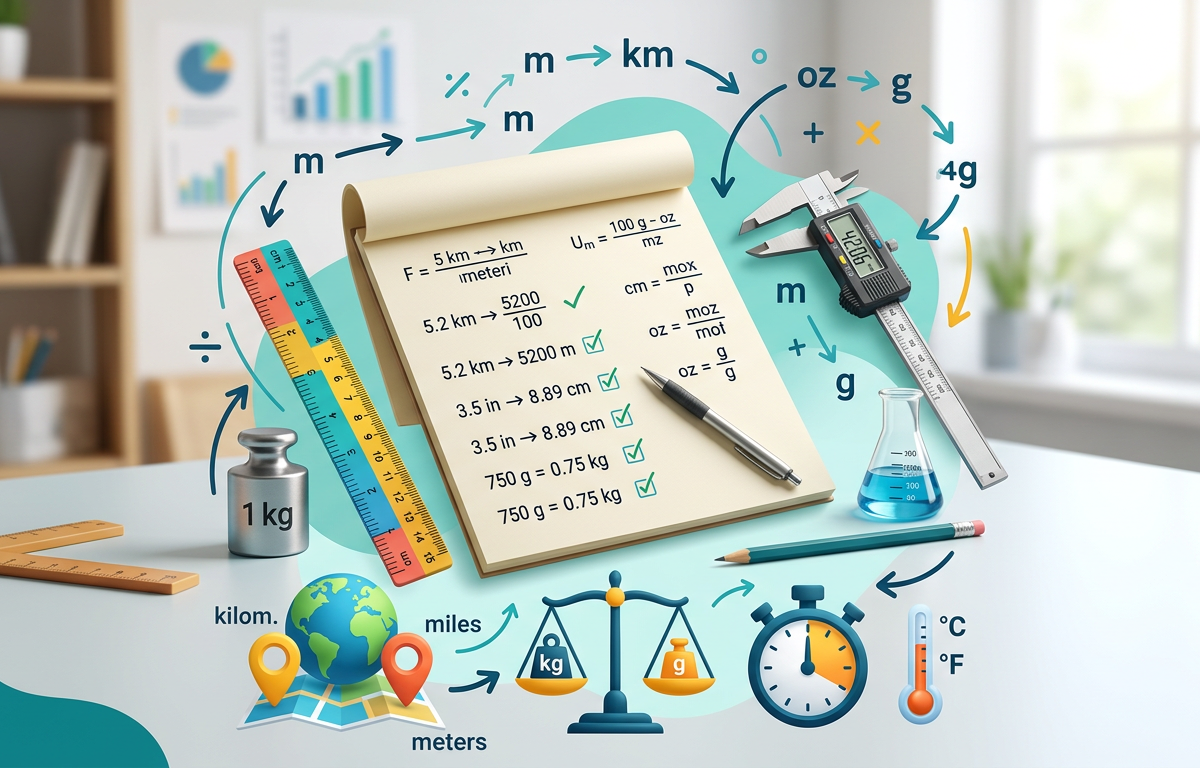
Unit conversion is the process of changing the measurement of a quantity from one unit to another while maintaining the same physical value. Mastering Unit Conversion Practice Questions is essential for success in fields ranging from engineering and medicine to everyday activities like cooking or traveling. Whether you are dealing with the Metric System, the Imperial System, or converting between the two, understanding the underlying mathematical relationships ensures accuracy in scientific calculations and real-world applications. This guide provides a deep dive into the methodology of dimensional analysis and offers a variety of problems to sharpen your skills.
Concept Explanation
Unit conversion is a multi-step process that involves multiplying a given measurement by a conversion factor, a ratio that expresses the relationship between two different units and equals one. The core principle relies on dimensional analysis, where units are treated like algebraic variables that can be canceled out. To convert units successfully, you must identify the starting unit, the desired target unit, and the specific conversion factor that links them. For instance, knowing that 1 inch equals 2.54 centimeters allows you to move between the Imperial and Metric systems with precision.
When performing these calculations, it is helpful to understand the hierarchy of the Metric System, which uses powers of ten. This is closely related to how we handle exponents and powers in mathematics. Common prefixes include kilo- (1,000), centi- (0.01), and milli- (0.001). For more complex problems involving rates, such as converting miles per hour to meters per second, you must apply multiple conversion factors in a chain, ensuring that each intermediate unit cancels out correctly.
Measurement Type Common Units Conversion Example Length Meters, Feet, Inches, Miles 1 mile = 1.609 kilometers Mass Grams, Kilograms, Pounds, Ounces 1 kilogram = 2.204 pounds Volume Liters, Gallons, Milliliters 1 gallon = 3.785 liters
Solved Examples
Reviewing step-by-step solutions is the best way to understand how to set up conversion equations. Here are four examples ranging from simple to complex.
Single-Step Metric Conversion: Convert 4500 milliliters (mL) to Liters (L).
Identify the conversion factor: 1000 mL = 1 L.
Set up the equation: 4500 mL × (1 L / 1000 mL).
Cancel the mL units and divide: 4500 / 1000 = 4.5.
Final Answer: 4.5 L.
Imperial to Metric Conversion: A person weighs 165 pounds (lbs). What is their mass in kilograms (kg)? (Use 1 kg = 2.2 lbs)
Identify the conversion factor: 1 kg / 2.2 lbs.
Set up the equation: 165 lbs × (1 kg / 2.2 lbs).
Cancel the lbs units and divide: 165 / 2.2 = 75.
Final Answer: 75 kg.
Multi-Step Length Conversion: Convert 5 miles into inches.
Identify factors: 1 mile = 5280 feet; 1 foot = 12 inches.
Set up the chain: 5 miles × (5280 ft / 1 mile) × (12 in / 1 ft).
Multiply across: 5 × 5280 × 12 = 316,800.
Final Answer: 316,800 inches.
Rate Conversion: Convert 60 miles per hour (mph) to feet per second (ft/s).
Identify factors: 1 mile = 5280 ft; 1 hour = 3600 seconds.
Set up the equation: (60 miles / 1 hr) × (5280 ft / 1 mile) × (1 hr / 3600 s).
Calculate: (60 × 5280) / 3600 = 316,800 / 3600 = 88.
Final Answer: 88 ft/s.
Practice Questions
Test your knowledge with these unit conversion practice questions. For more complex numerical reasoning, you might also find our linear equations practice questions useful.
Convert 8.5 kilometers (km) to meters (m).
A recipe requires 350 grams of flour. Convert this mass to kilograms (kg).
A car's gas tank holds 15 gallons. How many liters (L) is this? (Use 1 gallon = 3.785 L).
Want unlimited practice questions like these?
Generate AI-powered questions with step-by-step solutions on any topic.
Try Question Generator Free →Convert 72 inches to yards. (12 inches = 1 foot; 3 feet = 1 yard).
A runner completes a 10K race (10 kilometers). How many miles is this? (Use 1 mile = 1.609 km).
Convert a temperature of 25°C to Kelvin (K). (Formula: K = °C + 273.15).
A square tile has an area of 144 square inches. Convert this to square feet.
The speed of sound is approximately 343 meters per second. Convert this to kilometers per hour.
A bottle of medicine contains 0.25 grams of an active ingredient. How many milligrams (mg) is this?
Convert 5 cubic meters (m³) to liters (L). (1 m³ = 1000 L).
Answers & Explanations
8,500 m: Since 1 km = 1000 m, multiply 8.5 by 1000.
0.35 kg: Since 1000 g = 1 kg, divide 350 by 1000.
56.775 L: Multiply 15 gallons by 3.785 L/gallon.
2 yards: First, 72 / 12 = 6 feet. Then, 6 / 3 = 2 yards.
6.22 miles: Divide 10 km by 1.609 km/mile (10 / 1.609 ≈ 6.22).
298.15 K: Add 25 to 273.15.
1 square foot: Since 1 foot = 12 inches, 1 sq ft = 12 × 12 = 144 sq inches. Thus, 144 / 144 = 1.
1,234.8 km/h: (343 m / 1 s) × (1 km / 1000 m) × (3600 s / 1 hr) = (343 × 3600) / 1000 = 1234.8.
250 mg: Since 1 g = 1000 mg, multiply 0.25 by 1000.
5,000 L: Multiply 5 m³ by 1000 L/m³.
1. How many centimeters are in 2.5 meters?
Frequently Asked Questions
What is the easiest way to remember metric conversions?
The easiest way is to use the mnemonic "King Henry Died By Drinking Chocolate Milk," which stands for Kilo, Hecto, Deca, Base (meter, liter, gram), Deci, Centi, and Milli. Each step represents a power of ten, making it simple to move the decimal point left or right.
Why is dimensional analysis important in unit conversion?
Dimensional analysis is a foolproof method that ensures you are multiplying or dividing correctly by treating units as factors that cancel out. It prevents common errors, such as multiplying when you should be dividing, especially in multi-step problems.
How do you convert units of area and volume?
To convert area, you must square the linear conversion factor; for volume, you must cube it. For example, since 1 foot = 12 inches, 1 square foot = 144 square inches (12 squared), and 1 cubic foot = 1,728 cubic inches (12 cubed).
What is the difference between the Metric and Imperial systems?
The Metric system, used by most of the world and in science, is based on powers of ten. The Imperial system, used primarily in the United States, uses legacy units like feet, pounds, and gallons with non-uniform conversion factors, such as 12 inches in a foot or 16 ounces in a pound.
Can I use the same conversion methods for temperature?
No, temperature conversions usually require specific formulas rather than simple multiplication because their scales (Celsius, Fahrenheit, and Kelvin) do not share a zero point. For example, converting Celsius to Fahrenheit requires multiplying by 9/5 and adding 32, as detailed by the National Institute of Standards and Technology.
Want unlimited practice questions like these?
Generate AI-powered questions with step-by-step solutions on any topic.
Try Question Generator Free →
Want unlimited practice questions like these?
Generate AI-powered questions with step-by-step solutions on any topic.
Try Question Generator Free →Enjoyed this article?
Share it with others who might find it helpful.
Related Articles
Hard Le Chatelier’s Principle Practice Questions
Master Hard Le Chatelier’s Principle Practice Questions with our comprehensive guide featuring solved examples, practice problems, and detailed explanations.
Mar 30, 2026

Hard Reaction Quotient (Q) Practice Questions
Hard Reaction Quotient (Q) Practice Questions
Mar 30, 2026

Grams to Moles Practice Questions with Answers
Master grams to moles conversions with our comprehensive guide. Includes step-by-step examples, practice questions, and detailed answers for chemistry students.
Mar 26, 2026
Avogadro’s Number Practice Questions with Answers
Master the mole concept with our Avogadro’s Number practice questions. Includes step-by-step solved examples, a quick quiz, and detailed explanations.
Mar 26, 2026
Empirical Formulas: Solving Ratios from Mass and Percent Data
Master empirical formula calculations with 10 practice questions, worked answers, and a free step-by-step calculator for mass, percentage, and combustion problems.
Mar 26, 2026