Linear Equations Practice Questions with Answers
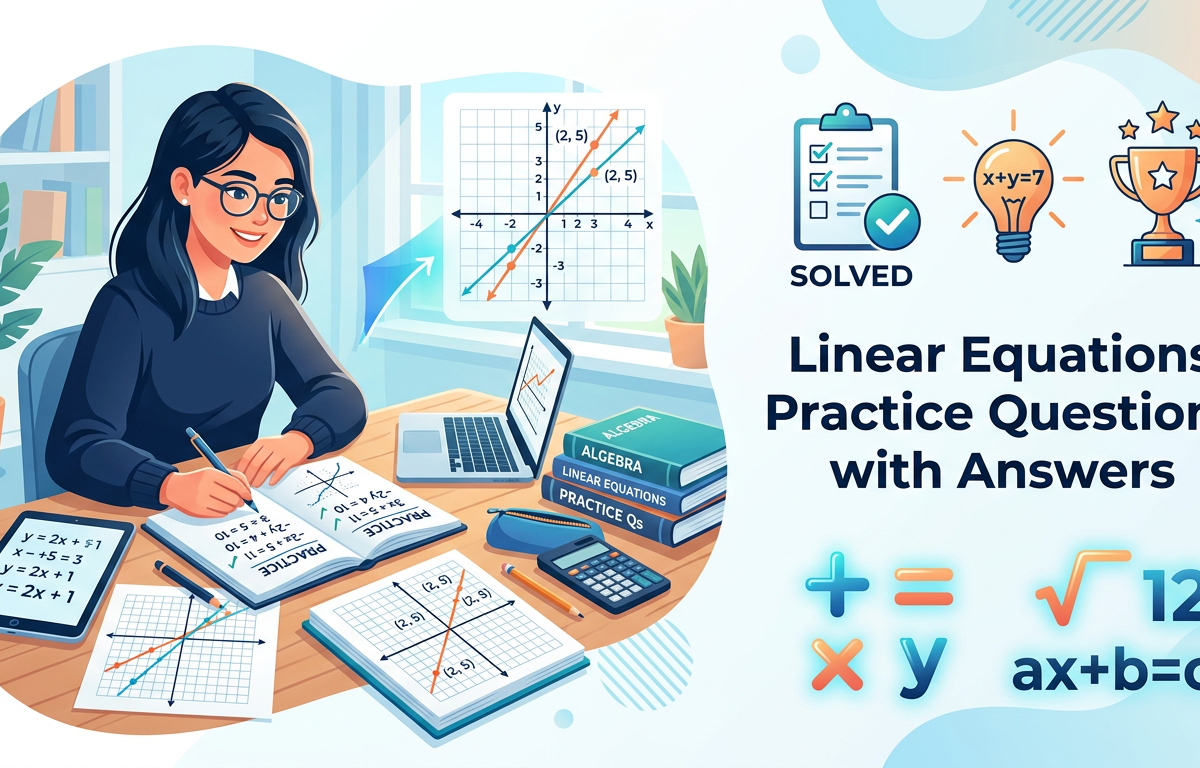
Mastering linear equations is a fundamental milestone in mathematics, serving as the gateway to advanced topics like calculus, physics, and economics. A linear equation is an algebraic equation in which each term is either a constant or the product of a constant and a single variable, representing a straight line when graphed on a coordinate plane. Whether you are simplifying expressions or modeling real-world growth, these equations provide the essential framework for solving unknown values.
Concept Explanation
Linear equations are mathematical statements that use an equal sign to show that two algebraic expressions are equivalent, where the highest power of the variable is always one. These equations can appear in several forms, most commonly the slope-intercept form (y = mx + b), the point-slope form, or the standard form (Ax + By = C). The primary goal in solving a linear equation is to isolate the variable on one side of the equation to find its specific value.
To solve these equations effectively, you must apply the Golden Rule of Algebra: whatever operation you perform on one side of the equation, you must perform on the other. This ensures the equality remains balanced. Common operations include:
Addition and Subtraction: Used to move constants or variable terms across the equal sign.
Multiplication and Division: Used to eliminate coefficients attached to the variable.
Distributive Property: Used to remove parentheses by multiplying a term outside the bracket by every term inside.
Linear equations are not just abstract symbols; they are used by organizations like NASA to calculate trajectories and by financial analysts to predict market trends. If you find yourself struggling with complex terms, you might want to review factoring polynomials to strengthen your algebraic foundation.
Solved Examples
Understanding the step-by-step logic behind solving linear equations helps prevent common errors. Here are three fully worked examples.
Example 1: Basic One-Step Equation
Solve for x: x + 15 = 42
Identify the operation performed on x (addition of 15).
Apply the inverse operation (subtraction) to both sides.
x + 15 - 15 = 42 - 15
x = 27
Example 2: Two-Step Equation with Fractions
Solve for y: (2/3)y - 4 = 10
Add 4 to both sides to isolate the variable term: (2/3)y = 14.
To clear the fraction, multiply both sides by the reciprocal (3/2).
y = 14 * (3/2)
y = 21
Example 3: Variables on Both Sides
Solve for z: 5z - 3 = 2z + 12
Subtract 2z from both sides to bring variables to the left: 3z - 3 = 12.
Add 3 to both sides to move the constant: 3z = 15.
Divide by 3 to solve for z: z = 5.
Practice Questions
Test your skills with these linear equations practice questions. They range from basic isolation to complex multi-step problems.
1. Solve for x: 4x - 7 = 13
2. Solve for m: 12 - 3m = 24
3. Solve for p: 5(p + 2) = 25
Want unlimited practice questions like these?
Generate AI-powered questions with step-by-step solutions on any topic.
Try Question Generator Free →4. Solve for y: 2y + 9 = 5y - 6
5. Solve for x: (x/4) + 5 = 2
6. Solve for a: 3(2a - 1) = 4a + 11
7. Solve for k: 0.5k + 2.1 = 4.6
8. Solve for x: 7x - (2x + 3) = 12
9. Solve for w: (2w - 5) / 3 = 7
10. Solve for x: 4(x - 2) = 2(x + 6)
Answers & Explanations
Review your work using the detailed solutions provided below. If you struggle with questions involving negative distributions, consider practicing with inequalities practice questions which use similar logic.
Answer: x = 5. Add 7 to both sides (4x = 20), then divide by 4.
Answer: m = -4. Subtract 12 from both sides (-3m = 12), then divide by -3.
Answer: p = 3. Distribute the 5 (5p + 10 = 25), subtract 10 (5p = 15), and divide by 5.
Answer: y = 5. Subtract 2y from both sides (9 = 3y - 6), add 6 (15 = 3y), and divide by 3.
Answer: x = -12. Subtract 5 from both sides (x/4 = -3), then multiply by 4.
Answer: a = 7. Distribute the 3 (6a - 3 = 4a + 11), subtract 4a (2a - 3 = 11), add 3 (2a = 14), and divide by 2.
Answer: k = 5. Subtract 2.1 from both sides (0.5k = 2.5), then divide by 0.5.
Answer: x = 3. Distribute the negative sign (7x - 2x - 3 = 12), combine like terms (5x - 3 = 12), add 3 (5x = 15), and divide by 5.
Answer: w = 13. Multiply both sides by 3 (2w - 5 = 21), add 5 (2w = 26), and divide by 2.
Answer: x = 10. Distribute both sides (4x - 8 = 2x + 12), subtract 2x (2x - 8 = 12), add 8 (2x = 20), and divide by 2.
1. Which of the following is the correct first step to solve 3x + 5 = 20?
Frequently Asked Questions
What is the difference between a linear and a quadratic equation?
A linear equation has a variable with a maximum exponent of 1 and forms a straight line, while a quadratic equation has a variable squared (exponent of 2) and forms a parabola. You can explore more about the latter in our quadratic equations practice questions guide.
How do you know if a linear equation has no solution?
An equation has no solution if, after simplifying, you reach a false mathematical statement like 5 = 10. This occurs when the variable terms on both sides cancel out, but the constant terms are unequal, indicating the lines are parallel and never intersect.
Can a linear equation have more than one variable?
Yes, linear equations can have multiple variables, such as 2x + 3y = 12. These are often solved using systems of equations or graphed as lines in a multi-dimensional coordinate system to find points of intersection.
Why is it called a "linear" equation?
It is called linear because the word is derived from "line." When you plot all the possible solutions (ordered pairs) of a linear equation on a Cartesian plane, they form a perfectly straight line according to Khan Academy mathematical standards.
What is the standard form of a linear equation?
The standard form is expressed as Ax + By = C, where A, B, and C are integers, and A and B are not both zero. This form is particularly useful for finding x and y intercepts quickly by setting one variable to zero.
Want unlimited practice questions like these?
Generate AI-powered questions with step-by-step solutions on any topic.
Try Question Generator Free →
Want unlimited practice questions like these?
Generate AI-powered questions with step-by-step solutions on any topic.
Try Question Generator Free →Enjoyed this article?
Share it with others who might find it helpful.
Related Articles
Quadratic Equations Practice Questions with Answers
Master quadratic equations with our comprehensive guide featuring solved examples, practice questions, and detailed explanations for all skill levels.
Apr 6, 2026

Decimal Conversion Practice Questions with Answers
Master decimal conversion with our comprehensive guide featuring solved examples, practice questions, and a quick quiz to sharpen your math skills.
Apr 6, 2026

Fraction Practice Questions with Answers
Fraction Practice Questions with Answers
Apr 6, 2026

Solving Time-Shift Algebra: How to Model Age Ratios and Sums
Master age problems with our comprehensive guide featuring solved examples, practice questions, and detailed algebraic explanations for all levels.
Apr 6, 2026

Logarithm Practice Questions with Answers
Master logarithms with our guide featuring core concepts, solved examples, and 10 practice questions with detailed answers to help you ace your math exams.
Apr 6, 2026
Exponents and Powers Practice Questions with Answers
Master exponents and powers with our comprehensive guide featuring core laws, solved examples, and 10 practice questions with detailed answers.
Apr 6, 2026

Absolute Value Equation Practice Questions with Answers
Master the absolute value equation with our comprehensive guide. Includes step-by-step solved examples, practice questions, and detailed explanations.
Apr 6, 2026

Inequalities Practice Questions with Answers
Master inequalities with our comprehensive guide featuring solved examples, practice questions, and detailed explanations for all skill levels.
Apr 6, 2026