Exponents and Powers Practice Questions with Answers
Concept Explanation
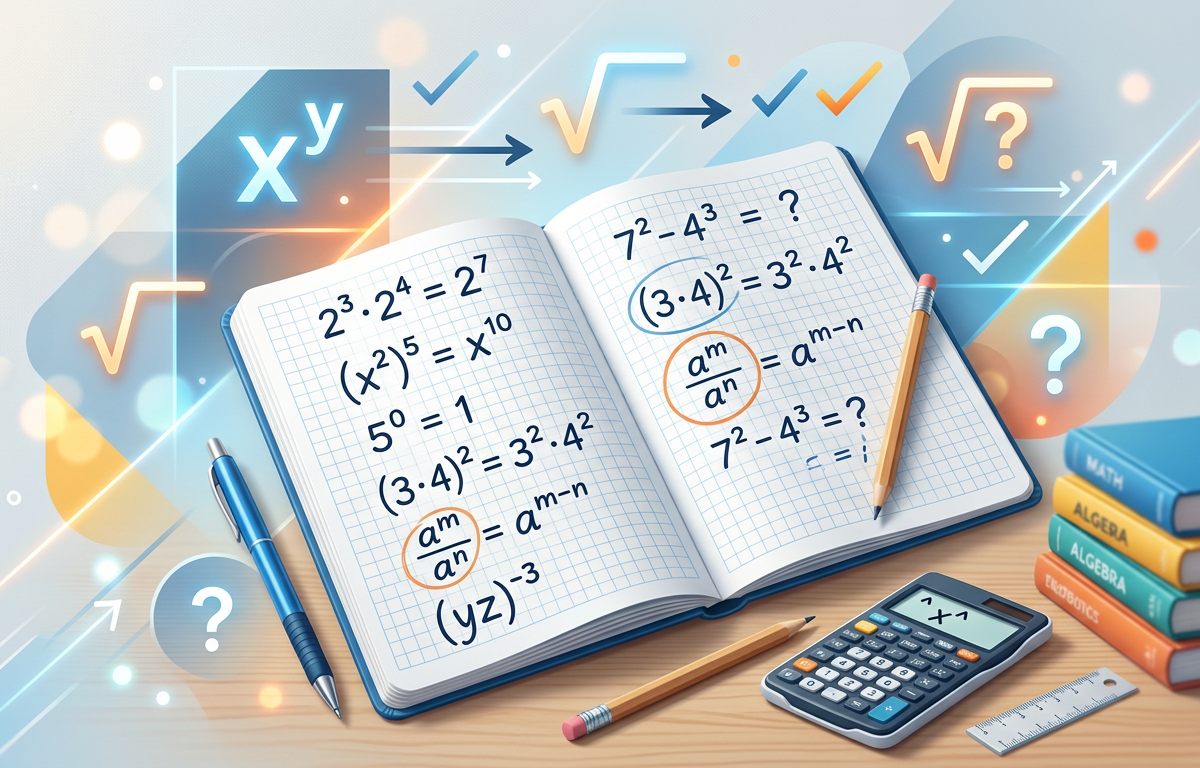
Exponents and powers are mathematical notations used to represent repeated multiplication of the same number by itself. In the expression an, a is the base (the number being multiplied) and n is the exponent or power (the number of times the base is used as a factor). For example, 23 means 2 × 2 × 2, which equals 8. This shorthand is essential in scientific notation, engineering, and advanced mathematics to handle extremely large or small quantities efficiently.
Understanding the fundamental laws of exponents is crucial for simplifying complex algebraic expressions. These rules, often referred to as the laws of indices, provide a systematic way to multiply, divide, and raise powers to other powers. Just as you might use mean, median, and mode to summarize data, exponents summarize multiplication.
Core Laws of Exponents
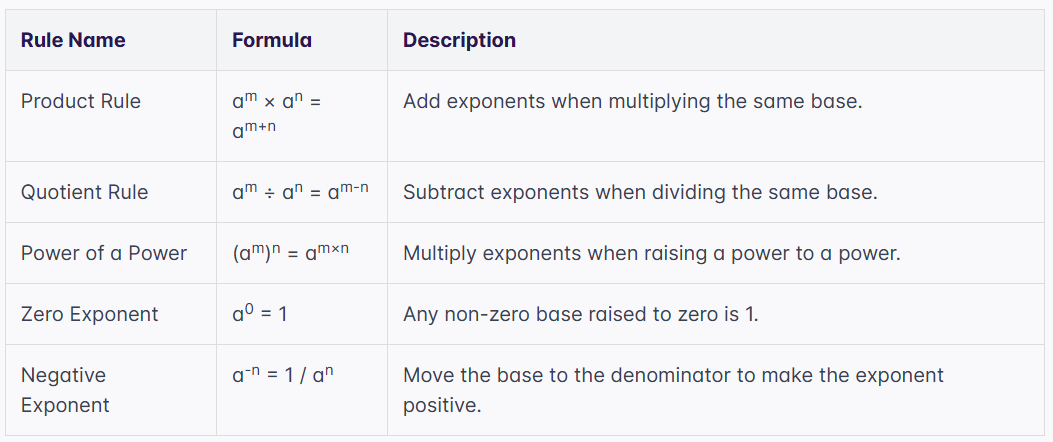
These rules are universal across all levels of math, from basic arithmetic to the complex calculus found on Khan Academy. Mastering them allows you to solve equations involving growth rates, decay, and scientific scales like pH or decibels.
Solved Examples
The following solved examples demonstrate how to apply these rules to simplify numerical and algebraic expressions.
Example 1: Using the Product and Quotient Rules
Simplify: (34 × 35) ÷ 37
Apply the Product Rule to the numerator: 34+5 = 39.
Apply the Quotient Rule: 39 ÷ 37 = 39-7.
The result is 32, which equals 9.
Example 2: Power of a Power with Negative Exponents
Simplify: (2-2)3
Apply the Power of a Power rule: Multiply the exponents -2 × 3 = -6.
The expression becomes 2-6.
Apply the Negative Exponent rule: 1 / 26.
The final simplified value is 1/64.
Example 3: Simplifying Algebraic Expressions
Simplify: (x2y3)2 × x-1
Distribute the power outside the parentheses: (x2)2 × (y3)2 = x4y6.
Multiply by the remaining term: x4y6 × x-1.
Combine the x terms using the Product Rule: x4 + (-1) = x3.
The final result is x3y6.
Practice Questions
Test your knowledge with these exponents and powers practice questions, ranging from foundational to advanced levels.
1. Evaluate: 53 × 5-1
2. Simplify the expression: (42)3 ÷ 44
3. Solve for the value: (1/2)-3
Want unlimited practice questions like these?
Generate AI-powered questions with step-by-step solutions on any topic.
Try Question Generator Free →4. Simplify: (x5 × x2) / x10
5. What is the value of (70 + 30) × 52?
6. Express 0.000045 in scientific notation using powers of 10.
7. Simplify: (2a2b3)3
8. Evaluate: [(-3)2]3 ÷ (-3)4
9. Simplify the radical expression: √(x8y4)
10. Solve for n: 2n × 23 = 29
Answers & Explanations
Check your work against the detailed solutions provided below.
1. Answer: 25
Using the product rule, 53 × 5-1 = 53 + (-1) = 52. 5 × 5 = 25.
2. Answer: 16
First, (42)3 = 42×3 = 46. Then, 46 ÷ 44 = 46-4 = 42. 4 × 4 = 16.
3. Answer: 8
A negative exponent flips the fraction: (1/2)-3 = (2/1)3. 23 = 2 × 2 × 2 = 8.
4. Answer: x-3 or 1/x3
Numerator: x5+2 = x7. Division: x7-10 = x-3. This can also be written as 1/x3.
5. Answer: 50
Any number to the power of 0 is 1. So, (1 + 1) × 52 = 2 × 25 = 50.
6. Answer: 4.5 × 10⁻⁵
Move the decimal point 5 places to the right to get 4.5. Since we moved right, the exponent is negative 5.
7. Answer: 8a6b9
Distribute the power of 3 to every factor: 23 × (a2)3 × (b3)3 = 8 × a6 × b9.
8. Answer: 9
Inside the bracket: (-3)2×3 = (-3)6. Then (-3)6 ÷ (-3)4 = (-3)6-4 = (-3)2. Since the power is even, the result is positive 9.
9. Answer: x4y2
A square root is the same as raising to the power of 1/2. (x8y4)1/2 = x8/2y4/2 = x4y2.
10. Answer: n = 6
Using the product rule, 2n+3 = 29. Since the bases are equal, the exponents must be equal: n + 3 = 9. Solving for n gives 6.
1. What is the value of any non-zero number raised to the power of 0?
Frequently Asked Questions
What is the difference between a base and an exponent?
The base is the factor that is being multiplied by itself, while the exponent indicates the total number of times that factor appears in the multiplication string. For example, in 54, 5 is the base and 4 is the exponent.
Why is any number to the power of zero equal to one?
This follows from the quotient rule; for example, 32 / 32 = 32-2 = 30. Since any number divided by itself is 1, it logically follows that 30 must be 1.
How do you handle negative exponents in an equation?
To make a negative exponent positive, move the base from the numerator to the denominator (or vice versa) and change the sign of the exponent. This is based on the reciprocal property of numbers.
Can the base of an exponent be a negative number?
Yes, the base can be negative, but the result depends on whether the exponent is even or odd. An even exponent results in a positive value, while an odd exponent results in a negative value.
What is scientific notation?
Scientific notation is a way to express very large or very small numbers as a product of a number between 1 and 10 and a power of 10. It relies heavily on the laws of exponents to simplify calculations in science and engineering.
Want unlimited practice questions like these?
Generate AI-powered questions with step-by-step solutions on any topic.
Try Question Generator Free →
Want unlimited practice questions like these?
Generate AI-powered questions with step-by-step solutions on any topic.
Try Question Generator Free →Enjoyed this article?
Share it with others who might find it helpful.
Related Articles

Decimal Conversion Practice Questions with Answers
Master decimal conversion with our comprehensive guide featuring solved examples, practice questions, and a quick quiz to sharpen your math skills.
Apr 6, 2026

Fraction Practice Questions with Answers
Fraction Practice Questions with Answers
Apr 6, 2026

Solving Time-Shift Algebra: How to Model Age Ratios and Sums
Master age problems with our comprehensive guide featuring solved examples, practice questions, and detailed algebraic explanations for all levels.
Apr 6, 2026

Logarithm Practice Questions with Answers
Master logarithms with our guide featuring core concepts, solved examples, and 10 practice questions with detailed answers to help you ace your math exams.
Apr 6, 2026
Linear Equations Practice Questions with Answers
Master linear equations with our comprehensive guide featuring step-by-step solved examples, practice questions, and detailed explanations for all levels.
Apr 6, 2026

Absolute Value Equation Practice Questions with Answers
Master the absolute value equation with our comprehensive guide. Includes step-by-step solved examples, practice questions, and detailed explanations.
Apr 6, 2026

Inequalities Practice Questions with Answers
Master inequalities with our comprehensive guide featuring solved examples, practice questions, and detailed explanations for all skill levels.
Apr 6, 2026
Quadratic Equations Practice Questions with Answers
Master quadratic equations with our comprehensive guide featuring solved examples, practice questions, and detailed explanations for all skill levels.
Apr 6, 2026