\nAcid-Base TitrationMass-to-Mass Stoichiometry Practice Questions with Answers
Acid-Base Titration Mass-to-Mass Stoichiometry Practice Questions with Answers
Acid-Base Titration Mass-to-Mass Stoichiometry is a quantitative chemical analysis technique used to determine the mass of an unknown acid or base by reacting it with a known mass of its chemical opposite. This process combines the principles of neutralization reactions with the predictive power of stoichiometry. By measuring the exact point of neutralization, often indicated by a color change, chemists can calculate precise mass relationships between reactants. Mastering these calculations is essential for students in general chemistry, analytical chemistry, and pharmacology, as it allows for the precise determination of substance purity and concentration in solid samples.
Concept Explanation
Acid-Base Titration Mass-to-Mass Stoichiometry is the process of using a balanced chemical equation to calculate the mass of one reactant required to completely neutralize a specific mass of another reactant. In a typical titration, an acid reacts with a base to produce water and a salt. The core of this concept lies in the mole ratio, which acts as the bridge between the mass of the known substance and the mass of the unknown substance.
The workflow for solving these problems generally follows a four-step sequence:
- Write and Balance the Equation: You must have a balanced chemical equation to identify the stoichiometric coefficients. For example, the reaction between sulfuric acid (H₂SO₄) and sodium hydroxide (NaOH) requires two moles of NaOH for every one mole of H₂SO₄.
- Convert Mass to Moles: Use the molar mass of the given substance (grams/mole) to convert the starting mass into moles.
- Apply the Mole Ratio: Use the coefficients from the balanced equation to convert moles of the known substance into moles of the unknown substance.
- Convert Moles back to Mass: Use the molar mass of the unknown substance to convert the calculated moles back into grams.
This technique is frequently used when dealing with solid acids (like oxalic acid or potassium hydrogen phthalate) or solid bases (like sodium carbonate). Understanding how to navigate these conversions is a fundamental part of developing effective studying habits for laboratory sciences. For more detailed information on chemical reactions, you can visit Khan Academy's Acid-Base resources.
Solved Examples
Example 1: Neutralizing Hydrochloric Acid with Sodium Carbonate
How many grams of sodium carbonate (Na₂CO₃) are required to completely neutralize 5.00 grams of hydrochloric acid (HCl)?
- Write the balanced equation: Na₂CO₃(s) + 2HCl(aq) → 2NaCl(aq) + H₂O(l) + CO₂(g)
- Convert mass of HCl to moles: Molar mass of HCl = 36.46 g/mol.
5.00 g / 36.46 g/mol = 0.1371 moles HCl. - Apply mole ratio: The ratio is 1 mole Na₂CO₃ : 2 moles HCl.
0.1371 mol HCl × (1 mol Na₂CO₃ / 2 mol HCl) = 0.06855 moles Na₂CO₃. - Convert moles to mass: Molar mass of Na₂CO₃ = 105.99 g/mol.
0.06855 mol × 105.99 g/mol = 7.27 grams Na₂CO₃.
Example 2: Sulfuric Acid and Potassium Hydroxide
What mass of potassium hydroxide (KOH) is needed to neutralize 10.0 grams of sulfuric acid (H₂SO₄)?
- Write the balanced equation: H₂SO₄(aq) + 2KOH(aq) → K₂SO₄(aq) + 2H₂O(l)
- Convert mass of H₂SO₄ to moles: Molar mass of H₂SO₄ = 98.08 g/mol.
10.0 g / 98.08 g/mol = 0.10196 moles H₂SO₄. - Apply mole ratio: The ratio is 2 moles KOH : 1 mole H₂SO₄.
0.10196 mol H₂SO₄ × (2 mol KOH / 1 mol H₂SO₄) = 0.20392 moles KOH. - Convert moles to mass: Molar mass of KOH = 56.11 g/mol.
0.20392 mol × 56.11 g/mol = 11.44 grams KOH.
Example 3: Acetic Acid and Barium Hydroxide
Determine the mass of barium hydroxide [Ba(OH)₂] required to react with 15.0 grams of acetic acid (HC₂H₃O₂).
- Write the balanced equation: Ba(OH)₂(aq) + 2HC₂H₃O₂(aq) → Ba(C₂H₃O₂)₂(aq) + 2H₂O(l)
- Convert mass of HC₂H₃O₂ to moles: Molar mass = 60.05 g/mol.
15.0 g / 60.05 g/mol = 0.2498 moles HC₂H₃O₂. - Apply mole ratio: Ratio is 1 mole Ba(OH)₂ : 2 moles HC₂H₃O₂.
0.2498 mol HC₂H₃O₂ × (1 mol Ba(OH)₂ / 2 mol HC₂H₃O₂) = 0.1249 moles Ba(OH)₂. - Convert moles to mass: Molar mass of Ba(OH)₂ = 171.34 g/mol.
0.1249 mol × 171.34 g/mol = 21.40 grams Ba(OH)₂.
Practice Questions
- A student titrates 2.50 g of oxalic acid (H₂C₂O₄) with sodium hydroxide (NaOH). What mass of NaOH is required for complete neutralization? Equation: H₂C₂O₄ + 2NaOH → Na₂C₂O₄ + 2H₂O.
- How many grams of calcium hydroxide [Ca(OH)₂] are needed to neutralize 12.0 g of nitric acid (HNO₃)? Equation: Ca(OH)₂ + 2HNO₃ → Ca(NO₃)₂ + 2H₂O.
- Calculate the mass of phosphoric acid (H₃PO₄) required to neutralize 8.50 g of lithium hydroxide (LiOH). Equation: H₃PO₄ + 3LiOH → Li₃PO₄ + 3H₂O.
Want unlimited practice questions like these?
Generate AI-powered questions with step-by-step solutions on any topic.
Try Question Generator Free →- Suppose you have 4.20 g of magnesium hydroxide [Mg(OH)₂]. What mass of hydrochloric acid (HCl) is needed for a complete reaction?
- What mass of sodium bicarbonate (NaHCO₃) is required to neutralize 1.50 g of sulfuric acid (H₂SO₄)? Equation: H₂SO₄ + 2NaHCO₃ → Na₂SO₄ + 2H₂O + 2CO₂.
- If 6.75 g of hydrobromic acid (HBr) is used, how many grams of potassium hydroxide (KOH) are necessary for neutralization?
- A 20.0 g sample of impure sodium hydroxide is titrated with 18.0 g of sulfuric acid. Assuming the acid is pure, what mass of NaOH actually reacted?
- Calculate the mass of perchloric acid (HClO₄) needed to react with 3.30 g of barium hydroxide [Ba(OH)₂].
- How many grams of strontium hydroxide [Sr(OH)₂] are needed to neutralize 5.40 g of acetic acid (HC₂H₃O₂)?
- Find the mass of citric acid (H₃C₆H₅O₇) required to neutralize 10.0 g of NaOH. Equation: H₃C₆H₅O₇ + 3NaOH → Na₃C₆H₅O₇ + 3H₂O.
Answers & Explanations
- 2.22 g NaOH: Moles H₂C₂O₄ = 2.50 g / 90.03 g/mol = 0.02777 mol. Moles NaOH = 0.02777 × 2 = 0.05554 mol. Mass NaOH = 0.05554 mol × 40.00 g/mol = 2.22 g.
- 7.05 g Ca(OH)₂: Moles HNO₃ = 12.0 g / 63.01 g/mol = 0.1904 mol. Moles Ca(OH)₂ = 0.1904 / 2 = 0.0952 mol. Mass Ca(OH)₂ = 0.0952 mol × 74.09 g/mol = 7.05 g.
- 11.61 g H₃PO₄: Moles LiOH = 8.50 g / 23.95 g/mol = 0.3549 mol. Moles H₃PO₄ = 0.3549 / 3 = 0.1183 mol. Mass H₃PO₄ = 0.1183 mol × 98.00 g/mol = 11.61 g.
- 5.25 g HCl: Equation: Mg(OH)₂ + 2HCl → MgCl₂ + 2H₂O. Moles Mg(OH)₂ = 4.20 g / 58.32 g/mol = 0.0720 mol. Moles HCl = 0.0720 × 2 = 0.1440 mol. Mass HCl = 0.1440 mol × 36.46 g/mol = 5.25 g.
- 2.57 g NaHCO₃: Moles H₂SO₄ = 1.50 g / 98.08 g/mol = 0.01529 mol. Moles NaHCO₃ = 0.01529 × 2 = 0.03058 mol. Mass NaHCO₃ = 0.03058 mol × 84.01 g/mol = 2.57 g.
- 4.67 g KOH: Equation: HBr + KOH → KBr + H₂O. Moles HBr = 6.75 g / 80.91 g/mol = 0.08343 mol. Moles KOH = 0.08343 mol (1:1 ratio). Mass KOH = 0.08343 mol × 56.11 g/mol = 4.67 g.
- 14.68 g NaOH: Equation: H₂SO₄ + 2NaOH → Na₂SO₄ + 2H₂O. Moles H₂SO₄ = 18.0 g / 98.08 g/mol = 0.1835 mol. Moles NaOH = 0.1835 × 2 = 0.3670 mol. Mass NaOH = 0.3670 mol × 40.00 g/mol = 14.68 g.
- 3.87 g HClO₄: Equation: 2HClO₄ + Ba(OH)₂ → Ba(ClO₄)₂ + 2H₂O. Moles Ba(OH)₂ = 3.30 g / 171.34 g/mol = 0.01926 mol. Moles HClO₄ = 0.01926 × 2 = 0.03852 mol. Mass HClO₄ = 0.03852 mol × 100.46 g/mol = 3.87 g.
- 5.47 g Sr(OH)₂: Equation: Sr(OH)₂ + 2HC₂H₃O₂ → Sr(C₂H₃O₂)₂ + 2H₂O. Moles HC₂H₃O₂ = 5.40 g / 60.05 g/mol = 0.0899 mol. Moles Sr(OH)₂ = 0.0899 / 2 = 0.04495 mol. Mass Sr(OH)₂ = 0.04495 mol × 121.63 g/mol = 5.47 g.
- 16.01 g Citric Acid: Moles NaOH = 10.0 g / 40.00 g/mol = 0.250 mol. Moles Citric Acid = 0.250 / 3 = 0.08333 mol. Mass Citric Acid = 0.08333 mol × 192.12 g/mol = 16.01 g.
Quick Quiz
Frequently Asked Questions
What is the difference between the equivalence point and the endpoint?
The equivalence point is the theoretical point where the moles of acid exactly equal the moles of base according to the stoichiometry. The endpoint is the physical point where the indicator actually changes color, which chemists try to match as closely as possible to the equivalence point.
Can I use mass-to-mass stoichiometry for liquid reactants?
While mass-to-mass stoichiometry is possible for liquids if you know their density and mass, it is much more common to use molarity and volume (solution stoichiometry) for liquid reactants in titrations. For more on this, check out our guide on limiting reagents.
What happens if I don't balance the chemical equation?
If the equation is not balanced, the mole ratio will be incorrect, leading to a mathematically wrong answer. Even a small error in coefficients can result in significant discrepancies in the final mass calculation.
Why is potassium hydrogen phthalate (KHP) often used in these problems?
KHP is a 'primary standard,' meaning it is highly pure, stable, and has a high molar mass. This makes it ideal for titrating against bases like NaOH to determine their exact concentration before further experiments.
How does the percent yield relate to titration results?
In a titration, we usually assume the reaction goes to completion; however, if you are synthesizing a salt via titration, you might use percent yield to compare the actual mass of salt recovered to the theoretical mass predicted by stoichiometry.
For more advanced study techniques, see the Wikipedia page on Titration or explore our active recall guide to help memorize molar masses and reaction types.
Enjoyed this article?
Share it with others who might find it helpful.
Related Articles
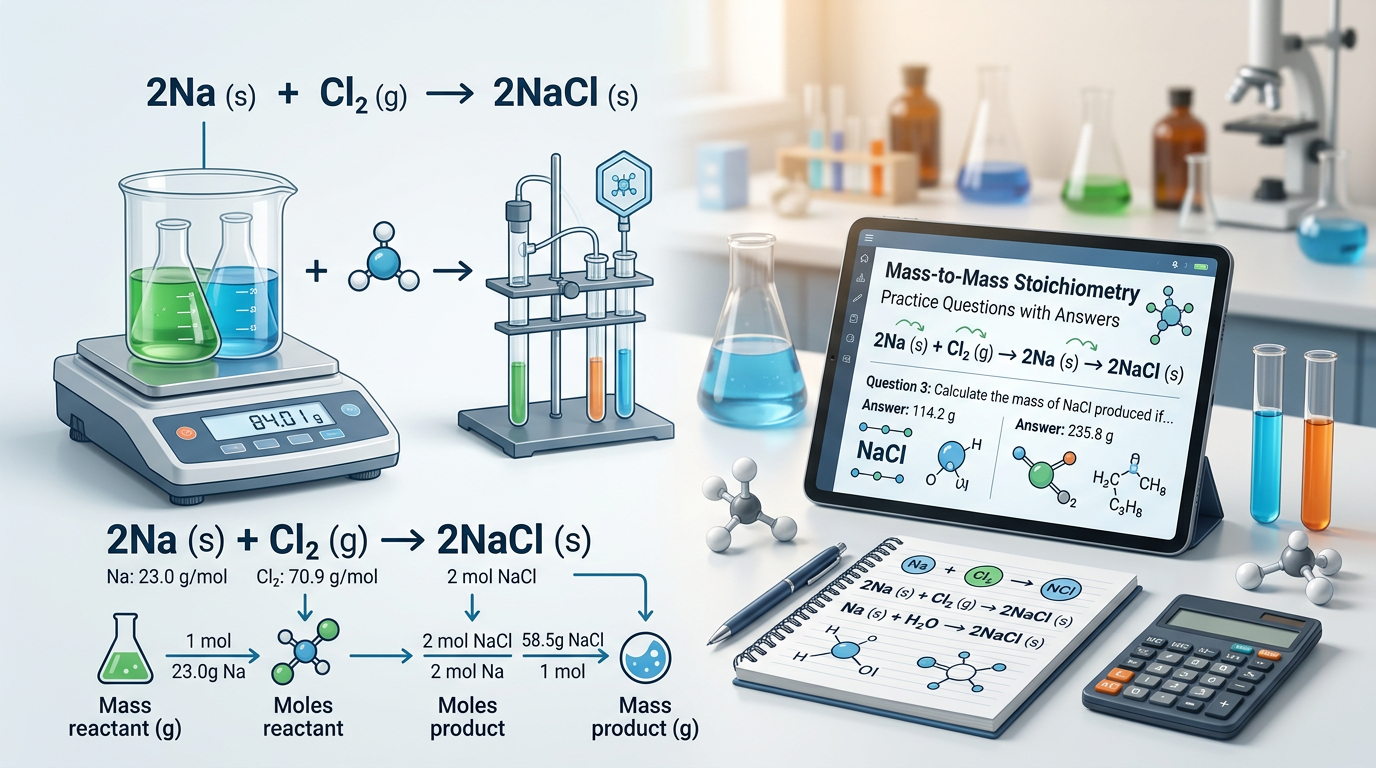
Mass-to-Mass Stoichiometry Practice Questions with Answers
Master mass-to-mass stoichiometry with our comprehensive guide. Includes step-by-step solved examples, practice questions, and a quick quiz to test your knowledge.
Mar 21, 2026
Theoretical Yield vs Actual Yield Practice Questions with Answers
Learn the difference between theoretical and actual yield with our comprehensive guide. Includes formulas, solved examples, and 10 practice questions with answers.
Mar 21, 2026

Percent Yield Practice Questions with Answers
Master percent yield calculations with our guide. Includes step-by-step solved examples, practice questions, and a quiz to test your chemistry skills.
Mar 21, 2026