Predicting Reaction Yields: Grams-to-Grams Stoichiometry Guide
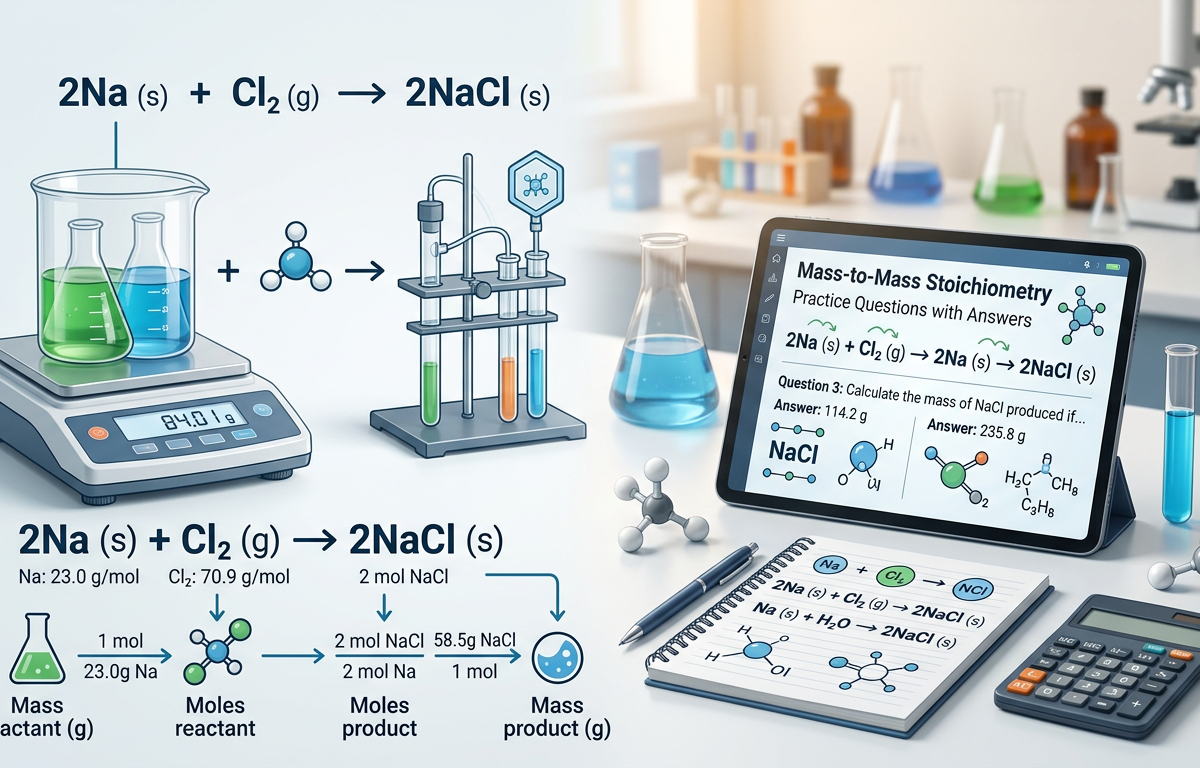
When a chemist measures 44.11 grams of propane, they are not just looking at a pile of fuel; they are looking at exactly 1.00 mole of molecules waiting to rearrange. The most common error in these calculations is trying to jump directly from the mass of your reactant to the mass of your product. Because different molecules have different weights, a 1:1 mass ratio almost never exists. Instead, you must use the chemical mole as a bridge to translate the macroscopic weight you see on a scale into the microscopic count of atoms required by the balanced equation.
Think of the balanced equation as a recipe that only speaks in counts, not weights. If your equation requires two moles of one substance to produce three of another, you cannot simply use a 2:3 ratio of grams. You must first divide your starting mass by the molar mass from the periodic table to find out how many particles you actually have. Only then can you apply the coefficients from the reaction to predict your final yield. This guide provides the specific mathematical pathways needed to navigate these three-step conversions without losing track of your units.
Mass-to-Mass Stoichiometry Practice Questions with Answers
Mass-to-mass stoichiometry is the process of using a balanced chemical equation to determine the mass of a product that can be formed from a known mass of a reactant, or vice versa. This fundamental concept in chemistry allows scientists and engineers to predict how much material they need for a reaction and how much product they will obtain. Understanding this process is a critical step before moving on to more complex topics like limiting reagent practice questions.
The Three-Step Gram Conversion Bridge
Mass-to-mass stoichiometry is a mathematical method used to calculate the mass of one substance in a chemical reaction based on the mass of another substance using the molar mass and the mole ratio from a balanced equation. To perform these calculations successfully, you must follow a specific sequence of conversions: grams of the known substance to moles, then moles of the known substance to moles of the unknown substance, and finally moles of the unknown substance back to grams. This pathway is often summarized as: Grams (A) → Moles (A) → Moles (B) → Grams (B).
The accuracy of these calculations relies heavily on the Law of Conservation of Mass, which states that matter cannot be created or destroyed in a chemical reaction. Therefore, every atom present in the reactants must be accounted for in the products. Before starting any mass-to-mass problem, you must ensure you have a balanced chemical equation. If you need a refresher on the basics, you might find stoichiometry practice questions helpful for building your foundation.
The Four Steps of Mass-to-Mass Stoichiometry
Balance the Equation: Ensure the number of atoms for each element is equal on both sides of the reaction.
Convert Mass to Moles: Use the molar mass of the given substance (found on the periodic table) to convert grams to moles.
Apply the Mole Ratio: Use the coefficients from the balanced equation to convert moles of the given substance to moles of the desired substance. This is the core of mole ratio practice.
Convert Moles to Mass: Use the molar mass of the desired substance to convert moles back into grams.
Solved Examples
Below are three fully worked examples demonstrating how to navigate mass-to-mass stoichiometry problems step-by-step.
Example 1: Combustion of Propane
How many grams of water (H2O) are produced when 44.11 grams of propane (C3H8) are burned in excess oxygen?
Reaction: C3H8 + 5O2 → 3CO2 + 4H2O
Identify Molar Masses: C3H8 = 44.11 g/mol; H2O = 18.02 g/mol.
Convert Grams C3H8 to Moles: 44.11 g / 44.11 g/mol = 1.00 mol C3H8.
Use Mole Ratio: From the equation, 1 mole of C3H8 produces 4 moles of H2O. So, 1.00 mol C3H8 × (4 mol H2O / 1 mol C3H8) = 4.00 mol H2O.
Convert Moles H2O to Grams: 4.00 mol × 18.02 g/mol = 72.08 g H2O.
Example 2: Formation of Aluminum Oxide
How many grams of Aluminum (Al) are needed to react with oxygen to produce 100.0 grams of Aluminum Oxide (Al2O3)?
Reaction: 4Al + 3O2 → 2Al2O3
Identify Molar Masses: Al = 26.98 g/mol; Al2O3 = 101.96 g/mol.
Convert Grams Al2O3 to Moles: 100.0 g / 101.96 g/mol = 0.981 mol Al2O3.
Use Mole Ratio: The ratio is 4 moles Al to 2 moles Al2O3. So, 0.981 mol Al2O3 × (4 mol Al / 2 mol Al2O3) = 1.962 mol Al.
Convert Moles Al to Grams: 1.962 mol × 26.98 g/mol = 52.93 g Al.
Example 3: Decomposition of Potassium Chlorate
If 12.26 grams of KClO3 decomposes, what mass of O2 is released?
Reaction: 2KClO3 → 2KCl + 3O2
Identify Molar Masses: KClO3 = 122.55 g/mol; O2 = 32.00 g/mol.
Convert Grams KClO3 to Moles: 12.26 g / 122.55 g/mol = 0.100 mol KClO3.
Use Mole Ratio: The ratio is 3 moles O2 for every 2 moles KClO3. 0.100 mol KClO3 × (3/2) = 0.150 mol O2.
Convert Moles O2 to Grams: 0.150 mol × 32.00 g/mol = 4.80 g O2.
Practice Questions
Test your skills with these mass-to-mass stoichiometry practice questions. Use a periodic table for molar mass values.
How many grams of CO2 are produced from the combustion of 25.0 g of methane (CH4)?
CH4 + 2O2 → CO2 + 2H2OWhat mass of Iron (III) oxide (Fe2O3) is produced when 10.0 g of Iron (Fe) reacts with excess oxygen?
4Fe + 3O2 → 2Fe2O3In the reaction 2H2 + O2 → 2H2O, how many grams of Oxygen (O2) are required to react with 5.0 g of Hydrogen (H2)?
How many grams of Sodium Chloride (NaCl) are produced when 15.0 g of Sodium (Na) reacts with excess Chlorine (Cl2)?
2Na + Cl2 → 2NaClWhat mass of Silver (Ag) is produced when 20.0 g of Copper (Cu) reacts with Silver Nitrate (AgNO3)?
Cu + 2AgNO3 → Cu(NO3)2 + 2AgFor the reaction N2 + 3H2 → 2NH3, how many grams of Ammonia (NH3) are produced from 50.0 g of Nitrogen (N2)?
If 100.0 g of Calcium Carbonate (CaCO3) decomposes, what mass of Calcium Oxide (CaO) is formed?
CaCO3 → CaO + CO2How many grams of Magnesium (Mg) are needed to produce 15.0 g of Magnesium Oxide (MgO)?
2Mg + O2 → 2MgOIn the reaction 2Al + 3Cl2 → 2AlCl3, what mass of Chlorine gas is needed to react with 35.0 g of Aluminum?
How many grams of Hydrogen (H2) are produced when 12.0 g of Magnesium reacts with Hydrochloric Acid?
Mg + 2HCl → MgCl2 + H2
Answers & Explanations
68.6 g CO2: 25.0 g CH4 / 16.04 g/mol = 1.558 mol CH4. The mole ratio CH4:CO2 is 1:1, so 1.558 mol CO2 is produced. 1.558 mol × 44.01 g/mol = 68.6 g.
14.3 g Fe2O3: 10.0 g Fe / 55.85 g/mol = 0.179 mol Fe. Mole ratio Fe:Fe2O3 is 4:2 (or 2:1). 0.179 mol Fe × (2/4) = 0.0895 mol Fe2O3. 0.0895 mol × 159.7 g/mol = 14.3 g.
39.6 g O2: 5.0 g H2 / 2.016 g/mol = 2.48 mol H2. Mole ratio H2:O2 is 2:1. 2.48 mol / 2 = 1.24 mol O2. 1.24 mol × 32.00 g/mol = 39.6 g.
38.1 g NaCl: 15.0 g Na / 22.99 g/mol = 0.652 mol Na. Ratio Na:NaCl is 2:2 (1:1). 0.652 mol NaCl × 58.44 g/mol = 38.1 g.
67.9 g Ag: 20.0 g Cu / 63.55 g/mol = 0.315 mol Cu. Ratio Cu:Ag is 1:2. 0.315 mol × 2 = 0.629 mol Ag. 0.629 mol × 107.87 g/mol = 67.9 g.
60.7 g NH3: 50.0 g N2 / 28.02 g/mol = 1.784 mol N2. Ratio N2:NH3 is 1:2. 1.784 mol × 2 = 3.568 mol NH3. 3.568 mol × 17.03 g/mol = 60.7 g.
56.0 g CaO: 100.0 g CaCO3 / 100.09 g/mol = 0.999 mol CaCO3. Ratio is 1:1. 0.999 mol × 56.08 g/mol = 56.0 g.
9.05 g Mg: 15.0 g MgO / 40.30 g/mol = 0.372 mol MgO. Ratio Mg:MgO is 2:2 (1:1). 0.372 mol × 24.31 g/mol = 9.05 g.
138.0 g Cl2: 35.0 g Al / 26.98 g/mol = 1.297 mol Al. Ratio Al:Cl2 is 2:3. 1.297 mol × (3/2) = 1.946 mol Cl2. 1.946 mol × 70.90 g/mol = 138.0 g.
0.99 g H2: 12.0 g Mg / 24.31 g/mol = 0.494 mol Mg. Ratio Mg:H2 is 1:1. 0.494 mol × 2.016 g/mol = 0.99 g.
Frequently Asked Questions
Can I skip the mole conversion and go directly from grams to grams?
No, you cannot skip the mole conversion because chemical equations are balanced based on the number of particles (moles), not mass. Since different substances have different molar masses, 10 grams of one substance does not contain the same number of molecules as 10 grams of another.
What happens if I don't balance the equation first?
If the equation is not balanced, the mole ratios will be incorrect, leading to an inaccurate calculation of the product or reactant mass. Balancing ensures the Law of Conservation of Mass is respected in your mathematical model.
Where do I find the molar mass for stoichiometry problems?
Molar mass is calculated by summing the atomic masses of all atoms in a molecule's formula, which are found on the periodic table of elements. For example, H2O has a molar mass of approximately 18.02 g/mol (2*1.008 + 16.00).
Is mass-to-mass stoichiometry used in real-world industries?
Yes, pharmaceutical companies and chemical manufacturers use these calculations to determine the exact amount of raw materials needed to produce specific quantities of medicine or materials. This minimizes waste and maximizes efficiency, often evaluated using percent yield practice.
Does the temperature or pressure affect mass-to-mass calculations?
While temperature and pressure affect the volume of gases, they do not change the mass of the substances involved. However, for gas stoichiometry, you might use the Ideal Gas Law to find moles before proceeding with stoichiometric ratios.
Start Learning Smarter Today
Join thousands of students using AI-powered study tools to achieve better results.
Get Started FreeEnjoyed this article?
Share it with others who might find it helpful.
Related Articles
Predicting Periodic Anomalies: Beyond Basic Trend Rules
Hard Periodic Trends Practice Questions
Apr 4, 2026
Hard Redox Reaction Practice Questions
Master complex chemistry with our Hard Redox Reaction Practice Questions. Learn to balance equations in acidic/basic media and calculate cell potentials.
Apr 4, 2026
Medium Redox Reaction Practice Questions
Master medium-level redox reaction problems with our comprehensive guide featuring solved examples, balancing tips, and practice questions for students.
Apr 4, 2026
Easy Redox Reaction Practice Questions
Master the basics of electron transfer with these easy redox reaction practice questions, featuring step-by-step solutions and clear explanations.
Apr 4, 2026
Redox Reaction Practice Questions with Answers
Master redox reactions with these practice questions and answers. Learn to identify oxidation, reduction, and balancing techniques for your chemistry exams.
Apr 3, 2026

Easy Reaction Order Practice Questions
Master chemical kinetics with these easy reaction order practice questions. Learn to calculate overall reaction orders and understand zero, first, and second-order reactions.
Apr 2, 2026
Medium Reaction Order Practice Questions
Master chemical kinetics with these medium reaction order practice questions, including step-by-step solutions, rate law calculations, and a quick quiz.
Apr 2, 2026
Predicting Radioactive Decay: Solving for Mass and Time Intervals
Master half-life calculations with our comprehensive guide featuring step-by-step solved examples, practice questions, and detailed answers for students.
Apr 2, 2026