Stoichiometry vs. Reality: Calculating Percent Yield in Chemistry
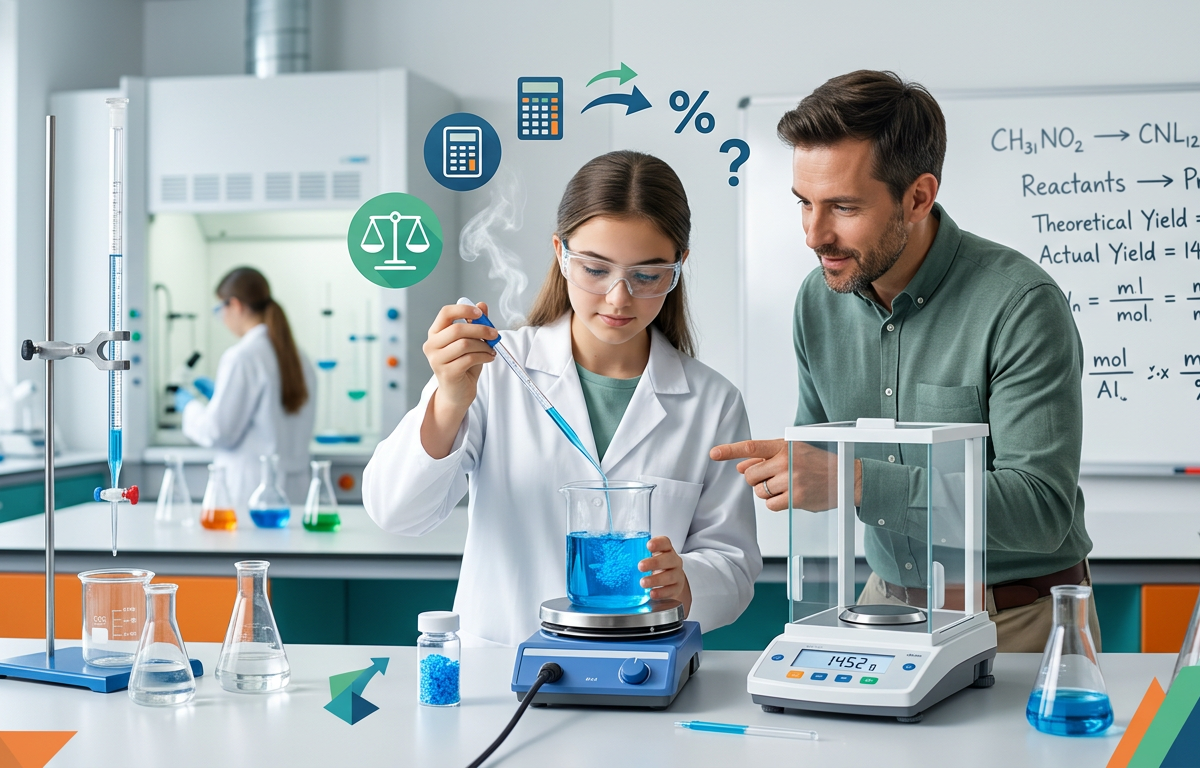
Imagine a student heating 25.0 grams of calcium carbonate expecting a specific mass of lime, only to find the scale reads lower than the paper calculation suggests. In the lab, matter seems to vanish through side reactions, incomplete conversions, or simple spills during filtration. This discrepancy between the theoretical yield predicted by balanced equations and the actual yield measured on a balance is the essence of percent yield. It is the metric of chemical efficiency, turning abstract stoichiometry into a report on how much product was truly recovered.
The most frequent error occurs long before the final division. Students often grab the mass of the limiting reactant and place it directly into the denominator, forgetting that the theoretical yield must be in the units of the product, not the starting material. To solve these problems correctly, you must first convert your limiting reagent to moles, use the stoichiometric ratio to find the moles of product, and then convert those moles back to grams. Only once you have two masses for the same substance can you accurately determine the percentage of success for your reaction.
Percent Yield Practice Questions with Answers
Mastering stoichiometry requires a firm grasp of how real-world chemical reactions differ from theoretical predictions. This guide provides comprehensive Percent Yield Practice Questions with Answers to help you bridge the gap between classroom theory and laboratory reality.
The Math of Chemical Efficiency
Percent yield is a measure of the efficiency of a chemical reaction, calculated as the ratio of the actual amount of product obtained (actual yield) to the maximum amount of product predicted by stoichiometry (theoretical yield) multiplied by 100. In a perfect world, a reaction would produce 100% of the predicted product; however, factors such as incomplete reactions, side reactions, and loss of material during filtration or transfer often result in a yield lower than 100%.
To calculate percent yield, you must follow the standard stoichiometry process to find the theoretical yield first. This involves identifying the limiting reagent, which is the reactant that is completely consumed and determines the maximum amount of product possible. The formula is expressed as:
Percent Yield = (Actual Yield / Theoretical Yield) × 100%
The actual yield is the amount of product physically measured in the lab, while the theoretical yield is the calculated value based on the balanced chemical equation. Understanding this concept is vital for industrial chemists who aim to maximize profit and minimize waste in large-scale production, such as in the manufacturing of pharmaceuticals or polymers. You can learn more about the fundamentals of chemical calculations on Khan Academy's guide to yield.
Solved Examples
Below are fully worked examples demonstrating how to calculate theoretical yield and percent yield step-by-step.
Example 1: Basic Percent Yield
A student reacts 10.0 g of magnesium with excess oxygen to produce magnesium oxide. The theoretical yield is calculated to be 16.58 g of MgO. If the student actually recovers 14.80 g of MgO, what is the percent yield?
Identify the given values: Actual Yield = 14.80 g; Theoretical Yield = 16.58 g.
Apply the formula: (14.80 g / 16.58 g) × 100.
Calculate the result: 0.8926 × 100 = 89.26%.
Answer: 89.26%
Example 2: Finding Theoretical Yield First
Consider the reaction: N₂ + 3H₂ → 2NH₃. If 28.0 g of Nitrogen (N₂) reacts with excess Hydrogen and produces 30.0 g of Ammonia (NH₃), what is the percent yield? (Molar masses: N₂ = 28.0 g/mol, NH₃ = 17.0 g/mol)
Convert mass of reactant to moles: 28.0 g N₂ / 28.0 g/mol = 1.00 mol N₂.
Use the mole ratio from the balanced equation: 1 mol N₂ produces 2 mol NH₃. So, 1.00 mol N₂ × 2 = 2.00 mol NH₃.
Convert moles of product to mass (Theoretical Yield): 2.00 mol NH₃ × 17.0 g/mol = 34.0 g NH₃.
Calculate percent yield: (30.0 g / 34.0 g) × 100 = 88.2%.
Answer: 88.2%
Example 3: Working with Limiting Reagents
If 5.00 g of H₂ reacts with 32.0 g of O₂ to form water, and 35.0 g of H₂O is produced, what is the percent yield?
Calculate moles of reactants: H₂ = 5.00 g / 2.02 g/mol = 2.48 mol; O₂ = 32.0 g / 32.00 g/mol = 1.00 mol.
Determine limiting reagent: The ratio is 2H₂ : 1O₂. 1.00 mol O₂ needs 2.00 mol H₂. Since we have 2.48 mol H₂, O₂ is the limiting reagent.
Calculate theoretical yield: 1.00 mol O₂ × (2 mol H₂O / 1 mol O₂) × 18.02 g/mol = 36.04 g H₂O.
Calculate percent yield: (35.0 g / 36.04 g) × 100 = 97.1%.
Answer: 97.1%
Practice Questions
15.0 g of aluminum reacts with excess chlorine to produce 65.0 g of aluminum chloride (AlCl₃). If the theoretical yield is 74.1 g, find the percent yield.
In a synthesis reaction, 40.0 g of product was expected, but only 32.0 g was obtained. Calculate the percent yield.
A chemist calculates that 125 g of copper should be produced in a displacement reaction. After the experiment, only 110 g is collected. What is the efficiency of this reaction?
Heating 25.0 g of CaCO₃ produces 12.0 g of CaO. The theoretical yield is 14.0 g. Determine the percent yield.
Consider the reaction: 2H₂ + O₂ → 2H₂O. If 4.0 g of H₂ reacts with excess O₂ to produce 30.0 g of H₂O, what is the percent yield? (Molar masses: H₂ = 2.0 g/mol, H₂O = 18.0 g/mol)
Phosphorus reacts with bromine to form PBr₃. If the theoretical yield is 50.0 g and the percent yield is 85%, how many grams were actually produced?
A reaction has a percent yield of 72%. If the actual yield was 18.0 g, what was the theoretical yield?
20.0 g of CH₄ reacts with excess oxygen to produce 44.0 g of CO₂. Calculate the percent yield. (Molar masses: CH₄ = 16.0 g/mol, CO₂ = 44.0 g/mol)
Iron reacts with sulfur to form FeS. If 55.8 g of Fe reacts with excess S to produce 75.0 g of FeS, and the theoretical yield is 87.9 g, what is the percent yield?
A laboratory procedure has an expected yield of 12.5 g. Due to a spill, only 9.2 g is recovered. Calculate the percentage loss and the percent yield.
Answers & Explanations
87.7%: (65.0 g / 74.1 g) × 100 = 87.71%.
80.0%: (32.0 g / 40.0 g) × 100 = 80%.
88.0%: (110 g / 125 g) × 100 = 88%. This represents the reaction's efficiency.
85.7%: (12.0 g / 14.0 g) × 100 = 85.71%.
83.3%: Moles H₂ = 4.0 / 2.0 = 2.0 mol. Theoretical yield H₂O = 2.0 mol × 18.0 g/mol = 36.0 g. Percent Yield = (30.0 / 36.0) × 100 = 83.33%.
42.5 g: Actual = (Percent / 100) × Theoretical = 0.85 × 50.0 g = 42.5 g.
25.0 g: Theoretical = Actual / (Percent / 100) = 18.0 / 0.72 = 25.0 g.
80.0%: Moles CH₄ = 20.0 / 16.0 = 1.25 mol. Theoretical CO₂ = 1.25 mol × 44.0 g/mol = 55.0 g. Percent Yield = (44.0 / 55.0) × 100 = 80%.
85.3%: (75.0 g / 87.9 g) × 100 = 85.32%.
73.6% Yield: Percent Yield = (9.2 / 12.5) × 100 = 73.6%. Percentage loss is 100 - 73.6 = 26.4%.
Frequently Asked Questions
Why is percent yield rarely 100%?
Percent yield is rarely 100% because of practical limitations like side reactions, loss of product during transfer or purification (such as stuck to filter paper), and reactions that reach equilibrium before they are finished. These real-world inefficiencies mean the actual amount collected is almost always less than the mathematical prediction.
Can percent yield be greater than 100%?
Technically, a percent yield cannot exceed 100% based on the law of conservation of mass. If a calculation results in a value over 100%, it usually indicates that the final product is impure, contains leftover solvent/water, or that an error occurred during weighing.
What is the difference between actual yield and theoretical yield?
The theoretical yield is the maximum amount of product that can be produced based on stoichiometric calculations using the limiting reagent. The actual yield is the weight of the product that is actually measured and collected by the scientist at the end of the experiment.
How does the limiting reagent affect percent yield?
The limiting reagent determines the theoretical yield; it is the reactant that runs out first and stops the reaction. To calculate percent yield correctly, you must first identify the limiting reagent to know the maximum possible product you could have formed.
Is a high percent yield always better?
In industrial chemistry, a high percent yield is generally preferred because it indicates high efficiency and less waste. However, sometimes a lower yield is acceptable if the process is significantly cheaper, safer, or faster than a high-yield alternative.
How do you calculate percent yield for a multi-step reaction?
For multi-step reactions, the overall percent yield is found by multiplying the decimal yields of each individual step together. For example, two steps with 90% yield each result in an overall yield of 81% (0.90 × 0.90 = 0.81).
Enjoyed this article?
Share it with others who might find it helpful.
Related Articles
Closing the Efficiency Gap: Calculating Percent Yield in Chemistry
Learn the difference between theoretical and actual yield with our comprehensive guide. Includes formulas, solved examples, and 10 practice questions with answers.
Mar 21, 2026

Calculating High-Stakes Meds: BSA Mosteller Formula Practice
Master hard body surface area-based dosage calculations with our comprehensive guide, solved examples, and practice questions for healthcare students.
May 17, 2026
Solving Equilibrium Problems Without Losing Your Stoichiometry
Master chemical equilibrium with these easy ICE table practice questions. Learn to calculate concentrations and K values with step-by-step solved examples.
Mar 30, 2026
Calculating Kc: Mastering the Ratio of Equilibrium Concentrations
Master the Equilibrium Constant (Kc) with our comprehensive guide featuring solved examples, practice questions, and detailed explanations for chemistry students.
Mar 30, 2026
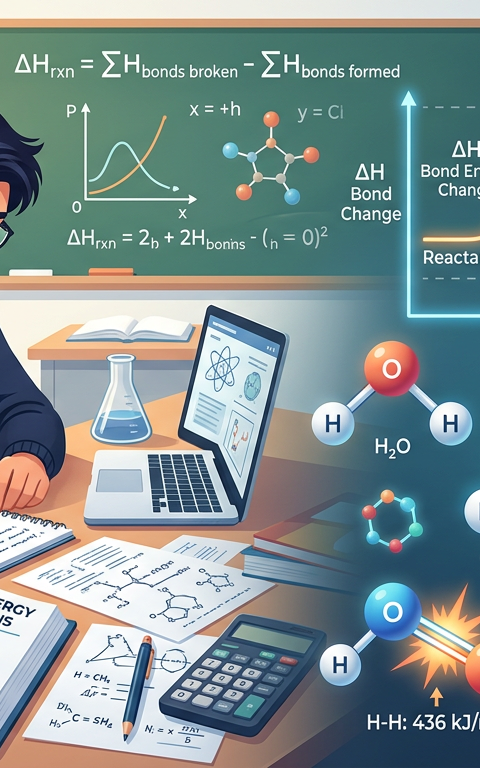
Calculating Enthalpy Changes Using Bond Enthalpy Data
Master bond energy calculations with our comprehensive guide. Includes solved examples, practice questions, and detailed explanations for chemistry students.
Mar 29, 2026
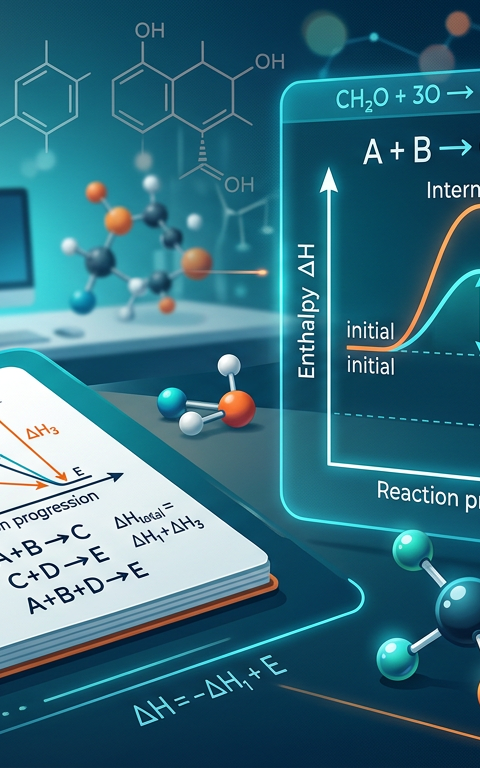
Calculating Enthalpy Changes: Hess’s Law Puzzle Solving Guide
Master Hess’s Law with our comprehensive guide featuring solved examples, step-by-step practice questions, and detailed answers for chemistry students.
Mar 29, 2026
Solving Titration Math: From M1V1 to Polyprotic Stoichiometry
Master the basics of neutralization with our easy acid-base titration practice questions. Includes step-by-step solved examples and a quick quiz.
Mar 29, 2026
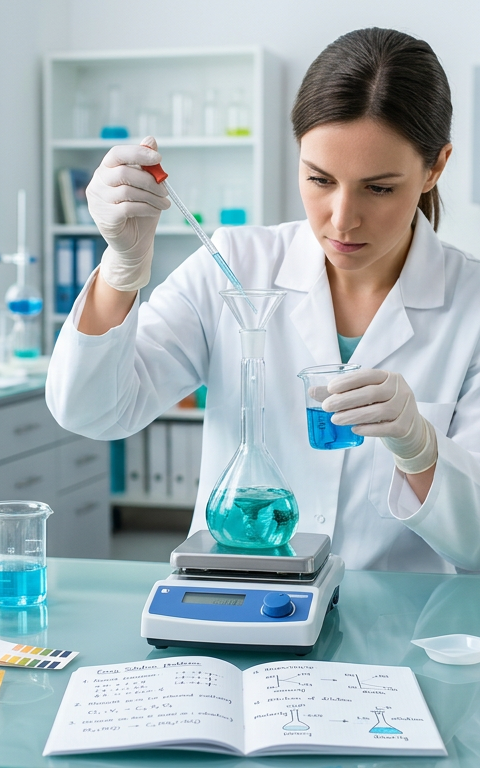
Stoichiometry of the Flask: Calculating Solute Mass and Dilutions
Master solution preparation with these easy practice questions. Learn to calculate molarity, mass, and dilutions with step-by-step examples and a quick quiz.
Mar 27, 2026