Closing the Efficiency Gap: Calculating Percent Yield in Chemistry
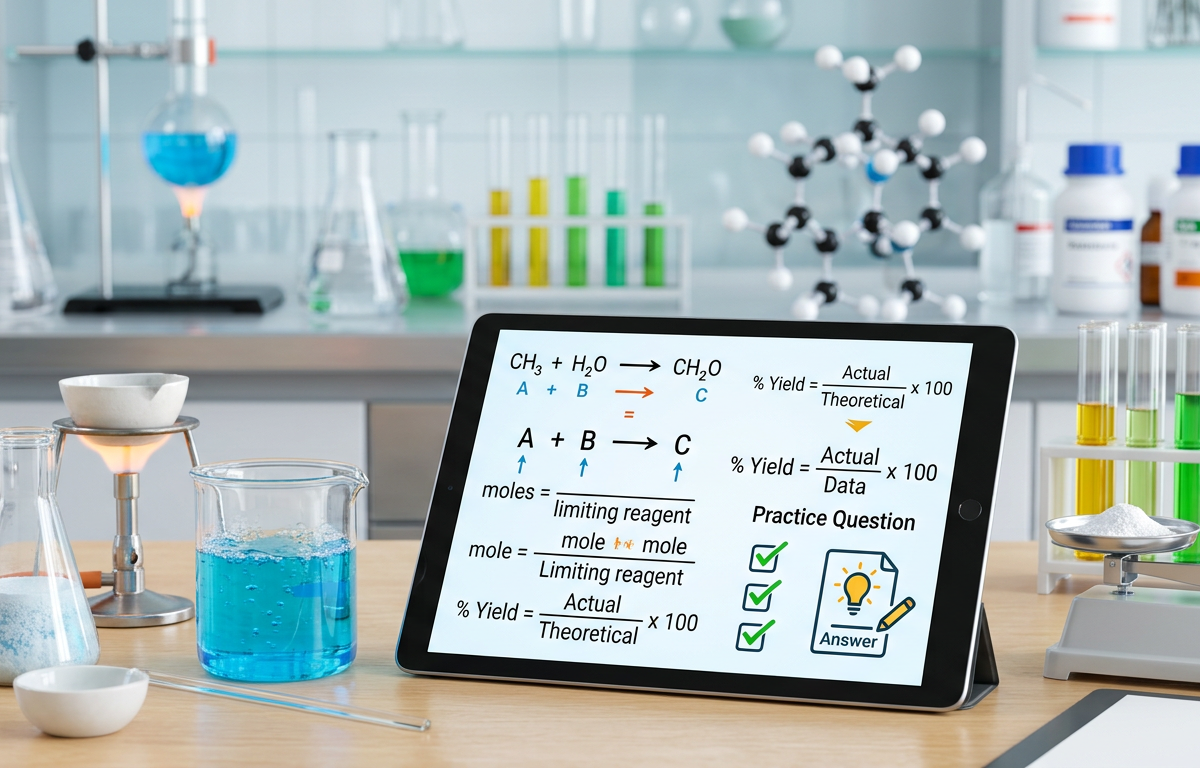
Imagine you have meticulously calculated that a reaction between 10.0 grams of hydrogen and excess oxygen should produce exactly 90.0 grams of water. You run the experiment, carefully dry your product, and place it on the scale only to see 80.0 grams staring back at you. That missing 10 grams is not a violation of physics; it is the reality of the actual yield. In a perfect world, stoichiometry gives us the theoretical yield, a mathematical ceiling that assumes every single atom behaves exactly as prescribed by the balanced equation. In the laboratory, however, factors like side reactions and mechanical loss ensure we rarely reach that peak.
To bridge the gap between paper calculations and bench results, we use the percent yield formula. This calculation is the primary way chemists audit their own efficiency, comparing what was physically collected against the maximum possible mass. The most common mistake students make is confusing the two values in the fraction. Always remember that the smaller, experimental value belongs in the numerator, while the calculated maximum serves as the denominator. If your result exceeds 100 percent, you likely have impurities or residual solvent skewing your data.
Theoretical Yield vs Actual Yield Practice Questions with Answers
Mastering the relationship between theoretical yield vs actual yield is essential for any student of chemistry, as it provides a quantitative measure of a reaction's efficiency. In laboratory settings and industrial manufacturing, reactions rarely produce the maximum possible amount of product due to factors like side reactions, incomplete conversions, or physical loss during filtration. Understanding how to calculate these values allows scientists to optimize processes and minimize waste.
Bridging Stoichiometry and Real-World Results
Theoretical yield is the maximum amount of product that can be generated from a given amount of reactant based on stoichiometric calculations, while actual yield is the amount of product physically obtained from a chemical reaction in a real-world setting. To understand these concepts, one must first be comfortable with stoichiometry practice questions and the law of conservation of mass.
The relationship between these two values is expressed as the percent yield. This percentage indicates how successful a reaction was. The formula is:
Percent Yield = (Actual Yield / Theoretical Yield) × 100%
Key Differences
Feature Theoretical Yield Actual Yield Origin Calculated on paper using balanced equations. Measured in the lab after the experiment. Value Always the maximum possible value. Usually less than the theoretical yield. Influencing Factors Determined by the limiting reagent. Affected by human error, side reactions, and impurities.
According to Wikipedia's entry on Chemical Yield, factors such as the equilibrium constant of a reaction can also limit the actual yield, preventing it from ever reaching 100% even under perfect conditions.
Solved Examples
Reviewing these worked examples will help you apply the formulas to real chemical equations.
Example 1: Basic Percent Yield
A student calculates that a reaction should produce 25.0 grams of Copper (II) sulfate. After performing the experiment, they collect 18.5 grams. Calculate the percent yield.
Identify the theoretical yield: 25.0 g.
Identify the actual yield: 18.5 g.
Apply the formula: (18.5 / 25.0) × 100.
Result: 74.0%.
Example 2: Calculating Actual Yield from Percent
A manufacturing process for Ammonia has a 85% yield. If the theoretical yield is 500 kg, how much Ammonia is actually produced?
Rearrange the percent yield formula: Actual Yield = (Percent Yield × Theoretical Yield) / 100.
Substitute the values: (85 × 500) / 100.
Result: 425 kg.
Example 3: Stoichiometry to Theoretical Yield
If 10.0 g of Hydrogen gas reacts with excess Oxygen to produce water (2H₂ + O₂ → 2H₂O), and 80.0 g of water is collected, find the percent yield. (Molar masses: H₂ = 2 g/mol, H₂O = 18 g/mol)
Convert grams of H₂ to moles: 10.0 g / 2.0 g/mol = 5.0 moles H₂.
Use mole ratio practice questions logic: 2 moles H₂ produce 2 moles H₂O. So, 5.0 moles H₂ produce 5.0 moles H₂O.
Convert moles H₂O to grams (Theoretical Yield): 5.0 mol × 18.0 g/mol = 90.0 g.
Calculate Percent Yield: (80.0 g / 90.0 g) × 100 = 88.9%.
Practice Questions
Test your knowledge with these problems. Remember to use the correct significant figures.
A reaction has a theoretical yield of 12.4 g. The lab technician recovers 10.8 g. What is the percent yield?
In the synthesis of aspirin, the theoretical yield is 45.0 g. If the percent yield is 60%, what is the actual yield?
Heating 24.8 g of Calcium Carbonate produces 11.2 g of Calcium Oxide in a 100% efficient reaction. If a student only collects 9.5 g of Calcium Oxide, what is their percent yield?
A chemist expects to produce 150 g of a compound but only obtains 120 g. What is the percent yield?
If a reaction is known to have a 92% yield, how many grams of product will be formed if the theoretical yield is 25.0 g?
Consider the reaction: N₂ + 3H₂ → 2NH₃. If 28.0 g of N₂ (molar mass 28.0 g/mol) reacts to produce 30.0 g of NH₃ (molar mass 17.0 g/mol), what is the percent yield?
Why is the actual yield almost always lower than the theoretical yield? Provide two common reasons.
A reaction produces 0.85 moles of a product. If the stoichiometry predicted 1.10 moles, what is the percent yield?
Calculate the theoretical yield if 5.0 grams of product were collected at an 80% yield.
A student performs a double displacement reaction and expects 4.55 g of precipitate. They recover 4.60 g. Calculate the percent yield and suggest why it might be over 100%.
Answers & Explanations
87.1%: (10.8 g / 12.4 g) × 100 = 87.096%. Rounded to three significant figures, it is 87.1%.
27.0 g: 60% of 45.0 g is 0.60 × 45.0 = 27.0 g.
84.8%: The theoretical yield was given as 11.2 g. (9.5 g / 11.2 g) × 100 = 84.82%.
80.0%: (120 g / 150 g) × 100 = 80%.
23.0 g: (92 / 100) × 25.0 g = 23.0 g.
88.2%: Theoretical yield calculation: 28.0 g N₂ is 1 mole. 1 mole N₂ produces 2 moles NH₃. 2 moles NH₃ × 17.0 g/mol = 34.0 g (Theoretical). Percent yield: (30.0 / 34.0) × 100 = 88.2%.
Incomplete reactions and loss during transfer: Reactions may not go to completion, or product can be lost when filtering or transferring between containers.
77.3%: (0.85 mol / 1.10 mol) × 100 = 77.27%.
6.25 g: Theoretical Yield = Actual Yield / (Percent Yield / 100) = 5.0 / 0.80 = 6.25 g.
101.1%: (4.60 / 4.55) × 100 = 101.1%. Yields over 100% usually indicate the product is impure or still damp (contains solvent/water).
Frequently Asked Questions
Can the actual yield ever be greater than the theoretical yield?
While theoretically impossible in terms of pure product, a measured actual yield can exceed the theoretical yield if the product is contaminated with impurities or is not completely dry. This usually indicates an error in the purification process rather than a violation of chemical laws.
What is the most common reason for a low percent yield?
The most common reasons include physical loss of product during transfer or filtration, side reactions that consume the starting materials, and reactions that reach equilibrium before all reactants are converted. For more on how chemicals interact, you can visit Khan Academy's Stoichiometry section.
How do you identify the theoretical yield in a word problem?
The theoretical yield is the value you calculate using the mass of the starting reactants and the balanced chemical equation. It is the "ideal" result that assumes every molecule reacts perfectly to form the desired product.
Why is percent yield important in industry?
In industrial chemistry, a high percent yield is critical for cost-effectiveness and sustainability. Low yields mean wasted raw materials and higher production costs, which is why chemical engineers focus heavily on optimizing reaction conditions.
How does the limiting reagent affect theoretical yield?
The limiting reagent is the substance that is completely used up first in a reaction. It limits the amount of product that can be formed, thus defining the theoretical yield based on its initial quantity.
Enjoyed this article?
Share it with others who might find it helpful.
Related Articles

Stoichiometry vs. Reality: Calculating Percent Yield in Chemistry
Master percent yield calculations with our guide. Includes step-by-step solved examples, practice questions, and a quiz to test your chemistry skills.
Mar 21, 2026

Calculating High-Stakes Meds: BSA Mosteller Formula Practice
Master hard body surface area-based dosage calculations with our comprehensive guide, solved examples, and practice questions for healthcare students.
May 17, 2026
Calculating Kc: Mastering the Ratio of Equilibrium Concentrations
Master the Equilibrium Constant (Kc) with our comprehensive guide featuring solved examples, practice questions, and detailed explanations for chemistry students.
Mar 30, 2026
Calculating Enthalpy Changes Using Bond Enthalpy Data
Master bond energy calculations with our comprehensive guide. Includes solved examples, practice questions, and detailed explanations for chemistry students.
Mar 29, 2026
Calculating Enthalpy Changes: Hess’s Law Puzzle Solving Guide
Master Hess’s Law with our comprehensive guide featuring solved examples, step-by-step practice questions, and detailed answers for chemistry students.
Mar 29, 2026
Stoichiometry of the Flask: Calculating Solute Mass and Dilutions
Master solution preparation with these easy practice questions. Learn to calculate molarity, mass, and dilutions with step-by-step examples and a quick quiz.
Mar 27, 2026
Calculate Trace Concentrations: ppm and ppb Chemistry Problems
Master ppm and ppb calculations with this comprehensive guide. Includes formulas, solved examples, and practice questions for chemistry and environmental science.
Mar 27, 2026

Calculating Mass Ratios: Percent Composition Mastery and Problems
Master percentage composition with our comprehensive guide featuring step-by-step solved examples, practice questions, and a quick quiz to test your knowledge.
Mar 26, 2026