MCAT Stereochemistry Practice Questions with Answers

MCAT Stereochemistry Practice Questions with Answers
Mastering MCAT Stereochemistry is essential for any pre-medical student aiming for a top score on the Chemical and Physical Foundations of Biological Systems section. This topic bridges the gap between basic organic chemistry and complex biochemistry, as the spatial arrangement of atoms determines how drugs interact with receptors and how enzymes catalyze reactions. By focusing on active recall and high-yield problem-solving, you can turn this challenging subject into a score booster.
Concept Explanation
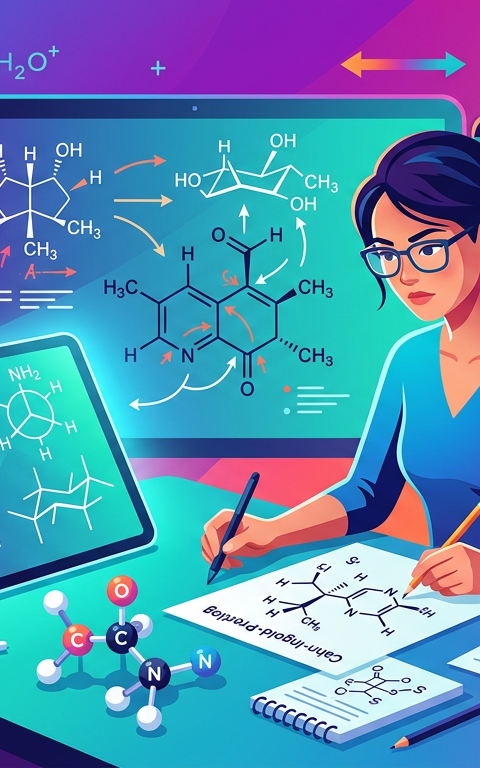
MCAT Stereochemistry is the study of the three-dimensional arrangement of atoms in molecules and how this spatial orientation affects their chemical properties and biological activities. At its core, stereochemistry distinguishes between molecules that have the same molecular formula and connectivity but differ in the orientation of their atoms in space. The most critical concept to master is chirality, which occurs when a molecule has a non-superimposable mirror image, usually due to a chiral center (a carbon atom bonded to four unique groups). Understanding how to assign Cahn-Ingold-Prelog (CIP) priorities to determine R and S configurations is a fundamental skill for the exam. Furthermore, students must differentiate between enantiomers (non-superimposable mirror images), diastereomers (non-mirror image stereoisomers), and meso compounds (achiral molecules with chiral centers and an internal plane of symmetry). These relationships are frequently tested through Fischer projections and Newman projections, which are standard ways to represent 3D molecules on a 2D surface.
To succeed, you should also be familiar with the physical properties of these isomers. Enantiomers share identical physical properties (like boiling point and solubility) except for their interaction with plane-polarized light and other chiral environments. Diastereomers, however, have different physical properties, making them easier to separate in a lab setting. For more on how to effectively memorize these differences, check out our guide on how retrieval practice transforms medical education.
Solved Examples
Review these step-by-step solutions to common MCAT-style stereochemistry problems to sharpen your logic.
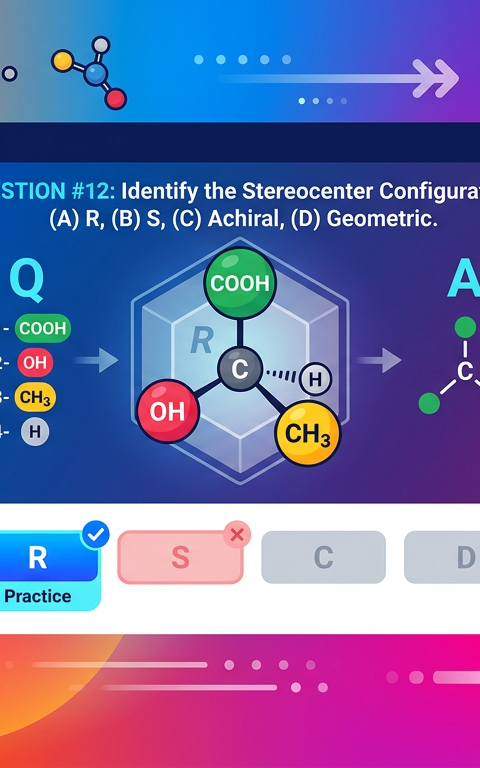
- Assigning R/S Configuration: Determine the configuration of a carbon atom bonded to , , , and .
- Assign priorities based on atomic number: is 1, is 2, is 3, and is 4.
- Ensure the lowest priority group () is pointing away (dashed bond).
- Trace the path from 1 to 2 to 3. If clockwise, it is R; if counter-clockwise, it is S.
- In this case, the path 1 2 3 is clockwise, so the configuration is R.
- Identifying Meso Compounds: Is (2R, 3S)-2,3-dibromobutane a meso compound?
- Draw the molecule and identify the chiral centers at C2 and C3.
- Check for an internal plane of symmetry. Since C2 and C3 have identical substituents (H, Br, CH3, and the rest of the chain) and opposite configurations (R and S), the molecule is symmetrical.
- Because it has chiral centers but is achiral due to symmetry, it is a meso compound.
- Calculating Specific Rotation: A solution of a pure enantiomer has a concentration of . In a polarimeter tube, the observed rotation is . What is the specific rotation ?
- Use the formula:
- Identify variables: , , (Note: ).
- Calculate:
Practice Questions
- A molecule has two chiral centers. One center is R and the other is S. If the substituents on both centers are identical, what is the relationship between this molecule and its mirror image?
- How many stereoisomers are possible for a molecule with the formula ?
- Which of the following properties differs between two enantiomers in an achiral environment: boiling point, density, refractive index, or rotation of plane-polarized light?
Don’t just reread. Train for recall.
Use Bevinzey’s active recall and retrieval practice tools to improve long-term memory and MCAT performance.
Try Active Recall Free- Define the relationship between (2R, 3R)-tartaric acid and (2S, 3S)-tartaric acid.
- In a Fischer projection, if the lowest priority group is on a horizontal bond and the sequence 1-2-3 is clockwise, what is the actual configuration?
- An equimolar mixture of two enantiomers is called what, and what is its optical activity?
- True or False: All molecules with chiral centers are chiral.
- Which isomerism describes the relationship between cis-1,2-dimethylcyclohexane and trans-1,2-dimethylcyclohexane?
- A specific molecule has a specific rotation of . If a sample contains of this enantiomer and of its mirror image, what is the observed rotation?
- If a molecule has chiral centers and no internal plane of symmetry, how many total stereoisomers exist?
Answers & Explanations
- Answer: They are identical. Explanation: A molecule with two chiral centers, identical substituents, and opposite configurations (R,S) possesses an internal plane of symmetry and is a meso compound. Meso compounds are superimposable on their mirror images.
- Answer: 4. Explanation: Using the formula , where is the number of chiral centers. Here, C2 and C3 are chiral centers. Since there is no symmetry, stereoisomers (two pairs of enantiomers).
- Answer: Rotation of plane-polarized light. Explanation: Enantiomers have identical physical properties in achiral environments except for the direction in which they rotate polarized light.
- Answer: Enantiomers. Explanation: Both chiral centers have been inverted (R,R to S,S), and there is no internal plane of symmetry in these specific isomers that would make them meso.
- Answer: S. Explanation: In a Fischer projection, horizontal bonds come "out" at you. If the lowest priority group is horizontal, you must reverse the result. Clockwise usually means R, so the reversed result is S.
- Answer: Racemic mixture; optically inactive. Explanation: A racemic mixture contains equal amounts of and enantiomers, which cancel each other's optical rotation out, resulting in a net rotation of zero.
- Answer: False. Explanation: Meso compounds contain chiral centers but are achiral overall due to an internal plane of symmetry.
- Answer: Diastereomers. Explanation: Cis/trans isomers (geometric isomers) are a sub-type of diastereomers because they are stereoisomers that are not mirror images of each other.
- Answer: . Explanation: The enantiomeric excess (ee) is . The observed rotation is of the pure rotation: .
- Answer: . Explanation: This is the maximum number of stereoisomers according to Le Bel-van't Hoff rule. If symmetry were present, the number would be fewer.
1. Which of the following is a requirement for a molecule to be chiral?
Frequently Asked Questions
What is the difference between enantiomers and diastereomers?
Enantiomers are non-superimposable mirror images that differ at every chiral center, while diastereomers are non-mirror image stereoisomers that differ at some, but not all, chiral centers.
How do I assign priority for R/S naming?
Priorities are assigned based on the Cahn-Ingold-Prelog rules, where atoms with higher atomic numbers receive higher priority; if there is a tie, you move along the chain to the next set of atoms.
Can a molecule be chiral without a chiral center?
Yes, molecules like allenes or substituted biphenyls can exhibit axial chirality even without a traditional tetrahedral chiral carbon atom.
Why are meso compounds optically inactive?
Meso compounds are optically inactive because they possess an internal plane of symmetry that causes the optical rotation of one half of the molecule to cancel out the rotation of the other half.
What does it mean if a mixture is racemic?
A racemic mixture consists of equal amounts of left- and right-handed enantiomers, resulting in zero net optical rotation of plane-polarized light.
How does the MCAT test stereochemistry in a biological context?
The MCAT often tests stereochemistry by asking how specific enzyme active sites only bind to one enantiomer of a substrate, such as L-amino acids or D-sugars. For more on biological applications, see our guide on retrieval practice for STEM subjects.
Don’t just reread. Train for recall.
Use Bevinzey’s active recall and retrieval practice tools to improve long-term memory and MCAT performance.
Try Active Recall FreeReviewed by
Michael Danquah, MS, PhD
Dr. Michael Danquah is a professor of pharmaceutical sciences and founder of several educational technology platforms focused on improving student learning and performance.
Enjoyed this article?
Share it with others who might find it helpful.
Related Articles

Medium MCAT Stereochemistry Practice Questions
Medium MCAT Stereochemistry Practice Questions
May 11, 2026
Easy MCAT Stereochemistry Practice Questions
Master the basics of chirality and R/S configuration with these easy MCAT stereochemistry practice questions and detailed explanations.
May 11, 2026

Easy MCAT Amino Acid Practice Questions
Easy MCAT Amino Acid Practice Questions
May 14, 2026
Easy MCAT Biochemistry Practice Questions
Easy MCAT Biochemistry Practice Questions
May 14, 2026
MCAT Citric Acid Practice Questions with Answers
MCAT Citric Acid Practice Questions with Answers
May 14, 2026

MCAT Biochemistry Practice Questions with Answers
MCAT Biochemistry Practice Questions with Answers
May 14, 2026
Solving High-Yield MCAT Stereochemistry: Beyond R and S Basics
Hard MCAT Stereochemistry Practice Questions
May 11, 2026
Hard MCAT Organic Chemistry Practice Questions
Hard MCAT Organic Chemistry Practice Questions
May 11, 2026