Easy MCAT Biochemistry Practice Questions

Concept Explanation
Easy MCAT Biochemistry Practice Questions focus on the foundational building blocks of life, including amino acids, protein structure, carbohydrate metabolism, and enzyme kinetics. These questions test your ability to recognize basic molecular structures, understand the properties of the 20 standard amino acids, and identify the primary metabolic pathways like glycolysis and the Krebs cycle. Mastering these basics is essential because the MCAT often builds complex passages on top of these fundamental principles. For instance, understanding the functional groups found in biological molecules allows you to predict how they will interact in a cellular environment.
Biochemistry on the MCAT is largely about how molecules carry out the work of the cell. Key areas include:
- Amino Acids: Knowing the three-letter and one-letter codes, as well as the chemical properties of their R-groups (nonpolar, polar, acidic, basic).
- Enzymes: Understanding how catalysts lower activation energy without changing the equilibrium constant .
- Metabolism: Recognizing the net products of pathways such as glycolysis, which yields 2 ATP and 2 NADH per glucose molecule.
- Nucleic Acids: Differentiating between DNA and RNA and understanding base-pairing rules (A-T/U and G-C).
According to the Association of American Medical Colleges (AAMC), biochemistry makes up a significant portion of both the Biological and Biochemical Foundations of Living Systems and the Chemical and Physical Foundations of Biological Systems sections. Building a strong foundation with easy-level practice ensures you don't lose points on high-yield, straightforward questions.
Solved Examples
The following examples demonstrate how to approach foundational biochemistry problems systematically.
- Problem: Determine the net charge of the amino acid Glycine at physiological pH (pH 7.4).
Solution:- Identify the functional groups: Glycine has an amino group () and a carboxyl group ().
- Compare pH to pKa: The pKa of the carboxyl group is ~2, and the pKa of the amino group is ~9.
- Determine protonation state: At pH 7.4, the carboxyl group is deprotonated () and the amino group is protonated ().
- Calculate net charge: . Glycine exists as a zwitterion.
- Problem: If an enzyme follows Michaelis-Menten kinetics, what happens to the reaction velocity when the substrate concentration is much lower than the ?
Solution:- Recall the Michaelis-Menten equation:
- Apply the condition: If , then .
- Simplify: The equation becomes .
- Conclusion: The reaction velocity is first-order with respect to substrate concentration.
- Problem: Calculate the total number of ATP molecules produced from the complete oxidation of one molecule of glucose in a typical eukaryotic cell.
Solution:- Glycolysis: Produces 2 ATP (net) and 2 NADH.
- Pyruvate Dehydrogenase: Produces 2 NADH (1 per pyruvate).
- Citric Acid Cycle: Produces 2 GTP (equivalent to 2 ATP), 6 NADH, and 2 .
- Oxidative Phosphorylation: NADH yields ~2.5 ATP; yields ~1.5 ATP.
- Total: ATP (Note: some cells yield 30 depending on the shuttle used).
Practice Questions
1. Which of the following amino acids contains a sulfur atom in its side chain?
- Serine
- Cysteine
- Threonine
- Tyrosine
2. In the context of enzyme inhibition, a competitive inhibitor increases which of the following parameters?
- Affinity
3. What is the primary secondary structure stabilized by hydrogen bonds between the carbonyl oxygen and the amide hydrogen four residues apart?
- Beta-pleated sheet
- Alpha-helix
- Disulfide bridge
- Hydrophobic collapse
Feel more confident on exam day.
Practice with realistic MCAT-style questions and strengthen your understanding before test day arrives.
Practice Free Now4. Which metabolic pathway occurs exclusively in the cytosol of eukaryotic cells?
- Citric Acid Cycle
- Electron Transport Chain
- Glycolysis
- Oxidative Phosphorylation
5. A nucleotide consists of which three components?
- Sugar, Phosphate, Nitrogenous Base
- Sugar, Sulfate, Amino Acid
- Glycerol, Fatty Acid, Phosphate
- Sugar, Phosphate, Fatty Acid
6. Which of the following is a non-reducing sugar?
- Glucose
- Fructose
- Lactose
- Sucrose
7. The formation of a peptide bond is a type of which reaction?
- Hydrolysis
- Dehydration synthesis
- Redox reaction
- Electrophilic substitution
8. Which molecule acts as the final electron acceptor in the electron transport chain under aerobic conditions?
9. Which amino acid is known for being a "helix breaker" due to its rigid cyclic structure?
- Alanine
- Proline
- Leucine
- Valine
10. What is the net yield of NADH from one turn of the Citric Acid Cycle (starting from Acetyl-CoA)?
- 1
- 2
- 3
- 4
Answers & Explanations
- Answer: B. Cysteine (and Methionine) are the two sulfur-containing amino acids. Cysteine is unique because its thiol () group can form disulfide bonds. For more on molecular properties, see our Easy MCAT Redox Practice Questions.
- Answer: B. Competitive inhibitors bind to the active site, competing with the substrate. This increases the apparent (meaning more substrate is needed to reach half ) but does not change the itself.
- Answer: B. The alpha-helix is characterized by hydrogen bonding between the of residue and the of residue . This is a foundational concept in protein structure.
- Answer: C. Glycolysis occurs in the cytosol. The Citric Acid Cycle and Electron Transport Chain occur within the mitochondria.
- Answer: A. A nucleotide is composed of a pentose sugar (ribose or deoxyribose), a phosphate group, and a nitrogenous base. Without the phosphate, it is called a nucleoside.
- Answer: D. Sucrose is a non-reducing sugar because the glycosidic bond involves the anomeric carbons of both glucose and fructose, leaving no free aldehyde or ketone group to act as a reducing agent.
- Answer: B. Peptide bond formation involves the loss of a water molecule, making it a dehydration (or condensation) reaction. This is related to concepts found in Easy MCAT Organic Reactions Practice Questions.
- Answer: C. Molecular oxygen () is the final electron acceptor, which is reduced to water () by Complex IV.
- Answer: B. Proline's side chain is bonded back to the nitrogen of the amino group, creating a secondary alpha-amino group and a kink in the polypeptide chain that disrupts alpha-helices.
- Answer: C. One turn of the Citric Acid Cycle produces 3 NADH, 1 , and 1 GTP.
1. Which amino acid has a side chain with a pKa closest to physiological pH (~6.0)?
Frequently Asked Questions
What are the most high-yield biochemistry topics for the MCAT?
Amino acids, enzyme kinetics (Michaelis-Menten), and metabolic pathways like glycolysis and the Krebs cycle are the most frequently tested topics. You should also focus on protein purification techniques and DNA replication.
Do I need to memorize all 20 amino acids for the MCAT?
Yes, you must know their full names, three-letter codes, one-letter codes, and chemical properties. You should also be able to recognize their structures and understand how their R-groups behave at different pH levels.
What is the difference between a nucleoside and a nucleotide?
A nucleoside consists of a nitrogenous base and a five-carbon sugar. A nucleotide is a nucleoside that has one or more phosphate groups attached to the sugar.
How does pH affect enzyme activity?
Enzymes have an optimal pH at which they function most efficiently; deviations can lead to the protonation or deprotonation of active site residues, potentially denaturing the enzyme or reducing its catalytic ability.
What is the difference between Vmax and Km?
Vmax is the maximum rate of reaction when the enzyme is saturated with substrate. Km is the substrate concentration at which the reaction rate is half of Vmax, often used as a measure of enzyme-substrate affinity.
Feel more confident on exam day.
Practice with realistic MCAT-style questions and strengthen your understanding before test day arrives.
Practice Free NowReviewed by
Michael Danquah, MS, PhD
Dr. Michael Danquah is a professor of pharmaceutical sciences and founder of several educational technology platforms focused on improving student learning and performance.
Enjoyed this article?
Share it with others who might find it helpful.
Related Articles

MCAT Biochemistry Practice Questions with Answers
MCAT Biochemistry Practice Questions with Answers
May 14, 2026

Easy MCAT Amino Acid Practice Questions
Easy MCAT Amino Acid Practice Questions
May 14, 2026
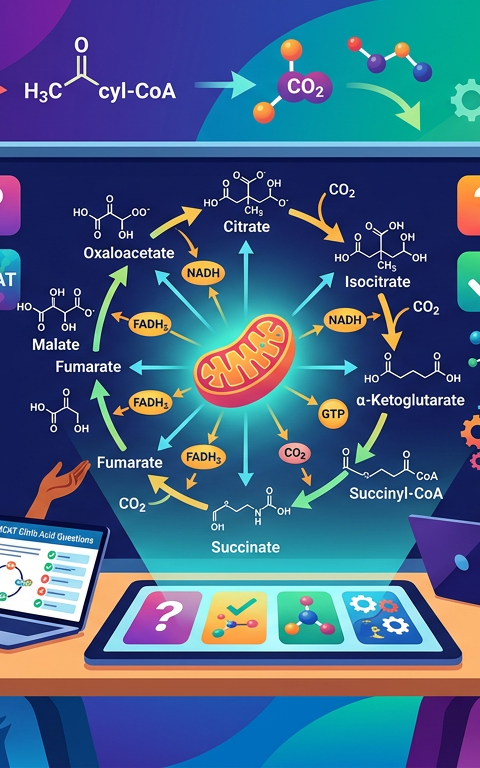
MCAT Citric Acid Practice Questions with Answers
MCAT Citric Acid Practice Questions with Answers
May 14, 2026
Solving High-Yield MCAT Stereochemistry: Beyond R and S Basics
Hard MCAT Stereochemistry Practice Questions
May 11, 2026
Hard MCAT Organic Chemistry Practice Questions
Hard MCAT Organic Chemistry Practice Questions
May 11, 2026
Medium MCAT Stereochemistry Practice Questions
Medium MCAT Stereochemistry Practice Questions
May 11, 2026
Medium MCAT Organic Chemistry Practice Questions
Medium MCAT Organic Chemistry Practice Questions
May 11, 2026
Easy MCAT Stereochemistry Practice Questions
Master the basics of chirality and R/S configuration with these easy MCAT stereochemistry practice questions and detailed explanations.
May 11, 2026