Medium MCAT Stereochemistry Practice Questions

Concept Explanation
Stereochemistry is the study of the three-dimensional arrangement of atoms within molecules and how these spatial orientations affect chemical reactivity and physical properties. In the context of the MCAT, stereochemistry centers on the identification of chiral centers, the assignment of R/S configurations using Cahn-Ingold-Prelog priority rules, and the distinction between isomers such as enantiomers, diastereomers, and meso compounds. Understanding these concepts is essential because biological systems are inherently chiral; for example, most naturally occurring amino acids are in the L-configuration, while sugars are typically in the D-configuration. Mastering these spatial relationships requires consistent retrieval practice for medical students to ensure that 3D visualization becomes second nature during the high-pressure environment of the exam.
Key terms to master include:
- Chiral Center: An atom (usually carbon) bonded to four unique substituents.
- Enantiomers: Non-superimposable mirror images that have identical physical properties except for the direction in which they rotate plane-polarized light.
- Diastereomers: Non-mirror image optical isomers that occur when a molecule has two or more stereocenters; these have different physical properties.
- Meso Compounds: Molecules with chiral centers that also possess an internal plane of symmetry, rendering them achiral and optically inactive.
Solved Examples
Reviewing worked problems helps solidify the logic needed to tackle medium-difficulty stereochemistry questions on the MCAT.
- Determining R/S Configuration: Assign the configuration for a carbon bonded to , , , and , where the hydrogen is pointing away from you.
- Assign priority based on atomic number: (1), (2), (3), and (4).
- Trace the path from 1 to 2 to 3.
- Since the path is clockwise and the lowest priority group is in the back, the configuration is (R).
- Identifying Enantiomers vs. Diastereomers: Compare a molecule with configuration (2R, 3S) to one with (2S, 3R).
- Look at the relationship between the centers. Both centers have been inverted (R to S and S to R).
- Since all chiral centers are inverted and the molecules are mirror images, they are enantiomers.
- Recognizing Meso Compounds: Determine if (2R, 3S)-tartaric acid is chiral.
- Tartaric acid has two identical chiral centers.
- In the (2R, 3S) configuration, the molecule possesses an internal plane of symmetry.
- Despite having chiral centers, the internal symmetry makes it a meso compound, which is achiral.
Practice Questions
Test your knowledge with these medium MCAT stereochemistry practice questions. Use the retrieval practice method to recall the rules of priority before looking at the answers.
1. Which of the following is a requirement for a molecule to be considered a meso compound?
2. A solution contains a 70:30 mixture of two enantiomers. If the pure (S)-enantiomer has a specific rotation of , what is the observed rotation of the mixture?
3. How many stereoisomers are possible for a non-cyclic molecule with the formula ?
Study smarter for the MCAT.
Turn practice into performance with AI-powered MCAT tools designed to help students retain more and score higher.
Start Learning Free4. In a Fisher projection, if the lowest priority group is located on a horizontal bond, how does this affect the determination of the R/S configuration?
5. Which physical property differs between a pair of enantiomers in a non-chiral environment?
6. Assign the configuration (R or S) to the chiral center of 2-chlorobutane where the chlorine is coming out of the page (wedge) and the ethyl group is in the plane of the page.
7. Compare (2R, 3R)-2,3-dibromobutane and (2R, 3S)-2,3-dibromobutane. What is their isomeric relationship?
8. An unknown compound with two chiral centers is found to be optically inactive. What are the two most likely explanations for this observation?
Answers & Explanations
- Answer: It must have at least two chiral centers and an internal plane of symmetry. A meso compound is achiral because the two halves of the molecule mirror each other, canceling out any optical activity despite the presence of stereocenters.
- Answer: . The enantiomeric excess (ee) is . The observed rotation is . If the (S) is and constitutes 70% of the mix, the rotation is .
- Answer: 4. The formula for the maximum number of stereoisomers is , where is the number of chiral centers. Here, C2 and C3 are chiral centers. . Since the substituents are different, no meso compounds exist to reduce this number.
- Answer: The configuration determined from the drawing must be reversed. In a Fisher projection, horizontal lines represent bonds coming toward the viewer. If the lowest priority group is on a horizontal line, a clockwise trace (R) is actually (S), and a counter-clockwise trace (S) is actually (R).
- Answer: Direction of rotation of plane-polarized light. Enantiomers have identical boiling points, melting points, and densities. They only differ in how they interact with chiral environments or plane-polarized light.
- Answer: (S)-2-chlorobutane. Priority: 1. , 2. , 3. , 4. . If Cl is a wedge and H is a dash (implied), the sequence 1→2→3 is counter-clockwise, which is (S).
- Answer: Diastereomers. Only one of the two chiral centers has been inverted (the center at C3). Because they are not mirror images but share the same connectivity, they are diastereomers. This is a common topic in medical education regarding drug-receptor interactions.
- Answer: The compound is a racemic mixture or a meso compound. Optical inactivity occurs either because there are equal amounts of enantiomers (racemic) or because the molecule itself is achiral due to internal symmetry (meso).
1. Which of the following describes a racemic mixture?
Frequently Asked Questions
What is the difference between an enantiomer and a diastereomer?
Enantiomers are non-superimposable mirror images where every chiral center is inverted between the two molecules. Diastereomers are non-mirror image stereoisomers where at least one, but not all, chiral centers are inverted.
How do you assign priority to groups with double bonds?
In the Cahn-Ingold-Prelog system, atoms involved in double bonds are treated as if they are bonded to two of that same atom. For example, a group is treated as a carbon bonded to two oxygens when determining priority.
Can a molecule with no chiral centers be chiral?
Yes, molecules like allenes or substituted biphenyls can be chiral if they possess axial chirality. However, for the MCAT, chirality almost always refers to the presence of a stereocenter with four different groups.
Why are meso compounds optically inactive?
Meso compounds are optically inactive because they possess an internal plane of symmetry that makes the molecule achiral. The rotation of light by one half of the molecule is exactly canceled out by the other half.
What is the specific rotation of a racemic mixture?
The specific rotation of a racemic mixture is always zero. This is because the equal and opposite rotations of the two enantiomers present in the mixture cancel each other out.
How does stereochemistry affect drug binding?
Biological receptors are made of chiral proteins, meaning they often only bind to one specific enantiomer of a drug. This specificity is why one enantiomer may be therapeutic while the other is inactive or even toxic, as seen in the history of thalidomide.
Study smarter for the MCAT.
Turn practice into performance with AI-powered MCAT tools designed to help students retain more and score higher.
Start Learning FreeReviewed by
Michael Danquah, MS, PhD
Dr. Michael Danquah is a professor of pharmaceutical sciences and founder of several educational technology platforms focused on improving student learning and performance.
Enjoyed this article?
Share it with others who might find it helpful.
Related Articles
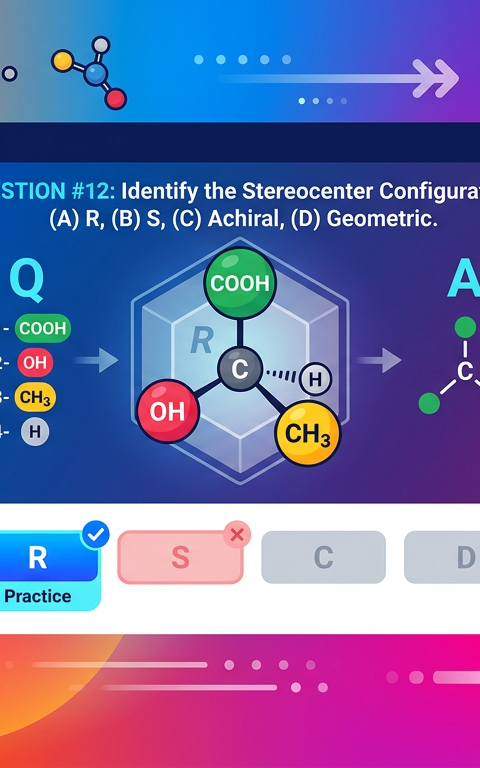
Easy MCAT Stereochemistry Practice Questions
Master the basics of chirality and R/S configuration with these easy MCAT stereochemistry practice questions and detailed explanations.
May 11, 2026
MCAT Stereochemistry Practice Questions with Answers
MCAT Stereochemistry Practice Questions with Answers
May 10, 2026

Easy MCAT Amino Acid Practice Questions
Easy MCAT Amino Acid Practice Questions
May 14, 2026
Easy MCAT Biochemistry Practice Questions
Easy MCAT Biochemistry Practice Questions
May 14, 2026
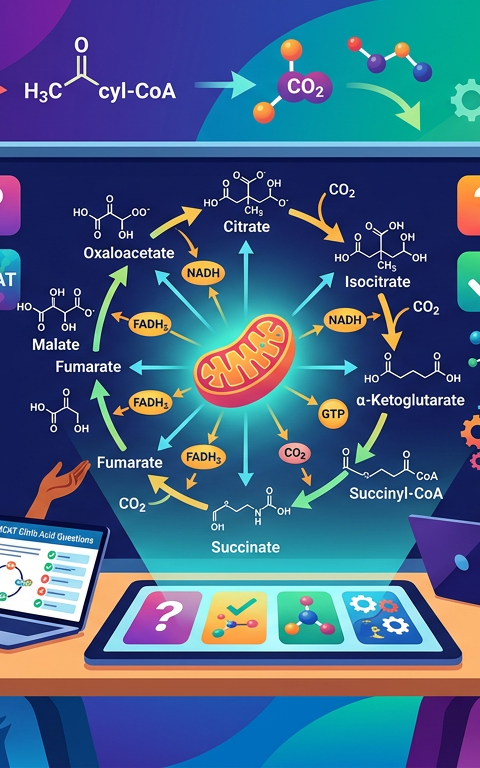
MCAT Citric Acid Practice Questions with Answers
MCAT Citric Acid Practice Questions with Answers
May 14, 2026

MCAT Biochemistry Practice Questions with Answers
MCAT Biochemistry Practice Questions with Answers
May 14, 2026
Solving High-Yield MCAT Stereochemistry: Beyond R and S Basics
Hard MCAT Stereochemistry Practice Questions
May 11, 2026
Hard MCAT Organic Chemistry Practice Questions
Hard MCAT Organic Chemistry Practice Questions
May 11, 2026