Hard MCAT Organic Chemistry Practice Questions
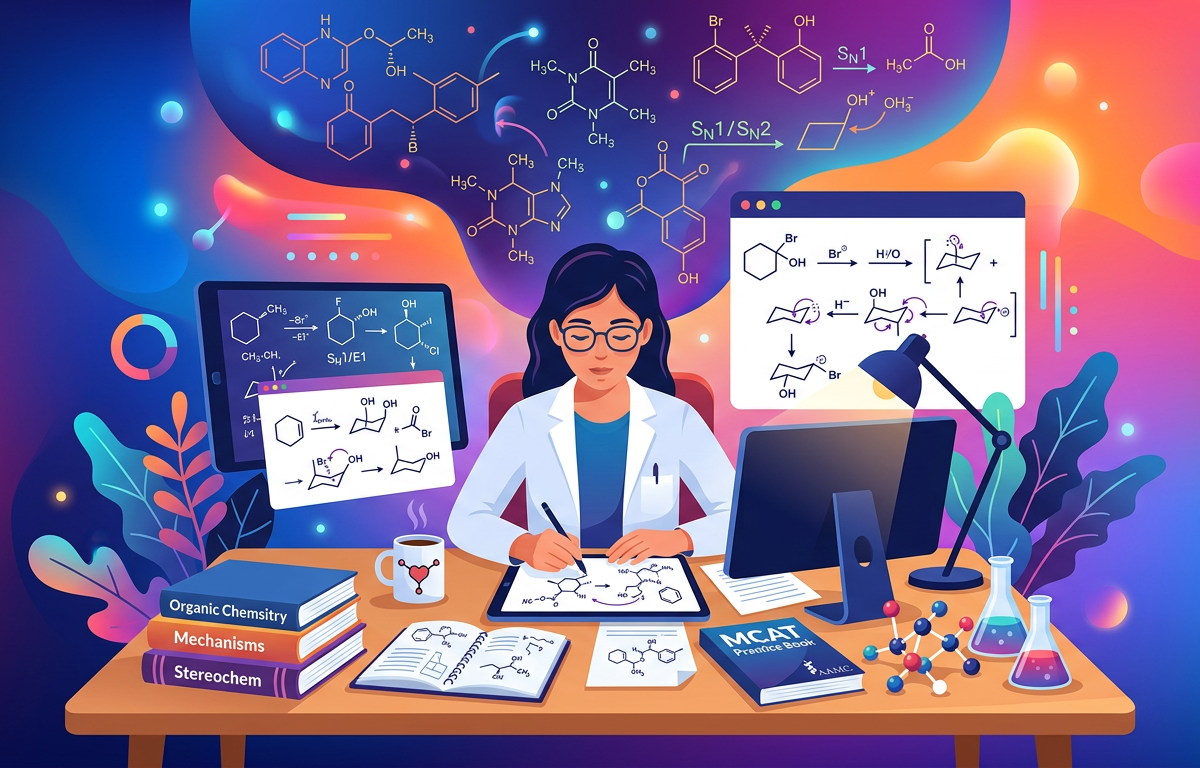
Mastering Hard MCAT Organic Chemistry Practice Questions requires more than just memorizing functional groups; it demands a deep understanding of electronic effects, stereochemistry, and complex reaction mechanisms. Organic chemistry on the MCAT often integrates multiple concepts, such as how a molecule's three-dimensional shape influences its reactivity or how resonance stabilization dictates the outcome of a nucleophilic attack. By engaging in active retrieval practice, students can move beyond passive recognition and develop the critical thinking skills necessary to navigate the most challenging passages on the exam.
Concept Explanation
Hard MCAT Organic Chemistry Practice Questions focus on high-yield topics like carbonyl chemistry, carboxylic acid derivatives, and advanced stereochemistry within the context of biological systems. To solve these problems, you must apply the principles of nucleophilicity and electrophilicity to predict how electrons flow during a reaction. Key concepts include the inductive effect, where electronegative atoms pull electron density through sigma bonds, and resonance, where pi electrons are delocalized across multiple atoms. Furthermore, understanding the relationship between , , E1, and E2 mechanisms is vital, particularly how solvent effects and steric hindrance determine the major product. Many students find that using power retrieval examples helps solidify these mechanisms in long-term memory.
Solved Examples
Review these detailed step-by-step solutions to understand the logic required for advanced organic chemistry problems.
- Example 1: Nucleophilic Substitution Stereochemistry
Question: What is the configuration of the product when (S)-2-bromobutane reacts with sodium cyanide () in dimethyl sulfoxide (DMSO)?- Identify the mechanism: is a strong nucleophile and DMSO is a polar aprotic solvent, favoring an reaction.
- Determine the stereochemical outcome: reactions proceed with inversion of configuration at the chiral center.
- Apply the inversion: The reactant is (S)-2-bromobutane. Inversion yields (R)-2-cyanobutane.
- Final Answer: (R)-2-cyanobutane.
- Example 2: Aldol Condensation Mechanism
Question: Predict the major product of the self-condensation of propanal in the presence of dilute .- Enolate formation: Hydroxide deprotonates the -carbon of one propanal molecule to form a resonance-stabilized enolate.
- Nucleophilic attack: The enolate attacks the carbonyl carbon of a second propanal molecule.
- Protonation: The resulting alkoxide is protonated by water to form a -hydroxy aldehyde (3-hydroxy-2-methylpentanal).
- Dehydration (if heat is applied): Loss of water results in an -unsaturated aldehyde (2-methyl-2-pentenal).
- Final Answer: 3-hydroxy-2-methylpentanal (aldol) or 2-methyl-2-pentenal (enone).
- Example 3: Carboxylic Acid Derivative Reactivity
Question: Rank the following in order of decreasing reactivity toward nucleophilic acyl substitution: Acetyl chloride, Ethyl acetate, Acetamide, Acetic anhydride.- Evaluate leaving group ability: The better the leaving group (weaker base), the more reactive the derivative.
- Compare leaving groups: (weakest base) > > > (strongest base).
- Rank by derivative: Acid Chloride > Anhydride > Ester > Amide.
- Final Answer: Acetyl chloride > Acetic anhydride > Ethyl acetate > Acetamide.
Practice Questions
Test your knowledge with these practice questions. Remember that retrieval practice via testing is one of the most effective ways to prepare for the MCAT.
- Which of the following compounds would have the highest boiling point: propanal, propan-1-ol, or propanone?
- During the formation of a hemiacetal from an aldehyde and an alcohol, what is the hybridization change of the carbonyl carbon?
- Identify the major product of the reaction between benzoic acid and , followed by an acid workup.
Study smarter for the MCAT.
Turn practice into performance with AI-powered MCAT tools designed to help students retain more and score higher.
Start Learning Free- A compound with the formula shows a strong IR absorption at and no signal above . What functional group is present?
- In the reaction of an alkene with followed by , what are the products if the starting material is 2-methyl-2-butene?
- Which amino acid contains a thiol group in its side chain and can form disulfide bridges?
- Explain why an amide is less reactive than an ester toward nucleophilic attack.
- What is the relationship between (2R, 3S)-tartaric acid and (2S, 3R)-tartaric acid?
- Predict the product when phenol reacts with in the presence of .
- How many stereoisomers are possible for a molecule with 3 non-identical chiral centers?
Answers & Explanations
- Propan-1-ol. Alcohols can participate in intermolecular hydrogen bonding, which significantly increases the boiling point compared to aldehydes (propanal) and ketones (propanone), which only have dipole-dipole interactions. More information on molecular forces can be found at Wikipedia.
- to . The carbonyl carbon in an aldehyde is hybridized (trigonal planar). Upon nucleophilic attack by an alcohol to form a hemiacetal, the carbon becomes bonded to four groups, resulting in hybridization (tetrahedral).
- Benzyl alcohol. (Lithium Aluminum Hydride) is a strong reducing agent that reduces carboxylic acids all the way to primary alcohols.
- Ketone. The peak at indicates a carbonyl group (). The lack of a signal above (specifically ) rules out alcohols and carboxylic acids. Since the formula is , it must be a ketone (butanone) or an aldehyde (butanal).
- Acetone and Acetaldehyde. Ozonolysis cleaves the double bond. 2-methyl-2-butene breaks into propan-2-one (acetone) and ethanal (acetaldehyde).
- Cysteine. Cysteine contains a sulfhydryl () group, which can undergo oxidation to form covalent disulfide bonds () with another cysteine residue.
- Resonance stabilization. The nitrogen atom in an amide is less electronegative than the oxygen atom in an ester. The lone pair on nitrogen donates more effectively into the carbonyl pi system, increasing the double-bond character of the bond and making the carbonyl carbon less electrophilic.
- They are the same molecule (Meso compound). Tartaric acid with (2R, 3S) configuration has an internal plane of symmetry, making it a meso compound. Therefore, its mirror image (2S, 3R) is superimposable on the original.
- o-bromophenol and p-bromophenol. The hydroxyl group on phenol is an activating group and an ortho/para director due to the lone pairs on the oxygen that can donate into the benzene ring via resonance.
- 8. The number of stereoisomers is calculated using the formula , where is the number of chiral centers. .
1. Which of the following reagents will reduce a ketone to a secondary alcohol but will NOT reduce a carboxylic acid?
Frequently Asked Questions
What is the most important factor in determining nucleophilicity?
Nucleophilicity is primarily determined by charge, electronegativity, and steric hindrance. A negatively charged species is typically a stronger nucleophile than its neutral counterpart, while lower electronegativity allows an atom to share its electrons more readily.
How do I distinguish between SN1 and SN2 mechanisms on the MCAT?
Focus on the substitution of the substrate and the strength of the nucleophile. SN2 is favored by primary substrates and strong nucleophiles, while SN1 is favored by tertiary substrates and weak nucleophiles in polar protic solvents.
Why are aldehydes more reactive than ketones?
Aldehydes are more reactive due to less steric hindrance and less inductive stabilization of the carbonyl carbon. Ketones have two electron-donating alkyl groups that reduce the partial positive charge on the carbon, making it less attractive to nucleophiles.
What is the difference between a protic and an aprotic solvent?
Protic solvents have a hydrogen atom bound to an electronegative atom like oxygen or nitrogen, allowing them to form hydrogen bonds. Aprotic solvents lack these hydrogen-bonding protons, which prevents them from solvating nucleophiles strongly, thereby increasing nucleophile reactivity in SN2 reactions.
How does resonance affect the acidity of a molecule?
Resonance increases acidity by stabilizing the conjugate base after a proton is lost. If the negative charge on the conjugate base can be delocalized over multiple atoms, the base is more stable, making the original acid more likely to donate its proton.
Study smarter for the MCAT.
Turn practice into performance with AI-powered MCAT tools designed to help students retain more and score higher.
Start Learning FreeReviewed by
Michael Danquah, MS, PhD
Dr. Michael Danquah is a professor of pharmaceutical sciences and founder of several educational technology platforms focused on improving student learning and performance.
Enjoyed this article?
Share it with others who might find it helpful.
Related Articles
Medium MCAT Organic Chemistry Practice Questions
Medium MCAT Organic Chemistry Practice Questions
May 11, 2026
Easy MCAT Organic Chemistry Practice Questions
Easy MCAT Organic Chemistry Practice Questions
May 11, 2026

Medium MCAT General Chemistry Practice Questions
Medium MCAT General Chemistry Practice Questions
May 9, 2026

Easy MCAT General Chemistry Practice Questions
Easy MCAT General Chemistry Practice Questions
May 9, 2026
MCAT General Chemistry Practice Questions with Answers
MCAT General Chemistry Practice Questions with Answers
May 9, 2026

Easy MCAT Amino Acid Practice Questions
Easy MCAT Amino Acid Practice Questions
May 14, 2026
Easy MCAT Biochemistry Practice Questions
Easy MCAT Biochemistry Practice Questions
May 14, 2026
MCAT Citric Acid Practice Questions with Answers
MCAT Citric Acid Practice Questions with Answers
May 14, 2026