Easy MCAT Stereochemistry Practice Questions
Easy MCAT Stereochemistry Practice Questions
Mastering stereochemistry is a fundamental step for any pre-med student, as it forms the backbone of organic chemistry and biochemistry on the MCAT. Understanding how atoms are arranged in three-dimensional space allows you to predict how drugs interact with receptors and how enzymes catalyze specific reactions. This guide provides Easy MCAT Stereochemistry Practice Questions designed to build your confidence and ensure you have a solid foundation in chirality, enantiomers, and Cahn-Ingold-Prelog priority rules.
Concept Explanation
Stereochemistry is the study of the relative spatial arrangement of atoms that form the structure of molecules and their impact on chemical behavior. At the heart of this topic is the concept of chirality; a molecule is considered chiral if it possesses a non-superimposable mirror image, much like your left and right hands. For a carbon atom to be a stereocenter (or chiral center), it must be bonded to four unique substituents. We distinguish between these spatial arrangements using the Cahn-Ingold-Prelog (CIP) system, assigning an (R) or (S) configuration based on the atomic number of the atoms directly attached to the chiral center.
Beyond individual centers, stereochemistry explores the relationships between whole molecules. Enantiomers are pairs of molecules that are non-superimposable mirror images of each other, sharing identical physical properties except for the direction in which they rotate plane-polarized light. Diastereomers, conversely, are stereoisomers that are not mirror images, often occurring when a molecule has multiple chiral centers. Mastering these distinctions is a prime example of where retrieval practice for medical students can significantly boost long-term retention of complex spatial concepts. For further reading on the chemical principles of chirality, you can visit the IUPAC Gold Book on Chirality.
Solved Examples
Review these worked examples to understand the step-by-step logic required for Easy MCAT Stereochemistry Practice Questions.
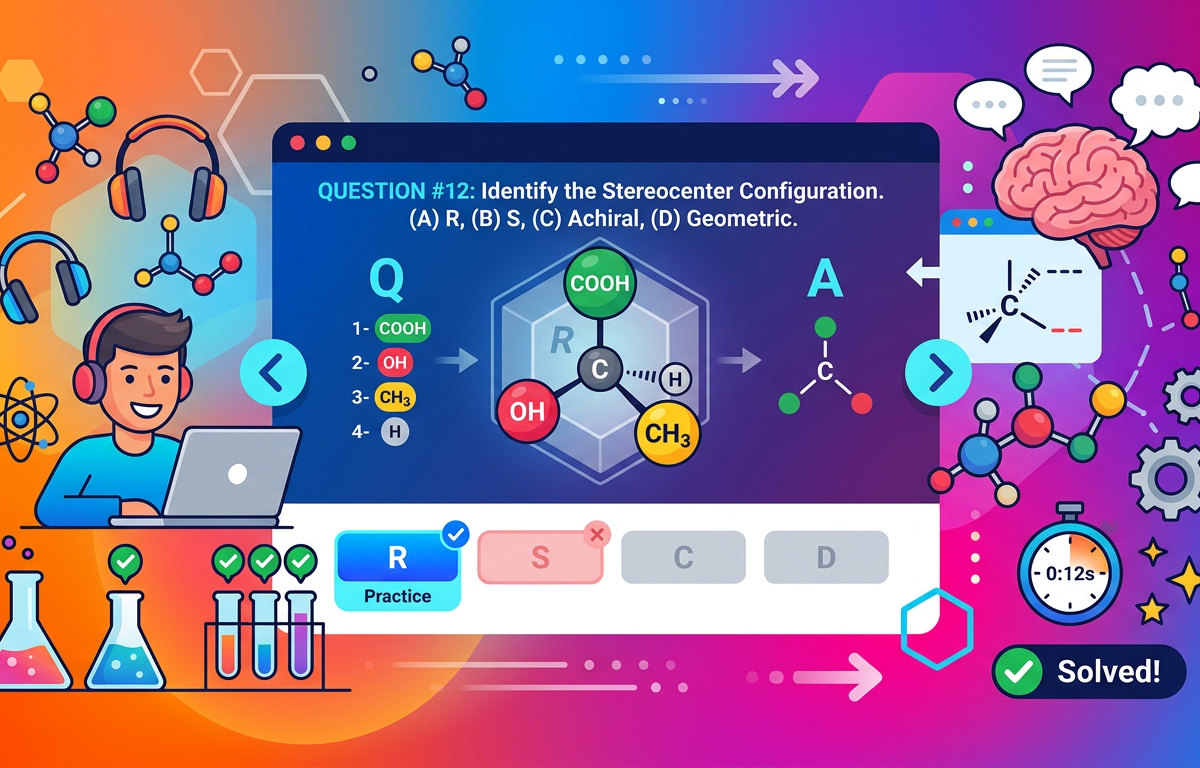
- Assigning (R/S) Configuration: Determine the configuration of a carbon bonded to , , , and (where H is pointing away/on a dash).
- Assign priority based on atomic number: (1), (2), (3), and (4).
- Since the lowest priority group (H) is already in the back, draw a circle from 1 to 2 to 3.
- The circle moves clockwise; therefore, the configuration is (R).
- Identifying Meso Compounds: Is cis-1,2-dimethylcyclohexane a meso compound?
- Identify chiral centers: Carbons 1 and 2 are both bonded to four different groups (H, methyl, and two different paths around the ring).
- Check for an internal plane of symmetry: In the cis-conformation, a plane can be drawn directly between C1 and C2.
- Because it has chiral centers and an internal plane of symmetry, it is a meso compound and is optically inactive.
- Calculating Stereoisomers: How many possible stereoisomers exist for 2,3-dichlorobutane?
- Use the formula , where is the number of chiral centers.
- Identify chiral centers: C2 and C3 are both chiral. .
- Check for meso forms: Because the molecule is symmetrical, the (R,S) and (S,R) forms are identical (meso).
- Total stereoisomers = 3 (one pair of enantiomers and one meso compound).
Practice Questions
Test your knowledge with these Easy MCAT Stereochemistry Practice Questions. Use retrieval practice to recall the rules of priority and isomerism without looking at your notes first.
1. Which of the following is a requirement for a carbon atom to be considered a chiral center?
2. Assign the priority (1 to 4) for the following groups according to the Cahn-Ingold-Prelog rules: , , , .
3. If a molecule rotates plane-polarized light in a clockwise direction, it is termed:
Study smarter for the MCAT.
Turn practice into performance with AI-powered MCAT tools designed to help students retain more and score higher.
Start Learning Free4. True or False: Enantiomers have different boiling points and melting points.
5. How many chiral centers are present in 3-methylhexane?
6. What is the relationship between (2R, 3S)-tartaric acid and (2S, 3R)-tartaric acid if the molecule has an internal plane of symmetry?
7. A racemic mixture contains equal amounts of two enantiomers. What is its observed specific rotation?
8. Which functional group has higher priority in R/S naming: an aldehyde () or an alcohol ()?
9. Define a diastereomer in terms of its mirror-image relationship.
10. If the lowest priority group is pointing toward the viewer (on a wedge), and the sequence 1 → 2 → 3 is clockwise, what is the actual configuration?
Answers & Explanations
- 1. Answer: It must be bonded to four unique substituents. A chiral center (or stereocenter) requires tetrahedral geometry with four different groups to lack a plane of symmetry.
- 2. Answer: (1), (2), (3), (4). Priority is based on atomic number: O (8) > N (7) > C (6) > H (1).
- 3. Answer: Dextrorotatory (+). Clockwise rotation is indicated by (+) or "d-", while counterclockwise is levorotatory (-) or "l-". Note that (d/l) is experimental and not directly related to (R/S).
- 4. Answer: False. Enantiomers share identical physical properties in achiral environments. They only differ in their interaction with polarized light and other chiral molecules.
- 5. Answer: One. Carbon 3 is bonded to a hydrogen, a methyl group, an ethyl group, and a propyl group.
- 6. Answer: They are the same molecule (Meso). Because of the internal plane of symmetry, the (2R, 3S) and (2S, 3R) configurations are identical and represent a single achiral meso compound.
- 7. Answer: 0 degrees. The clockwise rotation of one enantiomer exactly cancels out the counterclockwise rotation of the other.
- 8. Answer: Aldehyde (). The carbon in an aldehyde is double-bonded to an oxygen, which counts as being bonded to two oxygens in CIP rules, whereas the alcohol carbon is only single-bonded to one oxygen.
- 9. Answer: Non-mirror image stereoisomers. Diastereomers occur when at least one, but not all, chiral centers in a multi-center molecule differ in configuration.
- 10. Answer: (S). If the lowest priority group is on a wedge, you must reverse the result. Clockwise (normally R) becomes (S).
1. Which of the following molecules is achiral despite having chiral centers?
Frequently Asked Questions
What is the difference between R/S and +/- notation?
R and S describe the absolute configuration of atoms in space based on nomenclature rules, while + and - describe the experimental direction in which a molecule rotates plane-polarized light. There is no direct correlation between the two; an (R) molecule can be either (+) or (-).
How do I quickly identify a meso compound?
Look for a molecule that has two or more chiral centers and an internal plane of symmetry that divides the molecule into two identical halves. If you can fold the molecule in half and the groups match perfectly, it is meso and achiral.
Can a molecule be chiral without a chiral center?
Yes, molecules like allenes or certain substituted biphenyls can exhibit axial chirality. These molecules lack a specific chiral atom but have a spatial arrangement that prevents them from being superimposable on their mirror image.
Why does the MCAT test stereochemistry so frequently?
Stereochemistry is vital in biological systems because enzymes and receptors are chiral. This means they usually only interact with one specific enantiomer of a drug or substrate, making stereochemical purity essential for medical safety and efficacy.
What is the best way to study for stereochemistry questions?
The most effective method is using retrieval practice vs passive studying, where you actively draw molecules and assign configurations rather than just reading about them. Using a physical molecular model kit can also help visualize the 3D relationships more clearly.
Study smarter for the MCAT.
Turn practice into performance with AI-powered MCAT tools designed to help students retain more and score higher.
Start Learning FreeReviewed by
Michael Danquah, MS, PhD
Dr. Michael Danquah is a professor of pharmaceutical sciences and founder of several educational technology platforms focused on improving student learning and performance.
Enjoyed this article?
Share it with others who might find it helpful.
Related Articles
Medium MCAT Stereochemistry Practice Questions
Medium MCAT Stereochemistry Practice Questions
May 11, 2026
MCAT Stereochemistry Practice Questions with Answers
MCAT Stereochemistry Practice Questions with Answers
May 10, 2026

Easy MCAT Amino Acid Practice Questions
Easy MCAT Amino Acid Practice Questions
May 14, 2026
Easy MCAT Biochemistry Practice Questions
Easy MCAT Biochemistry Practice Questions
May 14, 2026
MCAT Citric Acid Practice Questions with Answers
MCAT Citric Acid Practice Questions with Answers
May 14, 2026

MCAT Biochemistry Practice Questions with Answers
MCAT Biochemistry Practice Questions with Answers
May 14, 2026
Solving High-Yield MCAT Stereochemistry: Beyond R and S Basics
Hard MCAT Stereochemistry Practice Questions
May 11, 2026
Hard MCAT Organic Chemistry Practice Questions
Hard MCAT Organic Chemistry Practice Questions
May 11, 2026