MCAT Citric Acid Practice Questions with Answers
MCAT Citric Acid Practice Questions with Answers
Mastering the Citric Acid Cycle, also known as the Krebs cycle or the TCA cycle, is essential for any student aiming for a high score on the MCAT Biological and Biochemical Foundations of Living Systems section. This metabolic pathway is the central hub of cellular respiration, processing acetyl-CoA to produce high-energy electron carriers that drive ATP synthesis. Understanding the substrates, enzymes, and regulatory checkpoints of this cycle allows you to predict how metabolic shifts affect overall energy production. In this guide, we provide a deep dive into the cycle along with MCAT Citric Acid practice questions to sharpen your test-taking skills.
Concept Explanation
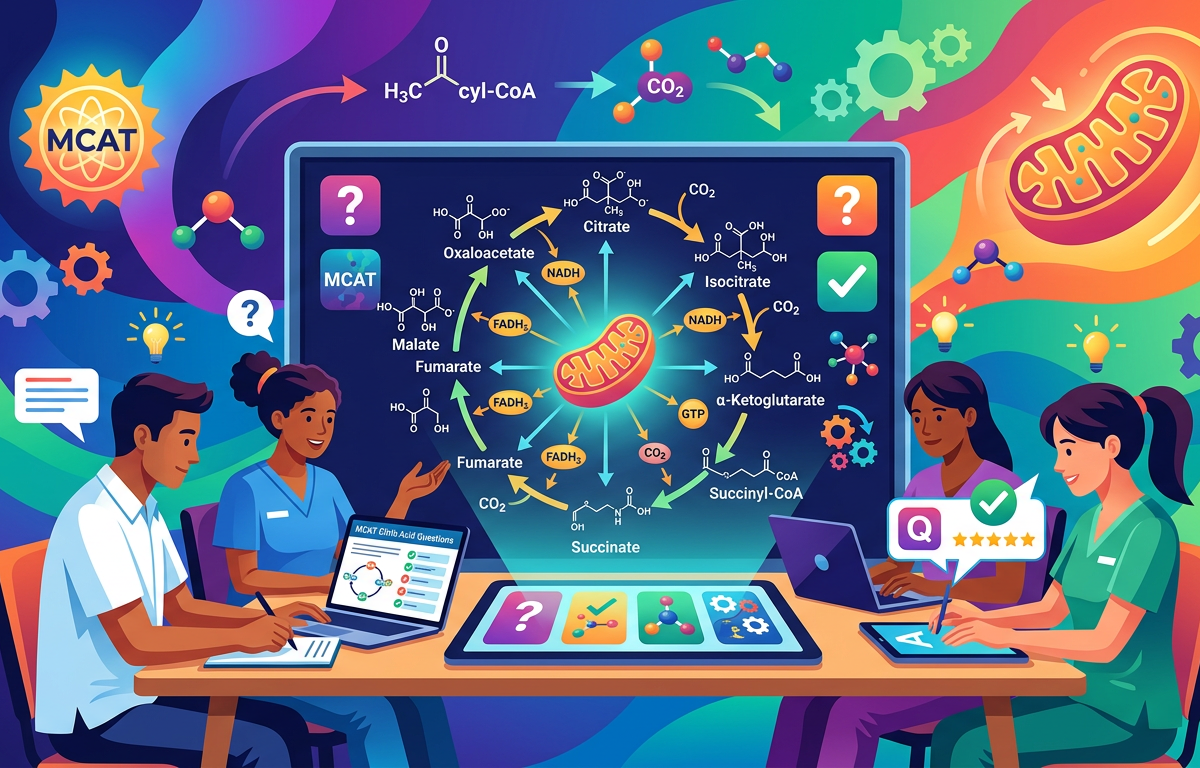
The Citric Acid Cycle is a series of eight biochemical reactions occurring in the mitochondrial matrix that oxidizes acetyl-CoA into two molecules of carbon dioxide while generating NADH, FADH2, and GTP/ATP. This cycle is considered amphibolic because it functions in both catabolism (breaking down molecules for energy) and anabolism (providing precursors for amino acid and heme synthesis). The process begins when the two-carbon acetyl group from acetyl-CoA condenses with the four-carbon oxaloacetate to form the six-carbon citrate, a reaction catalyzed by citrate synthase.
As the cycle progresses, several key oxidation-reduction reactions occur. Isocitrate is decarboxylated to alpha-ketoglutarate, and alpha-ketoglutarate is further decarboxylated to succinyl-CoA; both steps produce and reduce to . These steps are critical regulatory points, sensitive to the energy status of the cell (ATP/ADP ratio). For a broader look at how these molecules interact with other organic structures, you might find our MCAT Functional Group Practice Questions helpful. The final stages of the cycle involve the regeneration of oxaloacetate through the oxidation of succinate, fumarate, and malate, producing and another in the process.
| Step | Enzyme | Key Product(s) |
|---|---|---|
| 1 | Citrate Synthase | Citrate |
| 3 | Isocitrate Dehydrogenase | NADH, |
| 4 | -Ketoglutarate Dehydrogenase | NADH, |
| 5 | Succinyl-CoA Synthetase | GTP (or ATP) |
According to Nature Education, the efficiency of this cycle is paramount for aerobic organisms. Regulation primarily occurs at the irreversible steps: citrate synthase, isocitrate dehydrogenase, and the alpha-ketoglutarate dehydrogenase complex. High levels of ATP and NADH act as feedback inhibitors, signaling that the cell has sufficient energy, while high levels of ADP and (especially in muscle cells) stimulate the cycle to increase energy output.
Solved Examples
- Calculate the net yield of high-energy carriers from one turn of the Citric Acid Cycle starting from Acetyl-CoA.
- Identify the steps where reduction occurs: Isocitrate to -ketoglutarate (1 NADH), -ketoglutarate to succinyl-CoA (1 NADH), and malate to oxaloacetate (1 NADH). Total = 3 NADH.
- Identify the FAD reduction step: Succinate to fumarate produces 1 .
- Identify the substrate-level phosphorylation step: Succinyl-CoA to succinate produces 1 GTP.
- Conclusion: The net yield is 3 NADH, 1 , and 1 GTP per acetyl-CoA.
- Determine the effect of a competitive inhibitor of succinate dehydrogenase on the concentrations of cycle intermediates.
- Succinate dehydrogenase converts succinate to fumarate.
- Inhibition will cause a "backup" or accumulation of the substrate: Succinate levels will increase.
- The levels of downstream products (fumarate, malate, oxaloacetate) will decrease.
- This effectively slows the entire cycle, reducing the regeneration of oxaloacetate for the first step.
- Explain why the Citric Acid Cycle is considered aerobic even though oxygen is not a direct reactant in any of its eight steps.
- The cycle produces NADH and .
- These carriers must be re-oxidized to and FAD by the Electron Transport Chain (ETC) to keep the cycle running.
- Oxygen is the final electron acceptor in the ETC. Without oxygen, the ETC stalls, and FAD are not regenerated, and the Citric Acid Cycle stops due to a lack of available cofactors.
Practice Questions
Test your knowledge with these MCAT Citric Acid practice questions. For more practice with complex reaction types, check out our MCAT Organic Reactions Practice Questions with Answers.
- Which enzyme in the Citric Acid Cycle catalyzes the only step that performs substrate-level phosphorylation?
- A researcher notices that a cell line has a deficiency in the enzyme aconitase. Which intermediate will fail to be produced in sufficient quantities?
- Fluoroacetate is a metabolic poison that is converted into fluorocitrate, which then inhibits aconitase. What is the most likely effect on the cellular concentration of citrate?
Your MCAT prep should adapt to you.
Bevinzey analyzes your performance and helps you focus on the concepts you need most.
Try Adaptive Practice- Which Citric Acid Cycle enzyme is physically associated with the inner mitochondrial membrane rather than the matrix?
- How many molecules of are produced per molecule of glucose during the Citric Acid Cycle specifically (excluding pyruvate decarboxylation)?
- What is the rate-limiting enzyme of the Citric Acid Cycle?
- If a molecule of oxaloacetate is labeled with a radioactive isotope at the C4 position, where would that label likely be found after one full turn of the cycle?
- An increase in the concentration of relative to will have what effect on the activity of isocitrate dehydrogenase?
- Which intermediate is used as a precursor for the synthesis of heme?
- The conversion of fumarate to malate is classified as what type of reaction?
Answers & Explanations
- Succinyl-CoA synthetase: This enzyme converts succinyl-CoA to succinate. The energy released from the cleavage of the high-energy thioester bond is used to phosphorylate GDP to GTP (or ADP to ATP).
- Isocitrate: Aconitase is responsible for the isomerization of citrate into isocitrate via the intermediate cis-aconitate. Without it, isocitrate cannot be formed.
- Citrate concentration will increase: Since aconitase normally consumes citrate to produce isocitrate, inhibiting aconitase prevents the consumption of citrate, leading to its accumulation.
- Succinate dehydrogenase (Complex II): Unlike the other enzymes which are soluble in the mitochondrial matrix, succinate dehydrogenase is an integral protein of the inner mitochondrial membrane and participates directly in the electron transport chain.
- 4 : One molecule of glucose yields two molecules of acetyl-CoA. Each turn of the Citric Acid Cycle produces 2 . Therefore, 2 turns 2 = 4 . (Note: The other 2 from glucose are produced during the conversion of pyruvate to acetyl-CoA).
- Isocitrate dehydrogenase: This enzyme catalyzes the first oxidative decarboxylation in the cycle and is the primary point of regulation by ATP and NADH.
- Redistributed between C1 and C4: Due to the symmetry of the succinate molecule produced midway through the cycle, the label becomes scrambled between the two carboxyl ends of the four-carbon intermediates.
- Decrease in activity: NADH is a product of the reaction and acts as an allosteric inhibitor. A high NADH/NAD+ ratio signals high energy availability, slowing down the cycle.
- Succinyl-CoA: This intermediate is a vital precursor for porphyrin synthesis, which leads to the formation of heme found in hemoglobin and cytochromes.
- Hydration: Fumarase adds a water molecule across the double bond of fumarate to produce malate. For more on these types of transformations, see our MCAT Reaction Mechanism Practice Questions.
1. Which of the following molecules acts as an allosteric activator of the Citric Acid Cycle?
Frequently Asked Questions
What is the primary purpose of the Citric Acid Cycle?
The primary purpose is to harvest high-energy electrons from acetyl-CoA and transfer them to NADH and for use in the electron transport chain. It also produces GTP/ATP and provides metabolic intermediates for various biosynthetic pathways.
Where does the Citric Acid Cycle occur in eukaryotic cells?
The cycle takes place within the mitochondrial matrix, the innermost compartment of the mitochondria. This location allows for direct proximity to the electron transport chain located on the inner mitochondrial membrane.
Why is the Citric Acid Cycle called a cycle?
It is called a cycle because the starting material, oxaloacetate, is regenerated in the final step of the pathway. This allows a single molecule of oxaloacetate to facilitate the oxidation of many acetyl-CoA molecules.
How is the Citric Acid Cycle regulated?
Regulation occurs primarily through feedback inhibition by ATP, NADH, and succinyl-CoA at key enzymatic steps. Conversely, high levels of ADP and calcium ions act as activators to signal the need for more energy production.
Can the Citric Acid Cycle run without oxygen?
No, the cycle cannot run indefinitely without oxygen because it relies on a steady supply of and FAD. These cofactors are only regenerated when the electron transport chain is active, which requires oxygen as the terminal electron acceptor.
Your MCAT prep should adapt to you.
Bevinzey analyzes your performance and helps you focus on the concepts you need most.
Try Adaptive PracticeReviewed by
Michael Danquah, MS, PhD
Dr. Michael Danquah is a professor of pharmaceutical sciences and founder of several educational technology platforms focused on improving student learning and performance.
Enjoyed this article?
Share it with others who might find it helpful.
Related Articles

Easy MCAT Amino Acid Practice Questions
Easy MCAT Amino Acid Practice Questions
May 14, 2026
Easy MCAT Biochemistry Practice Questions
Easy MCAT Biochemistry Practice Questions
May 14, 2026

MCAT Biochemistry Practice Questions with Answers
MCAT Biochemistry Practice Questions with Answers
May 14, 2026

Solving High-Yield MCAT Stereochemistry: Beyond R and S Basics
Hard MCAT Stereochemistry Practice Questions
May 11, 2026
Hard MCAT Organic Chemistry Practice Questions
Hard MCAT Organic Chemistry Practice Questions
May 11, 2026

Medium MCAT Stereochemistry Practice Questions
Medium MCAT Stereochemistry Practice Questions
May 11, 2026
Medium MCAT Organic Chemistry Practice Questions
Medium MCAT Organic Chemistry Practice Questions
May 11, 2026
Easy MCAT Stereochemistry Practice Questions
Master the basics of chirality and R/S configuration with these easy MCAT stereochemistry practice questions and detailed explanations.
May 11, 2026