MCAT Biochemistry Practice Questions with Answers

MCAT Biochemistry Practice Questions with Answers
Mastering biochemistry is essential for success on the MCAT, as it bridges the gap between foundational biology and complex physiological systems. This guide provides comprehensive MCAT Biochemistry Practice Questions with Answers to help you refine your understanding of metabolic pathways, enzyme kinetics, and molecular biology. By practicing these high-yield concepts, you can build the analytical skills required to interpret experimental data and passage-based scenarios on exam day.
Concept Explanation
MCAT biochemistry focuses on the chemical processes within and relating to living organisms, primarily emphasizing the structure and function of biological macromolecules, enzyme catalysis, and bioenergetics. At its core, biochemistry examines how cells utilize energy through metabolic pathways like glycolysis, the citric acid cycle, and oxidative phosphorylation. Understanding the four levels of protein structure is fundamental, as the specific folding of amino acid chains determines the functional capabilities of enzymes and receptors. Furthermore, the study of enzyme kinetics, often modeled by the Michaelis-Menten equation, allows us to quantify how effectively these biological catalysts lower activation energy to speed up reactions. Beyond individual molecules, biochemistry explores the storage and transfer of genetic information through DNA and RNA, as well as the regulation of these processes via hormonal signaling and feedback loops. For students looking to broaden their preparation, reviewing Medium MCAT General Chemistry Practice Questions can provide a strong foundation for the chemical principles that underpin biological systems.
Solved Examples
- Calculate the net ATP yield from the aerobic metabolism of one molecule of glucose in a typical eukaryotic cell.
- Identify the ATP produced in Glycolysis: 2 net ATP and 2 NADH.
- Identify the ATP/NADH produced in the Pyruvate Dehydrogenase Complex: 2 NADH (one per pyruvate).
- Identify the products of the Citric Acid Cycle: 2 GTP (equivalent to ATP), 6 NADH, and 2 .
- Apply the exchange rates for oxidative phosphorylation: 1 NADH \u2248 2.5 ATP; 1 \u2248 1.5 ATP.
- Sum the totals: Glycolysis (2 ATP + 5 ATP from NADH) + PDC (5 ATP from NADH) + CAC (2 ATP + 15 ATP from NADH + 3 ATP from ).
- The net yield is approximately 30 to 32 ATP, depending on the shuttle system used to transport cytosolic NADH into the mitochondria.
- Determine the effect of a competitive inhibitor on the and of an enzyme-catalyzed reaction.
- Define competitive inhibition: The inhibitor binds to the active site, competing with the substrate.
- Analyze : Since the inhibitor can be outcompeted by high concentrations of substrate, the maximum velocity of the reaction remains unchanged.
- Analyze : Because more substrate is required to reach half of the , the apparent affinity of the enzyme for the substrate decreases, meaning the increases.
- Conclusion: Competitive inhibitors increase and have no effect on .
- A peptide has the sequence Asp-Lys-Gly-Glu. What is the approximate net charge of this peptide at physiological pH (7.4)?
- Identify the ionizable groups: The N-terminus, the C-terminus, and the side chains of Asp (D), Lys (K), and Glu (E).
- Evaluate charges at pH 7.4: N-terminus () is +1; C-terminus () is -1.
- Evaluate side chains: Asp () is -1; Lys () is +1; Glu () is -1.
- Sum the charges: .
- The net charge is -1.
Practice Questions
- Which amino acid is most likely to be found in the transmembrane portion of an alpha-helical protein?
- In the Lineweaver-Burk plot, what does the x-intercept represent?
- During prolonged fasting, which enzyme is responsible for the rate-limiting step of gluconeogenesis?
Your MCAT prep should adapt to you.
Bevinzey analyzes your performance and helps you focus on the concepts you need most.
Try Adaptive Practice- A mutation in the DNA sequence changes a UGG codon to UGA. What type of mutation is this?
- Which molecule acts as a potent allosteric activator of phosphofructokinase-1 (PFK-1) in the liver?
- What is the function of the enzyme topoisomerase during DNA replication?
- Calculate the isoelectric point (pI) of an amino acid with and .
- Which complex of the electron transport chain does NOT pump protons into the mitochondrial intermembrane space?
- If a reaction has a of , is the reaction spontaneous under standard conditions?
- Which vitamin is a precursor to the coenzyme FAD?
Answers & Explanations
- Leucine (or other nonpolar amino acids like Valine, Isoleucine, Phenylalanine). The transmembrane region of a protein interacts with the hydrophobic fatty acid tails of the lipid bilayer, necessitating amino acids with nonpolar side chains.
- . In a Lineweaver-Burk plot, which is a double-reciprocal plot of enzyme kinetics, the x-axis represents . The x-intercept is where , yielding the value of . For more on reaction rates, see Easy MCAT Kinetics Practice Questions.
- Fructose-1,6-bisphosphatase. This enzyme catalyzes the conversion of fructose-1,6-bisphosphate to fructose-6-phosphate, bypassing the irreversible PFK-1 step of glycolysis.
- Nonsense mutation. The codon UGG codes for Tryptophan, while UGA is a stop codon. A mutation that results in a premature stop codon is classified as nonsense.
- Fructose-2,6-bisphosphate. Produced by PFK-2, this molecule signals high glucose levels and overrides the inhibition of PFK-1 by ATP, accelerating glycolysis.
- Relieving torsional strain (supercoiling). As DNA helicase unwinds the double helix, tension builds up ahead of the replication fork; topoisomerase creates transient nicks to allow the DNA to swivel and relax.
- 5.95. For a neutral amino acid, the pI is the average of the two values:
- Complex II (Succinate Dehydrogenase). While Complexes I, III, and IV pump protons to establish the electrochemical gradient, Complex II transfers electrons from succinate to coenzyme Q without moving protons across the membrane.
- Yes. A negative indicates an exergonic reaction that is thermodynamically favorable and spontaneous under standard conditions. This concept is further explored in Hard MCAT Thermochemistry Practice Questions.
- Riboflavin (Vitamin B2). Flavin Adenine Dinucleotide (FAD) is derived from riboflavin and serves as an essential electron carrier in the citric acid cycle and beta-oxidation.
1. Which of the following best describes the effect of a noncompetitive inhibitor on enzyme kinetics?
Frequently Asked Questions
What is the difference between an apoenzyme and a holoenzyme?
An apoenzyme is the protein portion of an enzyme that is inactive because it lacks its required cofactor or coenzyme. A holoenzyme is the complete, catalytically active form of the enzyme consisting of the protein bound to its necessary non-protein components.
How does pH affect enzyme activity?
Each enzyme has an optimal pH at which its tertiary structure is most stable and its active site is correctly ionized for catalysis. Deviations from this pH can lead to denaturation or changes in the charge of key amino acid residues, significantly reducing or abolishing enzyme activity.
Why is the citric acid cycle considered amphibolic?
The citric acid cycle is amphibolic because it functions in both catabolism, by breaking down acetyl-CoA to produce energy, and anabolism, by providing precursors for the synthesis of amino acids, lipids, and heme. It acts as a central metabolic hub connecting various pathways.
What is the role of the Michaelis constant (Km)?
The Michaelis constant represents the substrate concentration at which the reaction rate is half of the maximum velocity (). It serves as a measure of the affinity between an enzyme and its substrate; a lower indicates a higher affinity.
How do uncoupling agents affect oxidative phosphorylation?
Uncoupling agents, such as 2,4-dinitrophenol (DNP), dissipate the proton gradient by allowing protons to leak back into the mitochondrial matrix without passing through ATP synthase. This results in the consumption of oxygen and fuel without the production of ATP, releasing the energy as heat instead.
What are the major differences between DNA and RNA?
DNA contains the sugar deoxyribose and uses thymine, typically existing as a double-stranded helix for long-term genetic storage. RNA contains the sugar ribose, uses uracil instead of thymine, and is usually single-stranded, serving various roles in protein synthesis and gene regulation.
Your MCAT prep should adapt to you.
Bevinzey analyzes your performance and helps you focus on the concepts you need most.
Try Adaptive PracticeReviewed by
Michael Danquah, MS, PhD
Dr. Michael Danquah is a professor of pharmaceutical sciences and founder of several educational technology platforms focused on improving student learning and performance.
Enjoyed this article?
Share it with others who might find it helpful.
Related Articles
Easy MCAT Biochemistry Practice Questions
Easy MCAT Biochemistry Practice Questions
May 14, 2026

Easy MCAT Amino Acid Practice Questions
Easy MCAT Amino Acid Practice Questions
May 14, 2026
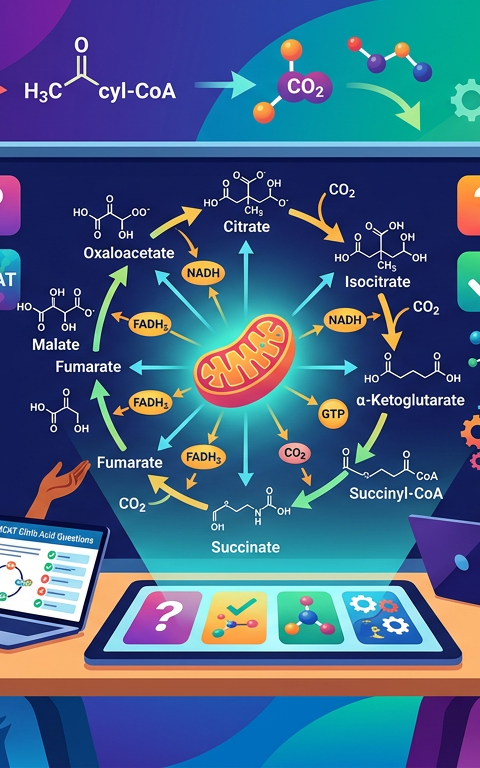
MCAT Citric Acid Practice Questions with Answers
MCAT Citric Acid Practice Questions with Answers
May 14, 2026
Solving High-Yield MCAT Stereochemistry: Beyond R and S Basics
Hard MCAT Stereochemistry Practice Questions
May 11, 2026
Hard MCAT Organic Chemistry Practice Questions
Hard MCAT Organic Chemistry Practice Questions
May 11, 2026

Medium MCAT Stereochemistry Practice Questions
Medium MCAT Stereochemistry Practice Questions
May 11, 2026

Medium MCAT Organic Chemistry Practice Questions
Medium MCAT Organic Chemistry Practice Questions
May 11, 2026
Easy MCAT Stereochemistry Practice Questions
Master the basics of chirality and R/S configuration with these easy MCAT stereochemistry practice questions and detailed explanations.
May 11, 2026