Medium Equilibrium Constant (Kc) Practice Questions
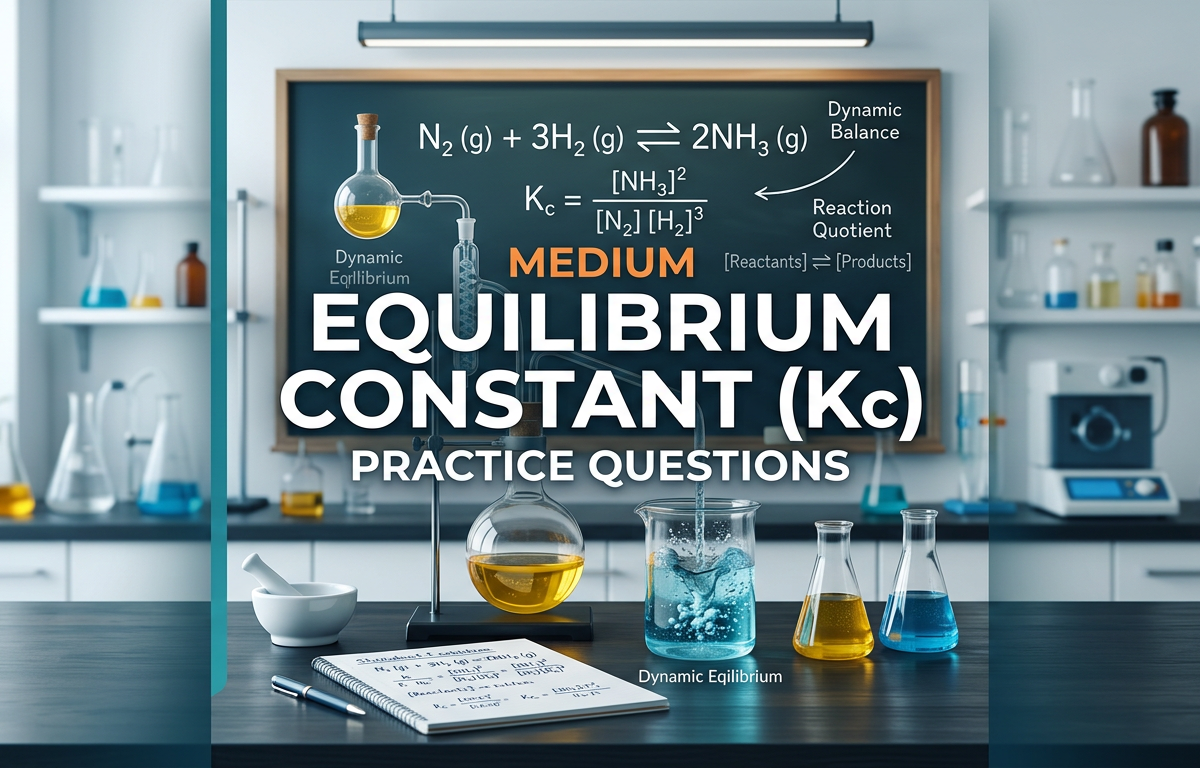
Concept Explanation
The equilibrium constant (Kc) is a numerical value that expresses the ratio of product concentrations to reactant concentrations at chemical equilibrium, with each concentration raised to the power of its stoichiometric coefficient. This constant is specific to a particular temperature and provides a quantitative measure of the extent of a reaction. When a system reaches chemical equilibrium, the rates of the forward and reverse reactions are equal, and the concentrations of the species involved remain constant over time.
To calculate Kc for a general reaction , we use the following expression:
Kc = [C]c [D]d / [A]a [B]b
In this expression, square brackets represent molar concentrations (mol/L). It is vital to remember that only gaseous and aqueous species are included in the Kc expression; pure solids and liquids are omitted because their concentrations remain constant. Understanding Kc is essential for predicting the direction of a reaction and is closely related to other thermodynamic concepts like enthalpy change and Gibbs free energy. If Kc is much greater than 1, the equilibrium favors the products; if Kc is much less than 1, the equilibrium favors the reactants.
Many students find it helpful to use an \"ICE\" table (Initial, Change, Equilibrium) to track concentration changes during a reaction. This method is particularly useful when you are given initial concentrations and only one equilibrium value or the Kc value itself. If you are also studying acid-base chemistry, you might notice similarities between Kc and Ka and Kb calculations, which are specific types of equilibrium constants for weak acids and bases.
Solved Examples
Review these step-by-step solutions to master the application of the Kc formula in various scenarios.
Example 1: Calculating Kc from Equilibrium Concentrations
Consider the reaction: . At equilibrium in a 1.0 L flask, there are 0.25 mol of , 0.15 mol of , and 0.50 mol of . Calculate Kc.Identify the concentrations: Since the volume is 1.0 L, molarity equals moles. [N₂] = 0.25 M, [H₂] = 0.15 M, [NH₃] = 0.50 M.
Write the Kc expression: Kc = [NH₃]² / ([N₂][H₂]³).
Substitute the values: Kc = (0.50)² / (0.25 × (0.15)³).
Calculate the result: Kc = 0.25 / (0.25 × 0.003375) = 1 / 0.003375 ≈ 296.3.
Example 2: Using an ICE Table
For the reaction , the initial concentrations of and are both 1.00 M. At equilibrium, the concentration of is 1.50 M. Find Kc.Set up the ICE table. Initial: [H₂]=1.00, [I₂]=1.00, [HI]=0.
Determine the Change: Since [HI] went from 0 to 1.50, the change (+2x) is 1.50. Therefore, x = 0.75.
Calculate Equilibrium concentrations: [H₂] = 1.00 - 0.75 = 0.25 M; [I₂] = 1.00 - 0.75 = 0.25 M.
Write Kc expression and solve: Kc = [HI]² / ([H₂][I₂]) = (1.50)² / (0.25 × 0.25) = 2.25 / 0.0625 = 36.
Example 3: Dealing with Different Volumes
In a 2.0 L container, 4.0 moles of decompose into and . At equilibrium, 0.8 moles of are present. Calculate Kc for .Convert moles to molarity: Initial [PCl₅] = 4.0 mol / 2.0 L = 2.0 M. Equilibrium [Cl₂] = 0.8 mol / 2.0 L = 0.4 M.
Set up ICE: [PCl₅] starts at 2.0, changes by -x. [PCl₃] and [Cl₂] start at 0, change by +x.
Solve for x: Since equilibrium [Cl₂] is 0.4, x = 0.4.
Equilibrium values: [PCl₅] = 2.0 - 0.4 = 1.6 M; [PCl₃] = 0.4 M; [Cl₂] = 0.4 M.
Calculate Kc: Kc = (0.4 × 0.4) / 1.6 = 0.16 / 1.6 = 0.10.
Practice Questions
Test your understanding with these medium-level problems. Ensure you pay attention to units and stoichiometry.
For the reaction , the equilibrium concentrations are [CO] = 0.20 M, [H₂O] = 0.50 M, [CO₂] = 0.32 M, and [H₂] = 0.32 M. Calculate Kc.
A 5.0 L vessel contains 0.10 mol of , 0.10 mol of , and 0.80 mol of at equilibrium. Calculate the value of Kc for the reaction: .
Initially, 0.60 mol of is placed in a 2.0 L container. At equilibrium, 0.10 mol of is present. Calculate Kc for: .
Start Learning Smarter Today
Join thousands of students using AI-powered study tools to achieve better results.
Get Started Free
Start Learning Smarter Today
Join thousands of students using AI-powered study tools to achieve better results.
Get Started FreeThe reaction has a Kc of 4.6 × 10⁴ at a certain temperature. If the equilibrium concentrations of and are 0.010 M and 0.020 M respectively, what is the equilibrium concentration of ?
At 448°C, the Kc for the reaction is 50.5. If a flask is filled with 0.100 M , what will be the equilibrium concentrations of all species?
For the heterogeneous equilibrium , the equilibrium concentration of is 0.025 M at 800°C. What is the value of Kc?
A mixture of 0.50 mol of and 0.50 mol of is placed in a 1.0 L flask at 1000 K. If Kc = 0.533, find the equilibrium concentrations of and for the reaction: .
The Kc for the reaction is 4.61 × 10⁻³ at 25°C. If the initial concentration of is 0.0400 M, calculate the equilibrium concentration of .
In the reaction , the initial concentrations are [A] = 1.0 M and [B] = 1.0 M. If the equilibrium concentration of C is 0.20 M, calculate Kc.
Determine the Kc for the reaction if at equilibrium [A] = 0.40 M and [C] = 0.60 M.
Answers & Explanations
Compare your work with the detailed solutions below to identify any errors in your logic or calculations.
Answer: 1.024
Kc = [CO₂][H₂] / ([CO][H₂O]) = (0.32 × 0.32) / (0.20 × 0.50) = 0.1024 / 0.10 = 1.024.Answer: 64
Concentrations: [H₂] = 0.10/5 = 0.02 M; [I₂] = 0.10/5 = 0.02 M; [HI] = 0.80/5 = 0.16 M. Kc = [HI]² / ([H₂][I₂]) = (0.16)² / (0.02 × 0.02) = 0.0256 / 0.0004 = 64.Answer: 0.025
Initial [SO₃] = 0.60/2.0 = 0.30 M. Equilibrium [O₂] = 0.10/2.0 = 0.05 M. From stoichiometry, [SO₂] = 2 × [O₂] = 0.10 M. [SO₃] at equilibrium = 0.30 - (2 × 0.05) = 0.20 M. Kc = [SO₂]²[O₂] / [SO₃]² = (0.10)²(0.05) / (0.20)² = 0.0005 / 0.04 = 0.0125. Wait, let's recheck: 0.01 × 0.05 / 0.04 = 0.0005 / 0.04 = 0.0125. (Corrected: 0.0125).Answer: 0.096 M
4.6 × 10⁴ = [NOCl]² / ((0.010)² × 0.020). [NOCl]² = 4.6 × 10⁴ × 0.0001 × 0.020 = 0.092. [NOCl] = √0.092 ≈ 0.303 M. (Recalculating: 46000 * 0.0001 * 0.02 = 0.092. Sqrt = 0.303).Answer: [HI] = 0.078 M, [H₂] = [I₂] = 0.011 M
Let change in HI be -2x. Equilibrium: [HI]=0.1-2x, [H₂]=x, [I₂]=x. 50.5 = (0.1-2x)² / x². Square root both sides: 7.106 = (0.1-2x)/x. 7.106x = 0.1 - 2x. 9.106x = 0.1. x = 0.01098. [H₂]=[I₂]=0.011 M. [HI]=0.1 - 2(0.011) = 0.078 M.Answer: 0.025
Since CaCO₃ and CaO are solids, they are excluded. Kc = [CO₂] = 0.025.Answer: [CO] = [H₂O] = 0.211 M
Kc = x² / (0.5-x)². √0.533 = x / (0.5-x). 0.730 = x / (0.5-x). 0.365 - 0.730x = x. 1.730x = 0.365. x = 0.211 M.Answer: 0.0115 M
Kc = (2x)² / (0.04-x). 0.00461 = 4x² / (0.04-x). Assuming x is small: 0.00461 ≈ 4x²/0.04. x² = 0.0000461. x = 0.00679. [NO₂] = 2x = 0.0136. (More accurate quadratic yields [NO₂] ≈ 0.0115 M).Answer: 1.39
Eq: [C]=0.2, [A]=1.0-0.2=0.8, [B]=1.0-2(0.2)=0.6. Kc = 0.2 / (0.8 × 0.6²) = 0.2 / 0.288 ≈ 0.694.Answer: 1.35
Kc = [C]³ / [A]². Kc = (0.60)³ / (0.40)² = 0.216 / 0.16 = 1.35.
1. Which of the following species is excluded from the Kc expression?
Frequently Asked Questions
What is the difference between Kc and Kp?
Kc is the equilibrium constant expressed in terms of molar concentrations, while Kp is expressed in terms of partial pressures of gaseous components. They are related by the equation Kp = Kc(RT)^Δn, where Δn is the change in moles of gas.
Why are solids and liquids omitted from Kc expressions?
The concentrations of pure solids and liquids are considered constant because their density does not change significantly during a reaction. Since their active mass remains unchanged, they are incorporated into the constant value of Kc itself.
Does temperature affect the value of Kc?
Yes, temperature is the only factor that can change the numerical value of the equilibrium constant for a specific reaction. According to Le Chatelier's Principle, changing the temperature shifts the equilibrium position and alters Kc depending on whether the reaction is endothermic or exothermic.
Can Kc ever be a negative value?
No, Kc cannot be negative because it is calculated from concentrations and stoichiometric powers, all of which are zero or positive. A value of zero would imply no products have formed, which does not represent a state of dynamic equilibrium.
What does a Kc value of 1 indicate?
A Kc value of approximately 1 indicates that neither reactants nor products are strongly favored at equilibrium. This means the concentrations of the species on both sides of the equation are comparable in magnitude.
Start Learning Smarter Today
Join thousands of students using AI-powered study tools to achieve better results.
Get Started FreeEnjoyed this article?
Share it with others who might find it helpful.
Related Articles
Easy Equilibrium Constant (Kc) Practice Questions
Master the basics of chemical equilibrium with our easy Equilibrium Constant (Kc) practice questions, including step-by-step solved examples and a quick quiz.
Mar 30, 2026
Solving Equilibrium Problems Without Losing Your Stoichiometry
Master chemical equilibrium with these easy ICE table practice questions. Learn to calculate concentrations and K values with step-by-step solved examples.
Mar 30, 2026
Calculating Kc: Mastering the Ratio of Equilibrium Concentrations
Master the Equilibrium Constant (Kc) with our comprehensive guide featuring solved examples, practice questions, and detailed explanations for chemistry students.
Mar 30, 2026

Calculating High-Stakes Meds: BSA Mosteller Formula Practice
Master hard body surface area-based dosage calculations with our comprehensive guide, solved examples, and practice questions for healthcare students.
May 17, 2026

Solving High-Stakes IV Titrations and Weight-Based Infusions
Master advanced IV flow rate calculations with these hard practice questions. Covers weight-based dosing, titrations, and dimensional analysis for nurses.
May 17, 2026

Solving Weight-Based Dosing: The 2.2 Conversion and Rounding Logic
Weight-Based Dosage Calculations Practice Questions with Answers
May 17, 2026

Predicting Periodic Anomalies: Beyond Basic Trend Rules
Hard Periodic Trends Practice Questions
Apr 4, 2026

Hard Electron Configuration Practice Questions
Hard Electron Configuration Practice Questions
Apr 4, 2026