Solving Complex pH Problems: Beyond Simple Strong Acids
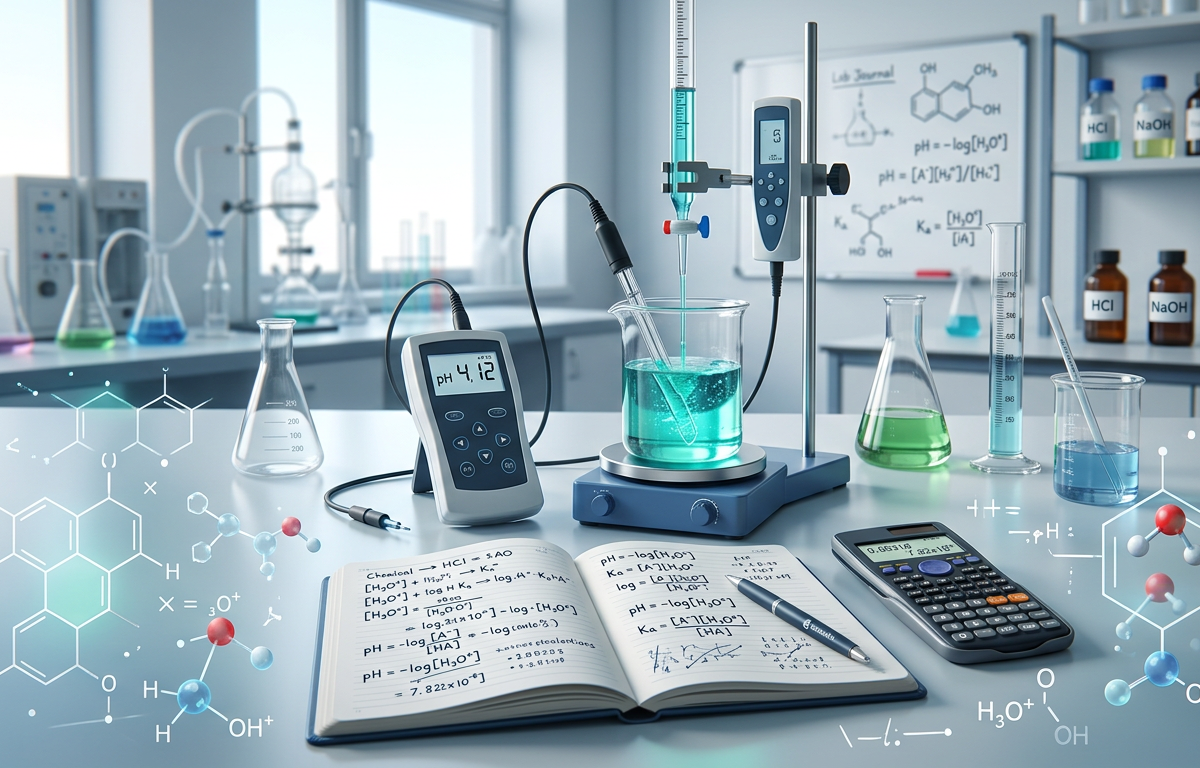
When you calculate the pH of 1.0 x 10^-8 M HCl and your result is 8.0, you have fallen into the most common trap in aqueous chemistry. A solution containing acid cannot be basic at 25°C, yet the standard negative log formula fails here because it ignores the 1.0 x 10^-7 M hydrogen ions naturally present from water's autoionization. In these advanced scenarios, the simple plug-and-play approach to molarity disappears. You are no longer just looking for a single concentration; you are navigating the simultaneous equilibria of weak species and their conjugates.
Rigorous pH analysis requires you to distinguish between total analytical concentration and actual equilibrium concentration. Whether you are dealing with the second dissociation constant of sulfuric acid or the basicity of a cyanide salt, the challenge lies in the quadratic setups and the Henderson-Hasselbalch limitations. You must decide when the small x approximation is a valid shortcut and when it will lead to a significant percentage error. The following problems move past the basics to test your ability to handle polyprotic systems, buffer shifts after titration, and the specific hydrolysis of salts like ammonium chloride.
Equilibrium Strategies for Complex Aqueous Systems
pH is a logarithmic measure of the hydrogen ion concentration in a solution, defined by the equation pH = -log[H+]. While basic calculations involve simple strong acids or bases, hard pH calculation tasks require analyzing weak acid/base equilibria, polyprotic acids, salt hydrolysis, and complex buffer systems. To solve these advanced problems, one must often employ the ICE (Initial, Change, Equilibrium) method and consider the autoionization of water in extremely dilute solutions. Understanding the relationship between pH and pOH is also critical, as the product of [H+] and [OH-] must always equal the water dissociation constant, Kw (1.0 x 10^-14 at 25°C). For systems involving weak species, you will frequently transition between Ka and Kb calculations to find the correct ion concentrations.
Solved Examples
Calculate the pH of a 0.0050 M solution of Sulfuric Acid (H2SO4), assuming the first dissociation is complete and the second dissociation has a Ka2 of 1.2 x 10^-2.
Identify species: H2SO4 is a strong acid for its first proton: [H+] from first step = 0.0050 M. The remaining species is HSO4-.
Set up ICE for second dissociation: HSO4- ⇌ H+ + SO4(2-).
Initial: [HSO4-] = 0.0050; [H+] = 0.0050; [SO4(2-)] = 0.
Equilibrium: [HSO4-] = 0.0050 - x; [H+] = 0.0050 + x; [SO4(2-)] = x.
Expression: Ka2 = [(0.0050 + x)(x)] / (0.0050 - x) = 0.012.
Solve the quadratic: x^2 + 0.017x - 0.00006 = 0. Using the quadratic formula, x ≈ 0.0031.
Total [H+] = 0.0050 + 0.0031 = 0.0081 M.
pH = -log(0.0081) = 2.09.
Find the pH of a 0.10 M solution of Sodium Cyanide (NaCN). The Ka for HCN is 4.9 x 10^-10.
Identify the salt: NaCN dissociates into Na+ (neutral) and CN- (basic anion).
Calculate Kb for CN-: Kb = Kw / Ka = (1.0 x 10^-14) / (4.9 x 10^-10) = 2.04 x 10^-5.
Set up equilibrium: CN- + H2O ⇌ HCN + OH-.
Kb = x^2 / (0.10 - x) ≈ x^2 / 0.10.
x = [OH-] = sqrt(2.04 x 10^-5 * 0.10) = 1.43 x 10^-3 M.
pOH = -log(1.43 x 10^-3) = 2.84.
pH = 14 - 2.84 = 11.16.
Determine the pH of a solution formed by mixing 50.0 mL of 0.10 M NH3 with 25.0 mL of 0.10 M HCl. (Kb for NH3 = 1.8 x 10^-5).
Calculate moles: n(NH3) = 0.005 mol; n(HCl) = 0.0025 mol.
Reaction: NH3 + HCl → NH4Cl. Moles remaining: NH3 = 0.0025 mol; NH4+ = 0.0025 mol.
Since moles of weak base equal moles of conjugate acid, this is a buffer at the half-equivalence point.
Use Henderson-Hasselbalch equation: pOH = pKb + log([Salt]/[Base]).
pKb = -log(1.8 x 10^-5) = 4.74. pOH = 4.74 + log(1) = 4.74.
pH = 14 - 4.74 = 9.26.
Practice Questions
Calculate the pH of a 1.0 x 10^-8 M HCl solution, accounting for the autoionization of water.
Calculate the pH of a 0.20 M solution of Ammonium Chloride (NH4Cl). (Kb for NH3 = 1.8 x 10^-5).
A buffer is prepared with 0.50 M Acetic Acid and 0.50 M Sodium Acetate (pKa = 4.76). What is the pH after adding 0.010 mol of NaOH to 1.0 L of this buffer?
[CTA_BLOCK_0]
Find the pH of a 0.010 M solution of Ethylenediamine (H2NCH2CH2NH2), a diprotic base with pKb1 = 3.29 and pKb2 = 6.44.
Calculate the pH of a 0.050 M solution of Pyridine (C5H5N). (Kb = 1.7 x 10^-9).
Determine the pH of a mixture of 100 mL of 0.10 M HF (Ka = 6.6 x 10^-4) and 50 mL of 0.10 M NaF.
What is the pH of a 0.15 M solution of NaHSO4? (Ka2 for H2SO4 = 1.2 x 10^-2).
Calculate the pH of a 1.5 x 10^-3 M solution of Ba(OH)2.
A solution is 0.10 M in H3PO4. Calculate the pH considering only the first dissociation (Ka1 = 7.5 x 10^-3).
What is the pH of a solution containing 0.02 M KOH and 0.01 M Ba(OH)2?
Answers & Explanations
Answer: 6.98. In extremely dilute strong acids, [H+]_total = [H+]_acid + [H+]_water. Using the charge balance equation [H+] = [OH-] + [Cl-], and substituting [OH-] = Kw/[H+], we get [H+] = Kw/[H+] + 1.0 x 10^-8. Solving the quadratic gives [H+] = 1.05 x 10^-7 M. pH = -log(1.05 x 10^-7) = 6.98.
Answer: 4.98. NH4+ is the conjugate acid of NH3. Ka = Kw / Kb = 10^-14 / 1.8 x 10^-5 = 5.56 x 10^-10. [H+] = sqrt(Ka * C) = sqrt(5.56 x 10^-10 * 0.20) = 1.05 x 10^-5. pH = 4.98.
Answer: 4.78. The NaOH reacts with the acetic acid: [Acid] = 0.50 - 0.01 = 0.49 M; [Base] = 0.50 + 0.01 = 0.51 M. pH = 4.76 + log(0.51/0.49) = 4.76 + 0.017 = 4.777.
Answer: 11.35. For a weak diprotic base, the first dissociation usually dominates. pKb1 = 3.29, so Kb1 = 10^-3.29 = 5.13 x 10^-4. [OH-] = sqrt(Kb1 * C) = sqrt(5.13 x 10^-4 * 0.010) = 2.26 x 10^-3. pOH = 2.65. pH = 11.35.
Answer: 8.96. [OH-] = sqrt(Kb * C) = sqrt(1.7 x 10^-9 * 0.050) = 9.22 x 10^-6. pOH = 5.04. pH = 14 - 5.04 = 8.96.
Answer: 2.88. Use Henderson-Hasselbalch. moles HF = 0.01, moles F- = 0.005. pKa = -log(6.6 x 10^-4) = 3.18. pH = 3.18 + log(0.005/0.01) = 3.18 - 0.30 = 2.88.
Answer: 1.84. HSO4- ⇌ H+ + SO4(2-). Ka = 0.012 = x^2 / (0.15 - x). x^2 + 0.012x - 0.0018 = 0. x = [H+] = 0.0143 M. pH = 1.84.
Answer: 11.48. Ba(OH)2 is a strong base: [OH-] = 2 * 1.5 x 10^-3 = 3.0 x 10^-3 M. pOH = -log(3.0 x 10^-3) = 2.52. pH = 11.48.
Answer: 1.62. Ka1 = x^2 / (0.10 - x) = 7.5 x 10^-3. x^2 + 0.0075x - 0.00075 = 0. x = [H+] = 0.0239 M. pH = 1.62.
Answer: 12.60. Total [OH-] = [OH-] from KOH + [OH-] from Ba(OH)2 = 0.02 + 2(0.01) = 0.04 M. pOH = -log(0.04) = 1.40. pH = 12.60.
1. Which factor most significantly complicates the pH calculation of a 10^-9 M HCl solution?
Frequently Asked Questions
Why does the pH of a very dilute acid not exceed 7?
In extremely dilute solutions, the hydrogen ions produced by the autoionization of water become significant compared to those from the acid. The total concentration of H+ will always be slightly higher than 10^-7 M, ensuring the pH remains just below 7 rather than becoming basic.
How do you calculate the pH of a polyprotic acid?
For most polyprotic acids, the first dissociation constant (Ka1) is much larger than subsequent ones, meaning the pH is primarily determined by the first ionization step. You only need to consider Ka2 if the acid is sulfuric acid or if Ka1 and Ka2 are very close in magnitude.
What is the difference between pH and pOH?
pH measures the acidity of a solution based on hydrogen ion concentration, while pOH measures alkalinity based on hydroxide ion concentration. At 25°C, the sum of pH and pOH always equals 14.0, which is the pKw of water.
When should I use the quadratic formula for pH calculations?
The quadratic formula is necessary when the approximation (Initial Concentration - x ≈ Initial Concentration) fails, typically when the dissociation constant Ka is large relative to the initial concentration (e.g., if C/Ka < 100). This is common in strong acid vs weak acid boundary cases.
Can pH be negative?
Yes, pH can be negative in highly concentrated strong acid solutions where the molarity of H+ ions is greater than 1.0 M. For example, a 2.0 M HCl solution has a theoretical pH of -0.30, although activity coefficients must be considered for accuracy at such high concentrations.
Want unlimited practice questions like these?
Generate AI-powered questions with step-by-step solutions on any topic.
Try Question Generator Free →Enjoyed this article?
Share it with others who might find it helpful.
Related Articles

Solving High-Stakes IV Titrations and Weight-Based Infusions
Master advanced IV flow rate calculations with these hard practice questions. Covers weight-based dosing, titrations, and dimensional analysis for nurses.
May 17, 2026

Solving Weight-Based Dosing: The 2.2 Conversion and Rounding Logic
Weight-Based Dosage Calculations Practice Questions with Answers
May 17, 2026
Predicting Periodic Anomalies: Beyond Basic Trend Rules
Hard Periodic Trends Practice Questions
Apr 4, 2026
Solving Combined Gas Law Problems: Managing Three Changing Variables
Master the Combined Gas Law with this comprehensive guide featuring clear explanations, step-by-step solved examples, and 10 practice questions with answers.
Apr 2, 2026
Solving Charles’s Law: Avoiding the Celsius Temperature Trap
Master Charles’s Law with our comprehensive guide featuring solved examples, practice questions, and step-by-step explanations for chemistry students.
Apr 2, 2026
Solving PV=nRT: Why Units and Constants Trip Up Every Student
Master the Ideal Gas Law with these easy practice questions. Includes step-by-step solved examples, unit conversion tips, and a quick quiz to test your skills.
Apr 2, 2026
Predicting Radioactive Decay: Solving for Mass and Time Intervals
Master half-life calculations with our comprehensive guide featuring step-by-step solved examples, practice questions, and detailed answers for students.
Apr 2, 2026
Predicting Rate Law Exponents: Beyond Stoichiometric Coefficients
Master reaction order with our comprehensive guide featuring solved examples, practice questions, and clear explanations for zero, first, and second-order kinetics.
Apr 2, 2026