Easy Ka and Kb Calculations Practice Questions
Concept Explanation
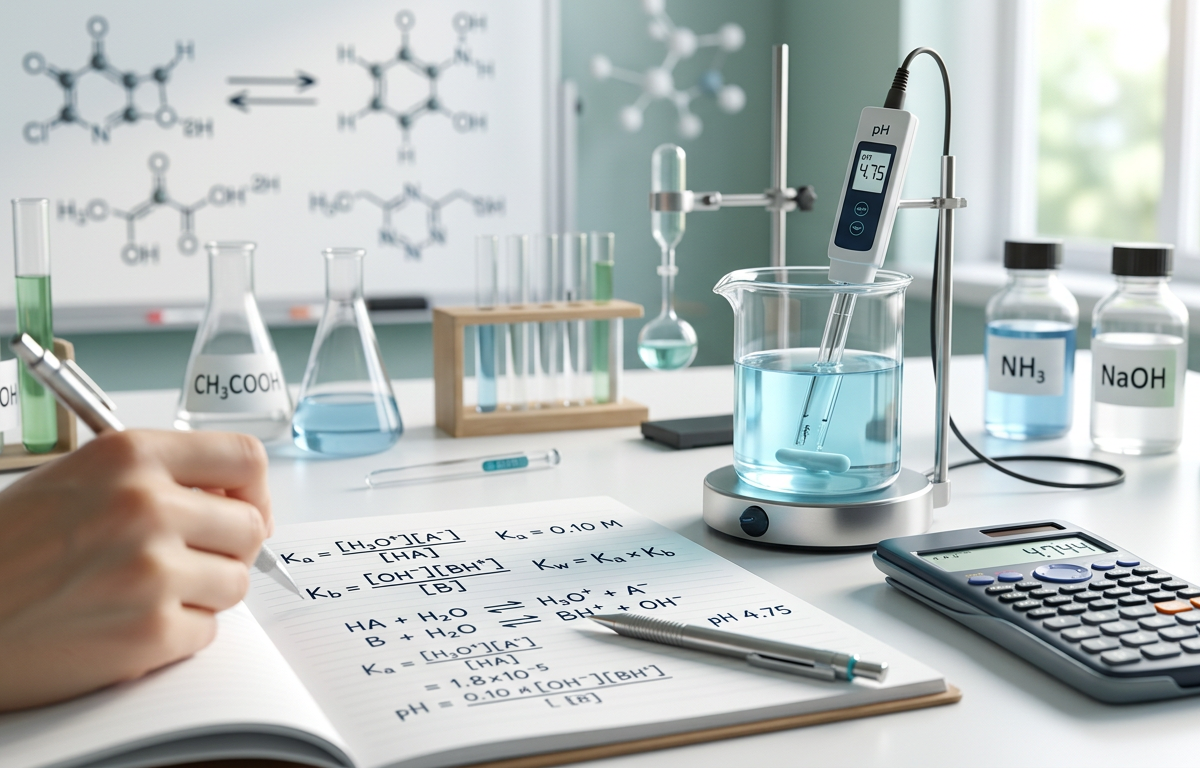
Ka and Kb are equilibrium constants that measure the strength of an acid or a base in an aqueous solution. The acid dissociation constant () represents the extent to which an acid donates protons to water, while the base dissociation constant () represents the extent to which a base accepts protons from water. These values are essential for determining the concentration of ions in solution, which directly influences the pH calculation of a substance. For any conjugate acid-base pair, the relationship between these constants is governed by the ion-product constant of water (), where at 25°C. This mathematical link allows chemists to easily convert between the two values when studying chemical equilibria.
When a weak acid ($HA$) dissolves in water, it reaches a state of equilibrium: . The expression for is . Similarly, for a weak base ($B$): , the expression is . Because these values are often very small, scientists frequently use logarithmic scales, leading to pKa and pKb values which are easier to manage in calculations. Understanding these constants is a fundamental step before moving on to more complex topics like buffer solution practice questions.
Solved Examples
Below are fully worked examples to demonstrate how to perform easy Ka and Kb calculations using standard formulas.
Calculating Ka from pH: A 0.10 M solution of a weak acid has a pH of 3.00. Find the .
Find : .
Set up the expression: . Since , .
Assume $0.10 - 0.001 \approx 0.10$.
.
Calculating Kb from Ka: The of acetic acid is $1.8 \times 10^{-5}$. What is the of its conjugate base, the acetate ion?
Use the relationship .
.
.
Finding OH- concentration from Kb: A 0.20 M solution of ammonia has a of $1.8 \times 10^{-5}$. Find $[OH^-]$.
. Let .
$1.8 \times 10^{-5} = x^2 / 0.20$.
.
.
Practice Questions
A 0.050 M solution of a monoprotic weak acid has a of $1.5 \times 10^{-4} M$. Calculate the .
If the of a base is $4.0 \times 10^{-6}$, what is the of its conjugate acid?
Calculate the of a 0.15 M weak base solution with a of $2.5 \times 10^{-7}$.
A weak acid has a . Calculate the of its conjugate base.
The pH of a 0.10 M solution of a weak base is 11.0. What is the of the base?
Find the for a 0.010 M solution of an acid that is 5% ionized.
What is the of the cyanide ion () if the of $HCN$ is $4.9 \times 10^{-10}$?
A solution of 0.25 M hydrofluoric acid ($HF$) has a of $6.6 \times 10^{-4}$. Calculate the concentration of .
If , calculate the value.
A base has a $pKb$ of 9.25. Calculate its value.
Answers & Explanations
Answer: $4.5 \times 10^{-7}$. .
Answer: $2.5 \times 10^{-9}$. .
Answer: $1.94 \times 10^{-4} M$. .
Answer: $1.61 \times 10^{-7}$. .
Answer: $1.0 \times 10^{-5}$. pH 11 means pOH = 3, so . .
Answer: $2.63 \times 10^{-5}$. 5% of 0.010 M is $0.0005 M$ (). .
Answer: $2.04 \times 10^{-5}$. .
Answer: $1.28 \times 10^{-2} M$. $6.6 \times 10^{-4} = x^2 / 0.25 \rightarrow x = \sqrt{1.65 \times 10^{-4}} = 0.0128 M$.
Answer: $1.78 \times 10^{-5}$. .
Answer: $5.62 \times 10^{-10}$. .
1. Which formula correctly relates Ka and Kb for a conjugate pair at 25°C?
Frequently Asked Questions
What is the difference between Ka and Kb?
Ka measures the strength of an acid by its ability to donate protons, whereas Kb measures the strength of a base by its ability to accept protons. Both are equilibrium constants that indicate the degree of ionization in water.
How do you calculate Kb if you only have Ka?
You can calculate Kb by dividing the ion-product constant of water () by the given Ka value. This relationship only applies to conjugate acid-base pairs at a temperature of 25°C.
Why is Ka important in chemistry?
Ka is vital because it allows scientists to predict the pH of solutions and the direction of chemical reactions. It is a standard value used in Khan Academy chemistry tutorials to categorize weak versus strong electrolytes.
Does Ka change with concentration?
No, Ka is an equilibrium constant and remains the same regardless of the initial concentration of the acid, provided the temperature is constant. Only a change in temperature will alter the value of Ka or Kb.
Can Ka be greater than 1?
Yes, strong acids such as hydrochloric acid (HCl) have Ka values much greater than 1, indicating they ionize almost completely in water. You can learn more about these differences in our guide on strong acid vs weak acid practice questions.
Want unlimited practice questions like these?
Generate AI-powered questions with step-by-step solutions on any topic.
Try Question Generator Free →Enjoyed this article?
Share it with others who might find it helpful.
Related Articles
Hard Le Chatelier’s Principle Practice Questions
Master Hard Le Chatelier’s Principle Practice Questions with our comprehensive guide featuring solved examples, practice problems, and detailed explanations.
Mar 30, 2026

Hard Reaction Quotient (Q) Practice Questions
Hard Reaction Quotient (Q) Practice Questions
Mar 30, 2026
Grams to Moles Practice Questions with Answers
Master grams to moles conversions with our comprehensive guide. Includes step-by-step examples, practice questions, and detailed answers for chemistry students.
Mar 26, 2026
Avogadro’s Number Practice Questions with Answers
Master the mole concept with our Avogadro’s Number practice questions. Includes step-by-step solved examples, a quick quiz, and detailed explanations.
Mar 26, 2026
Empirical Formulas: Solving Ratios from Mass and Percent Data
Master empirical formula calculations with 10 practice questions, worked answers, and a free step-by-step calculator for mass, percentage, and combustion problems.
Mar 26, 2026