How to Study Effectively: 8 Science-Backed Secrets to Mastery

The Science of Learning: Why Work Harder Isn't Better than Working Smarter
Learning how to study effectively is not about the number of hours you spend hunched over a desk, but how your brain processes that information. Most students fall into the trap of passive learning, reading a textbook multiple times and highlighting colorful passages, which often creates an "illusion of competence." You feel like you know the material because it looks familiar, but when the exam arrives, the information remains out of reach.
Active learning requires you to engage with the material through synthesis and retrieval. According to Harvard University research, students who engage in active learning perform significantly better than those receiving traditional lectures. This happens because your brain is a muscle that strengthens through resistance; if the learning feels easy, you probably aren't retaining much. Real mastery involves metacognition in learning, or thinking about how you think, to identify gaps in your knowledge before they become failures.
Every time you learn something new, the cognitive science of learning shows your brain undergoes neuroplasticity. This is the physical restructuring of neural pathways. When you encounter a challenging concept, like those found in hard molarity practice questions, your brain must build new "roads" to store that data. If you don't revisit that information, those roads deteriorate rapidly due to the Ebbinghaus Forgetting Curve.
The Forgetting Curve is your biggest enemy in academia. It suggests that without reinforcement, humans lose approximately 50% of new information within 24 hours and up to 80% within a month. To beat this, you must transform your study environment optimization from a passive reading nook into a laboratory for active retrieval. By using specific strategies like Active Recall, you force your brain to strengthen these neural paths, ensuring the information sticks for the long haul.
Foundational Habits for Peak Academic Performance
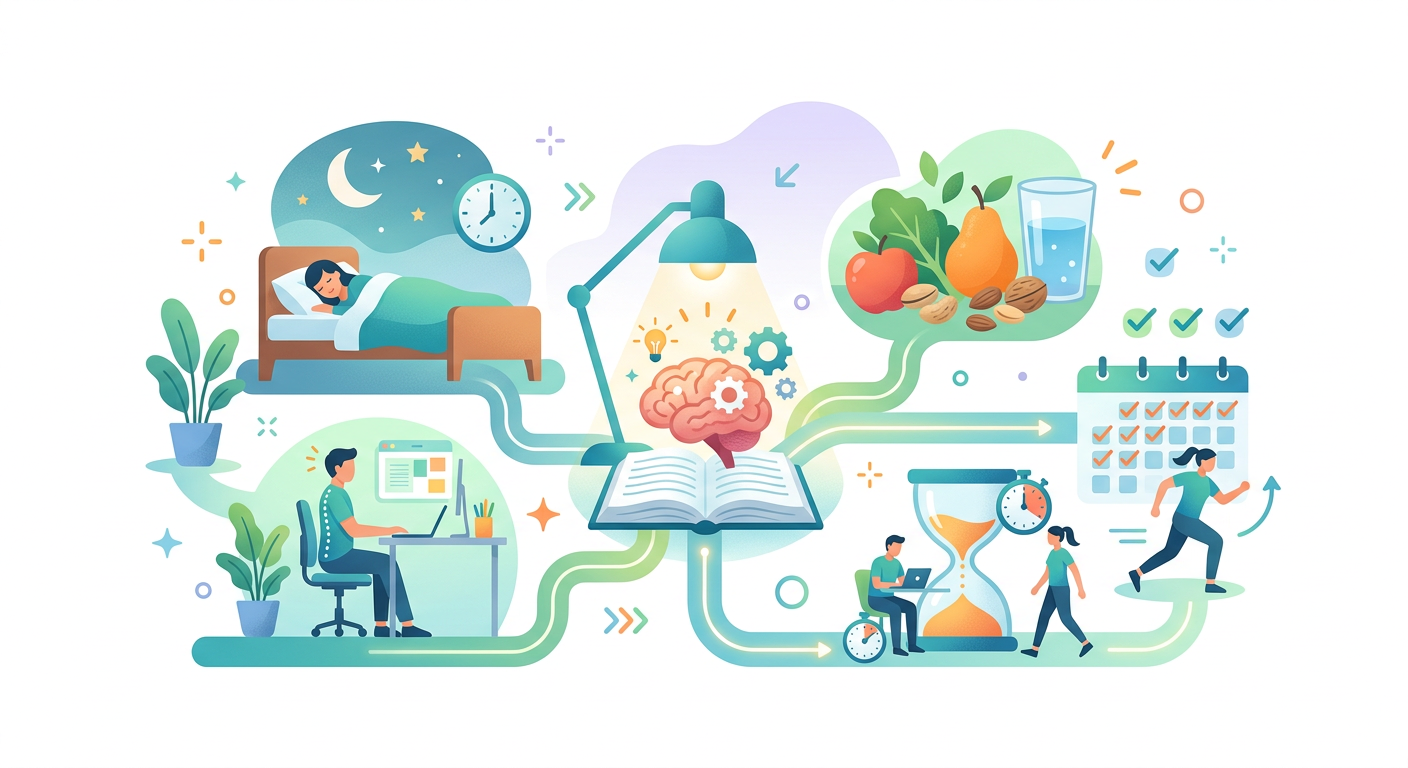
Peak performance starts with biological maintenance because a foggy brain cannot execute high-level cognitive tasks. Many students sacrifice sleep to cram, yet The Pomodoro Technique for students is useless if the brain lacks the REM cycles necessary for memory consolidation. During sleep, your brain flushes out toxins and moves information from short-term to long-term storage.
Diet and hydration play equally critical roles in how you focus. The CDC emphasizes that proper nutrition is linked to better grades and higher standardized test scores. Dehydration of just 2% can lead to significant drops in concentration and memory. If you are working through complex calculations, such as medium normality practice questions, sipping water consistently is more effective than chugging caffeine.
Strategic rest is the ultimate productivity hack. The human brain can only maintain "Deep Work" levels of focus for about 60 to 90 minutes before performance plateaus. By implementing the Spaced Repetition system and taking 5-10 minute breaks every half hour, you prevent metabolic waste from building up in the prefrontal cortex. These breaks aren't "time lost"; they are the periods where your brain actually organizes the data you just fed it.
Evidence-Based Study Techniques That Actually Work
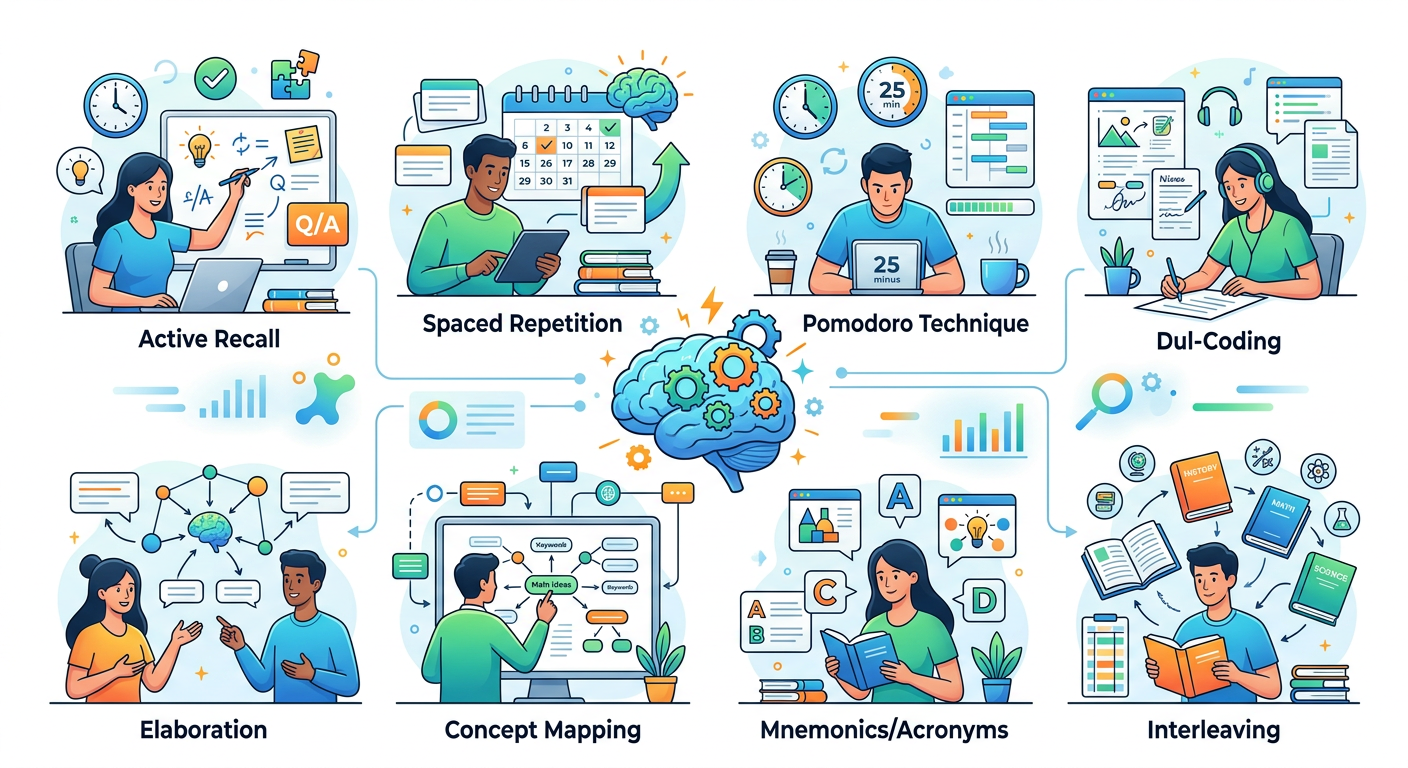
The Active Recall technique is the single most effective way to transfer knowledge into long-term memory. Instead of looking at your notes, you close the book and attempt to write down everything you remember or answer practice questions from scratch. This "testing effect" forces your brain to retrieve the information, which signals that the data is important and needs to be saved. This is particularly vital when tackling subjects like chemistry where you might need solution preparation practice questions with answers to test your true understanding.
Spaced Repetition complements active recall by timing these retrieval sessions at increasing intervals. Instead of studying a topic for five hours today, you study it for 30 minutes today, tomorrow, in three days, and then in a week. This timing allows you to review the information just as you are about to forget it, which is the exact moment when the neural connection is most reinforced. Using a Spaced Repetition system allows you to manage vast amounts of data without feeling overwhelmed.
The Feynman Technique is another pillar of how to study effectively. It involves picking a concept and explaining it in simple terms as if you were teaching it to a sixth-grader. If you can’t explain it without jargon, you don’t understand it. For example, if you are working on molarity formula explanations, try explaining the concept to a friend; if you stumble, go back to the source material and fill the gaps.
Interleaving is a lesser-known but powerful strategy where you mix different topics or types of problems within a single session. While it feels harder than focusing on one topic (blocking), it improves your ability to choose the right strategy for a given problem. If you spend an hour toggling between Active Recall for biology and solving grams to moles practice questions, your brain becomes more agile and better at identifying patterns during actual exams.
Advanced Note-Taking Systems for Better Comprehension
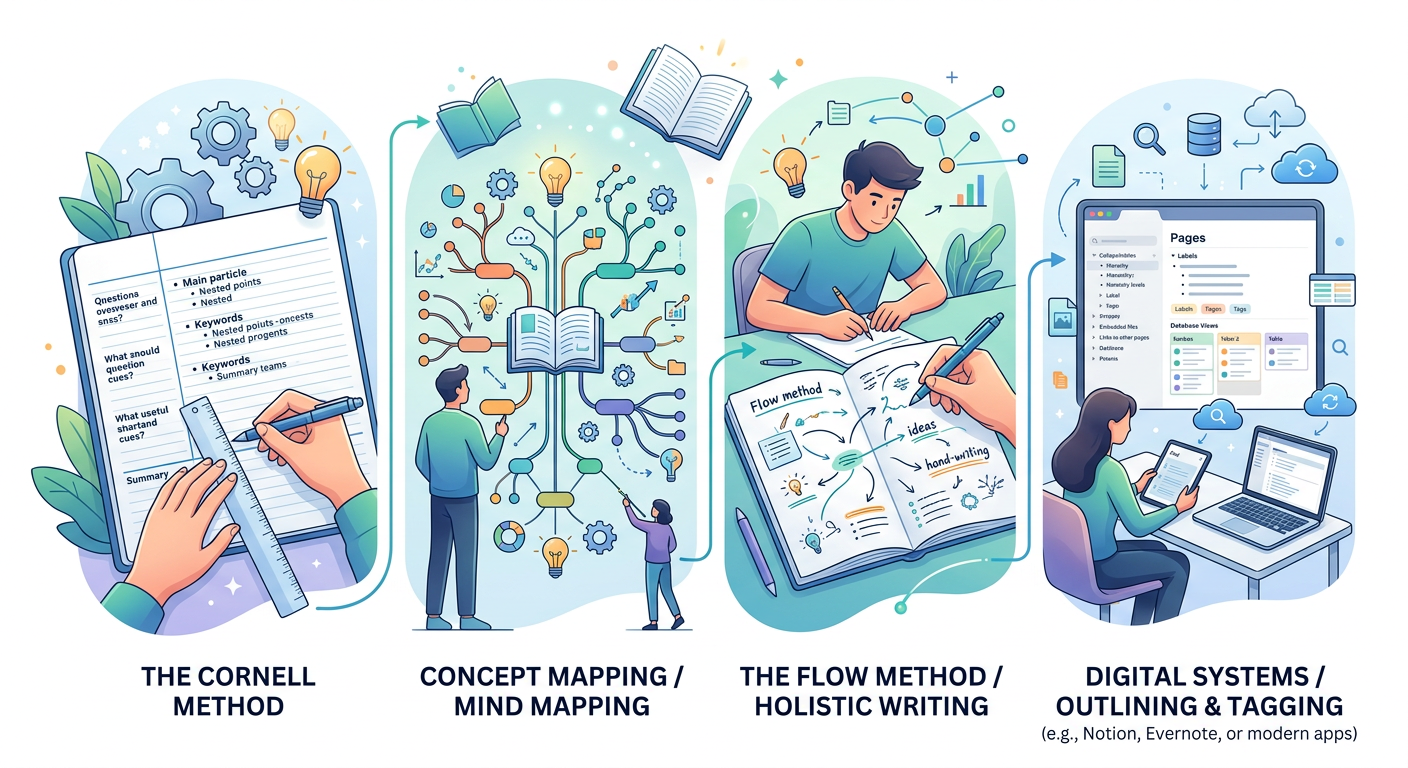
Effective note-taking methods involve synthesizing information rather than transcribing it word-for-word. The Cornell Method is a gold standard here, dividing your page into three sections: cues, notes, and a summary. This structure forces you to reflect on what you've written immediately after class, which jumpstarts the memory consolidation process. It turns a static piece of paper into a dynamic study tool that automatically incorporates Active Recall.
Visual learning through mind mapping and flowcharts is essential for understanding relationships between concepts. If you are looking at the cognitive science of learning, a mind map can help you visualize how sleep, nutrition, and technique all intersect. This holistic view prevents "siloed" learning where you know individual facts but can't see the big picture. Flowcharts are particularly helpful for procedural tasks, like mastering hard dilution practice questions where the order of operations is the key to success.
The choice between digital and analog tools depends on your personal study environment optimization. Research from ScienceDaily suggests that handwriting notes often leads to better conceptual understanding because it’s slower, forcing the brain to summarize. However, digital tools like Notion or Obsidian offer better searchability and the ability to integrate Spaced Repetition plugins. The best approach is often hybrid: hand-draw complex diagrams and use digital tools for text-heavy organization.
Creating the Ultimate Study Environment
To master how to study effectively, you must treat your study space as a sanctuary for focus. Digital hygiene is the most important factor in this; your smartphone is a distraction engine designed to hijack your dopamine levels. Leaving your phone in another room can increase your "brain power" even if it's turned off, as your mind isn't subconsciously waiting for a notification.
Physical factors like ergonomics and lighting can drastically extend your focused hours. Natural light is ideal, but if you study at night, use "cool" white light to mimic daylight and keep your brain alert. Ensure your chair supports your lower back so you aren't distracted by physical discomfort while attempting hard ppm and ppb practice questions. Small adjustments to your environment signal to your brain that it is time to work, not lounge.
Interestingly, the idea that you should always study in the same quiet spot is a myth. Cognitive scientists have found that "context variation"—studying in different rooms or even a coffee shop—can actually improve recall. This happens because the brain associates the information with subtle environmental cues. When you are in the exam hall, your brain can "search" through these diverse environmental markers to find the stored data more easily.
Stop wasting hours on passive reading. Use Bevinzey’s science-backed practice tools to implement Active Recall and Spaced Repetition today.
Get Started FreeOvercoming Procrastination and Building Motivation
Procrastination is rarely a time-management problem; it is an emotional regulation problem. We avoid tasks because they make us feel anxious, bored, or overwhelmed. Understanding this emotional root is the first step toward how to study effectively. When you feel the urge to check your phone instead of starting your Active Recall technique session, acknowledge the discomfort rather than running from it.
The "Two-Minute Rule" is a powerful psychological tool to break the barrier of entry. Tell yourself you will only study for two minutes. Often, the hardest part of any task is starting. Once you’ve opened your book and started a few easy molality practice questions, the momentum usually carries you forward. It’s a way to trick your brain’s resistance and build a "bridge" into a state of flow.
Motivation is a fickle friend, but SMART goals (Specific, Measurable, Achievable, Relevant, Time-bound) provide a reliable roadmap. Instead of saying "I will study chemistry tonight," say "I will complete 15 limiting reagent practice questions in 45 minutes." This clarity reduces the cognitive load of deciding what to do, allowing you to spend all your energy on the actual learning.
Subject-Specific Strategies: From STEM to Humanities
Mastering STEM subjects requires a high volume of practice and a deep understanding of logical dependencies. You cannot understand stoichiometry if you haven't mastered the molarity vs. molality difference. For these subjects, your study should be 80% problem-solving and 20% reading. Use metacognition in learning to ask yourself *why* a certain step is necessary, rather than just memorizing the procedure.
In the humanities, the challenge is synthesizing vast amounts of text into coherent arguments. Instead of memorizing dates, focus on themes and causal relationships. Use the "Brain Dump" method: after reading a chapter, write a one-paragraph summary without looking at the text. This forces you to engage in higher-level critical analysis, making essay planning much easier during exam scenarios.
For language acquisition, immersion and Spaced Repetition are the keys to fluency. Flashcards with audio help link sounds to visual cues, creating stronger neural connections. Don't just learn words in isolation; learn them in the context of sentences. This mimics natural language development and ensures you can use the vocabulary in real-world conversations, not just on a multiple-choice quiz.
Exam Preparation and Test-Taking Strategies
True exam preparedness comes from simulating the pressure of the test environment. Taking mock exams under timed conditions is the best way to identify how you perform when the clock is ticking. This reveals not only what you don't know but also how your Active Recall technique holds up under stress. Reviewing these mocks is just as important as taking them; analyze your mistakes to see if they were due to a lack of knowledge or a failure in strategy.
Managing test-day anxiety starts with the "Brain Dump" method. In the first five minutes of the exam, write down all the formulas, mnemonic devices, and key facts on your scratch paper. This clears your working memory, allowing you to focus on the questions without the fear of forgetting a crucial detail, like the molarity formula or a specific dates.
Finally, utilize a post-exam review process to refine how to study effectively for the future. Look at the questions you missed and categorize them: Was it a "silly mistake," a "lack of time," or a "concept gap"? This data is gold. It tells you exactly how to adjust your study environment optimization and which effective note-taking methods need tweaking for the next round.
Join thousands of students who have mastered complex subjects using our interactive practice questions and expert-led guides. Your journey to mastery starts now.
Get Started FreeFrequently Asked Questions
How can I focus for long periods without getting distracted?
Implementation of the Pomodoro Technique—25 minutes of work followed by a 5-minute break—is the most reliable method. It works by creating a sense of urgency and providing regular "rewards" for your brain to prevent fatigue.
Is it better to study at night or in the morning?
The best time depends on your personal circadian rhythm, but science suggests that for most people, memory consolidation is most effective when you study shortly before sleep. However, most complex problem-solving is better handled in the morning when the prefrontal cortex is fresh.
What is the most effective study technique backed by science?
Active Recall combined with Spaced Repetition is the gold standard. These methods force the brain to physically strengthen neural pathways through repeated, timed retrieval of information.
How many hours should I study each day for maximum retention?
Quality matters more than quantity, but generally, 3–4 hours of "Deep Work" is the upper limit for most humans. Beyond this, cognitive returns diminish significantly, often leading to burnout rather than learning.
How do I stop procrastinating and start studying?
Use the "Two-Minute Rule" to lower the barrier to entry. Focus on starting the task for just two minutes rather than worrying about finishing the entire assignment, which reduces the emotional resistance to the work.
Does listening to music while studying actually help or hurt?
Instrumental music or white noise can help by blocking out environmental distractions, but music with lyrics typically hurts performance. Lyrics compete with the same language-processing parts of your brain needed for reading and writing.
Enjoyed this article?
Share it with others who might find it helpful.
Related Articles

How to Solve Molarity Problems: Step-by-Step Mastery
Learn how to solve molarity problems step-by-step with formulas, unit tips, and worked examples so you can calculate concentration with confidence.
Mar 26, 2026
Avoid These 7 Common Molarity Mistakes in Chemistry
Master chemistry calculations! Avoid common molarity mistakes with our expert guide on unit conversions, dilution errors, and proper lab techniques.
Mar 26, 2026
What Is Molarity? The Complete Guide to Molar Concentration
Master molarity with our complete guide. Learn the formula, step-by-step calculations, and the critical differences between molarity and molality.
Mar 26, 2026
Why Molarity Matters: Converting Mass to Moles for Lab Solutions
Master chemistry with our guide to the molarity formula. Learn how to calculate concentration with step-by-step examples, units, and practical lab tips.
Mar 26, 2026
Molarity vs Molality: The Essential Difference Explained
Master the difference between molarity vs molality. Learn the formulas, key differences, and when to use each in this comprehensive chemistry guide.
Mar 26, 2026