Solution Preparation Practice Questions with Answers
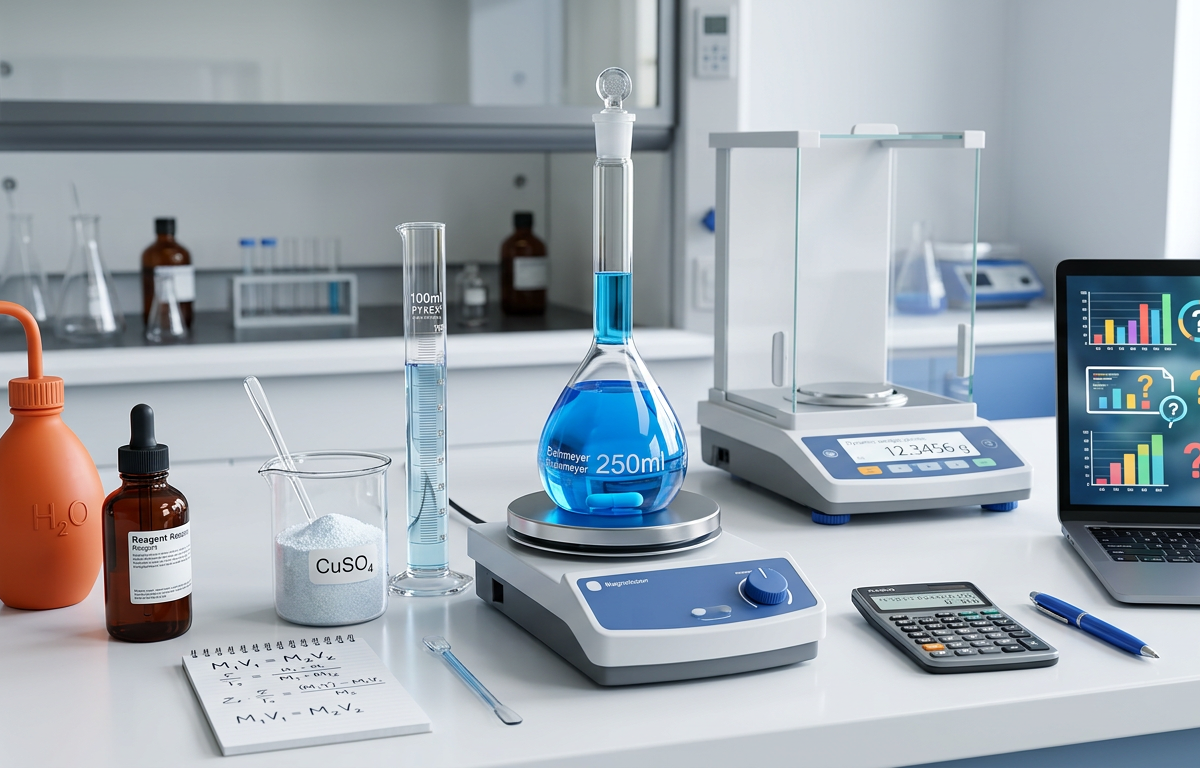
Concept Explanation
Solution preparation is the process of creating a homogeneous mixture by dissolving a specific amount of solute into a solvent to achieve a desired concentration. This fundamental laboratory skill relies on understanding the relationship between mass, moles, and volume. Chemists typically express concentration using molarity (M), which is defined as the number of moles of solute per liter of solution. Accurate preparation is vital in fields ranging from clinical medicine to industrial manufacturing, as even minor errors can lead to failed experiments or unsafe chemical reactions. According to Khan Academy, mastering these calculations is the first step toward performing complex stoichiometry in the lab.
There are two primary methods for solution preparation:
Preparation from a solid solute: This involves calculating the mass of a solid chemical needed, weighing it on a balance, and dissolving it in a volumetric flask.
Preparation by dilution: This involves taking a concentrated "stock" solution and adding more solvent to reach a lower concentration, using the formula M₁V₁ = M₂V₂.
To succeed in these calculations, you must be comfortable with converting grams to moles using the molar mass found on the Periodic Table. Precision is key; always ensure you are using the correct units, typically liters for volume and grams for mass.
Solved Examples
Review these step-by-step examples to see how the formulas are applied in real-world scenarios.
Example 1: Preparing a solution from a solid. How many grams of Sodium Chloride (NaCl) are needed to prepare 500 mL of a 0.20 M solution? (Molar mass of NaCl = 58.44 g/mol)
Identify knowns: Molarity (M) = 0.20 mol/L, Volume (V) = 0.500 L (converted from 500 mL).
Calculate moles needed: Moles = Molarity × Volume = 0.20 mol/L × 0.500 L = 0.10 moles.
Convert moles to grams: Mass = Moles × Molar Mass = 0.10 mol × 58.44 g/mol = 5.844 grams.
Answer: 5.84 g of NaCl.
Example 2: Dilution from a stock solution. You have a 12.0 M HCl stock solution. How much of this stock do you need to prepare 2.0 L of a 1.5 M HCl solution?
Use the dilution equation: M₁V₁ = M₂V₂.
Plug in the values: (12.0 M)(V₁) = (1.5 M)(2.0 L).
Solve for V₁: V₁ = (1.5 × 2.0) / 12.0 = 3.0 / 12.0 = 0.25 L.
Convert to mL (optional): 0.25 L = 250 mL.
Answer: 250 mL of stock HCl.
Example 3: Finding Molarity from mass. If 10.0 g of NaOH is dissolved in water to make 250 mL of solution, what is the molarity? (Molar mass of NaOH = 40.00 g/mol)
Convert grams to moles: 10.0 g / 40.00 g/mol = 0.25 moles.
Convert volume to liters: 250 mL = 0.25 L.
Calculate Molarity: M = Moles / Volume = 0.25 mol / 0.25 L = 1.0 M.
Answer: 1.0 M solution.
Practice Questions
Test your knowledge with these solution preparation practice questions. Use a periodic table for molar masses where necessary.
1. How many grams of Potassium Permanganate (KMnO₄) are required to prepare 250 mL of a 0.50 M solution? (Molar mass = 158.03 g/mol)
2. A student needs to prepare 1.5 liters of a 0.10 M Glucose (C₆H₁₂O₆) solution. What mass of glucose is needed? (Molar mass = 180.16 g/mol)
3. Calculate the volume of 18.0 M Sulfuric Acid (H₂SO₄) needed to prepare 500 mL of a 3.0 M H₂SO₄ solution.
Want unlimited practice questions like these?
Generate AI-powered questions with step-by-step solutions on any topic.
Try Question Generator Free →4. If you dilute 50 mL of a 2.0 M NaCl solution to a final volume of 500 mL, what is the new concentration?
5. What is the molarity of a solution made by dissolving 25.0 g of Copper(II) Sulfate Pentahydrate (CuSO₄·5H₂O) in enough water to make 100 mL of solution? (Molar mass = 249.68 g/mol)
6. How much water must be added to 100 mL of a 5.0 M NaOH solution to dilute it to 1.0 M?
7. To what volume should 25 mL of 15 M Nitric Acid (HNO₃) be diluted to prepare a 0.50 M solution?
8. A lab requires 2.0 L of 0.25 M Silver Nitrate (AgNO₃). How many grams of AgNO₃ do you need to weigh out? (Molar mass = 169.87 g/mol)
9. You have 500 mL of a 0.40 M solution. If you evaporate the solvent until the volume is 200 mL, what is the new molarity?
10. Calculate the mass of Calcium Chloride (CaCl₂) needed to prepare 750 mL of a 0.15 M solution. (Molar mass = 110.98 g/mol)
Answers & Explanations
19.75 g: First, find moles: 0.50 mol/L × 0.250 L = 0.125 mol. Then, mass: 0.125 mol × 158.03 g/mol = 19.75 g.
27.02 g: Moles needed: 0.10 mol/L × 1.5 L = 0.15 mol. Mass: 0.15 mol × 180.16 g/mol = 27.02 g.
83.3 mL: Using M₁V₁ = M₂V₂: (18.0 M)(V₁) = (3.0 M)(500 mL). V₁ = 1500 / 18 = 83.33 mL.
0.20 M: Using M₁V₁ = M₂V₂: (2.0 M)(50 mL) = (M₂)(500 mL). M₂ = 100 / 500 = 0.20 M.
1.00 M: Moles = 25.0 g / 249.68 g/mol = 0.100 mol. Volume = 0.100 L. Molarity = 0.100 mol / 0.100 L = 1.00 M.
400 mL: Final volume V₂ = (M₁V₁) / M₂ = (5.0 M × 100 mL) / 1.0 M = 500 mL. Water added = 500 mL (final) - 100 mL (initial) = 400 mL.
750 mL: V₂ = (15 M × 25 mL) / 0.50 M = 375 / 0.50 = 750 mL.
84.94 g: Moles = 0.25 mol/L × 2.0 L = 0.50 mol. Mass = 0.50 mol × 169.87 g/mol = 84.94 g.
1.0 M: (0.40 M)(500 mL) = (M₂)(200 mL). M₂ = 200 / 200 = 1.0 M.
12.49 g: Moles = 0.15 mol/L × 0.750 L = 0.1125 mol. Mass = 0.1125 mol × 110.98 g/mol = 12.49 g.
1. Which piece of glassware is most accurate for preparing a solution of a specific volume?
Frequently Asked Questions
What is the difference between molarity and molality?
Molarity is the number of moles of solute per liter of total solution, whereas molality is the moles of solute per kilogram of solvent. You can find a more detailed breakdown in our molarity vs molality guide.
Why should I add acid to water instead of water to acid?
Adding water to concentrated acid can cause a violent exothermic reaction that splashes acid out of the container. Adding acid to a large volume of water allows the water to absorb the heat safely, as noted by American Chemical Society safety standards.
How do I account for hydrates when weighing chemicals?
When using a hydrate, you must include the mass of the water molecules in the total molar mass calculation. For example, in Copper(II) Sulfate Pentahydrate, the five water molecules add about 90 g/mol to the formula weight.
What is a stock solution?
A stock solution is a highly concentrated solution that is prepared and stored for future use. It is typically diluted to a lower concentration for specific experiments to save time and storage space.
What happens to the number of moles during a dilution?
The total number of moles of solute remains constant during a dilution. Only the volume of the solvent and the concentration of the solution change, which is why the M₁V₁ = M₂V₂ relationship works.
Can I use milliliters in the dilution formula?
Yes, you can use milliliters in the dilution formula as long as you use the same unit for both V₁ and V₂. However, for molarity calculations (M = n/V), volume must always be in liters.
Want unlimited practice questions like these?
Generate AI-powered questions with step-by-step solutions on any topic.
Try Question Generator Free →
Want unlimited practice questions like these?
Generate AI-powered questions with step-by-step solutions on any topic.
Try Question Generator Free →Enjoyed this article?
Share it with others who might find it helpful.
Related Articles
Hard Le Chatelier’s Principle Practice Questions
Master Hard Le Chatelier’s Principle Practice Questions with our comprehensive guide featuring solved examples, practice problems, and detailed explanations.
Mar 30, 2026
Hard Reaction Quotient (Q) Practice Questions
Hard Reaction Quotient (Q) Practice Questions
Mar 30, 2026
Grams to Moles Practice Questions with Answers
Master grams to moles conversions with our comprehensive guide. Includes step-by-step examples, practice questions, and detailed answers for chemistry students.
Mar 26, 2026
Avogadro’s Number Practice Questions with Answers
Master the mole concept with our Avogadro’s Number practice questions. Includes step-by-step solved examples, a quick quiz, and detailed explanations.
Mar 26, 2026
Empirical Formulas: Solving Ratios from Mass and Percent Data
Master empirical formula calculations with 10 practice questions, worked answers, and a free step-by-step calculator for mass, percentage, and combustion problems.
Mar 26, 2026