Hard ppm and ppb Practice Questions
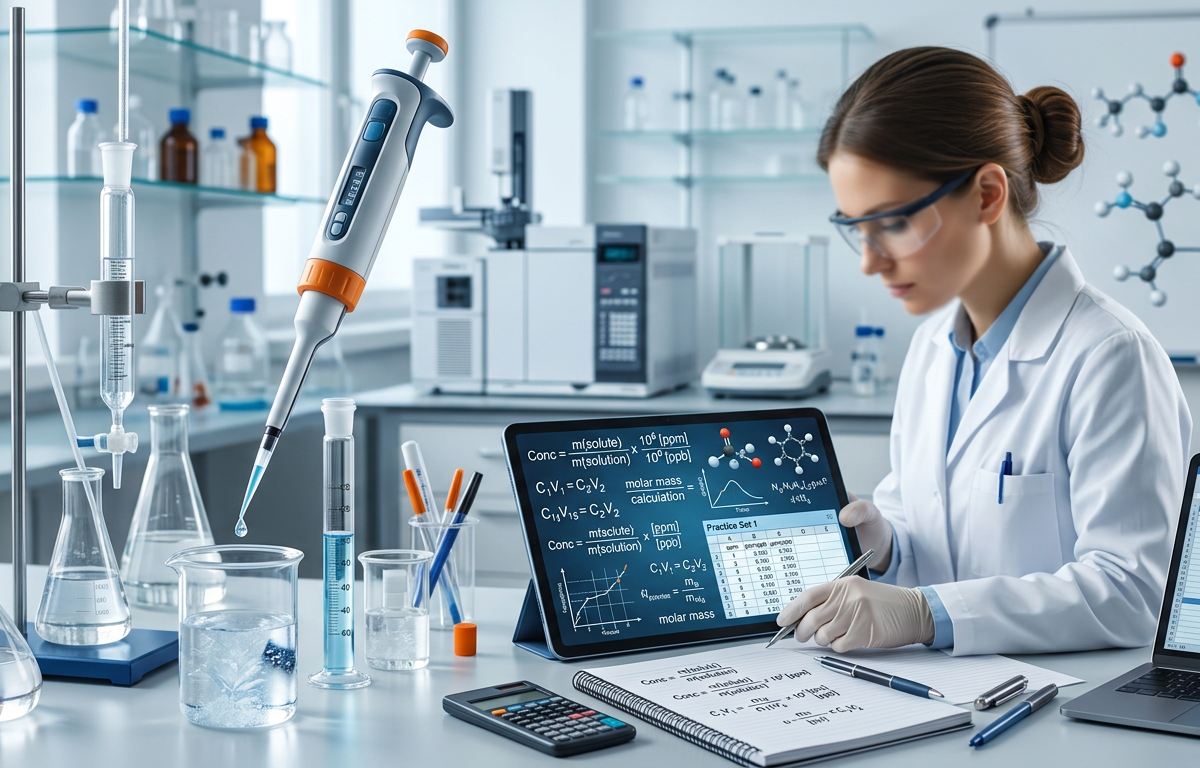
Hard ppm and ppb Practice Questions
Mastering concentration units like parts per million (ppm) and parts per billion (ppb) is essential for environmental science, toxicology, and analytical chemistry. These units allow scientists to measure trace amounts of substances, such as toxins in drinking water or pollutants in the atmosphere. This guide provides Hard ppm and ppb Practice Questions designed to challenge your understanding of unit conversions, density, and stoichiometry in dilute solutions.
Concept Explanation
Parts per million (ppm) and parts per billion (ppb) are units of concentration that express the ratio of the mass of a solute to the total mass of the solution, multiplied by a factor of 106 or 109, respectively. In the context of water quality, the Environmental Protection Agency (EPA) frequently uses these units to set safety limits for contaminants. Because these solutions are typically very dilute, the density of the solution is often assumed to be equal to that of pure water (1.00 g/mL), which means 1 ppm is equivalent to 1 mg/L and 1 ppb is equivalent to 1 μg/L.
To calculate these values, use the following formulas:
ppm = (mass of solute / total mass of solution) × 1,000,000
ppb = (mass of solute / total mass of solution) × 1,000,000,000
When working through Hard ppm and ppb Practice Questions, you will often need to convert between mass and volume using density or link these concepts to other concentration units like those found in hard molarity practice questions. Understanding the percentage composition of a mixture is also a foundational skill for these calculations, as ppm is simply a "percent" based on a million rather than a hundred.
Solved Examples
Example 1: Converting Molarity to ppm
A solution of Lead(II) nitrate, Pb(NO3)2, has a concentration of 2.5 × 10⁻⁵ M. What is the concentration of lead ions (Pb2+) in ppm? (Atomic mass of Pb = 207.2 g/mol; assume density of solution = 1.00 g/mL).
Identify the moles of Pb2+ in 1 Liter of solution: 2.5 × 10⁻⁵ moles.
Convert moles to mass: 2.5 × 10-5 mol × 207.2 g/mol = 0.00518 grams.
Convert grams to milligrams: 0.00518 g × 1000 mg/g = 5.18 mg.
Since the volume is 1 Liter, the concentration is 5.18 mg/L, which equals 5.18 ppm.
Example 2: Calculating ppb from Micrograms and Density
A 250 mL sample of groundwater contains 0.75 μg of arsenic. If the density of the water is 1.02 g/mL, what is the arsenic concentration in ppb?
Calculate the total mass of the solution: 250 mL × 1.02 g/mL = 255 g.
Convert the mass of solute to grams: 0.75 μg = 7.5 × 10⁻⁷ g.
Apply the ppb formula: (7.5 × 10⁻⁷ g / 255 g) × 109.
Result: 2.94 ppb.
Example 3: Converting ppm to Molarity
A sample of ocean water contains 412 ppm of Calcium ions (Ca2+). Calculate the molarity of Ca2+. (Atomic mass of Ca = 40.08 g/mol; assume density = 1.025 g/mL).
Understand ppm: 412 ppm means 412 mg of Ca2+ per 1,000,000 mg (1 kg) of solution.
Find the mass of 1 Liter of solution: 1000 mL × 1.025 g/mL = 1025 g.
Find the mass of Ca2+ in 1 Liter: (412 g Ca / 1,000,000 g solution) × 1025 g solution = 0.4223 g.
Convert mass to moles: 0.4223 g / 40.08 g/mol = 0.0105 mol.
Result: 0.0105 M.
Practice Questions
A 5.0 kg soil sample contains 0.025 grams of cadmium. Calculate the concentration of cadmium in ppm.
An industrial wastewater stream has a mercury concentration of 15 ppb. How many milligrams of mercury are present in 200 liters of this water? (Assume density = 1.00 g/mL).
The maximum contaminant level for fluoride in drinking water is 4.0 mg/L. Express this concentration in ppb.
Want unlimited practice questions like these?
Generate AI-powered questions with step-by-step solutions on any topic.
Try Question Generator Free →A chemical analysis shows that a 500 mL sample of air contains 2.2 × 10⁻⁴ grams of carbon monoxide. If the density of air is 1.2 g/L, calculate the CO concentration in ppm (mass/mass).
A solution is prepared by dissolving 1.5 mg of NaCl in enough water to make 2.5 kg of solution. Calculate the concentration of Na+ ions in ppb. (Molar mass NaCl = 58.44 g/mol; Na = 22.99 g/mol).
A student needs to prepare 2.0 L of a 50 ppm Cu2+ solution using copper(II) sulfate pentahydrate (CuSO4·5H2O). How many grams of the salt are required? (Molar mass of CuSO4·5H2O = 249.68 g/mol; Cu = 63.55 g/mol).
The concentration of silver ions in a solution is 0.0005% by mass. Convert this value to both ppm and ppb.
A sample of tap water has a density of 1.00 g/mL and contains 80 ppb of chloroform (CHCl3). What is the molarity of chloroform in the water?
A 1.2-liter sample of lake water contains 3.6 mg of dissolved oxygen. Calculate the oxygen concentration in ppm.
If a gold mine produces ore with a concentration of 0.5 ppm gold, how many metric tons of ore must be processed to obtain 1.0 kg of gold? (1 metric ton = 1000 kg).
Answers & Explanations
5 ppm.
Calculation: (0.025 g / 5000 g) × 106 = 5 ppm. We convert 5.0 kg to 5000 g to keep units consistent.3.0 mg.
15 ppb means 15 μg per Liter (since 1 L water ≈ 1 kg).
15 μg/L × 200 L = 3000 μg.
3000 μg / 1000 = 3.0 mg.4000 ppb.
4.0 mg/L is 4.0 ppm. To convert ppm to ppb, multiply by 1000.
4.0 × 1000 = 4000 ppb.366.67 ppm.
Mass of air = 0.5 L × 1.2 g/L = 0.6 g.
ppm = (2.2 × 10⁻⁴ g / 0.6 g) × 106 = 366.67 ppm.236 ppb.
Mass of Na+ = (22.99 / 58.44) × 1.5 mg = 0.59 mg.
ppb = (0.59 mg / 2,500,000 mg) × 109 = 236 ppb. Note: 2.5 kg = 2,500,000 mg.0.393 g.
50 ppm = 50 mg/L. For 2.0 L, we need 100 mg (0.100 g) of Cu2+.
Mass of salt = 0.100 g Cu × (249.68 g salt / 63.55 g Cu) = 0.393 g.5 ppm and 5000 ppb.
0.0005% = 0.0005 / 100 = 5 × 10⁻⁶.
ppm = (5 × 10-6) × 106 = 5 ppm.
ppb = (5 × 10-6) × 109 = 5000 ppb.6.7 × 10-7 M.
80 ppb = 80 μg/L = 8.0 × 10⁻⁵ g/L.
Molarity = (8.0 × 10⁻⁵ g / 119.38 g/mol) / 1 L = 6.7 × 10⁻⁷ mol/L.3 ppm.
Assuming density of 1 g/mL, 1.2 L = 1.2 kg.
ppm = 3.6 mg / 1.2 kg = 3 mg/kg = 3 ppm.2000 metric tons.
0.5 ppm = 0.5 g gold per 1,000,000 g ore (1 ton).
To get 1000 g (1 kg) of gold: 1000 g / 0.5 g/ton = 2000 tons.
1. Which of the following is equivalent to 1 ppm in an aqueous solution?
Frequently Asked Questions
What is the difference between ppm and ppb?
The difference lies in the scale of the ratio: ppm represents parts per million (106), while ppb represents parts per billion (109). Therefore, 1 ppm is 1,000 times larger than 1 ppb.
When should I use ppm vs ppb?
Scientists use ppm for trace concentrations such as minerals in bottled water, whereas ppb is reserved for ultra-trace concentrations, like highly toxic heavy metals or pesticides. Choosing between them depends on which unit provides a more readable number without excessive lead zeros.
Does the density of the solvent affect ppm calculations?
Yes, density affects the calculation when you are converting from volume-based measurements (like mg/L) to true mass-based ppm. While 1 mg/L is exactly 1 ppm for water at standard density, a denser solvent like seawater requires accounting for the extra mass of the solvent.
How do I convert ppm to molarity?
To convert ppm to molarity, first convert the ppm value (mg/L) to grams per Liter by dividing by 1,000. Then, divide that mass by the molar mass of the solute to find the moles per Liter, which is the molarity.
Is ppm the same as mg/kg?
Yes, ppm is equivalent to mg/kg because there are 1,000,000 milligrams in one kilogram. This mass-to-mass relationship is the standard definition of parts per million in chemistry and soil science.
Can ppm be used for gases?
Yes, in atmospheric chemistry, ppm is often used to describe the volume of a pollutant gas relative to the total volume of air (ppmv). This is different from mass-based ppm used in liquids and solids, as it relies on Avogadro's Law regarding gas volumes.
Want unlimited practice questions like these?
Generate AI-powered questions with step-by-step solutions on any topic.
Try Question Generator Free →
Want unlimited practice questions like these?
Generate AI-powered questions with step-by-step solutions on any topic.
Try Question Generator Free →Enjoyed this article?
Share it with others who might find it helpful.
Related Articles
Hard Le Chatelier’s Principle Practice Questions
Master Hard Le Chatelier’s Principle Practice Questions with our comprehensive guide featuring solved examples, practice problems, and detailed explanations.
Mar 30, 2026

Hard Reaction Quotient (Q) Practice Questions
Hard Reaction Quotient (Q) Practice Questions
Mar 30, 2026
Grams to Moles Practice Questions with Answers
Master grams to moles conversions with our comprehensive guide. Includes step-by-step examples, practice questions, and detailed answers for chemistry students.
Mar 26, 2026
Avogadro’s Number Practice Questions with Answers
Master the mole concept with our Avogadro’s Number practice questions. Includes step-by-step solved examples, a quick quiz, and detailed explanations.
Mar 26, 2026
Empirical Formulas: Solving Ratios from Mass and Percent Data
Master empirical formula calculations with 10 practice questions, worked answers, and a free step-by-step calculator for mass, percentage, and combustion problems.
Mar 26, 2026