Easy pOH Calculation Practice Questions
Concept Explanation
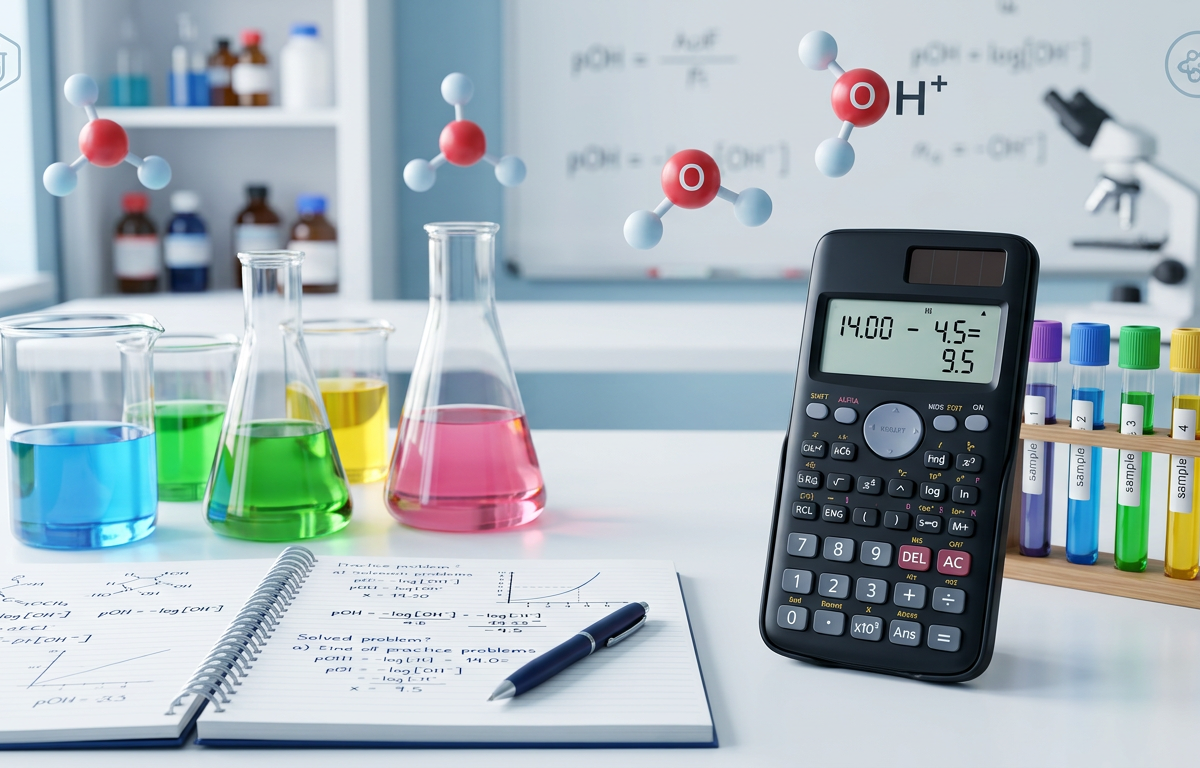
The pOH of a solution is a measure of its hydroxide ion (OH⁻) concentration, calculated as the negative logarithm (base 10) of the molarity of hydroxide ions. It serves as a scale to describe how basic or acidic a solution is, complementary to the pH scale. In aqueous solutions at 25°C, the relationship between pH and pOH is defined by the constant sum: pH + pOH = 14. This mathematical relationship originates from the self-ionization of water, where the ion product constant (Kw) equals 1.0 x 10⁻¹⁴. Understanding pOH calculation practice questions is essential for mastering chemical equilibrium and solution chemistry.
To calculate pOH, you apply the formula: pOH = -log[OH⁻]. Conversely, if you know the pOH and need to find the hydroxide concentration, you use the inverse formula: [OH⁻] = 10^-pOH. Because the scale is logarithmic, a change of one pOH unit represents a tenfold change in hydroxide concentration. For instance, a solution with a pOH of 3 is ten times more basic than one with a pOH of 4. For students transitioning from basic chemistry to more complex topics, mastering these logs is as fundamental as understanding pH calculation practice questions or the behavior of strong vs weak acids.
Solved Examples
Review these step-by-step solutions to understand the mechanics of calculating pOH from hydroxide concentrations and pH values.
Example 1: Calculating pOH from [OH⁻]
Find the pOH of a solution with a hydroxide ion concentration of 1.0 x 10⁻⁴ M.Identify the given concentration: [OH⁻] = 1.0 x 10⁻⁴.
Apply the formula: pOH = -log(1.0 x 10⁻⁴).
Using log rules: -(-4) = 4.
The pOH is 4.00.
Example 2: Calculating pOH from pH
A cleaning solution has a pH of 10.5. What is its pOH at 25°C?Recall the relationship: pH + pOH = 14.
Substitute the known value: 10.5 + pOH = 14.
Rearrange to solve for pOH: pOH = 14 - 10.5.
The pOH is 3.5.
Example 3: Finding [OH⁻] from pOH
If a solution has a pOH of 2.30, what is the molarity of the hydroxide ions?Use the inverse log formula: [OH⁻] = 10^-pOH.
Substitute the value: [OH⁻] = 10^-2.30.
Calculate the power: [OH⁻] ≈ 5.01 x 10⁻³ M.
The hydroxide concentration is 5.01 x 10⁻³ M.
Practice Questions
Calculate the pOH of a solution where [OH⁻] = 0.001 M.
Determine the pOH of a solution with a hydroxide concentration of 4.5 x 10⁻⁹ M.
If the pH of a vinegar solution is 3.0, what is its pOH?
Want unlimited practice questions like these?
Generate AI-powered questions with step-by-step solutions on any topic.
Try Question Generator Free →Find the pOH for a 0.05 M solution of NaOH (assume complete dissociation).
A solution has [OH⁻] = 1.0 x 10⁻⁷ M. What is the pOH?
The pH of a sample of sea water is 8.1. Calculate the pOH.
Calculate the pOH of a solution with [OH⁻] = 2.75 x 10⁻³ M.
If a solution has a pOH of 11.2, is it acidic, basic, or neutral?
Determine the pOH of a solution with [OH⁻] = 8.2 x 10⁻¹² M.
What is the pOH of pure water at 25°C?
Answers & Explanations
Answer: 3.00
Concentration [OH⁻] = 0.001 M is the same as 10⁻³ M. pOH = -log(10⁻³) = 3.Answer: 8.35
pOH = -log(4.5 x 10⁻⁹). Using a calculator, log(4.5) is approx 0.65. So, - (0.65 - 9) = 8.35.Answer: 11.0
Using the sum rule: pOH = 14 - pH. 14 - 3.0 = 11.0.Answer: 1.30
NaOH is a strong base, so [OH⁻] = 0.05 M. pOH = -log(0.05) = 1.30.Answer: 7.00
pOH = -log(1.0 x 10⁻⁷) = 7.00. This is the pOH of a neutral solution.Answer: 5.9
pOH = 14 - 8.1 = 5.9.Answer: 2.56
pOH = -log(2.75 x 10⁻³). log(2.75) ≈ 0.44. - (0.44 - 3) = 2.56.Answer: Acidic
A pOH of 11.2 corresponds to a pH of 2.8 (14 - 11.2). Since the pH is less than 7, the solution is acidic.Answer: 11.09
pOH = -log(8.2 x 10⁻¹²). log(8.2) ≈ 0.91. - (0.91 - 12) = 11.09.Answer: 7.00
In pure water, [H⁺] = [OH⁻] = 1.0 x 10⁻⁷ M. Therefore, pOH = -log(10⁻⁷) = 7.00.
1. What is the sum of pH and pOH at 25°C?
Frequently Asked Questions
What is the difference between pH and pOH?
pH measures the concentration of hydrogen ions (acidic intensity), while pOH measures the concentration of hydroxide ions (basic intensity). They are inversely related in aqueous solutions, meaning as one increases, the other must decrease to maintain the water equilibrium constant.
Can pOH be negative?
Yes, pOH can be negative if the hydroxide ion concentration is greater than 1.0 M. This typically occurs in extremely concentrated basic solutions, such as saturated sodium hydroxide.
How do you calculate pOH if only the [H⁺] is known?
You can first calculate the pH using -log[H⁺] and then subtract that value from 14 to find the pOH. Alternatively, you can find [OH⁻] using the water dissociation constant (Kw = [H⁺][OH⁻]) and then take the negative log.
Why is the number 14 used in pOH calculations?
The number 14 comes from the pKw of water at 25°C, which is the negative log of 1.0 x 10⁻¹⁴. This value is temperature-dependent, so the sum of pH and pOH only equals exactly 14 at standard room temperature.
Does a high pOH mean a solution is basic?
No, a high pOH actually means the solution is acidic because a high pOH indicates a very low concentration of hydroxide ions. Conversely, a low pOH (less than 7) indicates a basic solution with a high hydroxide concentration.
Want unlimited practice questions like these?
Generate AI-powered questions with step-by-step solutions on any topic.
Try Question Generator Free →
Want unlimited practice questions like these?
Generate AI-powered questions with step-by-step solutions on any topic.
Try Question Generator Free →Enjoyed this article?
Share it with others who might find it helpful.
Related Articles
Hard Le Chatelier’s Principle Practice Questions
Master Hard Le Chatelier’s Principle Practice Questions with our comprehensive guide featuring solved examples, practice problems, and detailed explanations.
Mar 30, 2026
Hard Reaction Quotient (Q) Practice Questions
Hard Reaction Quotient (Q) Practice Questions
Mar 30, 2026
Grams to Moles Practice Questions with Answers
Master grams to moles conversions with our comprehensive guide. Includes step-by-step examples, practice questions, and detailed answers for chemistry students.
Mar 26, 2026
Avogadro’s Number Practice Questions with Answers
Master the mole concept with our Avogadro’s Number practice questions. Includes step-by-step solved examples, a quick quiz, and detailed explanations.
Mar 26, 2026

Empirical Formulas: Solving Ratios from Mass and Percent Data
Master empirical formula calculations with 10 practice questions, worked answers, and a free step-by-step calculator for mass, percentage, and combustion problems.
Mar 26, 2026