Easy MCAT Ecology Practice Questions

Concept Explanation
Ecology is the scientific study of the interactions between organisms and their environment, focusing on the distribution and abundance of life on Earth. For the MCAT, understanding ecology requires a grasp of hierarchical levels, ranging from individual organisms and populations to communities, ecosystems, and the entire biosphere. Key concepts include energy flow through trophic levels, nutrient cycling, and the various symbiotic relationships that define biological communities. By mastering these basics, students can better understand how MCAT Evolution Practice Questions integrate with environmental pressures to shape the diversity of life.
Energy in an ecosystem typically begins with primary producers (autotrophs) like plants and algae, which convert solar energy into chemical energy via photosynthesis. This energy then moves through primary consumers (herbivores), secondary consumers (carnivores), and tertiary consumers. However, energy transfer is inefficient; only about 10% of the energy at one trophic level is passed to the next, a principle known as the 10% Rule. This inefficiency limits the number of trophic levels an ecosystem can support. Additionally, ecology explores population dynamics, such as carrying capacity and growth curves, which are essential for predicting how species respond to resource limitations or environmental shifts.
Solved Examples
The following examples demonstrate how to apply ecological principles to common MCAT-style problems.
- Calculate Energy Transfer: If a grassland ecosystem produces of energy at the producer level, how much energy is available to the secondary consumers?
- Identify the trophic levels: Producers → Primary Consumers → Secondary Consumers.
- Apply the 10% rule for the first transfer: (available to primary consumers).
- Apply the 10% rule for the second transfer: .
- Solution: 500 kcal is available to secondary consumers.
- Identify Symbiotic Relationships: A species of barnacle attaches to a whale's skin. The barnacle gains a place to live and access to nutrient-rich water as the whale swims, while the whale is neither helped nor harmed. What type of relationship is this?
- Analyze the interaction for each species: Barnacle (+), Whale (0).
- Recall the definitions: Mutualism (+/+), Parasitism (+/-), Commensalism (+/0).
- Solution: This is a commensalism relationship.
- Determine Population Growth: A population of rabbits enters an environment with unlimited resources. Initially, the growth rate increases rapidly. What type of growth curve does this represent, and what will happen as resources become scarce?
- Identify initial growth: Rapid growth with unlimited resources is exponential growth (J-shaped curve).
- Predict future shift: As resources become limited, the growth rate will slow down and level off at the carrying capacity ().
- Solution: The initial curve is exponential, which will eventually transition into logistic growth (S-shaped curve).
Practice Questions
Test your knowledge with these easy MCAT ecology practice questions designed to reinforce core definitions and relationships.
1. Which of the following best describes a niche?
2. In a food web, which group is responsible for returning inorganic nutrients to the soil?
3. A researcher observes that as the population of lynx increases, the population of hares decreases shortly thereafter. This is an example of what ecological interaction?
Need more MCAT practice questions?
Generate unlimited MCAT-style questions with instant explanations and adaptive practice powered by Bevinzey AI.
Generate Questions Free4. Which of the following factors is considered density-independent?
5. If an ecosystem has a net primary productivity (NPP) of and respiration (R) is , what is the gross primary productivity (GPP)?
6. According to the competitive exclusion principle, what happens when two species compete for the exact same niche?
7. Which trophic level generally contains the least amount of biomass in a terrestrial pyramid?
8. What is the primary difference between a community and an ecosystem?
Answers & Explanations
- Answer: The functional role and physical distribution of a species in its environment. A niche includes not just where an organism lives (its habitat), but how it interacts with biotic and abiotic factors to survive and reproduce.
- Answer: Decomposers. Decomposers like fungi and bacteria break down organic matter from dead organisms, recycling essential elements like nitrogen and phosphorus back into the environment.
- Answer: Predation. This is a classic predator-prey cycle where the size of the predator population is dependent on the availability of prey, and the prey population is controlled by the predator.
- Answer: Natural disasters (e.g., a forest fire). Density-independent factors affect a population regardless of its size. In contrast, density-dependent factors, like disease or competition, have a greater impact as the population density increases.
- Answer: . Gross Primary Productivity (GPP) is the total energy captured by producers. Net Primary Productivity (NPP) is GPP minus the energy used for respiration (R). Therefore, .
- Answer: One species will outcompete the other, leading to the latter's local extinction or niche shift. Two species cannot occupy the same niche indefinitely because resources are limited.
- Answer: Tertiary consumers. Because of the 10% rule of energy transfer, there is significantly less energy and biomass available at the top of the food chain compared to the producer base.
- Answer: An ecosystem includes abiotic factors, while a community only includes biotic factors. A community consists of all the different populations living in an area; an ecosystem adds the non-living components like water, sunlight, and soil chemistry.
1. Which term refers to the maximum population size that an environment can sustain indefinitely?
Frequently Asked Questions
What is the difference between a food chain and a food web?
A food chain is a linear sequence showing who eats whom, while a food web is a complex network of many interconnected food chains. Food webs provide a more realistic representation of the multiple feeding relationships within an ecosystem.
How does energy enter most ecosystems?
Most energy enters ecosystems through sunlight, which is captured by plants and other autotrophs during photosynthesis. This energy is stored in organic molecules and then passed through the food chain to consumers and decomposers.
What are the levels of ecological organization?
The levels of organization are organism, population (same species), community (multiple species), ecosystem (biotic and abiotic), biome (regional climate), and biosphere (global). Understanding these helps when studying MCAT Biology Practice Questions as they relate to broader biological systems.
Why is nitrogen cycling important for life?
Nitrogen is a critical component of amino acids and nucleic acids, but most organisms cannot use atmospheric nitrogen (). Nitrogen-fixing bacteria convert it into usable forms like nitrates, allowing it to enter the food web. This process is often discussed in the context of MCAT Cell Biology Practice Questions regarding protein synthesis.
What is the 10% Rule in ecology?
The 10% Rule states that only about 10% of the energy stored in organic matter at one trophic level is converted into organic matter at the next trophic level. The remaining 90% is lost primarily as heat during metabolic processes or through waste.
Need more MCAT practice questions?
Generate unlimited MCAT-style questions with instant explanations and adaptive practice powered by Bevinzey AI.
Generate Questions FreeReviewed by
Michael Danquah, MS, PhD
Dr. Michael Danquah is a professor of pharmaceutical sciences and founder of several educational technology platforms focused on improving student learning and performance.
Enjoyed this article?
Share it with others who might find it helpful.
Related Articles

Applying Coulomb’s Law and Potential to MCAT Biological Systems
MCAT Electrostatics Practice Questions with Answers
May 14, 2026
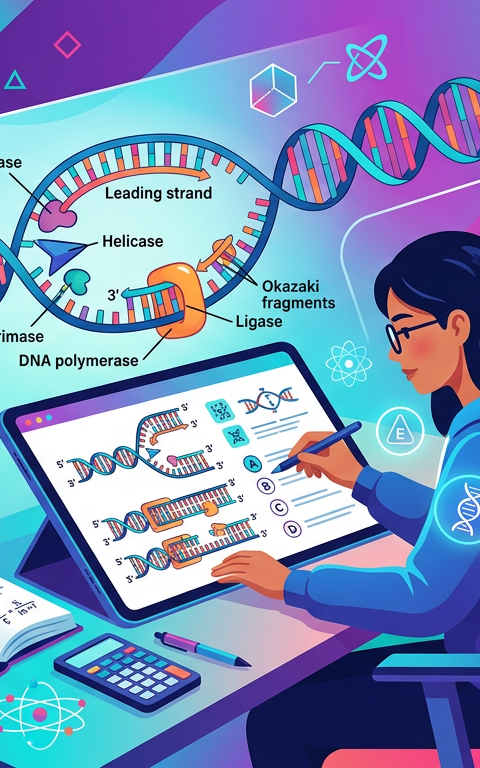
Hard MCAT DNA Replication Practice Questions
Master high-level DNA replication concepts with these hard MCAT practice questions covering enzymes, directionality, and telomeres.
May 14, 2026
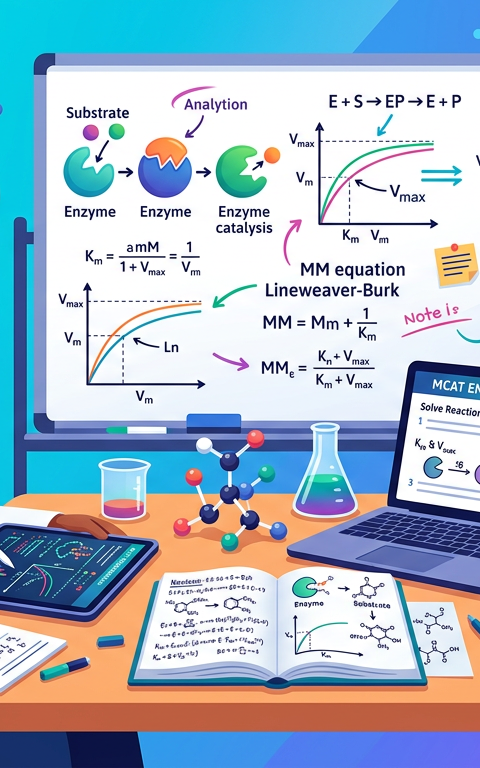
Hard MCAT Enzyme Practice Questions
Hard MCAT Enzyme Practice Questions
May 14, 2026
Medium MCAT DNA Replication Practice Questions
Medium MCAT DNA Replication Practice Questions
May 14, 2026

Medium MCAT Enzyme Practice Questions
Medium MCAT Enzyme Practice Questions
May 14, 2026

Easy MCAT DNA Replication Practice Questions
Master DNA replication with these easy MCAT practice questions. Learn about helicase, polymerase, and semi-conservative replication with detailed explanations.
May 14, 2026

MCAT Enzyme Kinetics: Solving KM and Vmax Without a Calculator
Easy MCAT Enzyme Practice Questions
May 14, 2026

MCAT DNA Replication Practice Questions with Answers
MCAT DNA Replication Practice Questions with Answers
May 14, 2026