Easy MCAT Biology Practice Questions

Easy MCAT Biology Practice Questions
Preparing for the Medical College Admission Test (MCAT) requires a solid grasp of foundational biological principles, ranging from cellular metabolism to organ system physiology. Utilizing easy MCAT biology practice questions allows students to build confidence and ensure they have mastered the high-yield basics before tackling complex, passage-based data analysis. This guide provides a structured approach to fundamental biology concepts, helping you identify knowledge gaps early in your study timeline.
Concept Explanation
MCAT biology focuses on the "big picture" of how living organisms maintain homeostasis, reproduce, and interact with their environment. At its core, the biology section tests your understanding of the central dogma of molecular biology, which describes the flow of genetic information from DNA to RNA to protein. Mastery of this section requires a deep dive into cell biology, where you must distinguish between prokaryotic and eukaryotic structures, as well as the metabolic pathways like glycolysis and the Krebs cycle that power life. Beyond the cellular level, the exam emphasizes human physiology, requiring you to understand how the nervous, endocrine, and immune systems coordinate complex responses to internal and external stimuli.
Solved Examples
Review these solved examples to understand the logic required for foundational biology questions.
- Question: If a cell has a high concentration of solutes compared to its environment, in which direction will water move via osmosis?
Solution:- Identify the tonicity: The cell is hypertonic to its environment.
- Recall the rule of osmosis: Water moves from areas of low solute concentration to high solute concentration.
- Conclusion: Water will move into the cell, potentially causing it to swell or burst.
- Question: During which phase of mitosis do sister chromatids separate and move toward opposite poles?
Solution:- Recall the stages: Prophase, Metaphase, Anaphase, Telophase (PMAT).
- Identify the action: Chromosomes line up in metaphase; separation occurs in the next step.
- Conclusion: The correct phase is Anaphase.
- Question: A DNA strand has the sequence . What is the complementary RNA sequence?
Solution:- Identify base pairing rules: A pairs with U (in RNA), T pairs with A, G pairs with C, and C pairs with G.
- Determine directionality: The strands must be antiparallel, so the RNA will be .
- Match: A-U, T-A, G-C, C-G result in , which is written as .
Practice Questions
- Which organelle is responsible for the post-translational modification and packaging of proteins?
- In a heterozygous cross (Aa x Aa), what is the expected phenotypic ratio of the offspring if 'A' is completely dominant over 'a'?
- Which hormone, produced by the pancreas, acts to lower blood glucose levels?
Need more MCAT practice questions?
Generate unlimited MCAT-style questions with instant explanations and adaptive practice powered by Bevinzey AI.
Generate Questions Free- What is the primary site of water reabsorption in the human digestive system?
- Which type of muscle tissue is striated and under involuntary control?
- According to the Hardy-Weinberg principle, if the frequency of a recessive allele is 0.3, what is the frequency of the dominant allele ?
- Which nitrogenous base is found in RNA but not in DNA?
- What is the function of the myelin sheath in the nervous system?
- During aerobic respiration, which process occurs in the cytosol rather than the mitochondria?
- Which valve prevents the backflow of blood from the left ventricle into the left atrium?
Answers & Explanations
- Golgi Apparatus: This organelle receives proteins from the endoplasmic reticulum, modifies them (e.g., glycosylation), and sorts them for transport to their final destinations.
- 3:1: In a Mendelian monohybrid cross, the genotypes are 1 AA, 2 Aa, and 1 aa. Since AA and Aa show the dominant phenotype, the ratio is 3 dominant to 1 recessive. You can learn more about these patterns in our guide on MCAT genetics practice questions.
- Insulin: Secreted by the beta cells of the islets of Langerhans in the pancreas, insulin facilitates glucose uptake into cells. For more on this topic, see MCAT endocrine system practice questions.
- Large Intestine (Colon): While the small intestine absorbs most nutrients, the large intestine is primarily responsible for absorbing water and salts from the remaining indigestible food matter.
- Cardiac Muscle: Skeletal muscle is striated and voluntary, smooth muscle is non-striated and involuntary, but cardiac muscle is uniquely both striated and involuntary.
- 0.7: The Hardy-Weinberg equation for allele frequency is . If , then .
- Uracil: DNA uses Adenine, Guanine, Cytosine, and Thymine. In RNA, Thymine is replaced by Uracil.
- Increases Conduction Speed: The myelin sheath acts as an insulator, allowing electrical impulses (action potentials) to jump between nodes of Ranvier via saltatory conduction.
- Glycolysis: While the Krebs cycle and Electron Transport Chain occur within the mitochondria, glycolysis breaks down glucose into pyruvate in the cytoplasm.
- Mitral (Bicuspid) Valve: This valve sits between the left atrium and left ventricle. The tricuspid valve is on the right side of the heart.
1. Which phase of the cell cycle involves DNA replication?
Frequently Asked Questions
What are the most high-yield biology topics for the MCAT?
High-yield topics include amino acid structures, enzyme kinetics, the central dogma (transcription and translation), and the major organ systems, particularly the renal and nervous systems. Focusing on these areas provides the best return on investment for your study time.
How is biology tested on the MCAT compared to undergrad exams?
While undergraduate exams often focus on rote memorization, the MCAT requires you to apply biological concepts to new, passage-based scenarios. You must be able to interpret experimental data and predict how changes in one variable affect a biological system.
Do I need to memorize all the enzymes in the Krebs cycle?
You should know the rate-limiting steps and the major substrates/products of the Krebs cycle, such as citrate, isocitrate, and alpha-ketoglutarate. Understanding the overall yield of NADH, FADH2, and ATP is more important than memorizing every single chemical structure.
What is the best way to use easy MCAT biology practice questions?
Use easy questions to verify your baseline knowledge and build mental stamina during the early stages of your prep. If you miss an easy question, it indicates a fundamental conceptual gap that should be addressed before moving to advanced practice passages.
How many biology questions are on the actual MCAT?
The Biological and Biochemical Foundations of Living Systems section contains 59 questions to be completed in 95 minutes. This includes a mix of passage-based questions and discrete standalone questions.
Need more MCAT practice questions?
Generate unlimited MCAT-style questions with instant explanations and adaptive practice powered by Bevinzey AI.
Generate Questions FreeReviewed by
Michael Danquah, MS, PhD
Dr. Michael Danquah is a professor of pharmaceutical sciences and founder of several educational technology platforms focused on improving student learning and performance.
Enjoyed this article?
Share it with others who might find it helpful.
Related Articles
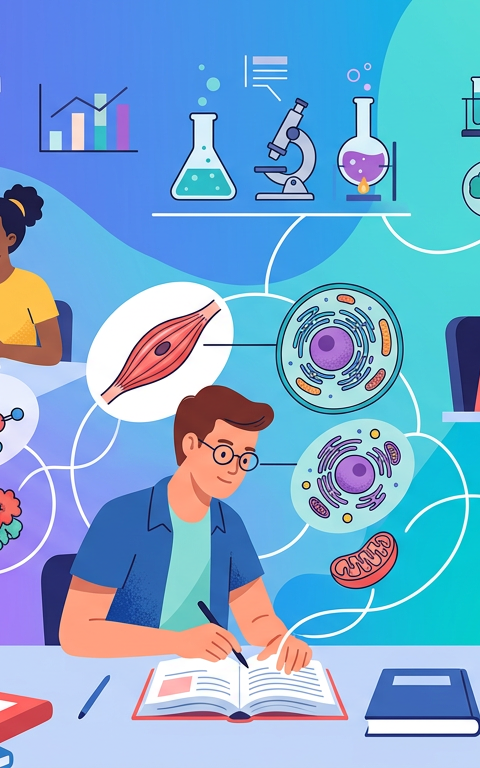
Hard MCAT Biology Exam Practice Questions
Hard MCAT Biology Exam Practice Questions
May 9, 2026

Applying Coulomb’s Law and Potential to MCAT Biological Systems
MCAT Electrostatics Practice Questions with Answers
May 14, 2026
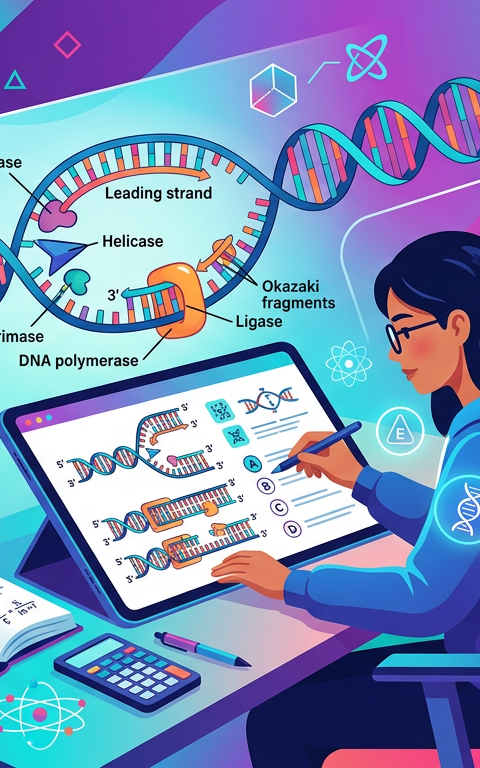
Hard MCAT DNA Replication Practice Questions
Master high-level DNA replication concepts with these hard MCAT practice questions covering enzymes, directionality, and telomeres.
May 14, 2026
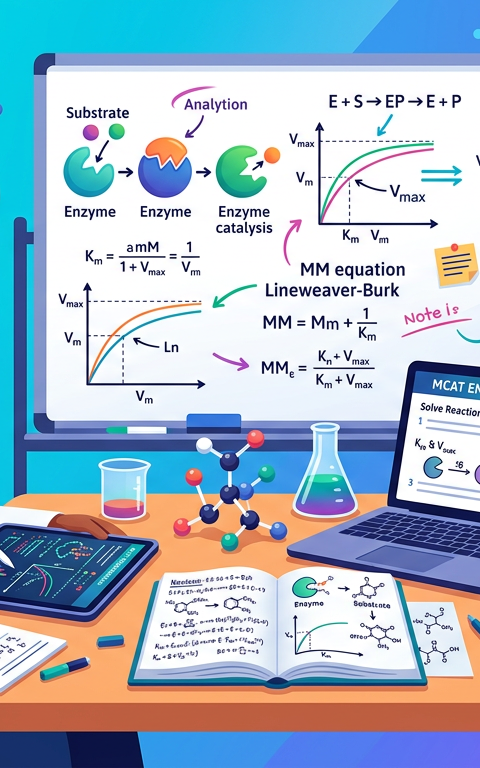
Hard MCAT Enzyme Practice Questions
Hard MCAT Enzyme Practice Questions
May 14, 2026
Medium MCAT DNA Replication Practice Questions
Medium MCAT DNA Replication Practice Questions
May 14, 2026

Medium MCAT Enzyme Practice Questions
Medium MCAT Enzyme Practice Questions
May 14, 2026

Easy MCAT DNA Replication Practice Questions
Master DNA replication with these easy MCAT practice questions. Learn about helicase, polymerase, and semi-conservative replication with detailed explanations.
May 14, 2026

MCAT Enzyme Kinetics: Solving KM and Vmax Without a Calculator
Easy MCAT Enzyme Practice Questions
May 14, 2026