Solving High-Level SAT Integer Logic and Number Theory Problems
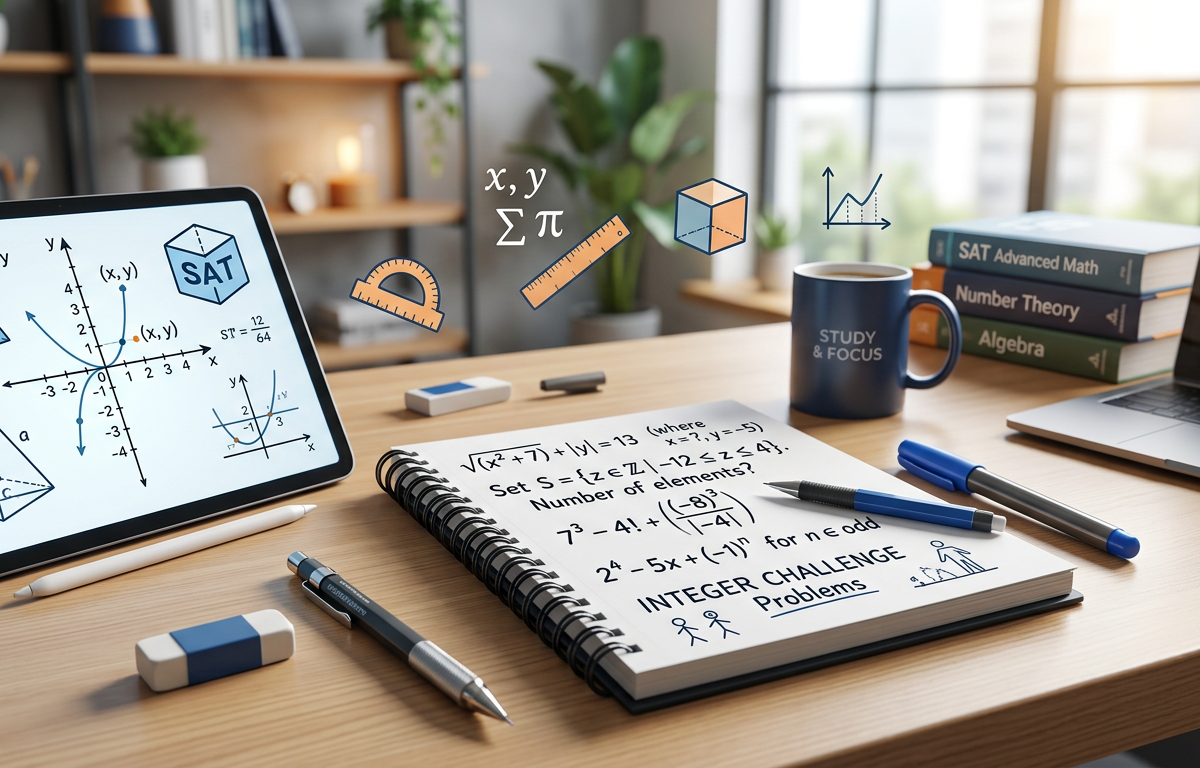
Consider the difference between a number being a multiple of 6 and a number whose square is divisible by 6. On the hardest section of the Digital SAT, the test makers rely on your tendency to overlook these subtle distinctions. While most students quickly identify that even plus even equals even, few are prepared to handle constraints where x and y must be non-zero consecutive negative integers within a system of inequalities. These problems are not testing your ability to count but rather your ability to apply number theory under strict logical constraints.
The most common mistake on these high-difficulty questions is failing to test the boundaries of the integer set. Students often forget that zero is an even integer or that negative numbers behave differently when squared in an inequality. Success requires a shift from basic arithmetic to algebraic reasoning, specifically involving divisibility rules and prime factorization. By isolating the properties of remainders and parity, you can solve complex word problems without relying on time-consuming trial and error. The following practice set focuses on these exact edge cases that differentiate a 700-level score from an 800-level score.
Core Properties of Integer Logic
Integers are the set of whole numbers—including positive numbers, negative numbers, and zero—that do not contain fractional or decimal parts. In the context of the SAT, integer problems frequently revolve around properties such as parity (even vs. odd), divisibility, prime factors, and remainders. For instance, you must know that the product of any two even integers is always even, while the product of two odd integers is always odd. Furthermore, the mathematical definition of an integer excludes numbers like or . Success on hard-level questions often involves testing extreme cases, such as negative integers or the number zero, which behaves uniquely in multiplication and division. Understanding these nuances is just as critical as mastering hard SAT algebra word practice questions.
Solved Examples
- Problem: If is an odd integer and is an even integer, which of the following must be an even integer?
A)
B)
C)
D)
Solution:- Test the properties: Odd + Even = Odd. Therefore, A is incorrect.
- Odd is Odd. Odd + Even = Odd. Therefore, B is incorrect.
- If is odd, is even. Even Even = Even. This matches.
- If is even, is odd. Odd Odd = Odd. Therefore, D is incorrect.
- Final Answer: C.
- Problem: The product of three consecutive integers is 210. What is the sum of these three integers?
Solution:- Let the integers be . Their product is .
- Estimate the cube root of 210. Since and , the numbers should be near 5 and 6.
- Test : .
- The sum is .
- Final Answer: 18.
- Problem: If and are positive integers such that , what is the value of ?
Solution:- Rearrange for : .
- Factor the right side: .
- Since 3 is not a factor of 7, must be a multiple of 3 for to be an integer.
- If , then .
- Substitute into the original: .
- Final Answer: 7.
Practice Questions
- If is a positive integer and is divisible by 12 and 15, what is the smallest possible value of ?
- When the positive integer is divided by 7, the remainder is 3. What is the remainder when is divided by 7?
- The sum of five consecutive even integers is 120. What is the greatest of these integers?
- If and are consecutive negative integers such that , which of the following must be positive?
A)
B)
C)
D) - A set of numbers consists of all integers from 1 to 100 inclusive. How many of these integers are divisible by 3 or 5 but not both?
- If is a prime number greater than 3, what is the remainder when is divided by 12? (Hint: Test prime numbers like 5, 7, 11).
- For how many integer values of is an integer?
- If and are integers such that , what is the value of ?
- Let be the smallest integer such that and be the largest integer such that . What is the value of ?
- The product of two integers is 48. If the sum of these two integers is 16, what is the absolute difference between the two integers?
Answers & Explanations
- Answer: 30.
If is divisible by 12 () and 15 (), it must be divisible by the Least Common Multiple (LCM) of 12 and 15, which is 60 (). For to be a perfect square, all prime factors in its prime factorization must have even exponents. The prime factorization of must include at least and . Thus, the smallest . Taking the square root, . - Answer: 1.
We can write . Then . Dividing by 7 leaves no remainder. Dividing 15 by 7 leaves a remainder of 1 (). Therefore, the remainder is 1. - Answer: 28.
Let the integers be . Their sum is , so . The greatest integer is . This is a common pattern in hard SAT word problems practice questions. - Answer: C.
Since are negative, their sum (A) is negative. The product of three negatives (B) is negative. In (C), , so is negative. A negative times a negative is positive. In (D), is positive but is negative, making the product negative. - Answer: 40.
Multiples of 3: . Multiples of 5: . Multiples of both (15): .
Only 3: . Only 5: . Total: . Wait, check the count: . (Correction: 41). - Answer: 1.
Test : . remainder 1. Test : . remainder 1. Test : . remainder 1. The remainder is always 1. - Answer: 12.
For to be an integer, must be a factor of 18. The factors of 18 are . There are 12 such factors. Since each factor leads to a unique value of , there are 12 values for . - Answer: 145.
Factor the difference of squares: . Since 17 is prime, the factors must be 1 and 17.
and . Adding gives . Subtracting gives .
. - Answer: 18.
. The smallest integer is 15.
. The largest integer is 33.
. - Answer: 8.
Let the integers be and . and . The factors of 48 that add to 16 are 12 and 4. The absolute difference is . Similar logic is applied in hard SAT systems of equations practice questions.
1. If \( x \) is an even integer and \( y \) is an odd integer, which of the following must be odd?
Frequently Asked Questions
What is the difference between an integer and a real number?
Integers are a subset of real numbers that do not include fractions or decimals, consisting only of whole values like -2, 0, and 5. Real numbers encompass all points on the number line, including integers, rational fractions, and irrational numbers like .
Is zero considered an even or odd integer on the SAT?
Zero is classified as an even integer because it can be divided by 2 without leaving a remainder (). On the SAT, it is important to remember that zero is neither positive nor negative, but it is an integer.
How do I handle remainders in SAT integer problems?
To solve remainder problems, you can use the formula . Alternatively, for many SAT questions, "picking a number" that fits the criteria is the fastest way to find the correct answer.
What are consecutive integers?
Consecutive integers are numbers that follow each other in order, each being 1 greater than the previous one, such as . If the problem specifies consecutive even or odd integers, the sequence increases by 2 each time, such as .
Are prime numbers always integers?
Yes, by definition, prime numbers must be positive integers greater than 1 that have exactly two distinct factors: 1 and themselves. This means that fractions, decimals, and negative numbers can never be prime.
Enjoyed this article?
Share it with others who might find it helpful.
Related Articles

Hard SAT Number Properties Practice Questions
Hard SAT Number Properties Practice Questions
Apr 27, 2026

Solving Weighted Averages and Median Shifts on the Digital SAT
Hard SAT Mean Median Mode Practice Questions
Apr 27, 2026

SAT Stats: Solving for Margin of Error and Skewed Distributions
Hard SAT Statistics Practice Questions
Apr 27, 2026
Solving the Hidden Geometry Traps in SAT Triangle Problems
Hard SAT Triangle Practice Questions
Apr 27, 2026
Solving Multistep SAT Geometry: From Circle Equations to Radians
Hard SAT Geometry Practice Questions
Apr 27, 2026

Medium SAT Number Properties Practice Questions
Medium SAT Number Properties Practice Questions
Apr 27, 2026
Solving Multistep SAT Geometry: Area and Volume Relationships
Master Medium SAT Area and Volume Practice Questions with our comprehensive guide, featuring solved examples, practice problems, and a quick quiz.
Apr 27, 2026

Easy SAT Number Properties Practice Questions
Easy SAT Number Properties Practice Questions
Apr 27, 2026