Medium Solution Preparation Practice Questions
Concept Explanation
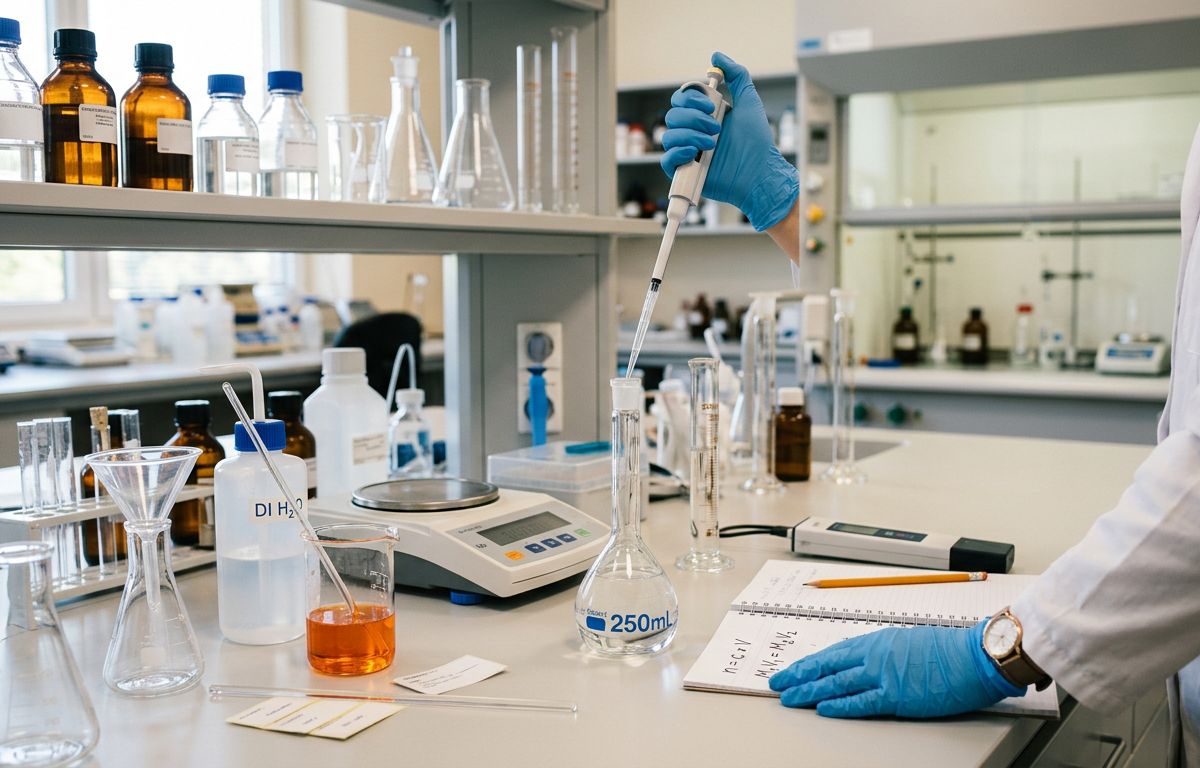
Solution preparation is the process of creating a homogeneous mixture by dissolving a specific amount of solute into a solvent to achieve a desired concentration. To master this, you must understand the relationship between mass, moles, volume, and concentration. Most laboratory work relies on molarity (M), which is defined as the number of moles of solute per liter of solution. Accurate preparation often requires calculating the mass of a solid needed using the molarity formula or determining the volume of a concentrated stock solution required for dilution. According to Wikipedia's entry on concentration, precision in these calculations is vital for reproducibility in scientific experiments. Whether you are dealing with grams to moles conversions or utilizing the dilution equation (C1V1 = C2V2), the goal is to ensure the final chemical environment is exactly as specified by the protocol.
Solved Examples
These examples demonstrate the step-by-step logic required to solve medium-level solution preparation problems.
Preparing a Solution from a Solid: How many grams of Sodium Chloride (NaCl) are needed to prepare 500 mL of a 0.25 M solution? (Molar mass of NaCl = 58.44 g/mol).
Identify the knowns: Volume = 0.500 L, Molarity = 0.25 mol/L.
Calculate moles of NaCl: Moles = Molarity × Volume = 0.25 mol/L × 0.500 L = 0.125 moles.
Convert moles to grams: Mass = 0.125 moles × 58.44 g/mol = 7.305 grams.
Final Answer: 7.31 g of NaCl.
Diluting a Stock Solution: You have a 12.0 M HCl stock solution. How much of this stock is needed to make 2.0 L of 1.5 M HCl?
Use the dilution formula: C1V1 = C2V2.
Plug in the values: (12.0 M)(V1) = (1.5 M)(2.0 L).
Solve for V1: V1 = (1.5 × 2.0) / 12.0 = 3.0 / 12.0 = 0.25 L.
Final Answer: 250 mL of the 12.0 M stock solution.
Finding Concentration from Mass and Volume: If 15.0 grams of Copper(II) Sulfate (CuSO4) are dissolved in water to make a 250 mL solution, what is the molarity? (Molar mass of CuSO4 = 159.61 g/mol).
Convert mass to moles: 15.0 g / 159.61 g/mol = 0.09398 moles.
Convert volume to liters: 250 mL = 0.250 L.
Calculate Molarity: M = 0.09398 mol / 0.250 L = 0.3759 M.
Final Answer: 0.376 M.
Practice Questions
Test your skills with these medium-difficulty solution preparation practice questions. Ensure you pay close attention to units like milliliters and liters.
Calculate the mass of Potassium Permanganate (KMnO4) required to prepare 750 mL of a 0.050 M solution. (Molar mass: 158.03 g/mol).
A student needs to prepare 100 mL of 0.10 M AgNO3. If they only have a 2.5 M stock solution, what volume of the stock solution should they use?
What is the molarity of a solution prepared by dissolving 45.0 g of Glucose (C6H12O6) in enough water to make 600 mL of solution? (Molar mass: 180.16 g/mol).
Want unlimited practice questions like these?
Generate AI-powered questions with step-by-step solutions on any topic.
Try Question Generator Free →How many milliliters of water must be added to 50 mL of 5.0 M NaOH to dilute it to a concentration of 0.50 M?
If you dissolve 12.5 g of Magnesium Chloride (MgCl2) in water and the final volume is 400 mL, what is the concentration of the Chloride ions (Cl⁻)? (Molar mass MgCl2: 95.21 g/mol).
To what volume should 25 mL of 18.0 M H2SO4 be diluted to obtain a 3.0 M solution?
A 2.0 L solution contains 0.5 moles of NaOH. If 500 mL of water evaporates, what is the new molarity of the solution?
Determine the mass of Calcium Chloride (CaCl2) needed to produce 1.5 L of a 0.15 M solution. (Molar mass: 110.98 g/mol).
You mix 100 mL of 1.0 M NaCl with 200 mL of 2.0 M NaCl. What is the final molarity of the mixture? (Assume volumes are additive).
If a solution of Ba(OH)2 has a hydroxide ion concentration [OH⁻] of 0.40 M, what was the mass of Ba(OH)2 used to make 500 mL of this solution? (Molar mass: 171.34 g/mol).
Answers & Explanations
5.93 g: Moles = 0.750 L × 0.050 M = 0.0375 mol. Mass = 0.0375 mol × 158.03 g/mol = 5.926 g.
4.0 mL: V1 = (C2V2) / C1 = (0.10 M × 100 mL) / 2.5 M = 10 / 2.5 = 4.0 mL.
0.416 M: Moles = 45.0 g / 180.16 g/mol = 0.2497 mol. Molarity = 0.2497 mol / 0.600 L = 0.416 M.
450 mL: Total final volume V2 = (5.0 M × 50 mL) / 0.50 M = 500 mL. Water added = 500 mL - 50 mL = 450 mL.
0.656 M: Moles MgCl2 = 12.5 g / 95.21 g/mol = 0.1313 mol. Molarity MgCl2 = 0.1313 / 0.400 L = 0.328 M. Since MgCl2 dissociates into 2 Cl⁻, [Cl⁻] = 2 × 0.328 = 0.656 M. Refer to molarity practice questions for more ion-concentration drills.
150 mL: V2 = (18.0 M × 25 mL) / 3.0 M = 150 mL.
0.33 M: New volume = 2.0 L - 0.5 L = 1.5 L. Molarity = 0.5 mol / 1.5 L = 0.333 M.
24.97 g: Moles = 1.5 L × 0.15 M = 0.225 mol. Mass = 0.225 mol × 110.98 g/mol = 24.97 g.
1.67 M: Total moles = (0.1 L × 1.0 M) + (0.2 L × 2.0 M) = 0.1 + 0.4 = 0.5 moles. Total volume = 0.3 L. Molarity = 0.5 / 0.3 = 1.667 M.
17.13 g: Since Ba(OH)2 produces 2 OH⁻, the [Ba(OH)2] = 0.40 M / 2 = 0.20 M. Moles = 0.500 L × 0.20 M = 0.10 mol. Mass = 0.10 mol × 171.34 g/mol = 17.134 g.
1. Which formula is most commonly used for solution dilution?
Frequently Asked Questions
What is the difference between molarity and molality?
Molarity is the number of moles of solute per liter of solution, whereas molality is the number of moles of solute per kilogram of solvent. Molarity is temperature-dependent because liquid volume changes with temperature, while molality remains constant. You can learn more about this in our molarity vs molality guide.
How do you convert milliliters to liters for molarity calculations?
To convert milliliters (mL) to liters (L), you divide the volume by 1,000. For example, 250 mL becomes 0.250 L, which is necessary because the unit for molarity is moles per liter.
Why should you add acid to water instead of water to acid?
Adding water to a concentrated acid can cause a violent exothermic reaction that splashes the acid out of the container. Adding acid to water allows the large volume of water to absorb the heat safely, a standard safety practice in labs like those described by the American Chemical Society.
What is a stock solution?
A stock solution is a highly concentrated solution that is prepared for long-term storage and later diluted to lower concentrations for actual use. This method saves time and improves accuracy when preparing many similar solutions.
Does the number of moles change during a dilution?
No, the number of moles of solute remains constant during a dilution; only the volume of the solvent and the concentration of the solution change. This principle is the foundation of the C1V1 = C2V2 equation.
How do you calculate the mass of solute needed for a specific molarity?
Multiply the desired molarity (mol/L) by the volume of the solution in liters to find the moles, then multiply the moles by the molar mass (g/mol) of the solute. This process is essential for accurate mole concept applications.
Want unlimited practice questions like these?
Generate AI-powered questions with step-by-step solutions on any topic.
Try Question Generator Free →
Want unlimited practice questions like these?
Generate AI-powered questions with step-by-step solutions on any topic.
Try Question Generator Free →Enjoyed this article?
Share it with others who might find it helpful.
Related Articles
Hard Le Chatelier’s Principle Practice Questions
Master Hard Le Chatelier’s Principle Practice Questions with our comprehensive guide featuring solved examples, practice problems, and detailed explanations.
Mar 30, 2026
Hard Reaction Quotient (Q) Practice Questions
Hard Reaction Quotient (Q) Practice Questions
Mar 30, 2026
Grams to Moles Practice Questions with Answers
Master grams to moles conversions with our comprehensive guide. Includes step-by-step examples, practice questions, and detailed answers for chemistry students.
Mar 26, 2026
Avogadro’s Number Practice Questions with Answers
Master the mole concept with our Avogadro’s Number practice questions. Includes step-by-step solved examples, a quick quiz, and detailed explanations.
Mar 26, 2026
Empirical Formulas: Solving Ratios from Mass and Percent Data
Master empirical formula calculations with 10 practice questions, worked answers, and a free step-by-step calculator for mass, percentage, and combustion problems.
Mar 26, 2026