Hard MCAT Carbonyl Practice Questions
Concept Explanation
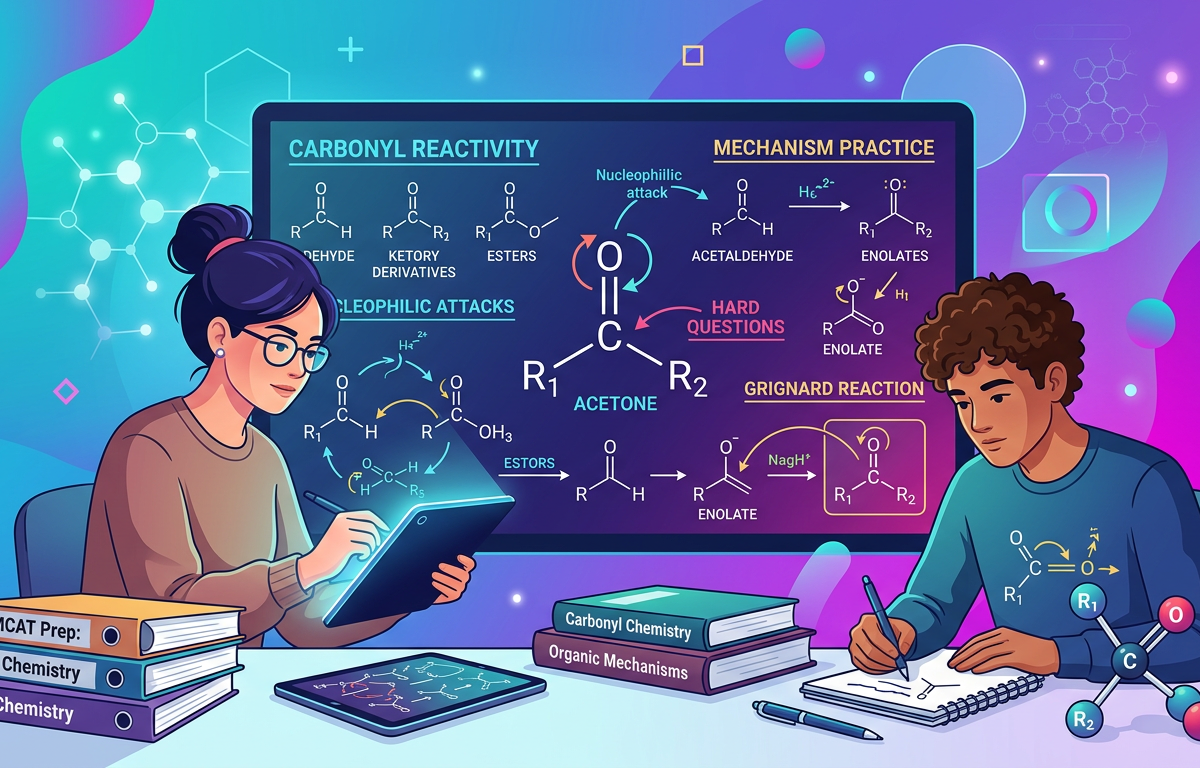
The carbonyl group consists of a carbon atom double-bonded to an oxygen atom, characterized by a strong dipole where the carbon is electrophilic and the oxygen is nucleophilic. In the context of the Medical College Admission Test (MCAT), mastering the reactivity of the carbonyl group is essential because it serves as the central hub for organic synthesis and biochemical pathways. The electrophilicity of the carbonyl carbon is largely determined by the inductive effects and resonance of surrounding substituents. For instance, aldehydes are generally more reactive than ketones due to less steric hindrance and fewer electron-donating alkyl groups that would otherwise stabilize the partial positive charge on the carbon.
Understanding these mechanisms requires more than rote memorization; it involves retrieval practice to ensure you can predict outcomes under various conditions. Key reactions include nucleophilic addition (common for aldehydes and ketones) and nucleophilic acyl substitution (common for carboxylic acid derivatives). In substitution reactions, the presence of a good leaving group—such as a halide or an anhydride—is the deciding factor. Furthermore, the acidity of the -hydrogen leads to enolate chemistry, which is the foundation for Aldol condensations and Michael additions. These concepts are frequently tested through multi-step synthesis and biological contexts, such as the mechanism of Glyceraldehyde 3-phosphate dehydrogenase in glycolysis.
Solved Examples
Review these solved examples to understand how to approach complex multi-step carbonyl problems on the MCAT.
Example 1: Nucleophilic Addition-Elimination
Predict the product of the reaction between benzoyl chloride and excess methylamine.
Solution:Identify the electrophile: Benzoyl chloride, a highly reactive carboxylic acid derivative.
Identify the nucleophile: Methylamine ().
Mechanism: The nitrogen lone pair attacks the carbonyl carbon, forming a tetrahedral intermediate.
Elimination: The carbonyl reforms, kicking out the chloride ion (a stable leaving group).
Final Step: A second equivalent of methylamine deprotonates the nitrogen to yield N-methylbenzamide.
Example 2: Keto-Enol Tautomerization
Which of the following molecules has the most acidic -hydrogen: acetone, ethyl acetate, or diethyl malonate?
Solution:Analyze the stability of the conjugate base (enolate).
Acetone has one carbonyl to stabilize the negative charge.
Ethyl acetate has an inductive donating effect from the ethoxy group, which destabilizes the enolate relative to acetone.
Diethyl malonate has two carbonyl groups flanking the -carbon, allowing the negative charge to be delocalized over two oxygen atoms via resonance.
Conclusion: Diethyl malonate is the most acidic.
Example 3: Grignard Reactivity
A student adds 1 equivalent of methylmagnesium bromide to a molecule containing both a ketone and an ester. What is the primary product?
Solution:Evaluate the relative reactivity of the functional groups.
Ketones are more electrophilic than esters because the alkoxy group of the ester donates electron density through resonance, reducing the partial positive charge on the carbonyl carbon.
The Grignard reagent will preferentially attack the ketone.
Conclusion: The ketone is converted to a tertiary alcohol while the ester remains unreacted.
Practice Questions
Test your knowledge with these Hard MCAT Carbonyl Practice Questions. Ensure you are using active recall strategies to maximize your score.
A chemist reacts 2-pentanone with sodium borohydride in ethanol. What is the stereochemical outcome of the product?
Rank the following in order of increasing boiling point: Butanal, Butanoic acid, Pentane, and 1-Butanol.
Which of the following compounds will undergo the fastest nucleophilic acyl substitution reaction: Propanoyl chloride, Propanoic anhydride, Methyl propanoate, or Propanamide?
Study Smarter for the MCAT
Turn practice into performance with AI-powered MCAT tools designed to help students retain more and score higher.
Start Learning FreeIn an Aldol condensation between two molecules of acetaldehyde, what is the structure of the intermediate formed before the dehydration step?
Explain why the reaction of a ketone with a primary amine yields an imine, while the reaction with a secondary amine yields an enamine.
A molecule of 4-hydroxybutanoic acid is treated with a catalytic amount of acid. Describe the resulting cyclic product.
During a Wittig reaction, a phosphorus ylide reacts with a carbonyl. What is the driving force for this reaction?
Which reagent would be most effective for the conversion of an ester directly to an aldehyde without further reduction to a primary alcohol?
Consider the reaction of acetophenone with and . What is the identity of the yellow precipitate formed?
Why are amides less reactive toward nucleophilic attack compared to acid anhydrides?
Answers & Explanations
Answer: A racemic mixture of (R)-2-pentanol and (S)-2-pentanol.
Sodium borohydride () reduces the prochiral carbonyl carbon of 2-pentanone. Since the hydride can attack from either the top or bottom face of the planar trigonal carbonyl with equal probability, a racemic mixture is produced.Answer: Pentane < Butanal < 1-Butanol < Butanoic acid.
Boiling point is determined by intermolecular forces. Pentane has only London dispersion forces. Butanal has dipole-dipole interactions. 1-Butanol can hydrogen bond. Butanoic acid can form stable hydrogen-bonded dimers, leading to the highest boiling point.Answer: Propanoyl chloride.
Reactivity in nucleophilic acyl substitution depends on the leaving group's stability. Chloride () is the weakest base among the options, making it the best leaving group.Answer: 3-hydroxybutanal (a -hydroxy aldehyde).
The enolate of one acetaldehyde attacks the carbonyl of another. The resulting alkoxide is protonated to form the aldol (aldehyde + alcohol) before heat causes dehydration to a conjugated enone.Answer: Availability of protons on the nitrogen.
A primary amine has two protons. After the initial attack and loss of one proton, a second proton is lost from the nitrogen to form the double bond (imine). A secondary amine has only one proton; once that is lost, the only way to neutralize the charge is to lose a proton from the -carbon, forming a double bond (enamine).Answer: -butyrolactone.
Intramolecular nucleophilic acyl substitution occurs because the hydroxyl group on the 4th carbon can reach the carbonyl carbon to form a stable five-membered ring (lactone).Answer: The formation of a very strong phosphorus-oxygen double bond.
The formation of triphenylphosphine oxide () is highly exothermic and drives the reaction toward the alkene product.Answer: DIBAL-H (Diisobutylaluminum hydride) at low temperatures.
DIBAL-H is a bulky, less reactive hydride source. At , it reduces esters to aldehydes but is not strong enough to continue the reduction to an alcohol.Answer: Iodoform ().
This is the iodoform test for methyl ketones. The -hydrogens are replaced by iodine, and the resulting group is a good enough leaving group to be displaced by hydroxide, forming iodoform.Answer: Resonance stabilization and leaving group strength.
The lone pair on the nitrogen of an amide is highly delocalized into the carbonyl, decreasing the electrophilicity of the carbon. Additionally, is a very poor leaving group compared to the carboxylate ion of an anhydride.
1. Which of the following will NOT react with a Grignard reagent to form a primary alcohol?
Frequently Asked Questions
Why are aldehydes more reactive than ketones?
Aldehydes have less steric hindrance around the carbonyl carbon, allowing nucleophiles to attack more easily. Furthermore, ketones have two electron-donating alkyl groups that stabilize the partial positive charge on the carbon, making it less electrophilic than an aldehyde's carbon.
What is the difference between a hemiacetal and an acetal?
A hemiacetal contains one ether group () and one hydroxyl group () attached to the same carbon atom. An acetal contains two ether groups () attached to the same carbon and is typically more stable in basic conditions.
How does the inductive effect influence carboxylic acid derivatives?
Electronegative atoms like chlorine withdraw electron density through sigma bonds, increasing the partial positive charge on the carbonyl carbon and making it more reactive. Conversely, donating groups like the nitrogen in amides decrease reactivity by sharing electron density through resonance.
What are the requirements for a molecule to undergo an Aldol condensation?
The molecule must possess at least one -hydrogen that can be deprotonated to form a nucleophilic enolate. Additionally, a second carbonyl must be present to act as the electrophile for the initial addition step.
Why is LiAlH4 a stronger reducing agent than NaBH4?
The aluminum-hydrogen bond is more polar and less stable than the boron-hydrogen bond, making the hydride in much more reactive. This allows it to reduce esters and carboxylic acids, which cannot achieve under standard conditions.
Study Smarter for the MCAT
Turn practice into performance with AI-powered MCAT tools designed to help students retain more and score higher.
Start Learning FreeReviewed by
Michael Danquah, MS, PhD
Dr. Michael Danquah is a professor of pharmaceutical sciences and founder of several educational technology platforms focused on improving student learning and performance.
Enjoyed this article?
Share it with others who might find it helpful.
Related Articles
Medium MCAT Carbonyl Practice Questions
Medium MCAT Carbonyl Practice Questions
May 11, 2026
Easy MCAT Carbonyl Practice Questions
Master the basics of carbonyl chemistry with our easy MCAT carbonyl practice questions, solved examples, and clear explanations for pre-med students.
May 11, 2026
MCAT Carbonyl Practice Questions with Answers
MCAT Carbonyl Practice Questions with Answers
May 10, 2026

Hard MCAT Philosophy Passage Practice Questions
Master Hard MCAT Philosophy Passage Practice Questions with our comprehensive guide featuring solved examples, practice questions, and expert explanations.
May 17, 2026

Hard MCAT Humanities Passage Practice Questions
Master Hard MCAT Humanities Passage Practice Questions with our comprehensive guide featuring solved examples, practice questions, and expert strategies.
May 17, 2026

Hard MCAT Critical Analysis Practice Questions
Hard MCAT Critical Analysis Practice Questions
May 17, 2026

Hard MCAT Reading Comprehension Practice Questions
Hard MCAT Reading Comprehension Practice Questions
May 17, 2026

Hard MCAT CARS Passage Practice Questions
Master high-difficulty MCAT CARS passages with our expert guide featuring solved examples, practice questions, and detailed logical analysis.
May 17, 2026