Medium ppm and ppb Practice Questions
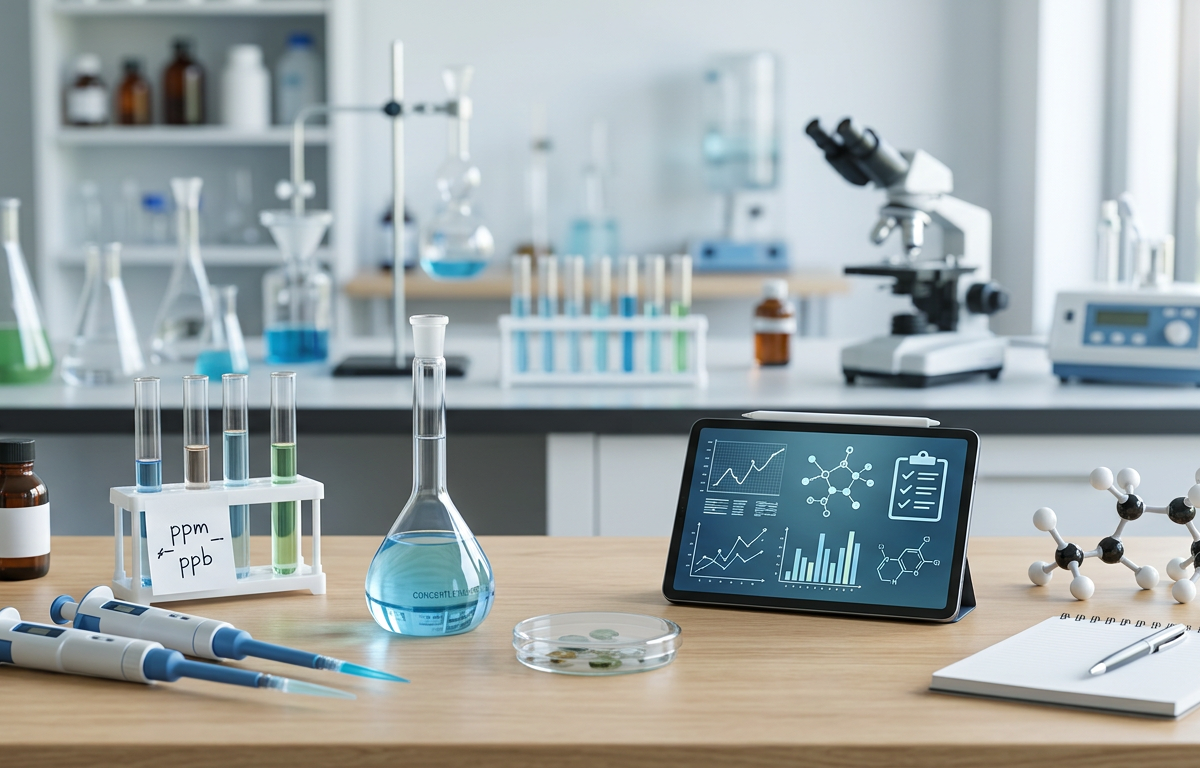
Mastering concentration units like parts per million (ppm) and parts per billion (ppb) is essential for anyone studying environmental science, toxicology, or analytical chemistry. These units allow scientists to measure extremely dilute substances, such as pollutants in drinking water or trace gases in the atmosphere. In this guide, we provide Medium ppm and ppb Practice Questions to help you refine your calculation skills and prepare for your next exam.
Concept Explanation
Parts per million (ppm) and parts per billion (ppb) are units of concentration used to express the amount of a solute in a very large amount of solution. One ppm represents one part of solute for every one million parts of the total solution, while one ppb represents one part of solute for every one billion parts of the total solution. These units are functionally similar to percentage composition, but instead of multiplying by 100, you multiply by 106 for ppm or 109 for ppb.
According to the United States Environmental Protection Agency (EPA), these units are standard for reporting water quality and contaminants. For aqueous solutions, because the density of water is approximately 1.00 g/mL, 1 ppm is equivalent to 1 mg/L, and 1 ppb is equivalent to 1 μg/L. Understanding these relationships is a key step in learning how to solve molarity problems and other complex concentration tasks.
Unit Ratio Multiplier Common Metric Equivalent (Water) ppm 1 / 1,000,000 106 1 mg/L or 1 mg/kg ppb 1 / 1,000,000,000 109 1 μg/L or 1 μg/kg
Solved Examples
The following examples demonstrate how to navigate unit conversions and apply the ppm/ppb formulas in different scenarios.
Example 1: Calculating ppm from Mass
A 2.5 kg sample of soil contains 0.015 grams of arsenic. What is the concentration of arsenic in ppm?Ensure mass units are consistent. Convert 0.015 g to mg: 0.015 g × 1000 = 15 mg.
Use the formula: ppm = (mass of solute in mg) / (mass of solution in kg).
Calculation: 15 mg / 2.5 kg = 6 ppm.
Example 2: Converting ppm to ppb
A water sample is found to have a lead concentration of 0.045 ppm. Express this value in ppb.Recall that 1 ppm = 1,000 ppb.
Multiply the ppm value by 1,000.
Calculation: 0.045 × 1,000 = 45 ppb.
Example 3: Finding Solute Mass from ppb
How many milligrams of fluoride are in 500 mL of a solution with a concentration of 800 ppb?Convert 800 ppb to μg/L: 800 ppb = 800 μg/L.
Convert the volume to Liters: 500 mL = 0.5 L.
Find total micrograms: 800 μg/L × 0.5 L = 400 μg.
Convert μg to mg: 400 μg / 1000 = 0.4 mg.
Practice Questions
Test your knowledge with these Medium ppm and ppb Practice Questions. Ensure you pay close attention to unit conversions between grams, milligrams, and micrograms.
A 150-gram sample of river water contains 0.0003 grams of mercury. Calculate the concentration in ppm.
The maximum contaminant level for nitrate in drinking water is 10 ppm. If a 2-liter bottle of water contains 25 mg of nitrate, does it exceed the limit?
A chemical analysis shows that a 500-gram sample of ocean water contains 1.5 μg of gold. What is the gold concentration in ppb?
Want unlimited practice questions like these?
Generate AI-powered questions with step-by-step solutions on any topic.
Try Question Generator Free →Convert a concentration of 0.00025% (m/m) to parts per million (ppm).
An industrial wastewater pipe discharges 5.0 kg of chromium into a lake containing 2.0 × 10⁸ liters of water. Calculate the chromium concentration in ppb (assume density of water is 1 kg/L).
A technician needs to prepare 250 mL of a 15 ppm solution of copper sulfate. How many milligrams of copper sulfate are required?
If a solution has a concentration of 12,500 ppb, what is its molarity if the solute is sodium chloride (NaCl, molar mass = 58.44 g/mol)?
A 25.0 mL sample of well water was found to contain 1.2 × 10⁻⁵ grams of iron. Calculate the concentration in both ppm and ppb.
A gas mixture contains 350 ppm of Carbon Dioxide. If the total pressure is 1 atm, what is the partial pressure of CO2 in mmHg? (Hint: ppm for gases can be treated as a mole fraction × 106).
A sample of air contains 15 ppb of ozone. How many molecules of ozone are in 1.0 liter of this air at STP? (Refer to Avogadro’s Number Practice Questions for help with molecule conversions).
Answers & Explanations
2 ppm. Calculation: (0.0003 g / 150 g) × 106 = 2 ppm. Alternatively, convert 0.0003 g to 0.3 mg and 150 g to 0.15 kg. 0.3 mg / 0.15 kg = 2 ppm.
Yes, it exceeds the limit. The concentration is 25 mg / 2 L = 12.5 mg/L, which is 12.5 ppm. Since 12.5 > 10, it exceeds the limit.
3 ppb. Calculation: (1.5 μg / 500 g) × 1000 (to get μg per kg). 1.5 μg / 0.5 kg = 3 μg/kg = 3 ppb.
2.5 ppm. Percent means parts per hundred. To go from percent to ppm, multiply by 10,000 (since 106 / 102 = 10,000). 0.00025 × 10,000 = 2.5 ppm.
25 ppb. First, convert mass to μg: 5 kg = 5.0 × 10⁹ μg. Volume is 2.0 × 10⁸ L. Concentration = (5.0 × 10⁹ μg) / (2.0 × 10⁸ L) = 25 μg/L = 25 ppb.
3.75 mg. 15 ppm = 15 mg/L. For 250 mL (0.25 L): 15 mg/L × 0.25 L = 3.75 mg.
2.14 × 10⁻⁴ M. 12,500 ppb = 12,500 μg/L = 12.5 mg/L = 0.0125 g/L. Molarity = (0.0125 g / 58.44 g/mol) / 1 L = 0.00021389 M.
0.48 ppm and 480 ppb. 1.2 × 10⁻⁵ g = 0.012 mg. 25 mL = 0.025 L. ppm = 0.012 mg / 0.025 L = 0.48 ppm. ppb = 0.48 × 1000 = 480 ppb.
0.266 mmHg. ppm as mole fraction: 350 / 1,000,000 = 0.00035. Partial pressure = 0.00035 × 760 mmHg = 0.266 mmHg.
4.03 × 10¹⁴ molecules. 15 ppb means 15 molecules of ozone per 109 molecules of air. At STP, 1 L of air contains (1/22.4) moles. Total molecules = (1/22.4) × 6.022 × 1023 = 2.688 × 10²². Ozone molecules = 2.688 × 1022 × (15 / 109) = 4.03 × 10¹⁴.
1. Which of the following is equivalent to 1 ppm?
Frequently Asked Questions
What is the difference between ppm and ppb?
The difference lies in the scale of the denominator: ppm measures parts per million (106), while ppb measures parts per billion (109). Therefore, 1 ppm is 1,000 times larger than 1 ppb.
When should I use ppm instead of molarity?
You should use ppm when dealing with extremely dilute solutions where the molarity would be a very small, inconvenient number. It is the standard for environmental regulations regarding toxins and trace minerals.
Is ppm always mass/mass?
Not necessarily; ppm can be expressed as mass/mass, volume/volume, or mole/mole depending on the context. In aqueous chemistry, it is typically mass/volume (mg/L), while in gas chemistry, it is usually mole fraction.
How do I convert ppm to mg/L?
For dilute aqueous solutions, the conversion is a 1:1 ratio because 1 liter of water weighs approximately 1 million milligrams. Thus, 1 ppm is effectively equal to 1 mg/L.
Why are these units important in environmental science?
These units allow for the precise monitoring of substances that are harmful even at very low levels. Many heavy metals and organic pollutants are regulated at the ppb level to ensure public safety.
Want unlimited practice questions like these?
Generate AI-powered questions with step-by-step solutions on any topic.
Try Question Generator Free →
Want unlimited practice questions like these?
Generate AI-powered questions with step-by-step solutions on any topic.
Try Question Generator Free →Enjoyed this article?
Share it with others who might find it helpful.
Related Articles
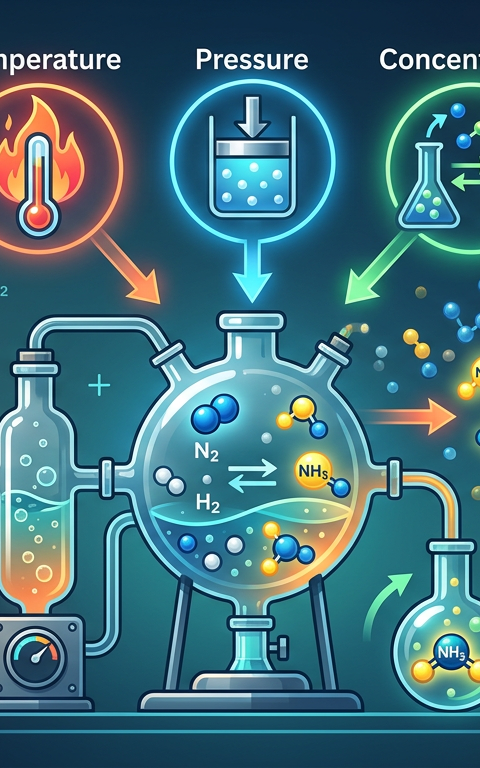
Hard Le Chatelier’s Principle Practice Questions
Master Hard Le Chatelier’s Principle Practice Questions with our comprehensive guide featuring solved examples, practice problems, and detailed explanations.
Mar 30, 2026
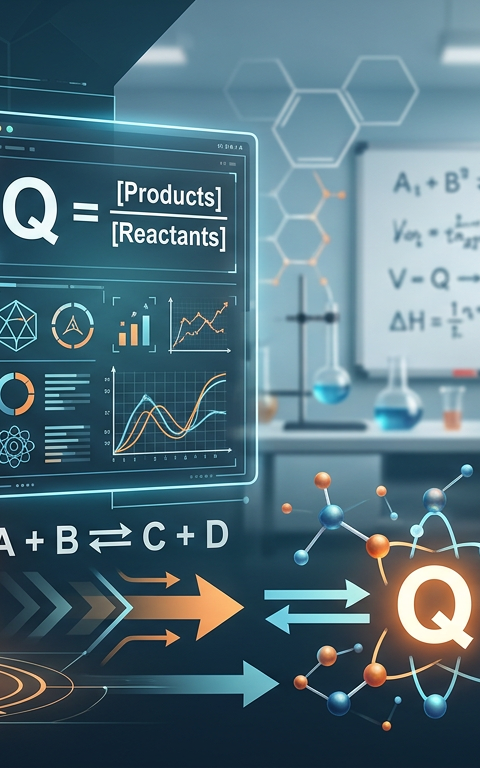
Hard Reaction Quotient (Q) Practice Questions
Hard Reaction Quotient (Q) Practice Questions
Mar 30, 2026
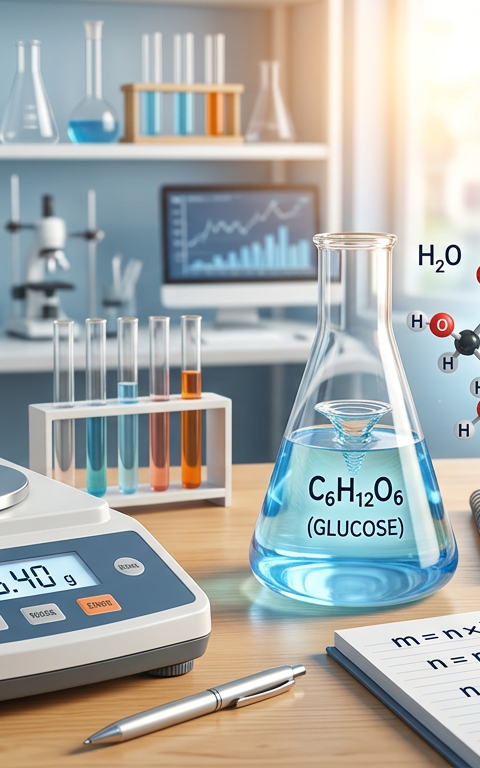
Grams to Moles Practice Questions with Answers
Master grams to moles conversions with our comprehensive guide. Includes step-by-step examples, practice questions, and detailed answers for chemistry students.
Mar 26, 2026
Avogadro’s Number Practice Questions with Answers
Master the mole concept with our Avogadro’s Number practice questions. Includes step-by-step solved examples, a quick quiz, and detailed explanations.
Mar 26, 2026
Empirical Formulas: Solving Ratios from Mass and Percent Data
Master empirical formula calculations with 10 practice questions, worked answers, and a free step-by-step calculator for mass, percentage, and combustion problems.
Mar 26, 2026